.png)
A Modern Guide to Warehousing in SCM for Manufacturers
Explore warehousing in SCM as a strategic advantage, not just storage. Learn how modern 3PL services drive efficiency, cut costs, and ...
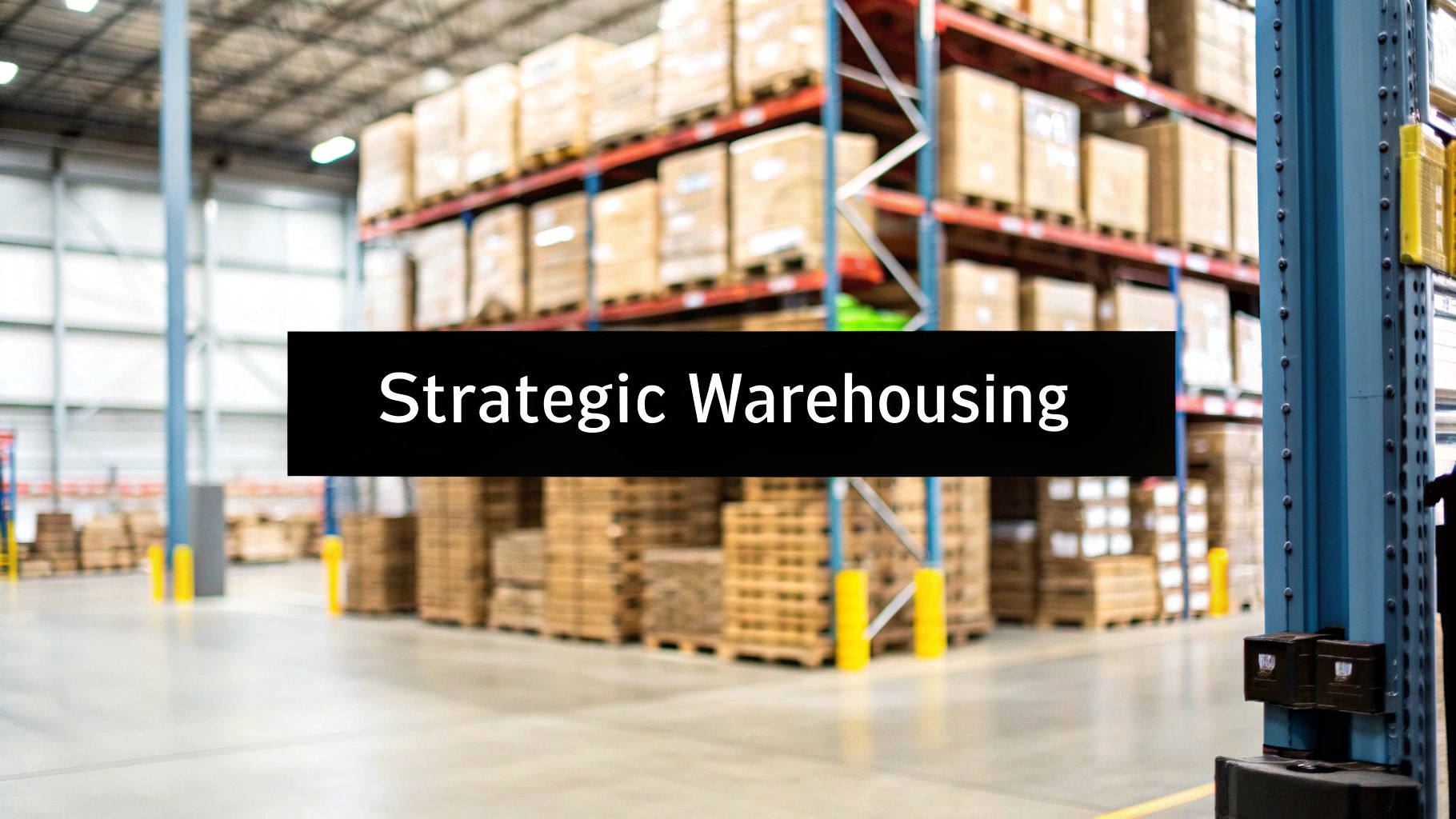

When we talk about warehousing in SCM, we're really talking about the intelligent management of the spaces, people, and processes that handle your goods as they move from supplier to production. It’s far more than a simple storage shed. A modern warehouse is a living, breathing part of the supply chain—a critical hub for services that keep assembly lines humming.
For any manufacturer, the way warehousing is handled directly shapes its agility, cost structure, and ability to weather disruptions.
The Strategic Role of Warehousing in Modern SCM
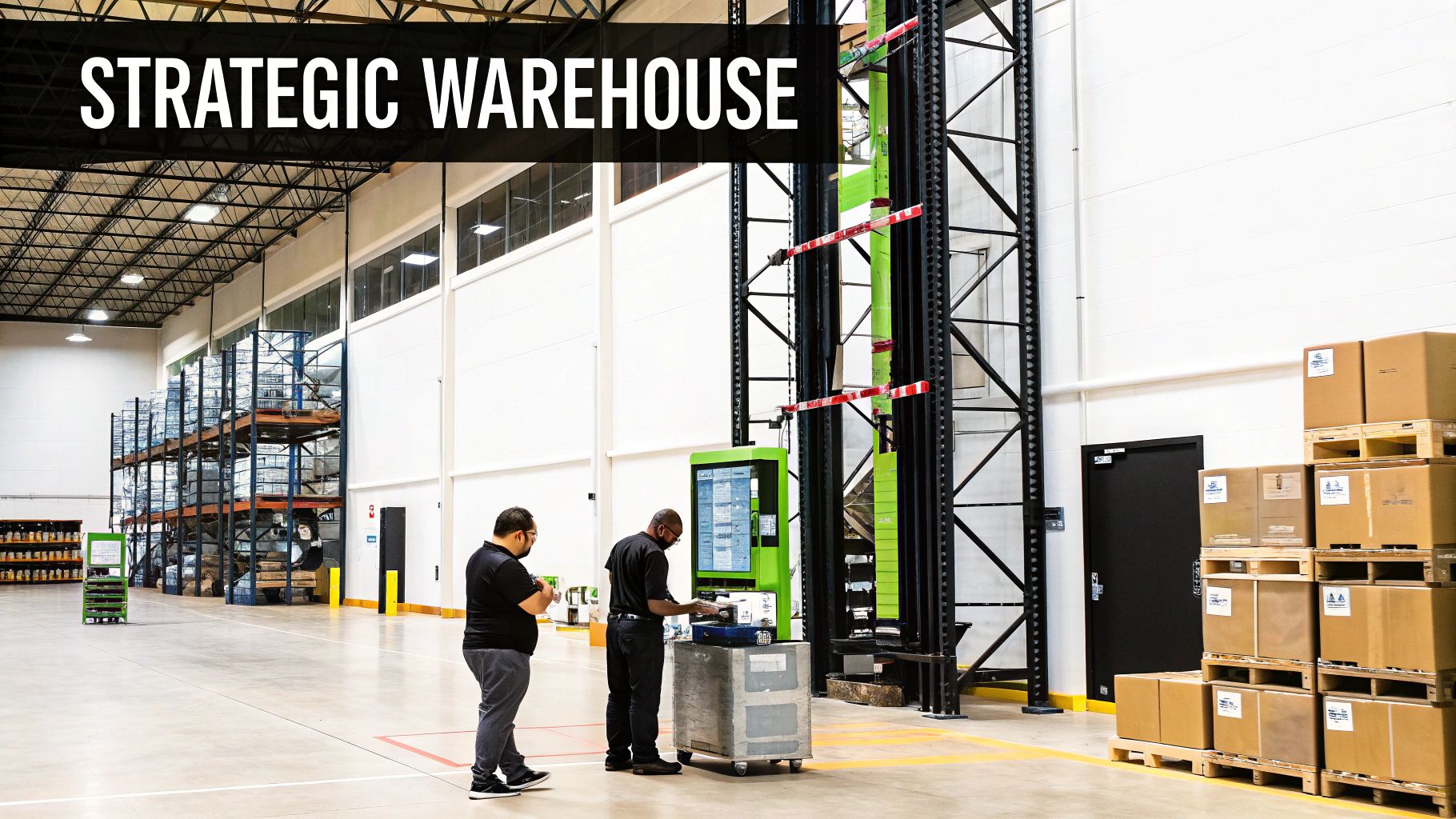
It’s easy to fall into the old trap of seeing a warehouse as just a cost center—a passive holding pen for parts and materials. But that’s a dangerously outdated view. In today's world, a high-performance warehouse functions less like a dusty attic and more like a dynamic control tower for your inventory.
This mindset shift is essential for original equipment manufacturers (OEMs) and their Tier 1 suppliers. In high-stakes industries like automotive or industrial manufacturing, even a minor hiccup can cascade into a catastrophic, line-down event. Strategic warehousing is the buffer that absorbs shocks, stabilizes complex logistics, and ultimately de-risks entire production programs.
From Cost Center to Value Creator
The modern warehouse has become a critical center for value-added services performed away from the chaos of the factory floor. These activities are all about feeding the assembly line precisely what it needs, right when it needs it, in the exact format required.
Think of it as an extension of your production line, but without the overhead.
Key value-creating functions now include:
- Component Consolidation: Instead of juggling dozens of LTL shipments from various suppliers, a warehouse can combine them into single, streamlined deliveries. This cuts inbound freight costs and simplifies your receiving dock.
- Just-in-Time Sequencing: Parts are organized into the precise sequence they’ll be installed on the assembly line, eliminating guesswork and handling time at the point of use.
- Rigorous Quality Control: The warehouse acts as a crucial firewall. Incoming components are inspected for defects before they ever reach your facility, preventing bad parts from ever causing a shutdown.
- Kitting and Sub-assembly: Components are pre-assembled into ready-to-use kits. This simple step can dramatically boost production throughput and slash assembly errors on the line.
By offloading these essential but non-core tasks to a specialized warehousing partner, manufacturers can reclaim valuable floor space and focus their resources on what they do best: building their final product. This strategic delegation creates a powerful competitive advantage.
The Growing Importance of Warehousing
The table below breaks down this evolution from a simple storage function to a strategic linchpin in the supply chain.
From Basic Storage to Strategic Value Creation
This shift from a passive function to an active, strategic one is why the global warehousing and storage market has seen such explosive growth. Projections show it expanding from around $1.08 trillion to a staggering $1.73 trillion by 2030. This boom is a direct reflection of warehousing's critical role, especially in sectors where getting the right parts at the right time is non-negotiable. You can read more about the warehousing market's impressive growth to understand the scale of this trend.
Ultimately, a true strategic warehousing partner ensures the right parts are in the right place, at the right time, and in perfect condition. It’s the very backbone of a lean, agile, and resilient manufacturing operation.
How Value-Added Services Drive Production Efficiency
A modern warehouse isn't just a roof over your inventory anymore; it’s an active, dynamic extension of your own factory floor. When we talk about strategic warehousing in scm, the whole game shifts from just passively storing goods to proactively adding value. These services directly feed into making your manufacturing faster, more accurate, and ultimately, more profitable.
By moving key preparation steps off-site, the warehouse becomes a critical operational hub. It's where components are sorted, organized, and triple-checked long before they ever see an assembly line. This is the secret to unlocking a whole new level of efficiency and resilience in your production cycle.
Streamlining Inbound Logistics with Component Consolidation
For most manufacturers, the receiving dock is a symphony of controlled chaos. You've got multiple less-than-truckload (LTL) shipments rolling in all day from different suppliers, and every single one needs its own unloading, inspection, and processing time. Component consolidation completely flips that script.
Instead of a dozen suppliers shipping directly to your plant, they send everything to a central warehouse. Your 3PL partner takes it from there—receiving, inspecting, and consolidating all those smaller shipments into a single, full truckload. That one organized truck is then delivered to your facility, right when you need it.
The impact is immediate and significant:
- Reduced Freight Costs: Turning a bunch of LTL shipments into one full truckload can slash your transportation spend by 20-40%.
- Simplified Receiving: Your dock team handles one truck instead of ten. That means less congestion, less paperwork, and lower labor costs.
- Improved Inventory Management: All the parts needed for a specific production run arrive together, making putaway and retrieval a breeze.
What was once a complex and reactive inbound process becomes a simple, predictable flow of materials you can count on.
Accelerating Assembly with Kitting and Sequencing
Once the parts are in the warehouse, the real magic begins. This is where services like kitting and sequencing come in, designed specifically to eliminate wasted time and motion on your assembly line and directly boost your output.
Kitting is simple in concept but powerful in practice. It’s the process of gathering all the individual parts needed for a particular sub-assembly and putting them together into one ready-to-go "kit." Think about it: instead of a line worker grabbing a bolt from one bin, a washer from another, and a nut from a third, they just grab a single kit with everything inside.
Sequencing takes that concept to the next level by delivering those kits or individual components to the line in the exact order they're needed. This is absolutely essential in complex operations like automotive manufacturing, where every single vehicle rolling down the line might have a completely different set of options.
Imagine an assembly line where workers never have to search for a part. The exact component they need for the exact product they are building arrives at their station just moments before they need it. This is the power of effective kitting and sequencing.
Protecting Production with Quality Control and Compliance
One bad part can bring a multi-million-dollar production line to a grinding halt, with downtime costs piling up by the minute. In-warehouse quality control acts as your first line of defense, catching non-conforming parts before they ever have a chance to cause a problem.
A good 3PL partner can handle a whole range of quality checks, from basic visual inspections to more complex functional testing, all based on your unique standards. The goal is to ensure only 100% compliant components make it into your production environment. You can see how these activities create a leaner supply chain by digging into the full range of value-added warehousing services.
For manufacturers navigating global supply chains, compliance management is just as crucial. A warehousing partner with deep expertise in international logistics can manage all the headaches—customs paperwork, tariffs, and other regulatory hurdles. This keeps your components flowing smoothly from overseas suppliers, preventing those costly, frustrating delays at the border.
Choosing the Right Warehousing Model for Your Business
Picking the right warehousing model is far more than a simple logistics choice. It’s a strategic move that fundamentally shapes your cost structure, your ability to react to market shifts, and how much control you have over your supply chain. Just like a craftsman selects a specific tool for a specific job, you need to match the warehouse model to your business reality.
The decision boils down to a few critical factors: Is your demand predictable or all over the place? How much inventory do you carry? Do you need specialized services? What are your growth projections? Each model presents a different mix of advantages and compromises, so understanding them is key.
Public Warehousing: The Flexible Solution
Think of public warehousing as the "pay-as-you-go" option. You’re essentially renting space and services on a short-term basis, often month-to-month. This makes it a perfect fit for businesses dealing with seasonal spikes or unpredictable inventory levels. It’s like renting a hotel room instead of leasing an entire apartment building.
This model offers incredible flexibility with almost no long-term commitment. If you’re an OEM testing a new product launch, a public warehouse gives you that crucial overflow capacity without locking you into a multi-year lease. The trade-off? That flexibility comes at a premium. The per-pallet cost is usually higher, and the services are often standardized, leaving little room for complex, custom needs like kitting or sequencing.
Contract Warehousing: The Strategic Partnership
Contract warehousing, typically managed by a Third-Party Logistics (3PL) provider, is a whole different ballgame. This is a deep, long-term partnership—less like renting a hotel room and more like designing and building a custom home. The 3PL dedicates specific space, staff, and equipment exclusively to your operations, often integrating their systems directly into yours.
For many manufacturers, this model is the core of their strategic warehousing in scm. It delivers stability, highly specialized services, and a partner who has a vested interest in your success. A Tier 1 supplier that relies on just-in-time delivery can use a contract warehouse for sub-assembly, quality checks, and precisely sequenced shipments straight to the assembly line.
A contract warehousing partnership requires a longer commitment, but what you get in return is operational consistency and specialized expertise that a public warehouse just can't offer. It shifts the warehouse from a line-item expense to an active, integrated component of your production strategy.
This decision tree shows how the value-added services you find in a contract warehousing setup can directly solve common production headaches.
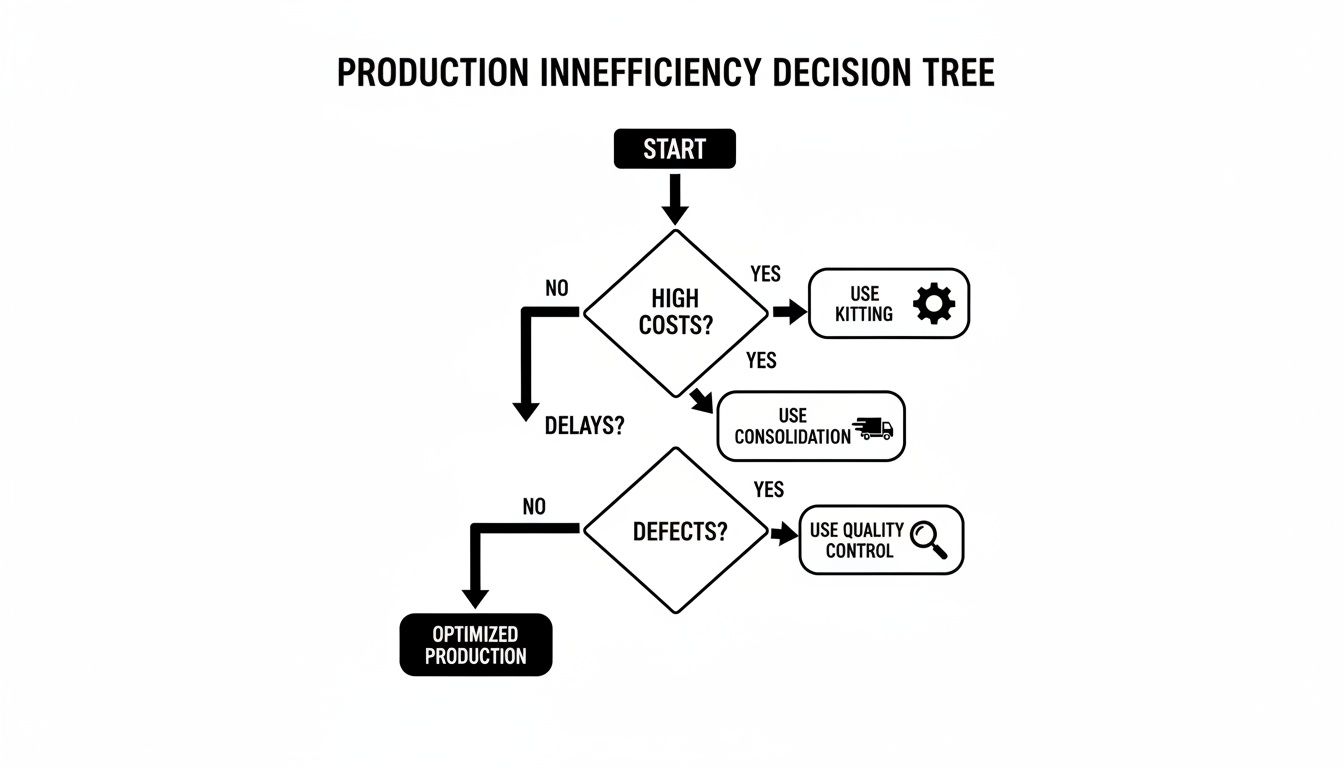
As you can see, there’s a clear path from operational pain points—like high costs, delays, or defects—to specific, value-driven solutions a warehouse can provide.
Specialized Warehousing Models
Beyond these two primary models, a few specialized options exist to meet very specific supply chain requirements.
- Bonded Warehousing: These are facilities approved by customs to hold imported goods before any duties or taxes have been paid. For companies with international supply chains, this is a massive cash flow advantage, allowing you to defer payments until your products are actually sold or moved into the domestic market.
- Regional Cross-Docking Centers: These places are all about speed, not storage. In a cross-docking facility, goods arrive on inbound trucks, are immediately sorted, and then loaded directly onto outbound trucks for their final destination. It’s a critical strategy for retailers and distributors who need to get products to customers as fast as possible with almost no inventory holding time.
Ultimately, picking the right model requires an honest look at your company’s operational DNA. If your business depends on agility and has to navigate unpredictable demand, public warehousing is a fantastic tool to have in your back pocket. But if your goal is long-term efficiency, deep operational integration, and a true strategic advantage, a contract warehousing partnership is almost always the better path.
The Technology Stack Behind High-Performance Warehousing
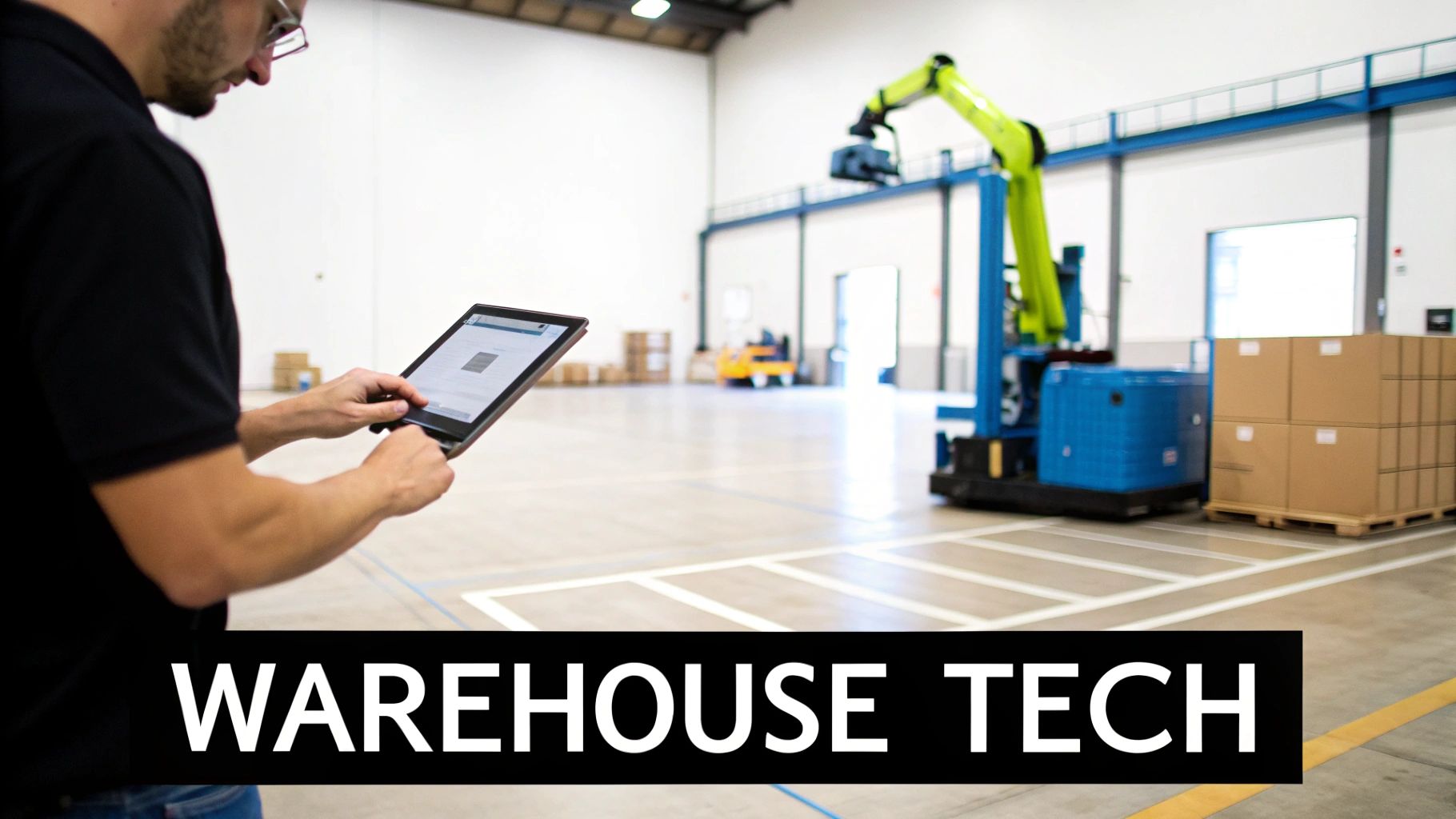
A modern warehouse isn't just a building; it's a finely-tuned machine running on a complex, interconnected web of technology. This digital nervous system is what delivers the precision, real-time visibility, and speed that lean supply chains absolutely depend on. Without it, all the valuable services manufacturers need—from kitting to just-in-time sequencing—would be impossible to pull off at scale.
This tech stack is what transforms a physical space full of parts into an intelligent, responsive hub. Each system has a specific job, but they all work together to orchestrate the complex dance of receiving, storing, and shipping millions of components with razor-sharp accuracy. If you're an OEM or Tier 1 supplier evaluating a 3PL partner, understanding these core technologies is non-negotiable.
The Warehouse Management System as the Operational Brain
The heart of any high-performance warehouse is its Warehouse Management System (WMS). Think of the WMS as the facility's operational brain—it directs every physical action that happens inside those four walls. It’s the system telling a worker the most efficient path to pick an order, deciding where to store an incoming pallet to maximize space, and tracking every single part from the moment it hits the dock to the second it’s loaded on a truck.
A truly robust WMS goes beyond simple tracking; it actively manages your resources. It optimizes labor by assigning tasks based on location and priority, and it provides the live data you need for accurate cycle counting and tight inventory control. For any manufacturer, a partner's WMS is the bedrock of trust, the guarantee that your parts are being managed with total precision. To get a better handle on this, you can explore the key benefits of a modern warehouse management system.
ERP Integration for End-to-End Visibility
A WMS is brilliant at managing what happens inside the warehouse, but it can’t operate in a silo. To get a true, end-to-end picture of the supply chain, that WMS has to talk seamlessly with an Enterprise Resource Planning (ERP) system. Your ERP is the company-wide system of record, the single source of truth for everything from purchasing and finance to production scheduling.
When the WMS and ERP are properly connected, information flows back and forth instantly. The ERP sends purchase orders and production schedules down to the WMS, and the WMS sends real-time updates on inventory levels, receipts, and shipments right back up. This constant dialogue ensures everyone, from the plant manager to the CFO, is looking at the same, accurate data.
Without this integration, you create data silos and operational blind spots. A 3PL with deep ERP integration capabilities, like expertise in PLEX, can function as a true extension of your own operations, not just a black box where your inventory disappears.
Automating Communication with EDI and ASN
In the fast-paced world of automotive and industrial manufacturing, there's no time for manual communication—it's just a recipe for errors and delays. This is where Electronic Data Interchange (EDI) becomes indispensable. EDI acts as a standardized digital language, allowing different companies’ computer systems to communicate directly without any human intervention. It automates the exchange of crucial documents like purchase orders, invoices, and, most importantly, Advance Ship Notices (ASN).
An ASN is essentially a digital packing list that the warehouse sends to the manufacturing plant before a shipment arrives. It details precisely what’s in the shipment—down to the specific part numbers and quantities on each pallet. This gives the plant’s receiving team a heads-up, allowing them to plan labor and space, which drastically speeds up the unloading process and makes flawless just-in-time delivery a reality.
The Rise of Automation and Robotics
The final piece of the modern warehousing puzzle is physical automation. This isn't some far-off future concept; it's happening right now. Automation is completely reshaping warehousing in scm, with the market projected to explode from $29.91 billion to $63.36 billion by 2030. This incredible growth is a direct response to chronic labor shortages and the relentless pressure to find new efficiencies.
By 2027, it's estimated that 26% of warehouses will be fully automated. This technology isn't one-size-fits-all and appears in several key forms:
- Automated Storage and Retrieval Systems (AS/RS): These are robotic cranes and shuttles that automatically put away and retrieve pallets from high-density racking. They maximize storage capacity and work at incredible speeds.
- Robotic Picking: Collaborative robots, or "cobots," can work right alongside human associates to pick and pack orders. This boosts accuracy and throughput while taking the physical strain off workers.
- Autonomous Mobile Robots (AMRs): Think of these as intelligent, self-driving carts that transport goods around the warehouse floor, automating the movement of inventory from receiving to storage and out to shipping.
For manufacturers, a 3PL’s investment in automation is a direct investment in the reliability of your supply chain. It means higher accuracy, greater throughput, and a more resilient operation ready to handle the intense demands of modern production.
Measuring Success With The Right Warehousing KPIs
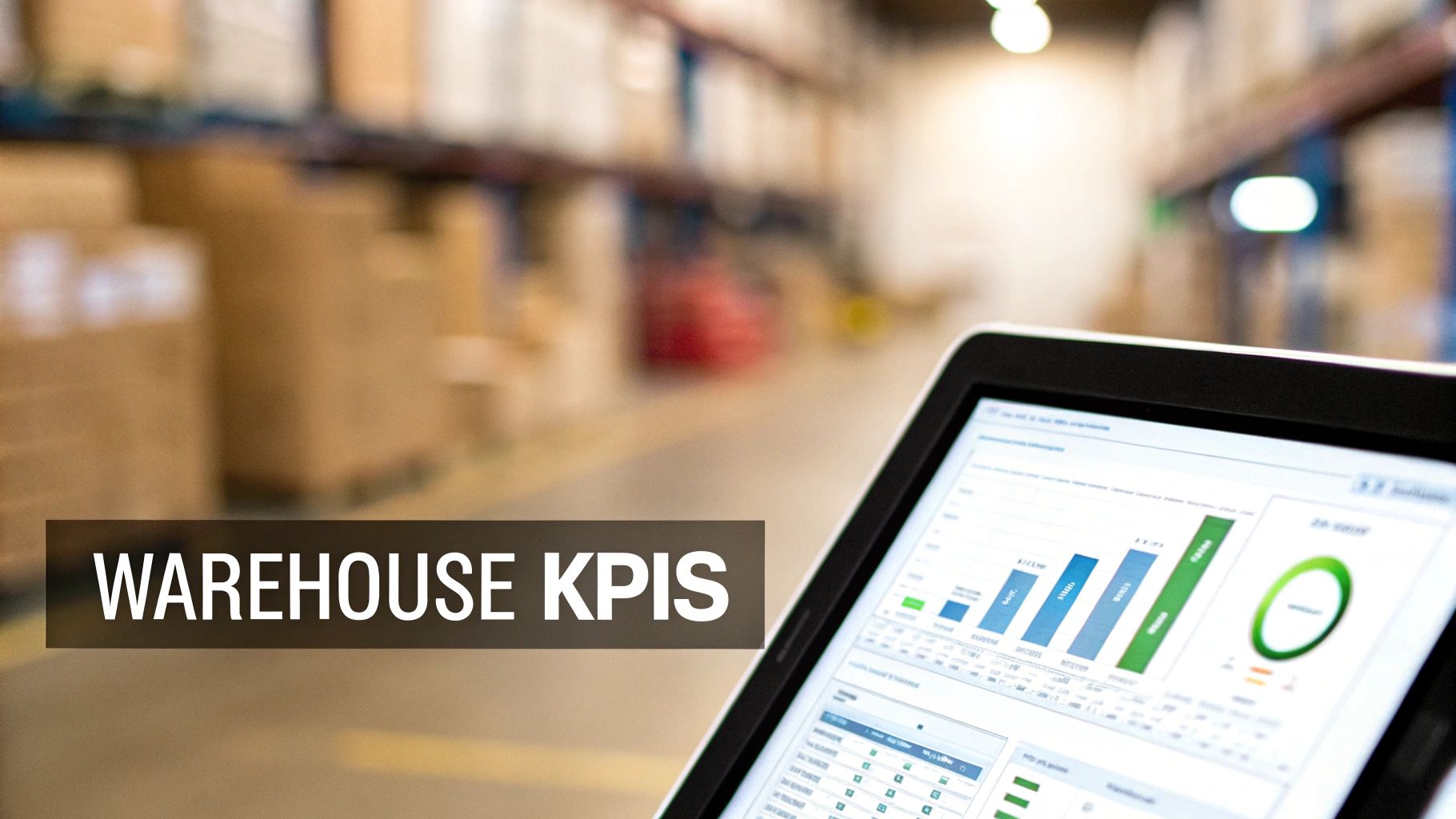
You can't manage what you don't measure. In a world of tight margins and even tighter production schedules, running a warehouse on gut feelings is a recipe for disaster. Effective warehousing in scm isn’t about guesswork; it's a data-driven discipline.
Key Performance Indicators (KPIs) are your dashboard. They give you the hard numbers needed to benchmark performance, spot trouble before it spirals, and drive meaningful improvements. For OEMs and Tier 1 suppliers, the right metrics tell a crystal-clear story about whether your 3PL partner is an asset or a liability. Vague data is just noise; you need numbers that connect directly to the health of your assembly line.
Core KPIs For Manufacturing Warehousing
In the high-stakes environment of automotive and industrial manufacturing, a few KPIs stand out for their direct impact on operational stability and cost control. These aren't vanity metrics—they're the vital signs of your supply chain.
Inventory Accuracy: This is the holy grail. It measures the difference between what your WMS says you have and what's physically on the shelf. An accuracy rate of 99.5% or higher isn't just a goal; it's the standard. Anything less introduces "phantom stock," leading to line-down situations and expensive emergency freight.
Order Fill Rate: How many orders are you shipping complete and correct on the first try? This KPI directly reflects your 3PL's ability to support your production schedule without hiccups. A dipping fill rate is a red flag, signaling inventory or process breakdowns that can bring manufacturing to a halt.
These first two metrics show how well the warehouse is managing its internal operations. The next two are all about how that performance translates into the speed and reliability your production line depends on.
Measuring Speed And Responsiveness
In any lean supply chain, speed is currency. It’s not enough for a warehouse to be accurate; it has to be fast. The clock is always ticking, and every delay introduces risk.
Dock-to-Stock Time is a fantastic indicator of receiving efficiency. It measures the total time from a truck hitting the dock to the moment those parts are put away, scanned, and available for use. Shorter times mean critical components are ready for production almost immediately.
This metric is especially critical in just-in-time (JIT) operations. A slow, congested receiving process creates a dangerous blind spot in your inventory, and you can't afford to be flying blind. If you're looking for a solid framework for choosing metrics and building a system to track them, this resource on how to measure operational efficiency is a great starting point.
Finally, the On-Time Shipping Rate is the ultimate test of reliability. It’s simple: what percentage of orders left the warehouse on or before their scheduled departure time? This number confirms whether your partner can consistently meet the commitments needed to keep your plant running like clockwork.
The table below breaks down these essential metrics, giving you a clear scorecard to evaluate any warehousing partner.
Essential Warehousing KPIs For Manufacturing SCM
Tracking these four KPIs provides a powerful, at-a-glance view of your warehouse's health. They replace assumptions with facts, empowering you to hold your partners accountable and ensure your supply chain is a source of strength, not stress.
Finding the Right 3PL Partner for Your Needs
Choosing a Third-Party Logistics (3PL) partner is the final, and most important, piece of the puzzle. This is where your warehousing strategy stops being a concept on paper and becomes a real-world competitive advantage. All the ideas we've covered—value-added services, technology, and KPIs—are only as good as the partner executing them. The right partnership is the difference between simply renting space for parts and creating an integrated extension of your own operations.
A true strategic partner doesn't just sell you square footage; they build solutions. For anyone in the automotive or industrial space, this means finding a team that truly understands the immense pressure of just-in-time production. They need the systems and, more importantly, the discipline to get it right every single time. They become a critical pillar supporting your operational stability and growth.
What to Look for in a Manufacturing 3PL
When you start evaluating potential partners, you have to look past the basic questions about pallet costs and warehouse size. The real value is in their operational DNA—the processes, the tech, and the experience they bring to your supply chain. An ideal partner for an OEM or Tier 1 supplier will have undeniable strengths in a few key areas.
Your vetting process should dig deep into these points:
- Proven Launch Discipline: Ask for proof of how they've handled new product or program launches. This is where meticulous planning and flawless execution are put to the test.
- Rigorous Quality Controls: What are their actual, day-to-day processes for inbound inspections, sorting, and rework? Their quality system has to be a firewall, protecting your line from bad parts.
- Robust System Integration: How well do they really know ERP systems like PLEX? Smooth EDI and ASN capabilities aren't a "nice-to-have"; they're essential for the visibility modern manufacturing demands.
- A Culture of Continuous Improvement: Look for real evidence of lean principles at work. A great partner is always hunting for ways to eliminate waste and improve flow.
This intense focus on operational excellence is what transforms a 3PL from a simple vendor into a source of stability. You can explore a deeper dive into what makes for the best warehousing partnerships in our comprehensive guide.
The Midwest Advantage for Automotive and Industrial SCM
Geography and regional expertise matter. A lot. The North American warehousing market is massive, with the U.S. alone accounting for an $86.1 billion market. Within that landscape, the Midwest has cemented itself as the critical hub for automotive and industrial supply chains.
A Michigan-based 3PL with deep roots in the industry offers a significant edge. It means access to over 200,000 sq ft of space specifically configured for the complex kitting and sequencing that OEMs rely on. As warehouse capacity gets tighter across the country, having a reliable partner in a strategic location is more critical than ever.
A dependable partner also invests in their people. On the transportation side, this means ensuring drivers meet current Entry-Level Driver Training (ELDT) standards, which is fundamental for safe and reliable operations.
Choosing a partner is about de-risking your future. When a 3PL has the right systems, a proven track record, and a culture dedicated to precision, they do more than manage inventory. They help you stabilize operations, confidently scale production, and turn your supply chain into a key driver of growth.
Ultimately, the right partnership delivers one thing above all else: peace of mind. It frees you up to focus on your core business—building incredible products—because you know a critical piece of your supply chain is in expert hands.
Your Warehousing Questions, Answered
Even with a solid plan, a few practical questions always come up when you're trying to dial in your warehousing strategy. Here are some of the most common things we hear from supply chain leaders, along with straightforward answers to help you make the right call.
What's the Real Difference Between a 3PL and a 4PL?
It's a common point of confusion, but the distinction is pretty simple when you think about who's doing the work.
A 3PL (Third-Party Logistics) provider is your hands-on partner. They're the ones physically running the warehouses, driving the trucks, and handling all those crucial value-added services like kitting or sub-assembly. They own or lease the actual assets—the buildings, the racks, the forklifts—that keep your products moving.
A 4PL (Fourth-Party Logistics) provider, on the other hand, is more like a general contractor for your entire supply chain. They don't usually own the trucks or warehouses. Instead, they manage a whole network of 3PLs for you, acting as a single point of contact to strategize and integrate everything into one cohesive operation.
How Does Value-Added Warehousing Actually Lower My Overall Costs?
Value-added warehousing is all about strategically attacking your Total Landed Cost. By shifting certain activities out of your plant and into a specialized facility, you can see savings in a few critical areas.
- Reclaim Your Plant Floor: When you move sub-assembly or kitting off-site, you free up valuable square footage that can be used for what you do best—core production.
- Reduce Labor Headaches: You get to sidestep the costs and complexities of hiring, training, and managing an in-house team for specialized logistics tasks.
- Prevent Line-Down Disasters: This is a big one. In-warehouse quality control acts as a firewall. Catching a bad part before it gets to your facility prevents a costly shutdown of a multi-million-dollar assembly line. That single catch can save you a fortune in downtime, rework, and emergency freight costs.
When Should We Seriously Consider Outsourcing Warehousing to a 3PL?
Making the jump to a 3PL partner is a major strategic decision, but it’s usually triggered by very specific growing pains or a desire to expand. It's probably time to have the conversation if you're nodding along to any of these scenarios.
First, look at your demand. If you're constantly dealing with seasonal spikes or unpredictable swings that leave you with either way too much space or not nearly enough, outsourcing gives you the power to scale up or down on demand. Second, if logistics management is starting to pull focus from your core business of engineering and manufacturing, that’s a flashing red light telling you it's time to bring in an expert.
A 3PL is also your secret weapon for market expansion. Need a footprint in a new region? A good partner gives you instant access to an established network and local know-how, slashing the time and capital you'd need to do it yourself.
What Are the First Steps for Integrating Our ERP with a 3PL's WMS?
Getting your Enterprise Resource Planning (ERP) system to talk to your 3PL's Warehouse Management System (WMS) is non-negotiable for data to flow smoothly. The process doesn’t start with software; it starts with a conversation.
The very first step is to get the IT and operations leaders from both sides in a room for a discovery session. The whole point is to map out every single piece of data that needs to pass between the two systems—think purchase orders, real-time inventory levels, and Advance Ship Notices (ASNs).
Once that map is clear, you decide on the best way to connect, which is usually through Electronic Data Interchange (EDI) or a more modern API. From there, you build out a detailed project plan that covers timelines, rigorous testing phases, and the go-live strategy. Throughout it all, constant, open communication is what makes or breaks the entire integration.
Ready to transform your warehousing from a cost center into a strategic advantage? Wolverine Assemblies, LLC delivers the precision, technology, and launch discipline your supply chain demands. Contact us today to stabilize your operations and scale with confidence.
Subscribe to our weekly newsletter