.png)
A Guide to the Kanban System in Manufacturing
Discover how a kanban system in manufacturing streamlines workflow, cuts waste, and boosts efficiency. Learn to implement this lean tool...

A Kanban system in manufacturing is a visual workflow management tool that uses a pull-based approach to control the flow of parts and materials. Instead of pushing work onto the production floor based on forecasts, it relies on simple signals—often just a card—to authorize production only when a part is actually needed.
This simple but powerful method is a core pillar of both lean manufacturing and just-in-time (JIT) production. It’s all about creating a smooth, efficient flow and ruthlessly eliminating waste.
Defining the Kanban Pull System
Think about a busy restaurant kitchen during the dinner rush. The grill cook doesn't start firing up steaks based on a guess that someone might order one. They wait for a ticket—a clear signal from a customer—before they begin cooking. That’s the core idea behind a Kanban system. It swaps out complex, often inaccurate forecasts for simple, real-time demand signals.
This is a world away from traditional Manufacturing Resource Planning (MRP), which operates on a "push" basis. In a push system, production schedules are driven by forecasts, and work orders are pushed out to the floor, often creating huge batches of parts that aren't immediately needed. This almost always leads to familiar headaches:
- Bloated Inventory: All that unsold product and raw material ties up cash and eats up valuable floor space.
- Production Waste: Overproduction is one of the biggest—and costliest—of the seven wastes in lean manufacturing. You're spending money on labor, materials, and energy for something nobody has bought yet.
- Slow Response Times: When customer demand suddenly shifts, a push system can't pivot quickly. You get stuck with a warehouse full of parts nobody wants anymore.
A Kanban system completely flips that script. Production is "pulled" forward by the immediate needs of the next step in the process, which is ultimately triggered by a real customer order. It's a far more responsive and efficient way to build things.
The Origins and Impact of Kanban
This isn't some new-age management fad. The Kanban system was famously developed by Toyota back in the 1950s as a critical component of its game-changing Toyota Production System. The objective was simple: build better cars, faster, with less waste than their mass-production competitors.
And it worked. The impact has been massive. Modern manufacturers that properly implement Kanban and other lean principles have seen manufacturing costs drop by 25-30% by slashing expenses tied to labor, storage, and excess materials. For a deeper dive, check out these insightful Kanban statistics and their impact on manufacturing.
Push vs Pull Manufacturing Systems at a Glance
To really get a feel for how different these two approaches are, it helps to see them side-by-side. The table below breaks down the fundamental philosophies driving push and pull systems.
As you can see, the two systems are driven by completely opposite goals. While a push system obsesses over keeping machines busy, a pull system focuses on delivering value to the customer with as little waste as possible.
The Core Principles and Signals of Kanban
A successful Kanban system isn't run by complex software or algorithms. It’s governed by a handful of simple, powerful rules that bring a sense of calm and predictability to the factory floor. Getting a handle on these mechanics is the first real step in shifting your operations from a chaotic, reactive mode to a smooth, demand-driven machine.
The whole system really rests on three core ideas. When you put them together, they create a self-regulating process that naturally exposes opportunities for improvement and systematically cuts down on waste.
Visualize the Workflow
The first and most important principle is simply to see the work. In manufacturing, this usually means a physical or digital Kanban board that maps out every single stage of a process. Imagine a sub-assembly line for an automotive fuel injector. You might have columns on a board for "Parts Staged," "Assembly," "Testing," and "Ready for Main Line."
Each job or batch gets a card that physically moves across this board as it makes progress. This simple visual trick creates instant clarity. Anyone, from a line operator to the plant manager, can walk by and see the status of work at a glance, immediately spotting where jobs are piling up or where a workstation is starved for parts.
Limit Work In Progress
Limiting Work in Progress (WIP) is probably the single most powerful thing you can do. It just means you set a hard cap on how many items can be in any stage of the workflow at one time. If your "Testing" stage has a WIP limit of five units, nobody is allowed to push a sixth unit into testing until one of the current five is finished and moved on.
This forces a culture shift from "start starting" to "start finishing." Instead of shoving more work into an already overloaded system, it stabilizes the workflow, stops bottlenecks from getting worse, and drastically shortens the time it takes for any single part to get through the entire process.
By capping WIP, you also slash your inventory carrying costs and often see a jump in quality, since operators can focus their attention on fewer tasks at once.
Manage and Measure Flow
The final piece of the puzzle is to manage and improve the flow of work. Once you have the workflow visualized and your WIP limits in place, you can start measuring how smoothly things are actually moving through your system. The goal is to make the flow as fast and predictable as possible, with minimal delays.
At its heart, Kanban is a system built for continuous improvement. By tracking metrics like cycle time—how long a task takes from the moment work begins until it's finished—you can pinpoint the real sources of inefficiency and make adjustments based on data, not guesswork. This focus on flow turns your production line into a predictable system where you can actually trust your delivery forecasts. For a deeper dive, there are many proven strategies for continuous process improvement that pair perfectly with Kanban’s philosophy.
Understanding Kanban Card Signals
The visual signals—the Kanban cards themselves—are the nervous system of the whole operation. They carry critical information and give authorization for specific actions, making sure the pull system actually works. While you can customize them endlessly, they generally fall into three main types.
Production Kanban: This card is a green light for a production cell to start making a specific part or sub-assembly. When a downstream process uses up a container of parts, it sends the attached Production Kanban back to the source. This is the signal to produce exactly one more container's worth to replace what was just taken.
Withdrawal Kanban: Think of this as a "move" card. It authorizes someone to move parts from one spot to another. For instance, it might tell a material handler to grab a container of finished components from a supermarket (a small, designated storage area) and deliver it to a specific point on the assembly line.
Supplier Kanban: This card is how you extend the pull system beyond your own four walls and out to your vendors. When your line consumes a bin of purchased components, the Supplier Kanban is sent directly to the vendor, acting as an immediate, pre-authorized purchase order to ship a specific quantity of that part. This is a core element in modern stock and replenishment strategies because it creates a seamless, responsive link with your supply chain.
When used together, these principles and signals create a highly responsive framework that aligns what you produce directly with what your customers are actually demanding in real-time.
How to Design Your Manufacturing Kanban System
Designing a solid Kanban system for your manufacturing floor isn't about fancy software; it's about discipline, clear rules, and a bit of straightforward math. The real aim is to build a self-regulating system where the plant floor's actual consumption drives every production and inventory decision. It’s a practical way to ensure you’re only building what you need, exactly when you need it.
The whole process starts with the most critical calculation in any Kanban setup: figuring out how many cards—and therefore, how much inventory—you actually need for each part.
Calculating the Optimal Number of Kanban Cards
The number of Kanban cards circulating in your system is the primary lever controlling your Work-in-Progress (WIP) and inventory levels. Get it wrong, and you're either risking a line-down situation with too few cards or reintroducing waste with too many. Thankfully, a standard formula gives you a reliable, data-driven place to start.
The calculation itself is a balancing act between three key variables:
- Average Daily Demand: How many units of a specific part does the next process actually use up in a typical day?
- Lead Time: How long does it really take to get more of that part? This has to include everything—order processing, production or transit time, the whole nine yards.
- Safety Stock: This is your buffer. It’s there to protect you from unexpected demand spikes or a supplier delay. We usually calculate it as a percentage of demand during your lead time.
The Formula:(Average Daily Demand × Lead Time) + Safety Stock = Total InventoryTotal Inventory / Container Size = Number of Kanban Cards
Let's make this real with an example for an automotive sub-assembly part:
- Daily Demand: 200 units
- Replenishment Lead Time: 3 days
- Safety Stock: 1 day's worth (200 units)
- Container Size: 50 units
First, you figure out the total inventory you need on hand: (200 units/day × 3 days) + 200 units = 800 units.
Then, you translate that into cards: 800 units / 50 units per container = 16 Kanban cards.
That number—16—tells you exactly how many containers (and cards) for this part need to be in the system at all times to keep the line moving without a hitch, even with a little variation.
Designing the Kanban Board and Pull Signals
Once you know your card counts, it’s time to visualize the workflow. This is the job of the Kanban board. It doesn't matter if it's a giant whiteboard on the shop floor or a digital dashboard in your ERP; its purpose is to give everyone an immediate, at-a-glance status of the entire process.
A typical manufacturing board might have simple columns like "To Do," "In Progress," and "Done." Each card physically or digitally moves across the board, mirroring the real-time status of a production order. You can learn more about how this connects to the bigger picture in our guide on value stream mapping in manufacturing.
But a card isn't the only way to send a "pull" signal. Other tried-and-true methods include:
- Two-Bin System: Deceptively simple and incredibly effective. Two bins of parts sit at a workstation. When the first bin is empty, the operator sets it aside—that’s the signal to replenish—and starts working from the second bin.
- E-Kanban Triggers: These are digital signals, often sent automatically when a barcode is scanned or an RFID tag passes a reader, updating your ERP in real time that a part has been used.
- Andon Lights: A classic visual factory tool. Colored lights above a workstation signal its status. A yellow light might mean the station is running low on a component and needs a material handler to bring more.
This flow diagram shows how these different signals—Production, Withdrawal, and Supplier—all work together in a closed loop.
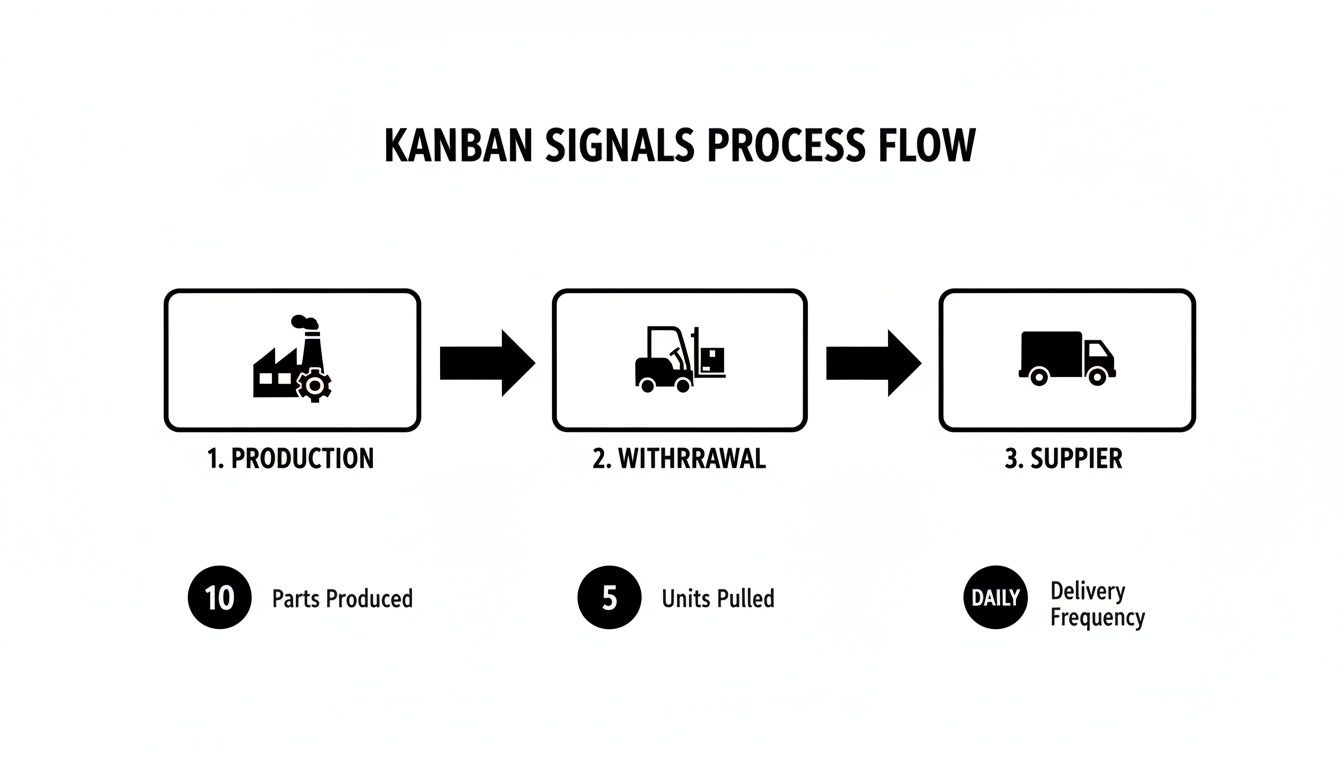
As you can see, consumption triggers a withdrawal signal. That withdrawal, in turn, triggers either a production order or a signal to an external supplier, keeping the whole system in a state of continuous flow.
Establishing Explicit System Policies
Finally, a Kanban system is only as good as the rules everyone agrees to follow. Setting explicit policies is non-negotiable. These rules have to spell out exactly what happens when a signal is sent.
Your policies should provide clear, direct answers to questions like:
- What specific event triggers a replenishment signal? (e.g., An empty bin is placed on the return rack.)
- Who is responsible for acting on that signal? (e.g., The material handler for that cell.)
- What is the standard, expected time for replenishment?
- How are we going to handle defective parts without breaking the flow?
By making these rules crystal clear and visible to everyone, you remove the guesswork and create a predictable, disciplined process that your team can execute consistently. It's this simplicity and discipline that has driven such widespread adoption. The 2022 State of Kanban Report, which surveyed people from 48 countries, found that over 25% of large companies now use it in multiple departments, a testament to its scalability.
Integrating Kanban with Modern Factory Technology
A physical Kanban system is powerful on its own, but it truly comes alive when you plug it into your factory's digital backbone. Connecting those simple visual pull signals to the technology already running your operations creates a responsive, automated system that all but eliminates manual errors and gives you a crystal-clear view of your entire supply chain. This is where Kanban’s elegant simplicity meets the precision of a data-driven factory.
The most critical connection point is your Enterprise Resource Planning (ERP) system. Think of the ERP as the central nervous system of your business—it handles everything from finance and HR to production scheduling and inventory.
When a Kanban signal is triggered on the floor, it doesn't have to be a person walking a card somewhere. In a modern setup, a digital trigger can instantly talk to the ERP, setting off a chain of critical background tasks automatically. This turns a simple manual process into an incredibly efficient, data-rich workflow. If you're new to the concept, you can learn more about what an ERP system is in manufacturing in our deep-dive guide.
From Manual Signals to Automated Workflows
Let's walk through an example. A workstation uses its last bin of a specific component. Instead of an operator physically moving a card, an e-Kanban system kicks in. The operator just scans a barcode on the now-empty bin.
That single scan can automatically:
- Generate a Work Order: The ERP instantly creates a new work order for the upstream production cell to make more of that exact part.
- Trigger a Purchase Order: If it's a part from a vendor, the system can generate a PO and fire it off directly to the supplier.
- Update Inventory Levels: The system adjusts inventory counts in real-time, giving planners a perfectly accurate, up-to-the-minute view of what's on hand.
This kind of automation radically cuts down on the administrative busywork for your team, slashes the potential for human error, and tightens the whole replenishment cycle.
Streamlining the Supply Chain with EDI and ASN
The integration doesn't stop at your factory doors. When a supplier Kanban signal is triggered, the system can automatically generate an Advance Shipping Notice (ASN) and send it via an Electronic Data Interchange (EDI) workflow.
An ASN is essentially a digital heads-up from your supplier telling you exactly what’s in a shipment and when it’s going to arrive. This allows your receiving team to prep, streamline unloading, and get parts to the line much faster.
This automated conversation gets rid of paperwork, cuts down on receiving mistakes, and tightens up the entire inbound logistics loop—a must for any lean operation.
The Rise of RFID and Smart Kanban Systems
The next leap forward is bringing in technologies like Radio-Frequency Identification (RFID). Forget manual scanning. With RFID tags on your bins or parts, Kanban signals can be triggered automatically as they pass through reader gates. This creates a completely hands-off, error-proof way to track material flow.
The market for these smart systems is growing fast. Valued at USD 1.91 billion in 2023, the global RFID Kanban systems market is expected to jump at a 25.9% compound annual growth rate through 2030. This growth is fueled by the need for real-time tracking that prevents costly stock-outs and errors. To take this even further, specialized AI development services can build in predictive analytics to anticipate needs before they even happen. In the U.S., which held 77.7% of the North American market in 2023, manufacturers often start with single-bin RFID systems because they are straightforward and easier to implement.
Here’s a look at the kind of digital dashboard that provides the visibility needed to run an effective e-Kanban system.
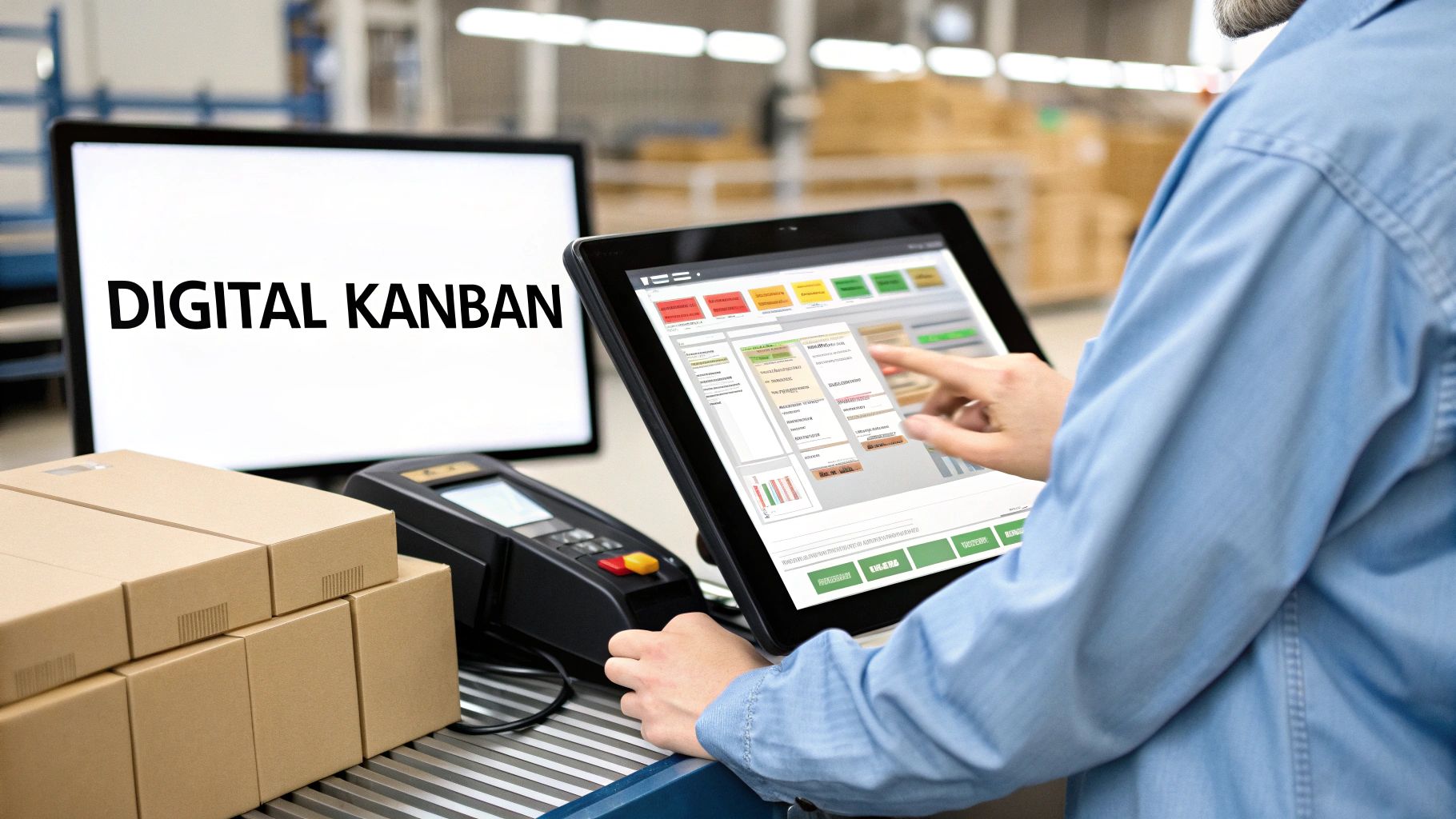
This interface gives managers a live look at production status, material levels, and any bottlenecks, all powered by data captured from the e-Kanban signals on the factory floor. This is how a kanban system in manufacturing evolves from a simple process tool into a strategic asset for data-driven decisions.
Measuring Success with Kanban Metrics
A Kanban system isn't something you just set up and forget. It's a living, breathing framework for Kaizen, or continuous improvement. Getting the system up and running is just the start; the real magic happens when you start measuring its performance. The right metrics turn your Kanban board from a simple workflow visual into a powerful diagnostic engine, showing you exactly where the bottlenecks are and how you can get more efficient.
Tracking performance isn't just about collecting data for the sake of it. It's about getting an honest, objective look at your production flow. This allows you to make decisions based on facts, not guesswork or gut feelings. These key performance indicators (KPIs) act as a health check for your system, guiding you as you systematically root out waste.
Core Metrics for Manufacturing Kanban
Three metrics, in particular, form the bedrock of Kanban analytics. Think of them as three different lenses that, when used together, give you a complete picture of your operational efficiency—both from your team's perspective and your customer's.
Lead Time: This is the big one for your customers. It’s the total time they wait, from the moment they place an order to the second it’s delivered. Lead time captures the entire journey, including any time an order sits waiting before production even starts. Shorter lead times mean happier customers.
Cycle Time: This is an internal view. Cycle time is a subset of lead time, measuring only the time your team is actively working on an item. It kicks off when production begins and stops when the work is finished. If you want to find a bottleneck on your line, this is the metric to watch.
Throughput: This is your output scorecard. Throughput simply measures how many units you successfully produce and deliver in a given period—think parts per day or assemblies per week. It’s a straightforward measure of your system's capacity and productivity.
When you track these three together, you start to see how everything is connected. For instance, if you see a sudden spike in cycle time at one workstation, you know it's only a matter of time before it drags down your overall lead time and hurts your throughput if you don't address it.
By focusing on the flow of value and using metrics to guide improvements, manufacturers can achieve a state of predictable, efficient production. The goal is to make the system so stable that delivery times are not just a target, but a reliable commitment.
Using Data to Optimize Your System
Once you've got this data flowing in, you can start making smart adjustments. Say you notice that the cycle time for a specific assembly stage is always longer than the others. You've just found a bottleneck. Now you have the data to dig deeper and find the root cause. Is it a machine that needs maintenance? A training issue? A poorly designed process?
In the same way, watching your throughput helps you set and adjust your Work In Progress (WIP) limits. If your throughput is stable or climbing, your WIP limits are probably working well. But if you tighten a WIP limit and see your throughput nosedive, it’s a clear signal you may have constrained the system too much.
To keep things clear, here’s a quick rundown of the essential metrics for monitoring the health of your manufacturing Kanban system.
Key Kanban Performance Metrics for Manufacturing
Ultimately, these metrics are the language of continuous improvement. They give you the objective feedback needed to refine your processes, balance your production flow, and methodically eliminate waste. This is how your kanban system in manufacturing evolves from a simple tool into a genuine competitive advantage.
Common Implementation Mistakes to Avoid
Even a perfectly designed Kanban system can stumble during the real-world rollout. The principles sound simple, but making them stick requires real discipline and a sharp eye for detail. Sidestepping a few common pitfalls can mean the difference between unlocking true lean efficiency and creating a system that just adds to the chaos.
Success with a Kanban system in manufacturing often comes down to avoiding those early missteps that can kill trust in the new process before it even has a chance. These aren't technical problems; they're failures in managing change and fine-tuning the system.
Setting Unrealistic Work-In-Progress Limits
One of the first places teams go wrong is setting their Work-in-Progress (WIP) limits incorrectly. They either set them way too high, which just brings back the old problems of overproduction and hidden bottlenecks, or they set them too low, starving downstream stations and grinding everything to a halt. Think of a WIP limit as a governor on your production engine—it’s not just some random number.
So, don't guess. Before you change anything, start by measuring your current WIP in a specific area. Use that real-world number as your starting point. The whole idea is to then methodically tighten those limits over time, but only after your team has found and fixed the bottlenecks that this pressure reveals.
Providing Inadequate Team Training
A Kanban system is only as good as the people who run it. If operators and material handlers don't understand why they have to follow the signals, they'll eventually fall back into old habits, especially when things get busy. That's when you hear the familiar temptation to "just build a few extra" to be safe, which completely undermines the system.
The core of Kanban is discipline. A card or a signal isn't a suggestion; it is the only authorization to produce or move material. Effective training has to go beyond the mechanics and drill this principle home.
The fix here is hands-on training that hammers home the "why" behind every rule. Run simulations. Show people exactly how ignoring a signal directly creates the very waste and inefficiency the system was built to eliminate.
Failing to Secure Full Stakeholder Buy-In
Without genuine commitment from everyone—from the plant manager right down to the operator on the line—a Kanban implementation is set up to fail. If leadership treats it as just another flavor-of-the-month initiative, or if the team sees it as a mandate from on high with no explanation, you're going to hit a wall of resistance.
The best way to handle this is to start with a pilot project in one, well-contained area. Use that pilot to rack up some quick, visible wins. This creates a group of champions who have seen the benefits firsthand and can help sell the concept to the rest of the facility. You're not just telling people it will work; you're showing them, building your full-scale rollout on a solid foundation of proven success.
Kanban FAQ: Your Questions Answered
Moving to a pull system always raises a few practical questions. While a Kanban system in manufacturing seems simple on the surface, making it work on the factory floor means having good answers for the common hurdles that operations and supply chain leaders run into.
This section tackles the most frequent questions we hear about putting Kanban into practice, covering everything from big-picture strategy to the nitty-gritty of daily operations.
How Is Kanban Different from Scrum?
People often group Kanban and Scrum together, but they're built for very different jobs. Think of Kanban as a system for managing a continuous flow of work—like an assembly line. It’s all about visualizing the process, limiting how much work is in progress at any one time (WIP), and making sure everything moves smoothly from start to finish. This is perfect for a factory where work is always happening and priorities might change.
Scrum, on the other hand, is for projects with a clear beginning and end. It breaks work into fixed-length "sprints" where a team commits to finishing a specific batch of tasks. You'd use Scrum for something like new product development, not for managing the day-in, day-out rhythm of a production floor.
Can Kanban Work in High-Mix, Low-Volume Manufacturing?
Absolutely. In fact, this is where Kanban really shines. High-mix, low-volume (HMLV) environments are notoriously difficult to manage with traditional, forecast-driven MRP systems. Demand is unpredictable, and you can easily end up buried in inventory for some parts while stocking out of others.
Kanban sidesteps that problem entirely. Instead of guessing what you'll need, you let actual consumption trigger production. A pull signal ensures you only make what's just been used, which is a far more responsive and efficient way to handle the variability inherent in HMLV.
Kanban thrives on variability. Instead of attempting to forecast the demand for hundreds of unique parts, the system allows actual consumption to dictate production priorities, creating a far more agile and cost-effective operation.
What Happens if a Kanban Card Gets Lost?
A lost card is a big deal. It’s not just a piece of paper; it’s a production signal. When it disappears, the information loop is broken, and a workstation could run out of parts without anyone knowing until it's too late.
The best defense is a good offense—design a robust system from the start.
- Durable Cards: Don't use flimsy paper. Invest in laminated cards or hard plastic tags that can withstand the shop floor environment.
- Clear Procedures: Everyone needs to know exactly how to handle cards. Define where they go, who moves them, and when. Designated drop-boxes are a simple but effective tool.
- Digital Systems: This is the ultimate fix. An e-Kanban system that uses barcodes or RFID scans to send digital signals makes it nearly impossible for a signal to get lost.
If a card does go missing, you need a clear protocol. A supervisor should be able to authorize a replacement immediately to keep the line running while the team figures out what went wrong.
At Wolverine Assemblies, LLC, we don't just talk about lean principles like Kanban—we use them to build and manage resilient supply chains for our manufacturing partners. Our end-to-end solutions in assembly, warehousing, and logistics are all about eliminating waste and smoothing out your operational flow. Learn how we can de-risk your programs and stabilize your supply chain at https://www.wolverine-llc.com.
Subscribe to our weekly newsletter