.png)
What Is End to End Supply Chain and How Does It Work
Discover what is end to end supply chain visibility and why it matters. This guide explains the core components, technology, and benefits...
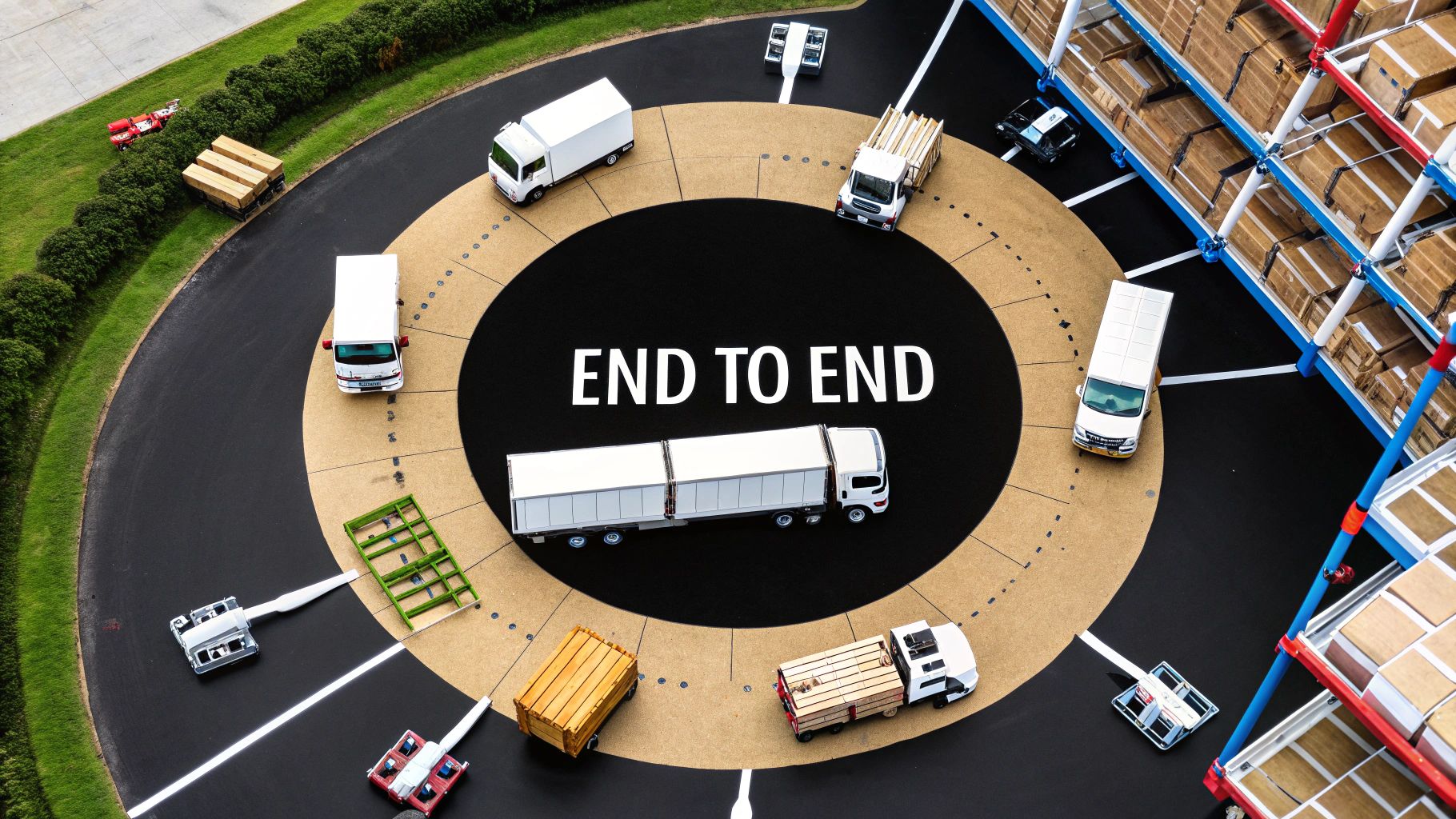

An end-to-end (E2E) supply chain is a way of looking at a product's entire journey not as a series of separate handoffs, but as one single, connected process. It's about managing everything from the raw materials supplier all the way to the final customer delivery as a unified system, giving you a bird's-eye view of the entire operation.
Understanding the End to End Supply Chain Model
Think of a traditional supply chain like a relay race where each runner is blindfolded. They can’t see the person before them, and they have no idea where the next runner is. The handoffs are clumsy, batons get dropped, and the final time is slow. That's a siloed supply chain—a collection of disconnected steps that breed inefficiency and risk at every turn.
Now, imagine that same race, but this time everyone can see the whole track. They anticipate each handoff, adjust their speed based on their teammates, and move in perfect sync. This is exactly what an end-to-end model brings to the table. It’s not just about moving boxes; it’s about creating a seamless, transparent flow of three critical things:
- Products: The physical journey of goods, from raw components to the finished item in the customer's hands.
- Information: Real-time data that flows freely between suppliers, manufacturers, warehouses, and carriers.
- Finances: The clear and timely movement of payments and credits across the entire network of partners.
From Disconnected Steps to a Unified System
The fundamental goal here is to move from a reactive posture—where a delay in one area creates a surprise fire drill somewhere else—to a proactive one. This complete view is essential for building a resilient operation. For example, by 2025, even with global disruptions, companies with better visibility saw annual losses around $184 billion, a figure 88% lower than previous peaks. You can explore the full analysis of recent supply chain trends to see just how much integration matters.
Often, a third-party logistics (3PL) partner is the one who brings it all together, acting as the conductor for this complex orchestra. By managing everything from sourcing parts to final assembly and delivery, a 3PL provides the central nervous system needed to make the E2E model a reality.
An E2E supply chain transforms a series of isolated functions into a single, intelligent organism. Every part communicates with the others, allowing the entire system to adapt and respond to changes with speed and precision.
The shift from a traditional, fragmented approach to a modern, integrated one is significant. The table below breaks down the core differences.
Siloed vs. End to End Supply Chain Models
This comparison highlights the fundamental differences between a traditional, fragmented supply chain and an integrated, end-to-end model.
Ultimately, the end-to-end model isn't just a different process—it's a different philosophy. It prioritizes collaboration and shared intelligence over departmental independence, leading to a far more agile and competitive operation.
The Core Components of an Integrated Supply Chain
An end-to-end supply chain isn’t just one single activity. It’s a whole network of interconnected stages, all working together. Think of it like a chain—its overall strength depends entirely on how well each individual link is integrated with the next. A breakdown in one area sends shockwaves through the entire operation.
This visual below maps out that fundamental flow, showing how materials move from their source, through production, and all the way to the customer’s doorstep.
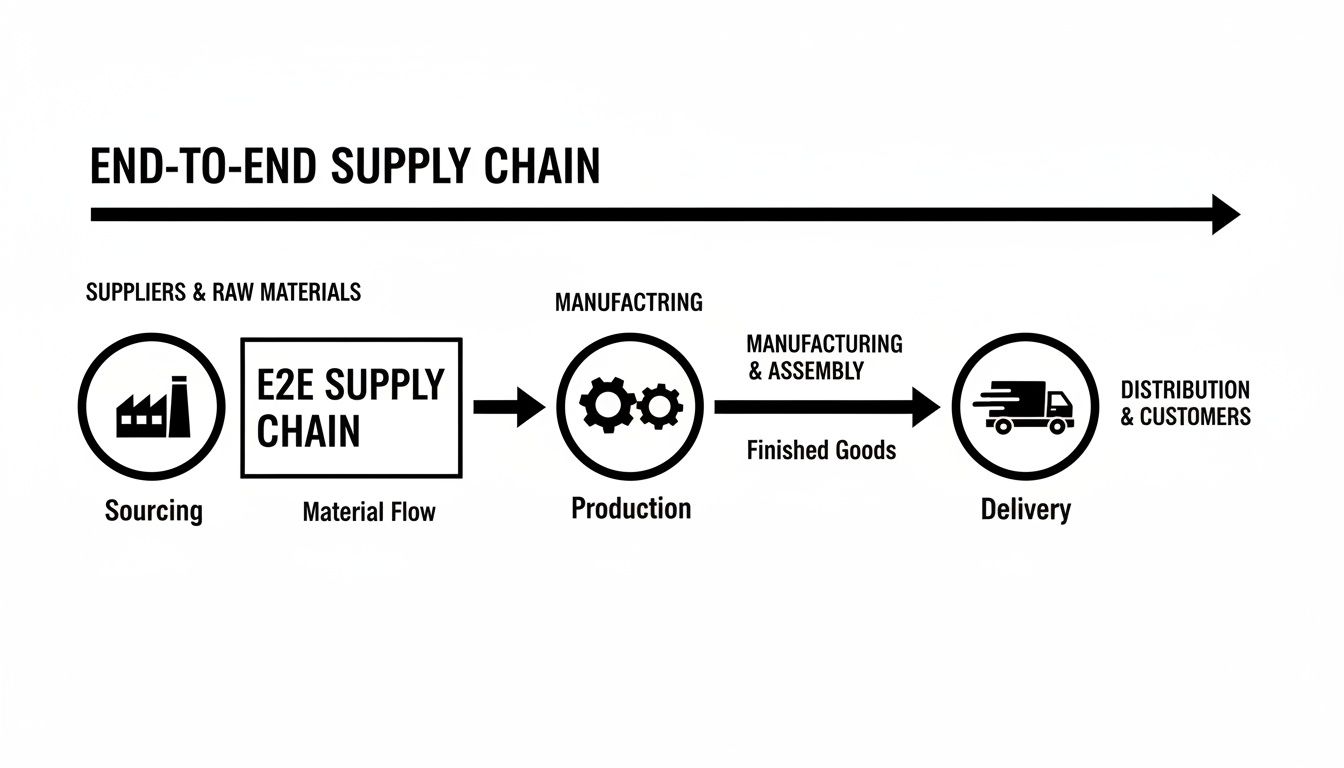
The diagram shows a continuous process where each stage feeds directly into the next. This highlights just how critical seamless handoffs are. Let's break down each of these key stages.
Sourcing and Procurement
It all starts here, with sourcing the right raw materials and components. This is so much more than just hunting for the cheapest supplier. It's about strategically building a resilient and reliable network of partners. Smart sourcing prioritizes quality, consistent supplier performance, and diversifying risk so that your production schedule is never held hostage by a single point of failure.
When done right, procurement ensures that material availability is perfectly synchronized with production demand. This delicate balance prevents both the high costs of overstocking and the disaster of a line-down scenario. This first step really sets the tone for the entire supply chain's efficiency.
Manufacturing and Assembly Services
Once the materials are in hand, the action moves to the production floor. In a modern end-to-end model, this stage often involves far more than just basic manufacturing. For OEM and Tier 1 customers, value-added assembly services are absolutely essential for keeping operations lean and efficient.
These services turn a warehouse from a simple storage space into a dynamic production hub.
- Kitting: We group separate but related parts into a single, ready-to-go unit for the assembly line.
- Sequencing: We deliver specific components to the production line in the precise order they’re needed. No more, no less.
- Sub-assembly: We handle preliminary assembly tasks to simplify and speed up the final manufacturing process.
By taking on these steps, a 3PL partner can dramatically boost an OEM’s throughput and cut down on complexity right on the factory floor. This is the stage where raw potential becomes a real, tangible product.
An integrated supply chain treats warehousing not as a static cost center, but as a dynamic hub for value creation. It's where efficiency is engineered before a product ever reaches the final assembly line.
Warehousing and Distribution
Warehousing acts as the central nervous system for distribution. It's not just about putting boxes on shelves; it's about smart inventory management, flawless order fulfillment, and prepping products for their final journey. A well-run warehouse guarantees the right products are in the right place, ready to go at the right time.
From there, distribution takes the baton. This piece of the puzzle manages the complex logistics of getting finished goods from the warehouse to their final destination, covering everything from carrier selection and route planning to ensuring every delivery is on-time and compliant.
Reverse Logistics
The supply chain doesn’t stop once a product is delivered. Reverse logistics is the process that manages everything flowing backward—from customer returns and warranty repairs to recycling and end-of-life disposal.
A truly strategic approach doesn't see this as a cost center. Instead, it’s a value-recovery engine. It’s an opportunity to recapture value from returned goods, collect crucial customer feedback, and demonstrate a real commitment to sustainability. Each of these components is a vital link, and only when they are all working in perfect sync can a supply chain truly hit its peak performance.
Key Technologies That Power E2E Visibility
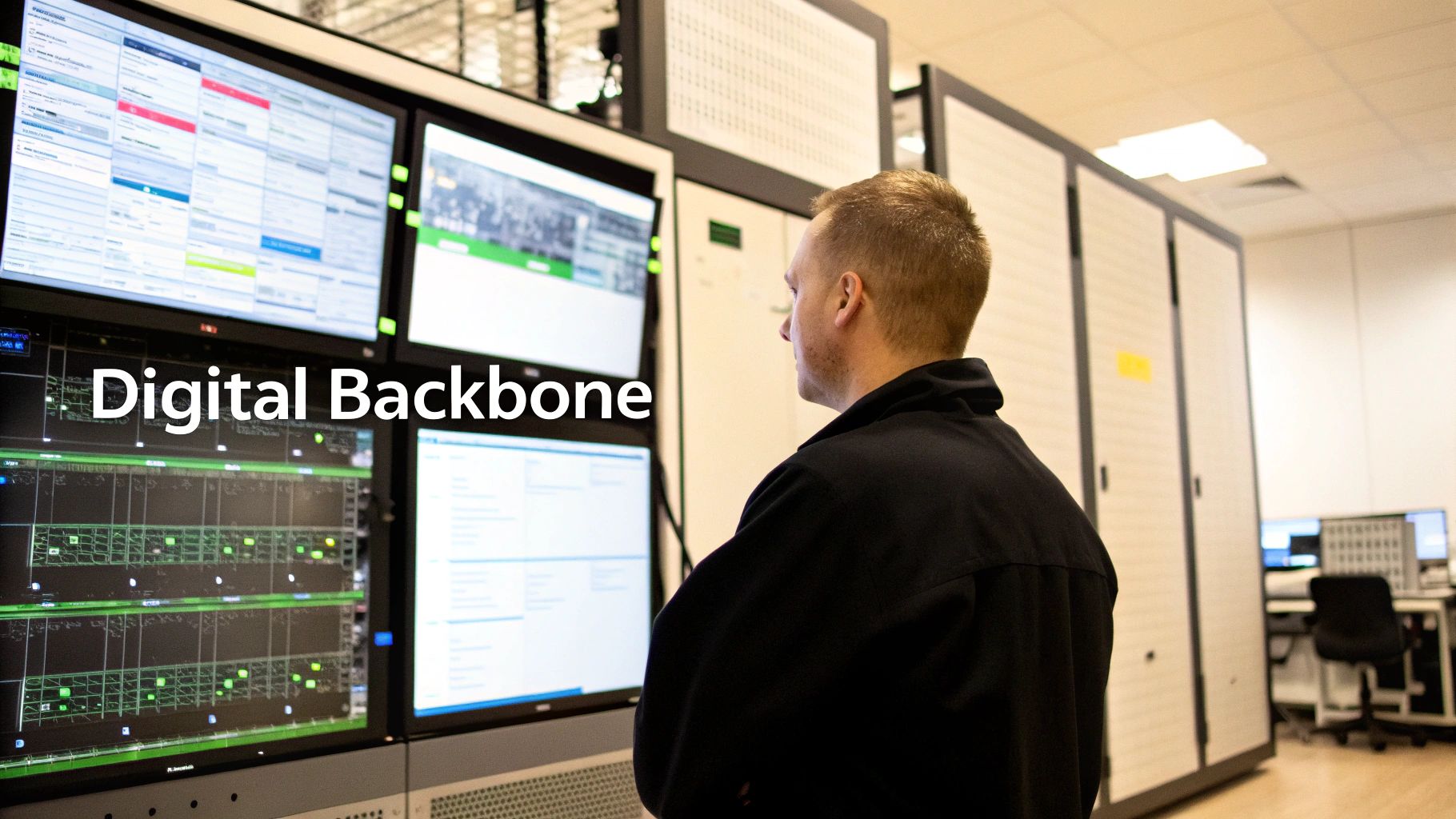
Achieving true end-to-end supply chain visibility isn't magic. It's built on a robust digital backbone that connects every partner and process, acting like a central nervous system for the entire operation. Without these technologies, the dream of a single, unified view of your supply chain remains just that—a dream. You're left with fragmented data and a purely reactive approach to problems.
This shift to digital integration is making a huge difference. A recent survey showed that by 2025, an overwhelming 96% of tech and telecom leaders reported getting better cost insights specifically because of these digital tools. This kind of clarity helps leaders proactively manage major economic shifts, like the 5.8% year-over-year drop in US imports seen in September 2025, by giving them the data to pivot instead of panic.
The Central Nervous System: ERP and EDI
At the very heart of any modern supply chain, you’ll find an Enterprise Resource Planning (ERP) system. The best way to think of it is as the company's central command center. It pulls everything—finance, procurement, manufacturing, inventory—into one shared database. This breaks down the data silos between departments, creating a single source of truth that everyone can trust and work from. To see how this plays out on the factory floor, you can learn more about what an ERP system in manufacturing really does in our guide.
If the ERP is the internal brain, then Electronic Data Interchange (EDI) is the universal translator that lets different companies talk to each other. EDI creates a standard digital format for critical business documents, like purchase orders and invoices. This allows the computer systems of a supplier, a 3PL, and an OEM to communicate directly and automatically. It's the digital handshake that makes real-time collaboration possible.
Optimizing Movement and Storage: WMS and TMS
When we get into the nitty-gritty of moving and storing physical goods, two other systems are absolutely vital.
- Warehouse Management System (WMS): This is the software that runs the show inside the four walls of a warehouse. It tracks every piece of inventory with incredible precision, guides the most efficient pick-and-pack workflows, and optimizes storage space to keep things running smoothly.
- Transportation Management System (TMS): Once a product leaves the warehouse, the TMS takes over. This system is a master of logistics, helping companies plan the smartest shipping routes, choose the right carriers, track shipments live, and keep a tight rein on freight costs.
These technologies aren’t just add-ons; they are the fundamental building blocks of a responsive, connected supply chain. They work together to turn a tangled web of separate steps into a single, intelligent operation.
When these systems are properly integrated, they feed decision-makers the real-time data needed to get ahead of problems. Today, advanced AI automation solutions are taking this even further, completely changing how businesses monitor their supply chains and turning potential disruptions into manageable events.
How to Measure E2E Supply Chain Performance
An end-to-end supply chain sounds great in theory, but without the right metrics, you’re just flying blind. The old saying is spot on: you can't improve what you don't measure. Making this model work in the real world means picking the right key performance indicators (KPIs) to act as a health check for your entire operation, showing you what’s working and, more importantly, where the hidden problems are.
These aren't just numbers on a dashboard. They tell a story about how well your products, information, and money are flowing from one end to the other. For any OEM or Tier 1 supplier, tracking the right KPIs is absolutely critical to staying competitive.
Key Metrics for Supply Chain Health
To get a true picture of performance, you need a balanced view. Focusing on just one area, like manufacturing output, while ignoring logistics will give you a distorted picture. The best approach is to look at performance across inventory management, logistics execution, and financial efficiency. Each piece has its own vital signs.
A few of the most critical KPIs include:
- Inventory Turnover: This tells you how many times your entire inventory is sold and replaced over a set period. A high turnover is a sign of healthy sales and lean inventory, whereas a low number might point to overstocking, obsolete parts, or slowing demand.
- On-Time In-Full (OTIF): OTIF is the ultimate customer-facing metric. It measures the percentage of orders that arrive on schedule, with the right items, and in the right quantity. It's a direct reflection of your logistical precision, and a score that dips below 95% is usually a red flag for deeper issues.
- Cash-to-Cash Cycle Time: This measures the time it takes for the cash you spent on raw materials to come back to you as payment from a finished product sale. A shorter cycle is always better—it means your working capital isn't tied up in inventory and you're in a much healthier financial position.
End-to-end visibility has a direct and powerful impact on these numbers. When you can see inventory levels across your entire network, you can fine-tune your turnover. When you can track shipments in real time, you can dramatically improve your OTIF score.
Benchmarking and Driving Improvement
Just watching the numbers isn't enough. The real magic happens when you use that data to benchmark your performance and find opportunities to get better. For example, if your OTIF rate starts to slip, it could trigger an investigation into a specific carrier’s performance or reveal a communication breakdown with a supplier. These data points give you the solid evidence you need to make smart, strategic changes instead of just guessing.
A deep dive into supplier performance metrics is often the perfect starting point, since a reliable upstream process is the foundation for everything that happens downstream. When you measure everything from a supplier's lead time accuracy to their defect rates, you build a far more predictable and resilient supply chain from the ground up.
The table below gives a quick summary of these vital KPIs, acting as a handy reference guide for anyone managing an E2E supply chain.
Key Performance Indicators for End to End Supply Chains
By keeping a close watch on these key areas, you can ensure your supply chain isn't just integrated, but is also running at peak performance.
Tackling the Problems Plaguing Disconnected Supply Chains
Let's be honest. Companies don't invest in end-to-end (E2E) supply chain solutions for the fun of it. They do it to solve expensive, recurring problems that constantly disrupt their operations. When every department—procurement, manufacturing, logistics—works from its own spreadsheet and speaks its own language, you get blind spots. These blind spots create friction that sends costly ripples through the entire system.
An E2E model is designed to eliminate that friction by creating a single source of truth for everyone. Think about it this way: a critical component gets held up at a port. In a disconnected system, the manufacturing team might only find out when the part doesn't show up for the production run. The result? A sudden, expensive, and chaotic shutdown.
But with an E2E view, that delay is flagged the second it happens. This gives everyone, from the planners to the final assembly team, the real-time data they need to adjust on the fly instead of reacting to a crisis.
Taming the Bullwhip Effect and Inventory Chaos
One of the most infamous problems in supply chain management is the bullwhip effect. It’s a perfect example of what happens when communication breaks down. A small change in customer demand at the retail level gets magnified exponentially as it moves back up the chain.
A minor dip in sales can look like a total market collapse by the time that signal reaches the raw material supplier, causing them to slash production. This lack of shared visibility creates two huge financial headaches:
- Excess Inventory: Fearing the unknown, companies start ordering extra materials "just in case." All that buffer stock ties up working capital and takes up expensive warehouse space.
- Stockouts: The flip side is just as bad. An unexpected demand spike catches everyone off guard, leading to lost sales, frustrated customers, and costly emergency freight to catch up.
It's no surprise that a recent study found 79% of companies are now using dashboards to get a clearer, end-to-end view of their operations. They see it as the best defense against the guesswork that creates these inventory nightmares. A unified view turns forecasting from a series of isolated guesses into a collaborative, data-backed strategy.
Preventing Delays and Costly Miscommunication
Beyond inventory, disconnected operations are a breeding ground for delays. A simple miscommunication between the warehouse and a trucking company can leave a driver waiting for a load that isn't ready or a shipment sitting on a dock. When the systems aren't connected, a small error can go unnoticed for hours or even days.
By then, it's snowballed into a major disruption that throws the entire delivery schedule off track.
An E2E framework replaces these messy, informal communication lines with a central nervous system. Tools like real-time tracking, automated alerts, and shared planning dashboards make sure every partner is on the same page. This sync-up does more than just prevent delays—it builds a far more resilient and predictable operation that can handle market volatility without breaking.
Partnering for a Truly Integrated Supply Chain
The idea of a perfectly synchronized end-to-end supply chain is one thing; making it a reality is another challenge entirely. Pulling it off takes more than just good software. It’s a massive strategic effort, and for many OEM and Tier 1 manufacturers, the secret lies in finding the right partner to bridge the gap between a fragmented process and a cohesive operational vision.
This is where a dedicated Third-Party Logistics (3PL) provider steps in. Think of an expert 3PL as the central nervous system for your supply chain, connecting all the disparate pieces and transforming them into a single, high-performance operation.

Driving Tangible Outcomes for OEMs
For manufacturers, the payoff from this kind of partnership is direct and measurable. A skilled 3PL brings its own robust technology stack to the table—including a sophisticated ERP and full EDI/ASN capabilities—to establish that single source of truth everyone is chasing. This technological backbone is what allows them to deliver critical value-added services that solve real-world production headaches.
These aren't just logistical tasks; they are strategic solutions aimed at complex manufacturing needs:
- Component Consolidation: Simplifying the inbound flow of parts, which cuts down on complexity and handling costs.
- Kitting and Sub-assembly: Assembling components into production-ready kits before they hit the factory floor, speeding up final assembly.
- Sequencing: Delivering specific parts to the line at the exact moment and in the exact order they're needed, which is the cornerstone of lean manufacturing.
Handing over these functions isn't just about outsourcing work. It's about strategically embedding an expert team into your operation to achieve specific, high-impact results.
Partnering with an integrated 3PL is about more than offloading logistics; it's about embedding an expert team into your operation that is fully aligned with your goals for efficiency, resilience, and growth.
Ultimately, this is about strengthening your market position and improving your bottom line. By entrusting these critical functions to a specialist, companies can de-risk new program launches, drive down total landed costs, and boost production throughput. As you look at your own operations, understanding what a third-party logistics provider can truly do is the first step toward building the kind of resilient supply chain that lets you thrive.
Frequently Asked Questions
Even with a solid grasp of the concept, a lot of practical questions pop up when you start thinking about moving to a fully connected supply chain. Let's tackle some of the most common ones.
What’s the Real Difference Between SCM and End-to-End SCM?
Think of traditional Supply Chain Management (SCM) as a relay race where each runner focuses only on their leg of the race. Procurement optimizes for cost, logistics for speed, and warehousing for space, but they don't always look at the bigger picture together. This often creates functional silos.
An end-to-end supply chain is more like a synchronized rowing team. It’s a holistic approach that connects and optimizes the entire flow—products, information, and cash—from the very first supplier all the way to the final customer. Everyone pulls in the same direction at the same time.
How Does End-to-End Visibility Actually Make a Supply Chain More Resilient?
Imagine end-to-end visibility as having a GPS with live traffic updates for your entire supply chain. Instead of just seeing your own car, you see every vehicle on the road, every accident, and every traffic jam miles ahead.
This allows you to spot potential disruptions—a delayed container ship, a factory shutdown, a sudden spike in demand—long before they become a full-blown crisis.
With a complete, real-time view, you can proactively reroute shipments, activate backup suppliers, or adjust production schedules, turning a potential crisis into a manageable event.
What's the Best First Step to Implement an End-to-End Strategy?
Jumping in headfirst can be overwhelming. A smart first step is to focus on technology integration and process mapping.
Start by taking an honest look at your current operations. Where are the communication breakdowns? Where do information silos exist? Once you've identified those gaps, the next move is to invest in a central platform, like an ERP system, that can serve as a single source of truth for you, your key suppliers, and your logistics partners. This builds the foundation for everything else.
For ongoing industry insights, news, and detailed discussions on supply chain topics, explore timbercloud's blog for industry insights.
At Wolverine Assemblies, we don't just talk about theory; we build resilient, end-to-end supply chain solutions that deliver real-world results for OEM and Tier 1 customers. From component consolidation and kitting to sub-assembly and international logistics, we bring the people, processes, and technology together to lower your costs, boost throughput, and take the risk out of your programs.
Discover how our integrated capabilities can stabilize and scale your operations.
Subscribe to our weekly newsletter