.png)
What Is Light Manufacturing and Why It Matters for Your Supply Chain
Explore what is light manufacturing, how it differs from heavy industry, and its vital role in creating more resilient and efficient...
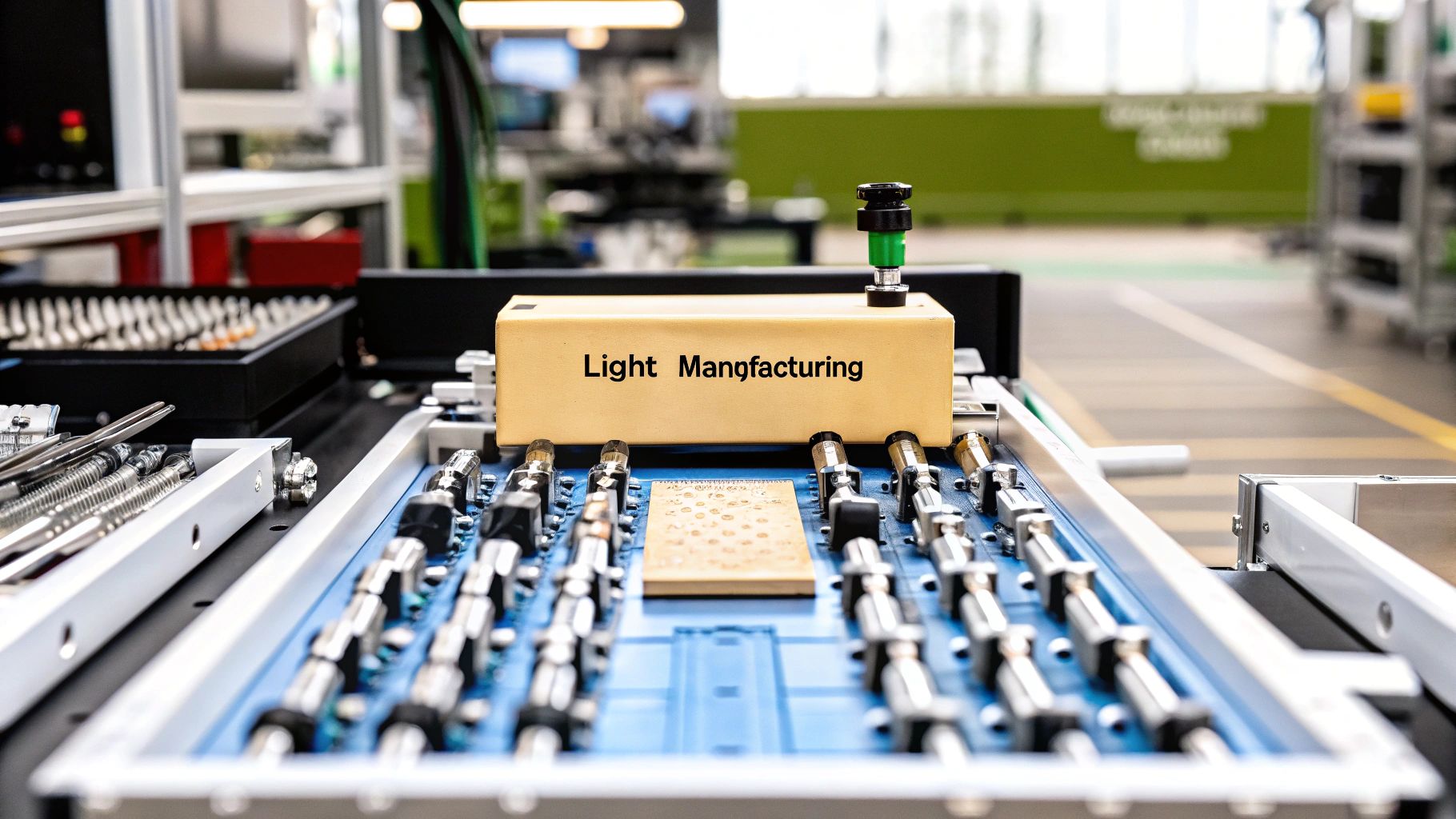

Light manufacturing isn't about forging steel or creating raw materials from scratch. Instead, it’s a strategic part of the supply chain focused on the assembly, kitting, and final configuration of products using components that have already been made. It’s all about adding precision and value right before the final production stage, often handling smaller, high-value parts for industries like automotive and electronics.
Defining Light Manufacturing in Today's Supply Chain
Think of it like the highly skilled prep kitchen behind a five-star restaurant. Your final assembly line is the main kitchen, where the complex, signature dish comes together. But the speed and quality of that final dish depend entirely on the prep work—the team that meticulously washes, chops, measures, and organizes every single ingredient beforehand. This specialized crew makes sure everything is perfect and ready, preventing costly delays and mistakes during the main event.
In the same way, light manufacturing takes individual components—fasteners, wire harnesses, electronics—and gets them ready for seamless integration. It’s the crucial link that turns a box of loose parts into a perfectly sequenced, quality-checked kit or sub-assembly, ready to be installed. This move shifts complexity away from your core production floor, letting it run at peak efficiency.
Core Activities and Purpose
The main goal here is to make final assembly simpler. Rather than having line workers hunt for dozens of tiny parts for each unit, a light manufacturing partner can deliver a single, consolidated package. This usually involves a few key activities:
- Sub-Assembly: Building smaller, self-contained modules offline, like the complete electronics package for a vehicle's center console.
- Kitting and Sequencing: Grouping every component needed for a specific task into one kit and delivering it in the exact order required on the line.
- Quality Inspection and Testing: Catching problems early by verifying that all incoming components meet spec before they ever get near your main assembly line.
- Final Configuration: Customizing products based on specific orders, like installing a particular software version or adding optional hardware.
This process isn't just about putting things together; it's a strategic firewall for quality and a powerful accelerator for production. By handling these detailed tasks upstream, you shield your core operations from part shortages, defects, and other variables, leading to a smoother, faster, and more reliable output.
Light manufacturing is a huge part of the global economy, especially for assembly-intensive products. In the United States alone, key sectors that rely heavily on these processes—like transportation equipment, electrical equipment, and fabricated metals—contributed hundreds of billions in gross output in 2023 and employed over 3 million people.
For OEMs and Tier 1 suppliers, these numbers highlight how much of their value chain is already being executed in these specialized environments. You can learn more about the manufacturing market's economic impact to see the scale. This model ensures that experts are handling the precision assembly, testing, and flexible capacity needed to keep the entire supply chain stable and efficient.
To put it all together, here's a quick look at the core characteristics of light manufacturing.
Key Characteristics of Light Manufacturing
Ultimately, these attributes allow light manufacturing to act as a flexible, responsive extension of the main production line, absorbing complexity and boosting overall efficiency.
Light Manufacturing Versus Heavy Manufacturing
To get a real feel for what light manufacturing is, it helps to first understand what it isn't. The manufacturing world is broadly split into two camps—light and heavy—and they’re fundamentally different animals. Think of it like a construction project.
Heavy manufacturing is the crew pouring the foundation and erecting the steel skeleton of a skyscraper. It’s all about massive, capital-intensive work, like smelting iron ore or stamping out huge body panels for a semi-truck. This requires enormous factories, a colossal amount of energy, and powerful, specialized equipment. The goal here is to create large-scale goods or raw materials from the ground up.
Light manufacturing, on the other hand, is the team doing the intricate electrical work and interior finishing. They take pre-made components—wires, fixtures, circuit boards, panels—and assemble them into complex, functional systems. You don't need a blast furnace for this; you need skilled technicians, precision tools, and a clean, controlled environment.
The Core Differences in Operations
The operational DNA of these two models couldn't be more distinct. Heavy manufacturing is defined by its massive capital outlay and significant environmental footprint. You’ll usually find these plants in remote industrial parks because of the noise, emissions, and sheer space they command.
Light manufacturing facilities, however, are cleaner, quieter, and demand far less upfront investment in heavy machinery. This flexibility allows them to be located closer to urban centers and, crucially, right next to the final assembly plants they supply. That proximity is everything when you're supporting a Just-in-Time (JIT) production line where every second is accounted for.
Key activities like kitting, assembly, and quality inspection are the bread and butter of light manufacturing, all designed for precision and responsiveness.
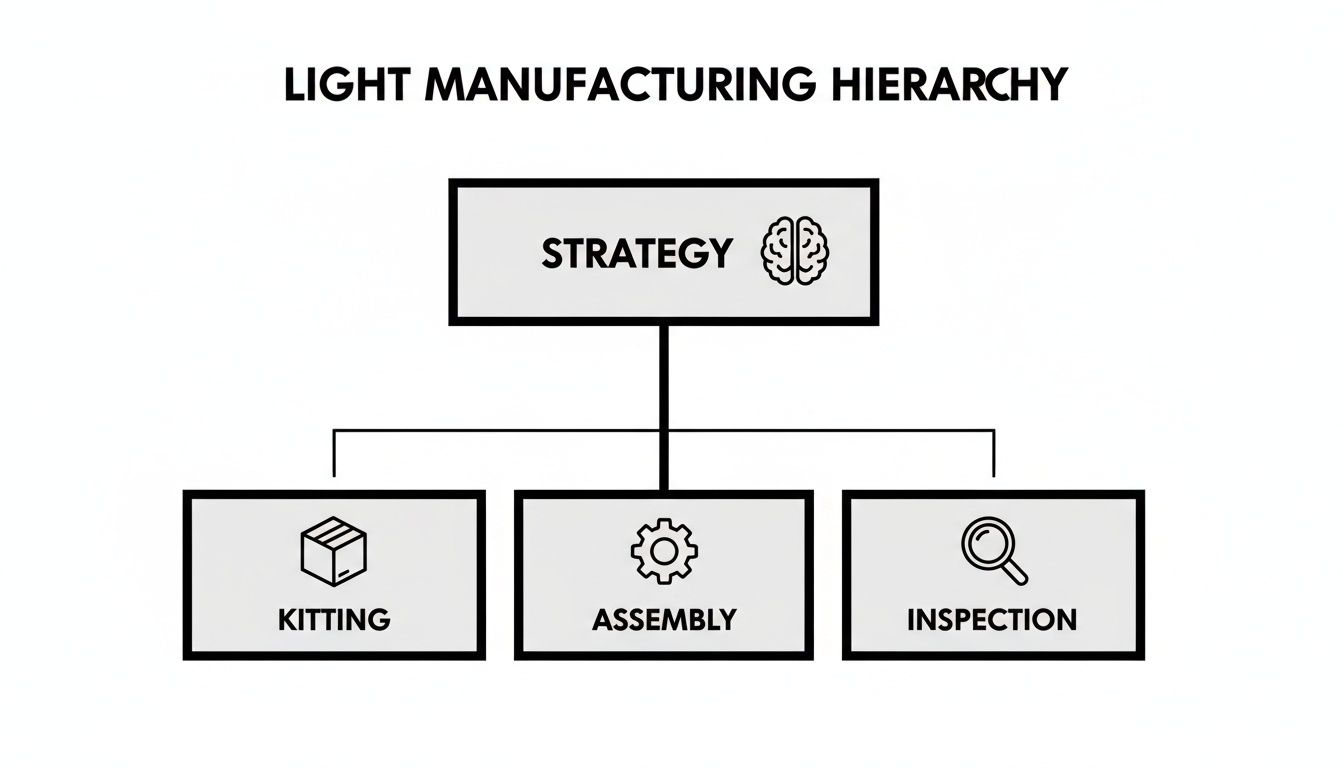
This hierarchy shows how a central strategy drives the core value-added services that truly define the light manufacturing process.
Light vs. Heavy Manufacturing: A Head-to-Head Comparison
Breaking down the differences across a few key business dimensions really sharpens the picture. A primary distinction is whether the focus is on consumer-facing products and sub-assemblies or on foundational industrial goods.
The real split comes down to inputs and outputs. Heavy manufacturing turns raw materials into basic industrial goods. Light manufacturing takes finished components and turns them into sophisticated, high-value sub-assemblies.
This table offers a direct comparison, laying out the fundamental differences between the two manufacturing models.
Ultimately, any OEM or Tier 1 supplier needs to grasp this contrast. The skills, infrastructure, and quality systems needed to assemble a delicate electronics module are worlds apart from what’s required to forge a chassis component. Finding the right partner means recognizing that light manufacturing isn’t just a scaled-down version of heavy industry—it's a distinct discipline built on precision, flexibility, and adding strategic value where it counts most.
The Core Services That Make Your Supply Chain Hum
What exactly is light manufacturing? It’s not one single activity. Instead, it’s a collection of focused, value-added services that solve very specific headaches for OEMs and Tier 1 suppliers. Think of them as strategic tools designed to pull complexity, guesswork, and potential defects out of your main production process, directly boosting throughput and quality.
At its core, light manufacturing simplifies things on the factory floor. Imagine an automotive line where a worker needs to install a center console. Without help, they're staring at dozens of bins—fasteners, clips, harnesses, modules. The chance for a mistake is high, and every second spent hunting for parts is wasted time.
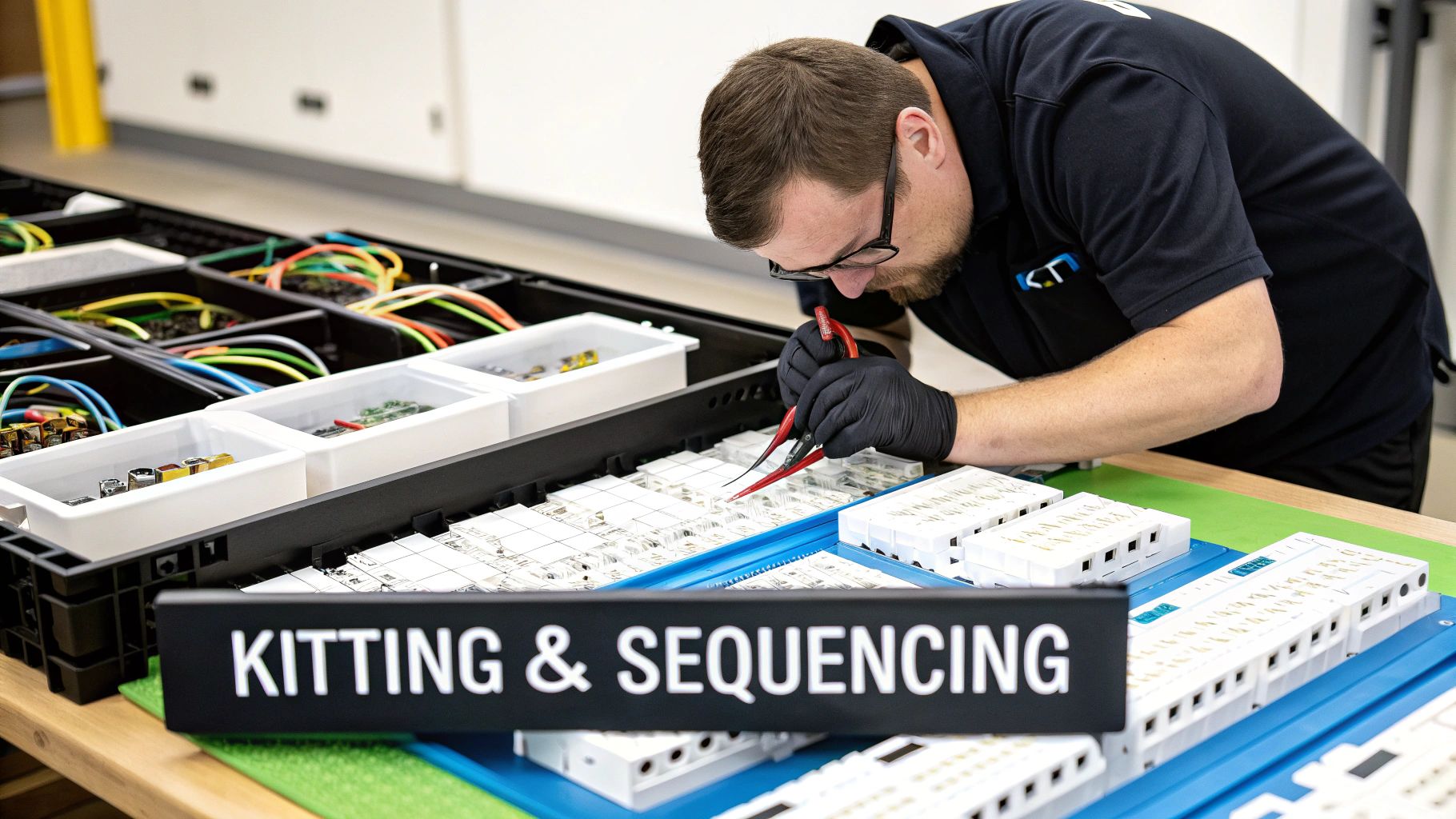
Now, picture that same workstation receiving a single, perfectly organized tray. This kit contains every single component for that console, laid out in the exact order of assembly. That’s the direct result of a light manufacturing partner working upstream.
Kitting and Sequencing: The Foundation of Assembly Efficiency
Kitting is the simple but powerful act of gathering all the individual parts for one job and packaging them together as a single unit. It turns a chaotic pile of parts into a streamlined, error-proof package. Sequencing takes it a step further by delivering those kits to the line in the precise order they’re needed, perfectly timed with the production schedule.
For instance, a modern vehicle has hundreds of trim and color combinations. A light manufacturing partner can build fastener kits for each specific VIN and deliver them sequentially. This guarantees the red SUV with the premium interior gets the exact right hardware, followed immediately by the correct kit for the blue base model right behind it.
The impact is immediate:
- Less Clutter on the Line: Assembly workers aren't searching for parts, which slashes wasted motion.
- Tighter Inventory Control: You're managing a handful of complete kits on the floor, not thousands of individual SKUs.
- Better Quality: The risk of grabbing the wrong part plummets, preventing rework and future warranty claims.
To see how these processes work together, you can learn more about the strategic advantages of combining kitting with assembly services—it’s a powerful duo for production efficiency.
Sub-Assembly: Building Quality Offline
Sub-assembly is all about building smaller, self-contained modules away from the main production line. It's a game-changer for complex or delicate components like wire harnesses, fluid systems, or electronic control units.
By building these in a dedicated, controlled environment, you can use specialized tools and focused training that just aren't practical on a fast-moving main line.
A core principle of lean manufacturing is catching defects at the earliest possible stage. Sub-assembly is the physical embodiment of this idea, creating a quality firewall that prevents faulty components from ever disrupting final production.
Take a complex wire harness for an agricultural vehicle. Assembling it offline allows technicians to perform 100% functional testing on every single connection before it goes anywhere near the vehicle. If a fault is found, it's a quick, cheap fix. If that same faulty harness was installed directly, finding and replacing it could halt the line for hours and send costs skyrocketing.
Inspection and Configuration: The Final Value-Add
Beyond just building things, light manufacturing partners often act as your first line of defense for quality. They can run detailed incoming inspections on parts from global suppliers—verifying dimensions, materials, and function before those components ever hit your inventory. It’s a crucial service for de-risking your supply chain.
Final configuration is another critical task. This is where a standard product is customized to a specific customer order. For an industrial equipment OEM, this could look like:
- Flashing a specific firmware version onto a control module.
- Adding optional hardware based on the sales order.
- Applying unique labels or branding for different regional markets.
By handling these final touches, a light manufacturing provider lets your main assembly line churn out a standardized "vanilla" product. Customization gets pushed to the last possible moment, which dramatically improves forecast accuracy and cuts down on the amount of finished goods inventory you have to hold.
How This Impacts Your Supply Chain Strategy
Bringing a light manufacturing partner into the fold isn't just about handing off a few tasks—it’s a move that can fundamentally change how your business operates. It directly reinforces the three things that matter most in manufacturing: cost, quality, and supply chain stability. It’s about turning operational headaches into a real competitive edge.
Instead of treating assembly or kitting as just another internal process to manage, the smartest OEMs see it as a specialized service. This mental shift frees up their capital, their floor space, and their best people to focus on what they do best—final product innovation and assembly—while a dedicated partner handles the critical prep work.
Flip Your Cost Structure from Fixed to Variable
One of the most powerful financial wins here is the ability to turn fixed overhead into a variable expense. Think about it: maintaining in-house space for kitting or sub-assembly means you're paying for that square footage, the equipment, and the labor 24/7, whether production is humming or sitting idle. During a slow period, that space is just dead weight on your balance sheet.
When you partner with a 3PL that handles light manufacturing, you pay for the services you need, precisely when you need them. This "pay-as-you-go" approach gives you incredible financial flexibility.
- Dodge Major Capital Costs: You avoid sinking money into specialized tools, testing equipment, and workstations that might be obsolete after the next product cycle.
- Get Smart with Labor Costs: Tap into a skilled, ready-to-go workforce without the long-term overhead of hiring, training, and benefits.
- Handle Demand Spikes with Ease: You can instantly ramp up to meet a surge in orders without over-hiring or burning out your core team with expensive overtime.
This model makes your cost structure predictable and ties it directly to your output. Your financial forecasts become sharper, and capital is freed up for things that really move the needle, like R&D or upgrading your main production lines. You can get a deeper look at how these activities fit into the bigger picture in our guide to value added warehousing services.
Build a Firewall for Quality Control
A dedicated light manufacturing partner is your first line of defense—a quality firewall that catches problems long before they can reach your expensive final assembly line. When components arrive from suppliers all over the world, your partner is there to run the checks, perform the tests, and validate everything.
Finding a single bad part on your main assembly line can bring production to a screeching halt, costing tens of thousands of dollars for every minute of downtime. A light manufacturing partner is built to stop that from ever happening by catching problems at the source.
This proactive approach to quality control contains issues when they're cheapest to fix. A faulty wire in a sub-assembled harness is a simple correction offline. Discovering that same faulty wire after the harness has been buried deep inside a vehicle chassis? That's a disaster. By catching these things early, you dramatically cut down on rework, scrap, and the risk of costly warranty claims later on.
Create an Essential Buffer for Your Capacity
Beyond the immediate cost and quality benefits, outsourcing light manufacturing gives your supply chain much-needed resilience. It creates a flexible capacity buffer, letting you react to market shifts without taking on huge risks. If a new product takes off faster than you predicted, your partner can absorb the extra volume. If demand cools, you can scale back without idling your own expensive people and equipment.
This strategy is absolutely critical in industries like automotive. With North American light-vehicle production forecast to hit around 15.24 million units in 2025, the sheer scale is staggering. Each of those vehicles contains 20,000–30,000 individual parts. Even if only 10–20% of those are handled in kits or pre-assembled modules, that's still an immense flow of light-manufactured components. As S&P Global’s 2025 light vehicle production forecasts show, this buffer is what allows the industry to manage that mind-boggling complexity day in and day out.
When Should You Partner With a Light Manufacturing Provider?
Knowing when to bring in a light manufacturing specialist isn't about admitting defeat. It's a smart, strategic move to get ahead of the growing pains that hit almost every successful OEM or Tier 1 supplier. Think of these triggers as clear signals that your own team is stretched thin and that a dedicated partner could help you find a whole new level of efficiency.
It’s like a health check for your operations. If you're constantly putting out fires related to floor space, quality control, or production bottlenecks, that’s a sure sign you've outgrown your current setup. The idea is to stop reacting to problems and start building a proactive strategy that makes your supply chain stronger.
Your Assembly Floor Is Maxed Out
One of the clearest and most common signs is simply running out of physical space. When every square foot of your production floor is already dedicated to final assembly, there's literally no room left for value-added work like kitting or building sub-assemblies. Trying to cram these tasks into an already packed facility is a recipe for inefficiency and safety hazards.
If your team is tripping over cluttered aisles or you're paying a fortune for off-site storage just to stash components, you’re stuck in a classic capacity crunch.
A light manufacturing partner solves this problem instantly by taking those space-hogging activities off your plate. This frees up your most valuable real estate—your primary production floor—to focus on what it does best: push finished goods out the door.
This isn't just about clearing floor space; it's about creating operational breathing room. It lets you fine-tune your core workflows without being held back by the messy logistics of managing thousands of individual parts right on the line.
You're Launching a New or Complicated Product
New product introductions (NPIs) are famous for causing chaos. They bring in a flood of new parts, unproven assembly steps, and a steep learning curve for your people. Trying to absorb all that complexity on your main line puts your existing, high-volume products at risk.
This is a perfect time to call in a partner. They can take ownership of the entire pre-production and launch phase for sub-assemblies, hammering out the process in a controlled, separate environment.
A specialist can handle all the critical launch headaches, like:
- Building and testing prototypes.
- Creating standardized work instructions for tricky assemblies.
- Managing the initial production ramp-up for component builds.
This approach takes a huge amount of risk out of the launch. You get to iron out all the kinks with new components or assembly sequences offline. By the time that sub-assembly hits your main line, it's a proven, stable module that's ready to go.
You’re Fighting Never-Ending Supplier Quality Problems
Is your line constantly shutting down because a bad batch of parts from a supplier slipped through? When your internal teams are running lean, they rarely have the time to perform detailed incoming inspections on every shipment. You're forced to just trust your suppliers, and that can be a gamble.
A light manufacturing provider acts as your dedicated quality gatekeeper. Their entire reason for being is built around inspection, testing, and validation. They can quarantine incoming shipments, perform 100% inspections, and catch any defects long before they contaminate your production inventory. That simple handoff can have a massive impact, slashing your rework costs and protecting your line from unexpected shutdowns.
How to Select the Right Manufacturing Partner
Choosing a light manufacturing partner isn’t just about comparing quotes. It’s a strategic decision that has a direct line to your product quality, production stability, and ultimately, your bottom line. The right provider becomes a true extension of your team, not just another vendor on an invoice. That’s why a deep, thorough evaluation is so important—it’s how you find a partner who can deliver the real strategic value your supply chain needs.
You have to look past the price-per-unit and get into the weeds of their operational DNA. A low-cost quote means nothing if the provider can’t hit your quality specs, integrate with your systems, or pull off a flawless product launch. Real value comes from a partner whose processes, technology, and culture are built to handle the pressures of modern manufacturing.
Evaluate Their Quality Management Systems
The first place to look—and the most critical—is their approach to quality. A premier light manufacturing provider won't just talk about quality; they’ll have the certifications and systems to prove it. For anyone in the automotive or industrial space, this is completely non-negotiable.
Look for specific, rigorous credentials that show they mean business:
- IATF 16949: This is the global gold standard for the automotive industry. A partner with this certification has proven they have a systematic approach to everything from risk management to continuous improvement, all tailored for the zero-defect world of auto production.
- ISO 9001:2015: This is the foundation. It demonstrates a solid commitment to documented processes, customer satisfaction, and consistent quality management across their entire organization.
- Safety Certifications: You also need to know they meet all compliance and safety standards. For instance, understanding a Practical Guide to ISO 45001 Certification in Australia gives you a good idea of the kinds of safety management systems that protect their workforce and, by extension, your products.
These systems are your assurance that the partner can deliver repeatable, high-quality results, time and time again. They signal a culture of discipline that protects your brand.
Scrutinize Their Technology and Integration Capabilities
In today's just-in-time environment, data has to flow just as smoothly as physical parts. A partner’s tech backbone is every bit as important as their assembly lines. Without solid system integration, you’re basically inviting manual errors, communication gaps, and inventory headaches into your supply chain.
A top-tier provider’s ERP system should be the central nervous system of their operation, not just a record-keeping tool. Seamless EDI integration isn’t a luxury; it’s the price of admission for serving a modern OEM.
Your evaluation checklist absolutely must include:
- ERP System: What are they running? A modern, manufacturing-focused ERP like PLEX shows they have tight control over inventory, production scheduling, and traceability.
- EDI/ASN Capabilities: Can they seamlessly exchange forecasts, purchase orders, and Advance Shipping Notices (ASNs) with your systems? This automates critical communication and is the lifeblood of JIT logistics.
- Real-Time Visibility: Can they give you a clear, immediate window into production status and inventory levels?
Confirm Their Program Management and Location Strategy
Finally, a great partner is a master of execution. You see this in a disciplined program management process built for flawless launches and steady, ongoing production. Ask them to walk you through detailed examples of how they handle new product introductions, from initial planning and prototype builds all the way to a full-scale production ramp-up. They should have a clear, documented process for heading off risks before they become problems.
Don’t forget about geography. The partner’s location and service model are strategically vital. Light manufacturing is increasingly clustered in flexible, logistics-rich hubs where 3PL, warehousing, and assembly all happen under one roof. For Midwest-based automotive, agricultural, and industrial manufacturers, these integrated facilities are crucial for stabilizing production and hitting on-time delivery targets. The right partner's location can directly compress lead times and reduce your total landed cost.
This combination of services, which includes expert management of contract packaging services, creates a truly resilient node in your supply chain. By vetting these three core areas—quality, technology, and execution—you can confidently pick a partner who delivers true strategic and operational excellence.
Answering Key Questions About Light Manufacturing
Even when the benefits seem clear, it's natural for leaders to have pointed questions before diving into a light manufacturing partnership. These aren't just details; they get to the heart of the matter—scope, quality, and how this new piece will fit into your operational puzzle. Getting solid answers is what builds the confidence to move forward.
Most of these questions circle back to the practical side of outsourcing important assembly and logistics work. Let’s tackle the ones we hear most often.
Is Light Manufacturing Just Another Term for Contract Manufacturing?
Not quite, though it’s easy to see why they get confused. They operate on different strategic levels.
A contract manufacturer is typically hired to produce a complete, finished product that someone else will put their brand on. Think of a company that manufactures an entire television, from the internal electronics to the plastic casing, for a well-known retail brand. They handle the whole thing, start to finish.
Light manufacturing, especially when handled by a 3PL, is much more targeted. It’s about taking on specific, value-added tasks within your existing supply chain—things like building sub-assemblies, creating specialized kits for the assembly line, or performing detailed inspections. It’s not about replacing your production, but about making your final assembly operations faster, leaner, and more efficient. It’s a supporting role, not a full production hand-off.
How Can We Trust Quality Control When Assembly Is Outsourced?
This is probably the single most important question, and the answer lies in finding a partner who operates with OEM-level quality systems. A high-caliber provider won’t just do a quick visual check. They live and breathe the same rigorous standards you do, like IATF 16949 in the automotive world. It’s a systematic, embedded approach to quality, not an afterthought.
A truly robust quality process has several layers:
- Multi-stage inspections: Parts are checked when they arrive, during the assembly process, and again before they ever leave the facility.
- Functional testing: Every single sub-assembly is tested to make sure it performs exactly as it should. No exceptions.
- Full component traceability: We’re talking about tracking every component from the moment it hits the dock to the second it ships out in a finished kit.
Think of your partner as a quality firewall. Their entire operation is engineered to catch, contain, and fix defects long before they can ever reach your primary production line. They insulate you from supplier issues and prevent costly disruptions downstream.
What Does the Integration Process Actually Look Like?
A successful partnership is built on more than just a handshake and a contract. It's about deep operational and technical alignment. The process kicks off with an intensive discovery phase where we nail down every program requirement, quality benchmark, and production forecast.
From there, it splits into two parallel tracks. On the technical side, the backbone is system integration, usually through EDI/ASN (Electronic Data Interchange/Advance Shipping Notice). This creates a seamless, automated conversation between your ERP and your partner’s systems for forecasts, orders, and shipping data.
Operationally, it's about people and process. You'll have dedicated program managers, clear communication channels, and a shared commitment to continuous improvement. When it's done right, your partner feels less like a vendor and more like a seamless, highly responsive extension of your own plant.
Your supply chain deserves a partner built for precision and resilience. Wolverine Assemblies, LLC delivers expert light manufacturing, kitting, and warehousing solutions that stabilize your production and lower total landed costs. Discover how our integrated approach can strengthen your operations at https://www.wolverine-llc.com.
Subscribe to our weekly newsletter