.png)
What Is Kitting in Logistics A Guide to Fulfillment Efficiency
Wondering what is kitting in logistics? This guide explains the process, its benefits, and how it transforms manufacturing and supply chain...
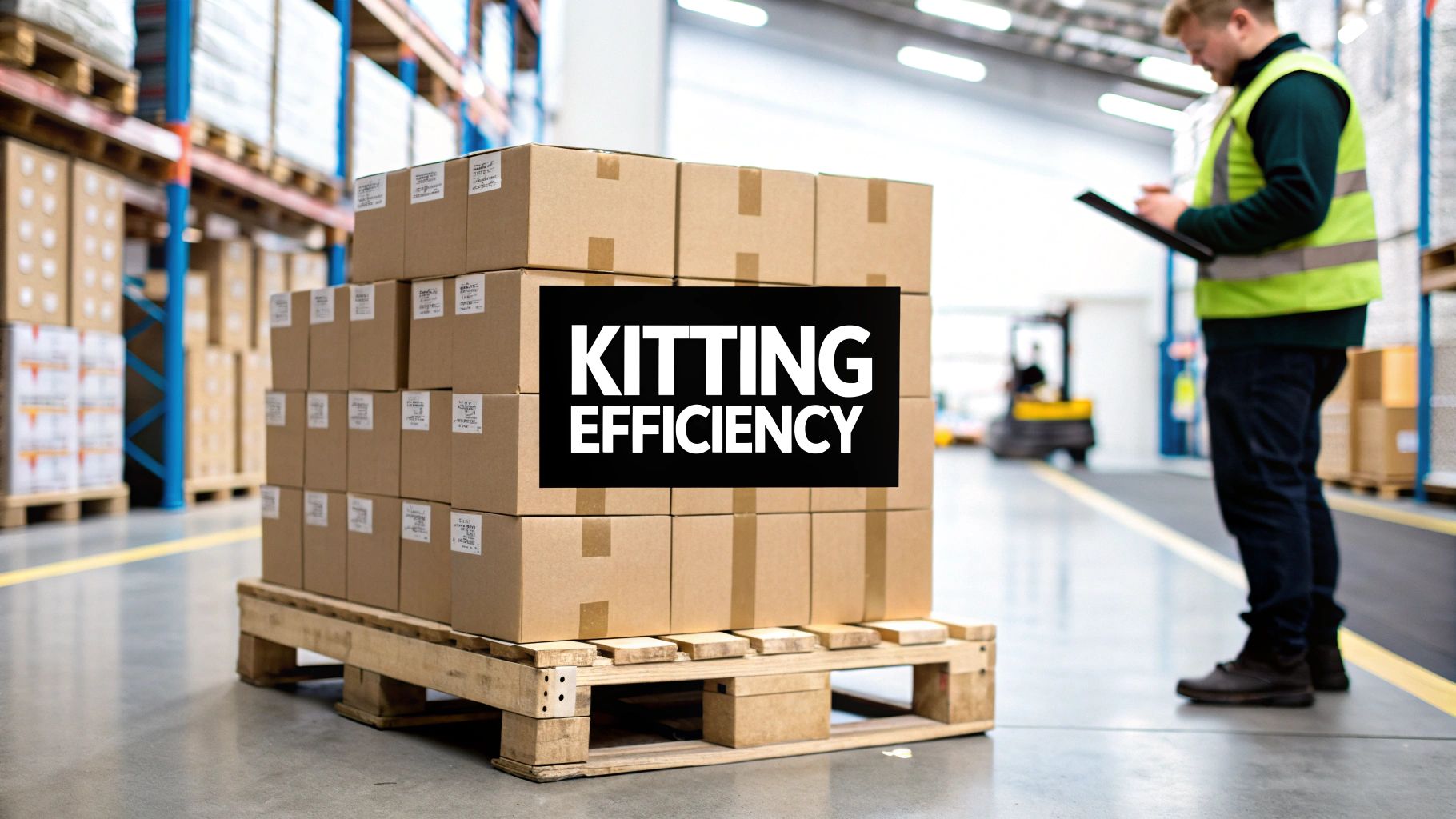

So, what is kitting in logistics? Put simply, it’s the process of bundling individual, related parts into a single package. This package is then treated as one item, ready to be shipped to a customer or sent to an assembly line. This seemingly small change can completely reshape a clunky, mistake-ridden process into a smooth, efficient operation.
Understanding Kitting: A Core Strategy for Modern Logistics
Think about those meal-kit delivery boxes that show up at your doorstep. Everything you need for a recipe—pre-measured ingredients, spices, instructions—is all there in one box. Kitting in a warehouse or on a factory floor works on the exact same principle.
Instead of an assembly worker walking around to pick a dozen different components from various bins—a bolt from here, a washer from there, a bracket from somewhere else—they get a single, complete kit with its own barcode.
This kit, now identified by a single SKU, contains every part needed for a specific job. By getting these kits ready ahead of time, companies transform a bunch of separate, time-consuming picks into one quick grab. It’s a fundamental shift that acts as a powerful lever for operational excellence, making inventory easier to manage, speeding up fulfillment, and slashing assembly errors.
The Strategic Value of a Single SKU
The real genius of kitting is how it consolidates complexity. By giving each pre-assembled kit its own unique Stock Keeping Unit (SKU), you turn a whole handful of individual parts into one easy-to-manage item. The payoff is immediate.
- Simplified Inventory Management: It's far easier to track one kit SKU than to keep an eye on dozens of component SKUs. This drastically cuts down on the risk of running out of a crucial part or having way too much of another.
- Accelerated Picking and Packing: Warehouse teams can pull orders or supply production lines much more quickly when they just need to grab one kit instead of hunting for multiple items. This gives a direct boost to productivity.
- Enhanced Order Accuracy: Because the kits are checked for completeness before they're even put on the shelf, the chance of shipping a partial order or sending the wrong parts to the assembly line drops to nearly zero.
By grouping components in advance, kitting significantly reduces picking, packing, and inspection times. Staff can work more efficiently by handling one SKU instead of many, boosting overall productivity and minimizing costly errors.
This process isn't just about putting items in a box. It's a key part of many value-added warehousing services that are all about driving efficiency.
It's especially critical in high-stakes industries like automotive manufacturing, where speed and precision are non-negotiable. By prepping all the necessary components for an assembly station beforehand, you eliminate the time workers waste just looking for parts. In a world where every second counts, this kind of proactive organization can be the make-or-break factor in hitting production targets. Kitting makes sure every person on the line has exactly what they need, right when they need it.
Kitting vs. Pre-Kitting vs. Sequencing
While many people use "kitting" as a catch-all term, it's really the starting point for two more sophisticated logistics strategies: pre-kitting and sequencing. Getting the distinctions right is critical. Choosing the wrong one can complicate your production floor, but aligning the right process with your specific needs can unlock massive efficiency gains.
Think of it like getting ready for a big road trip.
- Kitting is piling all your snacks, maps, and luggage in the living room before you leave. Everything is together, but it’s not organized for the journey itself.
- Pre-kitting is packing that pile into specific bags the night before you go. The beach bag is ready, the snack bag is packed—it’s proactive.
- Sequencing is loading those packed bags into the car in the exact order you'll need them. The cooler with drinks is up front, while the luggage you won't touch until the hotel is in the back.
This simple decision tree can help you figure out if kitting is even on the table for your operation.
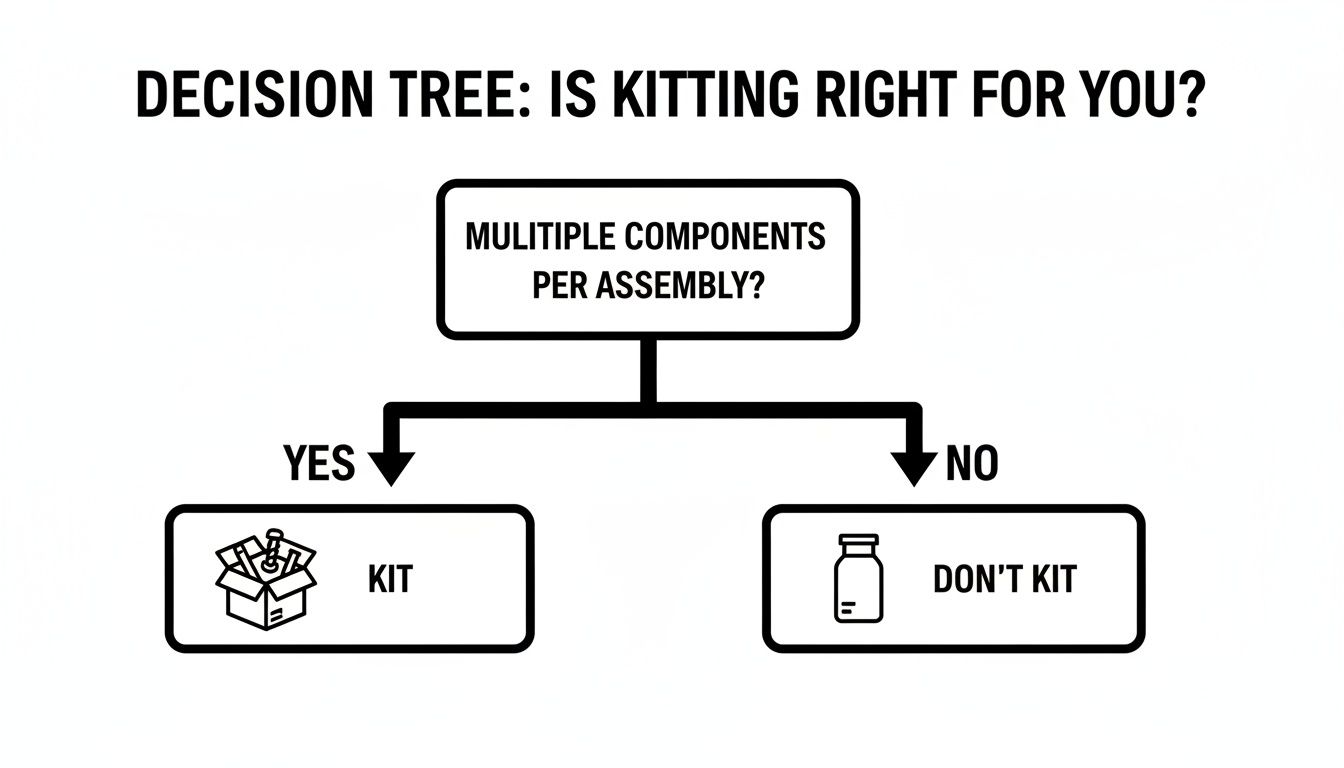
As the diagram shows, the core driver is pretty straightforward: if you’re dealing with multiple components for a single assembly, kitting can simplify a complex task into one manageable unit.
Kitting: The Foundational Process
Standard kitting is the most direct of the three. It’s the simple act of gathering all the parts needed for a specific product assembly and grouping them into a single package, under a single SKU. This is usually done on-demand, triggered directly by a production order or customer request.
The goal is to turn a multi-item pick list into a single grab. This small change has an immediate impact, boosting both efficiency and accuracy by making sure every required part is accounted for before it ever hits the assembly line.
Pre-Kitting: A Proactive Approach
Pre-kitting takes this a step further by preparing these kits before they are actually needed. Instead of waiting for an order to drop, teams build kits based on production forecasts or historical sales data, often during lulls in warehouse activity.
The biggest advantage here is readiness. When a production order comes through, the pre-assembled kits are already on the shelf, ready to be pulled. This can dramatically slash the lead time between the order and line-side delivery, creating a far more agile workflow that can better handle demand swings.
Pre-kitting decouples the kit assembly process from the immediate production schedule. This allows for better resource planning and ensures that a sudden surge in orders doesn't create a bottleneck at the kitting station.
Sequencing: The Pinnacle of Precision
Sequencing, often called Just-in-Sequence (JIS), is the most advanced and demanding of these strategies. It goes way beyond just grouping parts. It involves delivering complete, correct kits to the assembly line in the exact order they are required for production.
This is absolutely essential in environments with high product variability, like modern automotive manufacturing. Imagine a line where every car could have different features. A sequencing operation would deliver the kit for a blue dashboard with a premium sound system just as that specific car chassis arrives, followed immediately by the kit for a black dashboard with a standard radio for the very next car.
To clarify these differences, let’s look at them side-by-side. The following table breaks down the core attributes of each strategy, helping supply chain leaders see where their operation fits best.
Kitting vs Pre-Kitting vs Sequencing At a Glance
As you can see, sequencing isn’t for everyone. It demands tight, real-time integration between a supplier's inventory system and the manufacturer’s production schedule, often relying on EDI (Electronic Data Interchange) and ASN (Advanced Shipping Notice) data to keep everything in sync. While it’s complex to implement, the payoff is huge: minimal line-side inventory, less material handling, and the ability to support mass customization at scale.
The Real-World Impact of a Strategic Kitting Program
It's one thing to talk about kitting in theory, but its real value hits home when you see the results on the balance sheet. For OEMs and their Tier 1 suppliers, a smart kitting program isn't just a minor tweak—it's a direct solution to some of the most stubborn and expensive problems in production and fulfillment. The impact isn't just incremental; it’s a fundamental upgrade to how efficiently, accurately, and quickly you can operate.
A well-designed kitting strategy transforms your operation into something more predictable and, ultimately, more profitable. It gets right to the heart of operational waste, turning chaotic, multi-step processes into simple, repeatable tasks. This shift produces hard numbers and tangible business outcomes that strengthen the entire supply chain.
Drastically Reducing Labor Costs
Let's be blunt: one of the biggest line items in any warehouse budget is the cost of labor for order picking. This single activity can be a massive drain on resources. Industry surveys show that order picking can easily eat up 50–60% of total warehouse operating costs. Kitting takes a sledgehammer to that expense by consolidating dozens of individual picks into one.
Instead of paying an employee to wander through miles of aisles hunting for a long list of small parts, they just grab one pre-assembled kit. As you can discover from detailed industry reports, this simple change can slash pick-and-pack time per order by 20–40%. That’s a huge saving that really adds up when you're processing thousands of orders.
This reduction in "travel time" inside the warehouse is where the magic happens. Less time spent walking and searching means more time spent on work that actually adds value. Those saved labor hours can be put to use on other critical tasks, or the savings can flow straight to the bottom line, improving the cost-per-unit for your finished goods.
By transforming a complex, multi-part pick list into a single-SKU transaction, kitting effectively minimizes the most labor-intensive part of the fulfillment process. The result is higher throughput with the same or fewer labor hours.
Achieving Near-Perfect Order Accuracy
In a complex assembly environment, just one missing bolt or incorrect widget can bring a production line to a screeching halt. That means costly downtime and frustrating rework. Kitting acts as a powerful quality control checkpoint, moving the accuracy check upstream. Kits are put together in a controlled setting where every part can be verified, often with scanners and software, to ensure nothing is missed.
This proactive approach has a dramatic effect on accuracy. The benefits are clear and immediate:
- Reduced Rework: When fewer incorrect parts make it to the assembly line, you spend less time and money on corrections.
- Minimized Production Downtime: The line keeps moving because assemblers always have the complete, correct set of components right when they need them.
- Enhanced Customer Satisfaction: For direct-to-customer orders, kitting ensures the end user gets exactly what they ordered, which means fewer returns and support calls.
When each kit is barcoded and validated the moment it's created, you can push fulfillment accuracy toward 99.8–100%. That level of precision is next to impossible to sustain with traditional piece-picking, especially when you're operating at scale.
Accelerating Assembly and Fulfillment Times
Ultimately, any logistics improvement is about getting things done faster without sacrificing quality. Kitting delivers on this by simplifying tasks at two of the most critical points in the supply chain: the warehouse picking station and the manufacturing assembly line.
Think about it from the assembler's perspective. When a complete kit arrives at their station, they can get to work instantly. There's no time wasted searching for components, double-checking part numbers, or waiting for a runner to bring a missing piece. This creates a predictable, steady flow of materials that enables faster assembly cycles, allowing manufacturers to produce more units in the same amount of time. The result is a more competitive and resilient supply chain that can react quickly to shifts in customer demand.
Kitting in Action Across Key Manufacturing Sectors
It's one thing to talk about the theory of kitting, but seeing it work on a bustling factory floor is where its value really clicks. The abstract idea of grouping parts suddenly becomes a concrete solution to very real production headaches. When we look at demanding sectors like automotive, industrial machinery, and electronics, we can see how a smart kitting program transforms an assembly line from complex and chaotic to simple and precise.
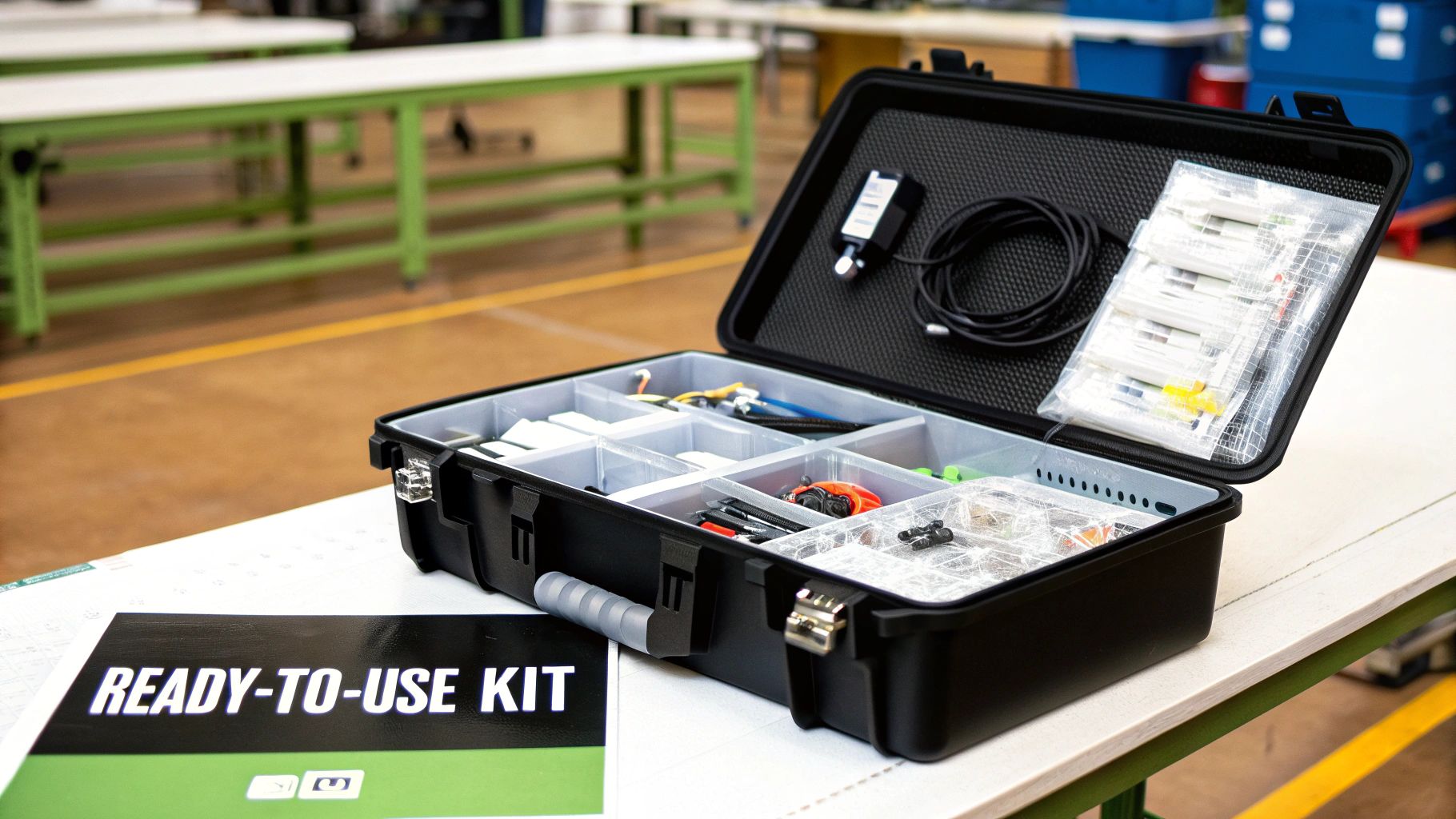
The fundamental principle is the same no matter the industry: swap out a long, messy list of individual components for a single, pre-verified kit. This simple change has a profound impact on the entire workflow, driving efficiency and accuracy right where it’s needed most.
Automotive Assembly Lines
The automotive world is probably the most classic and powerful example of kitting's impact. Modern cars are astonishingly complex, with a dizzying number of customization options. This level of variation turns traditional line-side inventory management into a logistical nightmare.
Think about an assembly station tasked with installing a car's door module.
- Before Kitting: The line operator has to pull dozens of separate parts from a sea of bins—different wire harnesses, clips, screws, a window motor, a speaker, and a side mirror. Every single pick is a chance for error. Did they grab the right harness for the premium sound system? Did they forget one tiny, but critical, clip?
- After Kitting: That same operator now receives a single tote with one barcode to scan. Inside is the complete "door module kit," with every part needed for that specific vehicle, identified by its VIN. The pick process becomes a single scan, and accuracy is built-in long before the kit ever arrives on the line.
This method is the backbone of Just-in-Sequence (JIS) manufacturing, where parts arrive at the assembly line in the precise order they’ll be used.
By delivering a complete, sequenced kit for a specific assembly task, automotive manufacturers dramatically reduce line-side clutter, minimize worker movement, and nearly eliminate the risk of assembly errors caused by incorrect or missing components.
Industrial and Agricultural Equipment
Building heavy machinery, from tractors to massive industrial generators, presents a similar set of challenges. These products are engineered for durability and involve incredibly complex hydraulic, electrical, and mechanical assemblies. Kitting is what brings order to that complexity.
A hydraulic assembly station for a combine harvester, for example, is a perfect candidate. Instead of trying to stock countless seals, O-rings, fittings, and hoses of all different sizes, the assembly team gets a "hydraulic assembly kit" tailored to the specific model they're building. This doesn't just make the initial build faster; it also makes aftermarket support a breeze.
When that machine needs service years down the road, a "repair kit" with all the necessary seals and gaskets can be shipped out as a single part number. If you want to dive deeper into these applications, you can explore detailed guides covering what is kitting in manufacturing and how it directly boosts production efficiency.
Electronics and Technology
In the high-speed electronics industry, kitting plays a dual role in both production and final product presentation. An installation kit for a server rack, for instance, might bundle the specific rack mounts, cage nuts, power cords, and network cables needed for that exact server model.
This ensures that a field technician arrives at a customer site with everything they need to get the job done right on the first visit, avoiding expensive delays and follow-up trips. It also elevates the customer experience by packaging accessories like chargers, cables, and adapters with the main device, delivering a complete, ready-to-use solution straight out of the box.
Building a Successful Kitting Operation from the Ground Up
Moving from the idea of kitting to actually doing it well requires a solid plan. Launching a kitting program is more than just putting items in a box; it's a fundamental operational shift. It demands careful planning, the right tech, and an obsession with precision. For any operations manager, building this capability means creating a well-oiled machine where every part, process, and piece of data works together perfectly.
The whole thing starts with a deep dive into your bill of materials (BOM). This is where you find the best candidates for kitting. You’re looking for assemblies with lots of components, common build patterns, or parts that are frequently ordered together. The goal is to pinpoint the opportunities that will give you the biggest bang for your buck in labor savings and accuracy.
Once you know what you’re going to kit, the next challenge is designing the physical workflow. A poorly laid-out workstation can kill any efficiency gains before you even start, quickly becoming a major bottleneck.
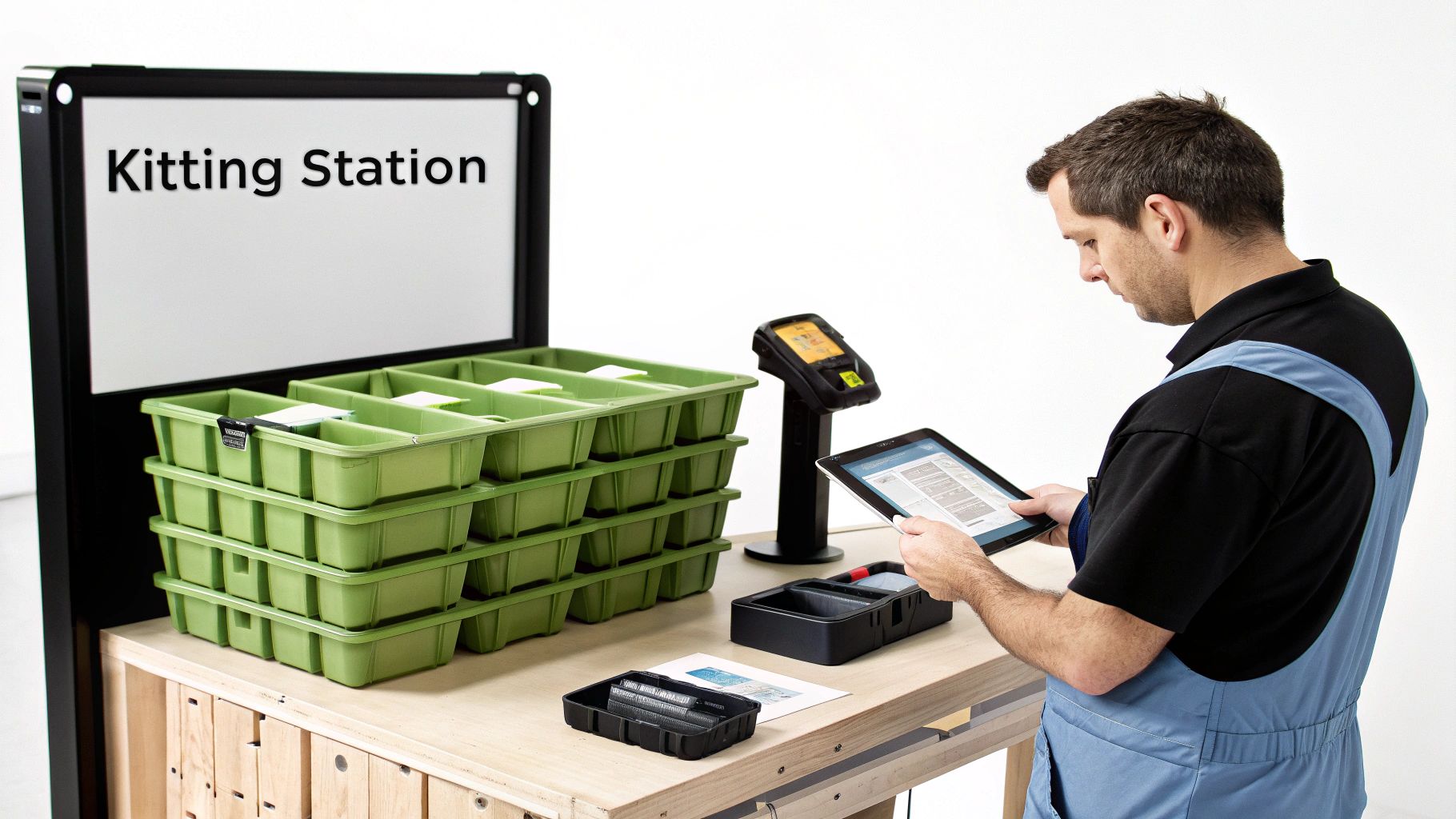
Designing an Efficient Kitting Workstation
A truly effective kitting station is built on the principles of lean manufacturing—it’s all about minimizing wasted motion and maximizing output. Every tool, bin, and scanner needs a home, allowing operators to build kits with a smooth, repeatable rhythm that becomes second nature.
Here’s what a high-performance workstation needs:
- Ergonomic Layout: Bins for the most-used components should be right at hand. This simple step reduces physical strain and wasted movement.
- Visual Instructions: Digital displays or simple, clear diagrams show the operator exactly what goes into each kit. This cuts down on guesswork and mistakes.
- Integrated Technology: Barcode scanners, scales for weight verification, and terminals linked to your ERP are non-negotiable. They are the bedrock of accuracy and traceability.
When you're setting up or improving a kitting line, especially if you’re thinking about automation, bringing in the right industrial automation system integrator is critical. Their expertise can help you weave together robotics, conveyors, and software into a truly optimized workflow.
The Technology Backbone: ERP and Data Exchange
Let's be clear: you can't run a serious kitting operation on spreadsheets and sticky notes. It demands a robust technology backbone to manage inventory, guarantee accuracy, and keep everything visible across the supply chain. Your Enterprise Resource Planning (ERP) system is the central nervous system for this entire process.
The ERP handles the complex inventory gymnastics of kitting. When a kit is assembled, the system has to perform a crucial transaction: it deducts all the individual components from inventory and simultaneously adds one brand-new, finished kit SKU. This is the only way to keep your inventory counts accurate in real-time and prevent stockouts of a critical part.
A properly configured ERP system provides the component-level traceability that is essential for quality control. If an issue is ever discovered with a specific batch of a component, you can instantly identify every kit that contains a part from that batch.
Beyond your own four walls, seamless data exchange with your partners is just as important. Think of Electronic Data Interchange (EDI) and Advanced Shipping Notices (ASN) as the digital handshakes that connect you to suppliers and customers. This automated communication ensures everyone is working from the same up-to-the-minute information on orders and inventory, which is the absolute foundation of advanced models like Just-in-Sequence (JIS) supply.
Kitting also pays off big in shipping. As carriers have increasingly leaned on dimensional-weight pricing, smart packaging has become a major lever for cost savings. Simply consolidating multiple items into a single, right-sized carton can cut shipping spend by 10–25% per order. Fulfillment providers have even found that bundling items into kits not only uses less packaging material but can also lower the total number of packages shipped by 30–50% for certain programs.
By bringing all these physical and digital elements together, you don't just create an efficient kitting operation—you build one that's resilient and ready to scale.
When Outsourcing Kitting to a 3PL Partner Makes Sense
Deciding whether to handle kitting in-house or bring in a third-party logistics (3PL) partner is a huge strategic fork in the road. While keeping everything under your own roof feels like the safe bet, there are some very clear signals that outsourcing is the smarter, more scalable move.
Catching these signs early can save you from hitting major operational walls and help your company grow without needing a massive cash injection upfront.
The decision really boils down to three things: space, labor, and expertise. When your warehouse is bursting at the seams and you can't imagine carving out a dedicated area for a kitting line, that's a red flag. The same goes for when you're constantly struggling to find and train people to build kits correctly. A 3PL already has the trained staff and dedicated real estate ready to go.
Scaling Operations and Managing Variability
One of the biggest triggers for outsourcing is the need to scale—fast. Maybe you’re launching a new product, gearing up for a seasonal rush, or you just landed a massive contract. These events can swamp an in-house team almost overnight, and catching up often means major disruptions and costs.
A 3PL partner gives you that flexibility on demand. They have the people, the space, and the systems to handle those spikes without missing a beat. This lets a manufacturer ramp up or dial back kitting operations without the pain of hiring temp workers or buying equipment that might just collect dust later.
Partnering with a 3PL completely changes your cost structure. It turns what would be a heavy capital investment into a predictable operational expense. You gain the agility to respond to the market without being anchored by fixed assets.
Leveraging Specialized Expertise and Technology
Beyond just providing bodies and square footage, a good 3PL brings deep process knowledge and technology that's incredibly expensive and time-consuming to build yourself. Logistics is their entire world. Their workflows are already optimized for maximum efficiency and near-zero errors because that's how they stay in business.
They’ve also made the big investments in Warehouse Management Systems (WMS) and ERP integrations that are non-negotiable for tight inventory control and part traceability. This expertise is a game-changer, especially in complex supply chains. A 3PL can offer a whole menu of services, from basic kit assembly to highly sophisticated Just-in-Sequence (JIS) deliveries right to the assembly line. For a deeper look at the strategic benefits, check out these insights into outsourcing logistics management.
An experienced 3PL also provides comprehensive contract packaging services, which is much more than just putting parts in a box. This can cover everything from designing custom packaging to final assembly and labeling, ensuring your product is put together correctly and looks professional. By tapping into this expertise, you get a partner whose sole focus is perfecting a critical piece of your supply chain, freeing up your team to concentrate on what they do best: innovation and production.
Your Kitting Questions Answered
Even when you've got the basics down, a few practical questions always pop up when it's time to actually put a kitting program into practice. Let's tackle some of the most common ones I hear from clients to clear up the details and make sure your team is ready to go.
Getting these points straight from the beginning helps everyone get on the same page and launch an effective kitting operation right out of the gate.
How Does Kitting Affect Inventory Management?
This is a big one. Kitting adds a new layer to your inventory transactions, and it has to be managed meticulously. When a kit is assembled, your system has to do two things at once: deduct all the individual component SKUs and, in the same breath, add one new kit SKU to your stock.
You absolutely need a solid ERP or WMS to automate this. If you try to manage it manually, you’re asking for trouble. You'll inevitably create “phantom inventory”—where your system says you have components on the shelf that have actually been used in a kit. That leads directly to surprise stockouts and painful production delays.
Think of it this way: proper inventory management is the bedrock of a successful kitting program. Each kit becomes its own traceable unit, which actually simplifies stock counts and gives you better visibility. But that only works if the system transactions behind the scenes are flawless.
What Is the Difference Between a Kit and a Bill of Materials (BOM)?
This distinction trips people up all the time, but it's actually quite simple.
- A Bill of Materials (BOM) is the recipe. It’s the master list in your system that details every single raw material, sub-assembly, and part needed to build a final product.
- A Kit is the actual batch of ingredients you’ve pulled from that recipe for one specific job. It's the physical bundle of parts, grouped together under a single new part number (SKU), ready to be sent to the line or shipped out.
So, the BOM tells you what you need in theory, while the kit is the tangible bundle of what you get in practice.
Can Kitting Be Used for Both Manufacturing and eCommerce?
Yes, definitely. The application looks a little different, but the core principles of boosting efficiency and reducing errors hold true for both worlds.
- In manufacturing, kitting is all about feeding the assembly line. You’re gathering all the necessary components for a specific production run to eliminate the time workers waste searching for parts. The focus is on production velocity.
- In eCommerce fulfillment, kitting is about bundling products that customers often buy together. The goal here is to speed up the pick-and-pack process so you can get orders out the door faster.
A great eCommerce example is a "new laptop bundle." That kit might include the laptop, a wireless mouse, and a case, all pre-packaged under one SKU. When an order comes in, the warehouse worker just grabs one box instead of three. It’s a versatile strategy that adds value all across the supply chain.
Ready to unlock the efficiency and precision of a professionally managed kitting program? Wolverine Assemblies, LLC provides expert kitting, sequencing, and sub-assembly services tailored to the demanding needs of OEM and Tier 1 suppliers. Let us stabilize your supply chain and scale your production.
Explore our end-to-end solutions at https://www.wolverine-llc.com.
Subscribe to our weekly newsletter