.png)
Finding the Best Warehousing Partner: 7 Options for OEM & Tier 1 Leaders in 2026
Discover the best warehousing solutions for OEMs and Tier 1 suppliers. This guide reviews 7 top providers to help you stabilize operations...

For OEM and Tier 1 supply chain leaders, selecting a warehousing and 3PL partner is a high-stakes decision that directly impacts production stability, cost control, and scalability. The difference between a transactional vendor and a strategic partner lies in their ability to integrate seamlessly with your systems, provide value-added services like kitting and sequencing, and uphold rigorous quality standards. A misaligned partnership can lead to production disruptions, quality escapes, and unforeseen costs, making the evaluation process critical. Implementing effective contractor management strategies from the outset is essential for establishing clear expectations and ensuring long-term operational success.
This guide moves beyond generic advice to offer a structured framework for identifying the best warehousing solution for your unique operational needs. We will analyze seven distinct platforms and service providers, from specialized OEM-focused partners like Wolverine Assemblies to flexible on-demand network providers like Flexe and Stord. The goal is to equip you with the specific, actionable insights needed to make an informed decision that strengthens your supply chain resilience.
Each option in this comprehensive roundup includes a detailed breakdown of its core offerings, ideal use cases, and key capabilities. You will find screenshots to visualize the platforms and direct links for further investigation. We will dissect their suitability for specific challenges, such as managing inventory overflow, launching new production programs, or improving total landed cost models, allowing you to confidently select a partner that truly aligns with your strategic objectives.
1. Wolverine Assemblies, LLC
Wolverine Assemblies, LLC stands out as a premier partner for OEMs and Tier 1 suppliers seeking more than just storage. This Midwest-based 3PL and light-manufacturing specialist offers a sophisticated blend of warehousing, precision assembly, and end-to-end supply chain services, making it a powerful choice for organizations aiming to de-risk launches, improve throughput, and lower total landed costs. Their entire operational model is engineered to meet the stringent demands of modern manufacturing, positioning them as a top contender for the best warehousing partner in the region.
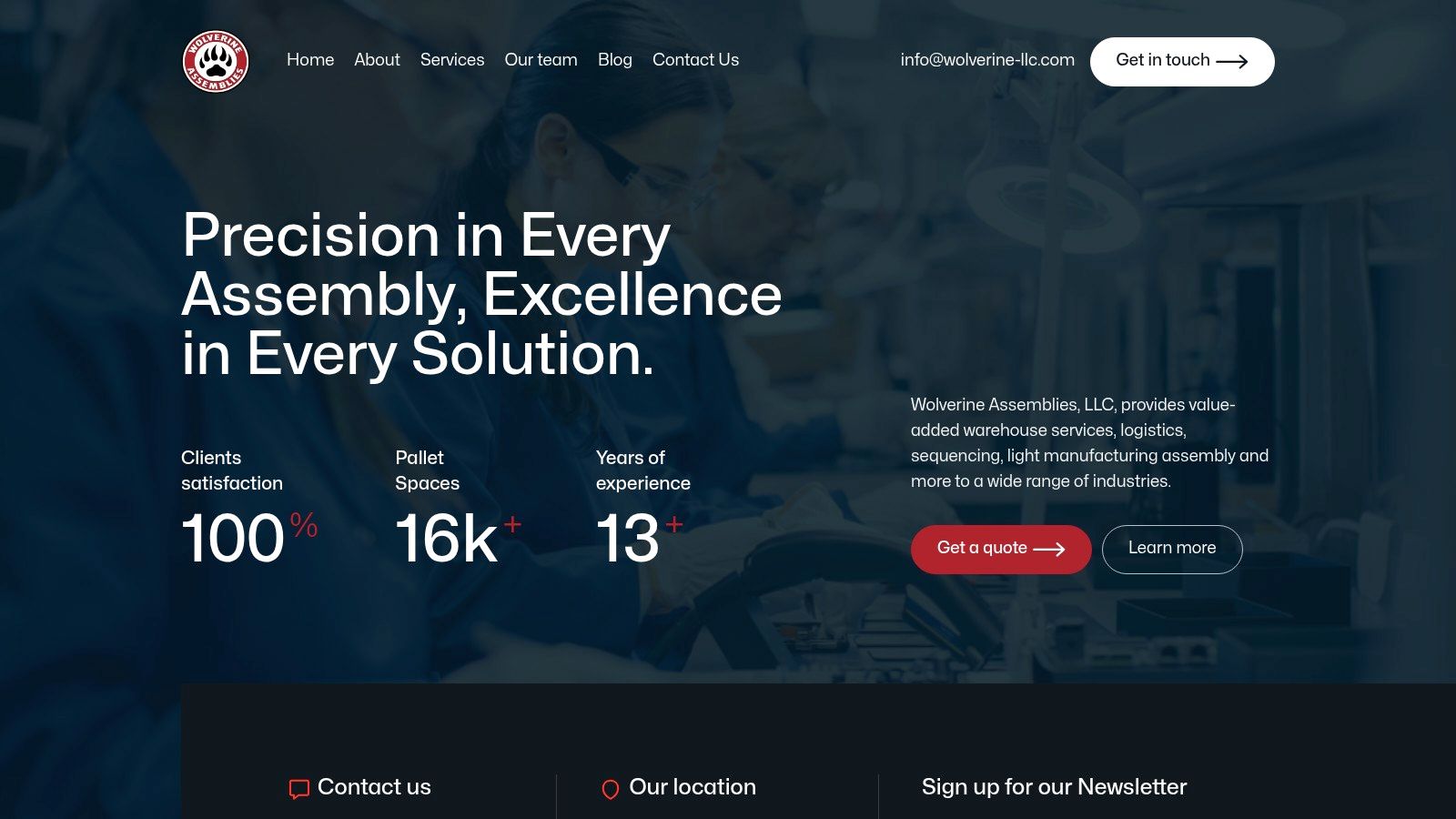
From their 200,000+ sq. ft. facility in Wixom, Michigan, Wolverine combines expansive physical capacity with robust technological integration. This isn't just a space to hold inventory; it's a strategic hub for value creation.
In-Depth Analysis of Core Competencies
Wolverine's strength lies in its ability to seamlessly integrate with complex, high-stakes supply chains. The company has built its infrastructure and processes around the specific needs of automotive, agricultural, energy, and industrial sectors, where precision, compliance, and reliability are non-negotiable.
Key capabilities include:
- OEM-Ready Systems: Full integration with Plex ERP and comprehensive EDI/ASN capabilities ensure flawless data exchange. This eliminates manual processes and reduces the risk of errors in order fulfillment, shipping notices, and inventory management, creating a single source of truth between partners.
- Expansive and Flexible Capacity: With over 16,000 pallet positions, the facility is equipped to handle significant warehousing needs. The space is strategically designed to support both high-volume storage and complex, value-added workflows simultaneously.
- Advanced Value-Added Services: Wolverine excels in services that go beyond basic storage. These include intricate sub-assembly, just-in-time (JIT) kitting, and in-sequence parts delivery directly to manufacturing lines. They also manage component consolidation, rigorous testing and inspection, and international supply chain logistics. For a deeper dive into how these services drive efficiency, you can explore insights on value-added warehousing on wolverine-llc.com.
- Rigorous Quality and Launch Discipline: A culture of continuous improvement and lean workflows is embedded in their operations. This focus, combined with a 100% client satisfaction emphasis and a safety-first culture, ensures that product launches are executed flawlessly and ongoing operations remain stable and compliant.
Strategic Differentiators and Use Cases
Beyond its core services, Wolverine brings unique strategic advantages. As a certified Minority Business Enterprise (MBE), it helps clients meet their supplier diversity goals without compromising on quality or capability. Furthermore, a formal collaboration with Gentex Corporation significantly extends its electronics manufacturing capabilities, a critical asset for clients in the automotive and industrial tech spaces.
Practical Summary and Next Steps
Pricing: Wolverine does not publish pricing online. This is typical for providers offering highly customized solutions. To get a quote, you must contact them directly via their website, email (info@wolverine-llc.com), or phone (+1 248-863-2339).
Pros:
- Systems and processes are pre-built for OEM/Tier 1 integration.
- Extensive value-added services reduce supply chain complexity.
- Proven 13+ year track record with strong client testimonials.
- MBE certification and unique electronics capabilities.
Cons:
- Pricing requires a direct inquiry, slowing initial comparisons.
- Single-facility focus may not be ideal for global, multi-site distribution networks.
For supply chain leaders in the Midwest seeking a partner that offers more than just square footage, Wolverine Assemblies, LLC presents a compelling, high-value proposition. It is an ideal choice for stabilizing regional operations, outsourcing complex assemblies, and ensuring new product launches are executed with precision.
Website: https://www.wolverine-llc.com
2. Flexe
Flexe distinguishes itself as an on-demand warehousing marketplace, offering a network model that provides significant agility for enterprise-level supply chains. Unlike traditional third-party logistics (3PL) providers that require long-term leases, Flexe operates on a transactional, "pay-as-you-go" basis. This model allows original equipment manufacturers (OEMs) and Tier 1 suppliers to secure storage, distribution, and fulfillment capacity rapidly across North America without the associated capital expenditures.
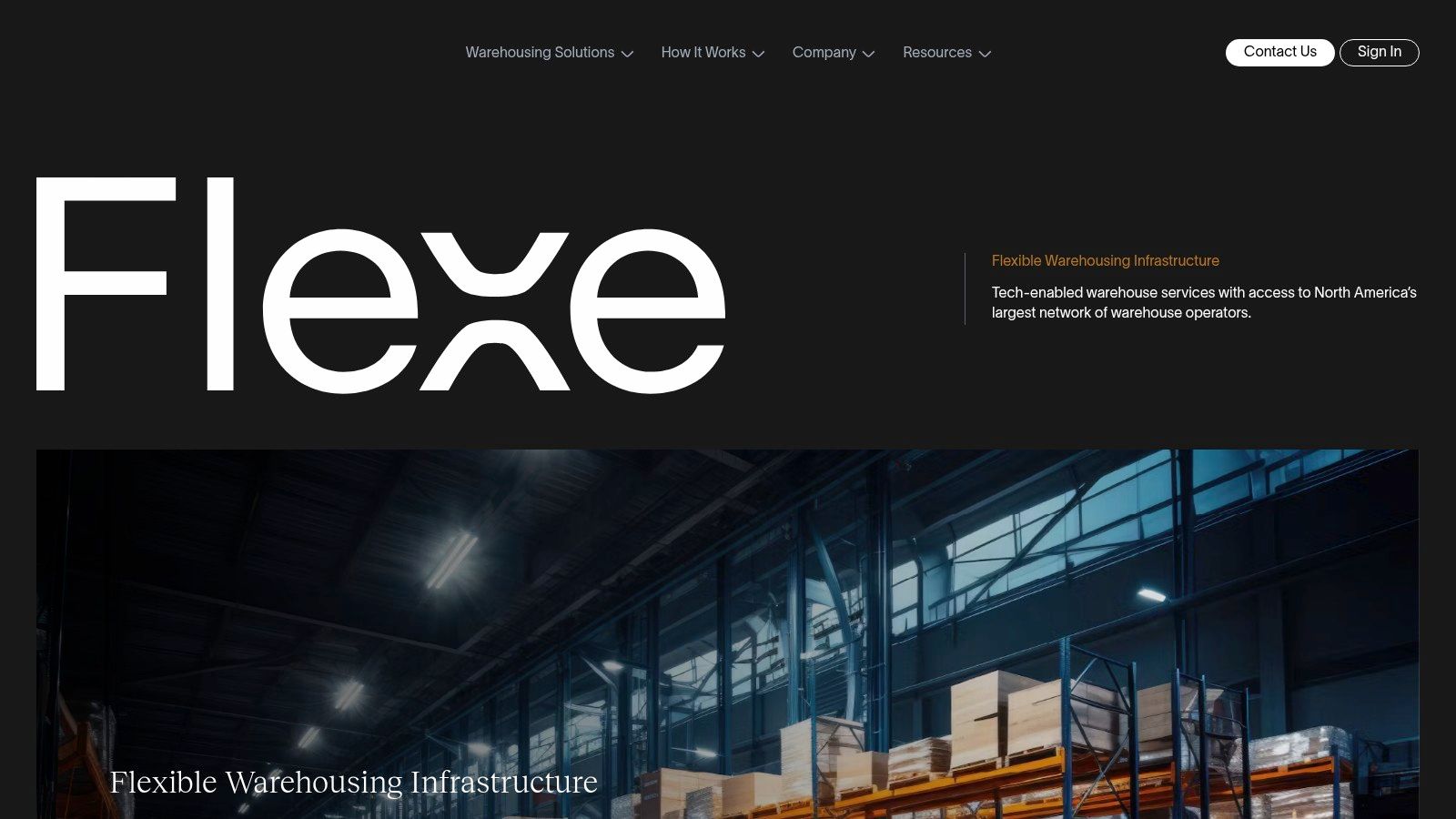
The platform is engineered for speed and scale, making it one of the best warehousing solutions for managing demand volatility. It's particularly effective for handling seasonal surges, buffering against supply chain disruptions, or launching products in new markets with minimal lead time. The core value proposition is the unification of over 800 warehouse operators under a single technology platform and contract, streamlining what would otherwise be a complex procurement and integration process.
Key Features and Strategic Application
Flexe’s technology-first approach provides a centralized "control tower" for managing logistics operations. Users can monitor inventory levels, track order fulfillment, and manage service-level agreements (SLAs) across multiple independent warehouse providers through a single interface. This is a crucial advantage for maintaining operational consistency and visibility.
Primary Use Cases for Industrial & Automotive Sectors:
- Inventory Overflow: Quickly add warehousing nodes to manage excess parts or finished goods during demand lulls or production overruns.
- Forward-Deployed Inventory: Position critical components or service parts closer to manufacturing plants or end customers to improve lead times and meet on-time in-full (OTIF) targets.
- Pop-up Fulfillment Centers: Establish temporary distribution centers in weeks, not months, to support new product launches or short-term retail distribution programs.
The platform's single integration point via API or EDI is a significant technical benefit. It allows companies to connect their existing ERP or WMS systems once and gain access to the entire network, drastically reducing the typical IT lift required when onboarding a new logistics partner.
Expert Tip: When engaging with Flexe, be prepared with detailed operational data, including SKU profiles, inbound/outbound volume forecasts, and specific handling requirements (e.g., kitting, light assembly). This information is critical for them to accurately quote a program and match you with the most suitable network partners.
Pricing and Operational Considerations
Flexe does not offer a public rate card; pricing is bespoke and quoted on a per-program basis. The model is transactional, meaning you only pay for the capacity and services you consume. While this offers flexibility, costs can fluctuate with market demand and the specific capabilities required.
While the network is vast, sourcing highly specialized services like foreign trade zone (FTZ) or bonded storage may be more limited and command a premium. For OEMs and suppliers considering this model, it’s important to understand the distinctions between an asset-based 3PL and a network-based platform like Flexe. You can explore a deeper analysis of the differences between these third-party logistics provider models.
Website: https://www.flexe.com
3. Stord
Stord defines itself as a "cloud supply chain" provider, uniquely bundling a nationwide fulfillment network with proprietary logistics software. The platform integrates warehousing, a warehouse management system (WMS), an order management system (OMS), and last-mile parcel optimization into a single offering. Following its strategic acquisition of Ware2Go, Stord significantly expanded its physical footprint and high-volume package throughput, positioning it as a powerful solution for B2B and B2C brands requiring deeply integrated technology and physical capacity.
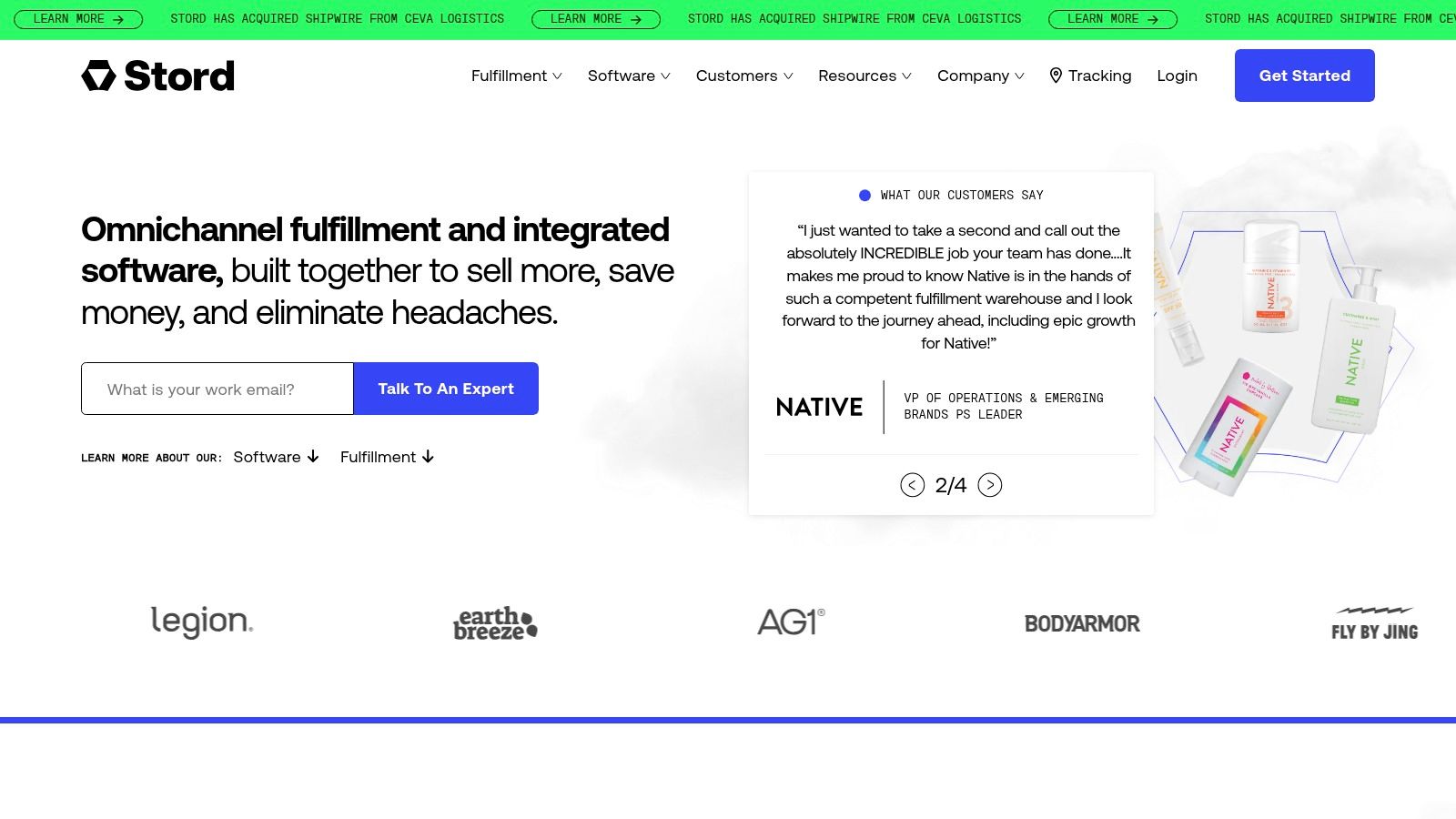
The platform is designed to provide end-to-end visibility and control, from inventory intake to final delivery. This makes it one of the best warehousing choices for companies looking to outsource both the physical execution and the technological backbone of their logistics. By combining its growing physical network with a comprehensive software suite, Stord aims to eliminate the common data silos and integration challenges that arise when using separate providers for warehousing and technology.
Key Features and Strategic Application
Stord’s core value is its unified model, where a single partner provides both the operational services and the software to manage them. Its enterprise-level WMS, Stord One Warehouse, can be used independently in a company's own facilities or as the operating system for fulfillment services within Stord's network. This flexibility allows for a phased approach to outsourcing or a hybrid logistics model.
Primary Use Cases for Industrial & Automotive Sectors:
- Omnichannel Fulfillment: Manage complex inventory flows for direct-to-consumer parts sales alongside bulk B2B distribution to retailers or assembly plants.
- Distributed Inventory: Leverage a large network of facilities to position service parts and components for 1-2 day ground delivery, meeting demanding customer SLAs.
- Technology-Led Operations: Implement a modern WMS to gain granular visibility, improve order accuracy (with reported metrics of 99.9%), and track operational KPIs in real-time.
The integrated software suite is a significant advantage, providing a single source of truth for inventory, orders, and shipments across all channels. This unified data layer simplifies reporting and enables more sophisticated supply chain planning and optimization.
Expert Tip: When evaluating Stord, focus on the total cost of ownership. While they provide an integrated solution, it's critical to benchmark the combined cost against sourcing a standalone WMS and a separate 3PL partner. Ask for detailed demos of the software's reporting and analytics capabilities to ensure it meets your specific KPI tracking needs.
Pricing and Operational Considerations
Stord does not publish standardized pricing; all programs are custom-quoted based on volume, complexity, and specific service requirements. The model is built for scale, and pricing will reflect the comprehensive nature of its integrated technology and fulfillment services.
While the company has proven its high-volume throughput capabilities, its historical focus is skewed toward e-commerce and omnichannel retail. OEMs and Tier 1 suppliers with highly specialized industrial or plant-adjacent needs should conduct thorough due diligence to confirm the network's capabilities for services like kitting, light assembly, or just-in-sequence delivery. The benefits of a modern warehouse management system are a key part of Stord's value proposition.
Website: https://www.stord.com
4. Flowspace
Flowspace positions itself as a tech-forward logistics network, providing on-demand warehousing and omnichannel fulfillment services. The platform connects businesses with a certified network of over 150 warehouse locations across the United States. Its core strength lies in its proprietary software layer, a Fulfillment Management System that standardizes operations and provides real-time visibility across disparate facilities. This makes it a strong contender for companies seeking flexible capacity and robust B2B or direct-to-consumer (DTC) replenishment capabilities.
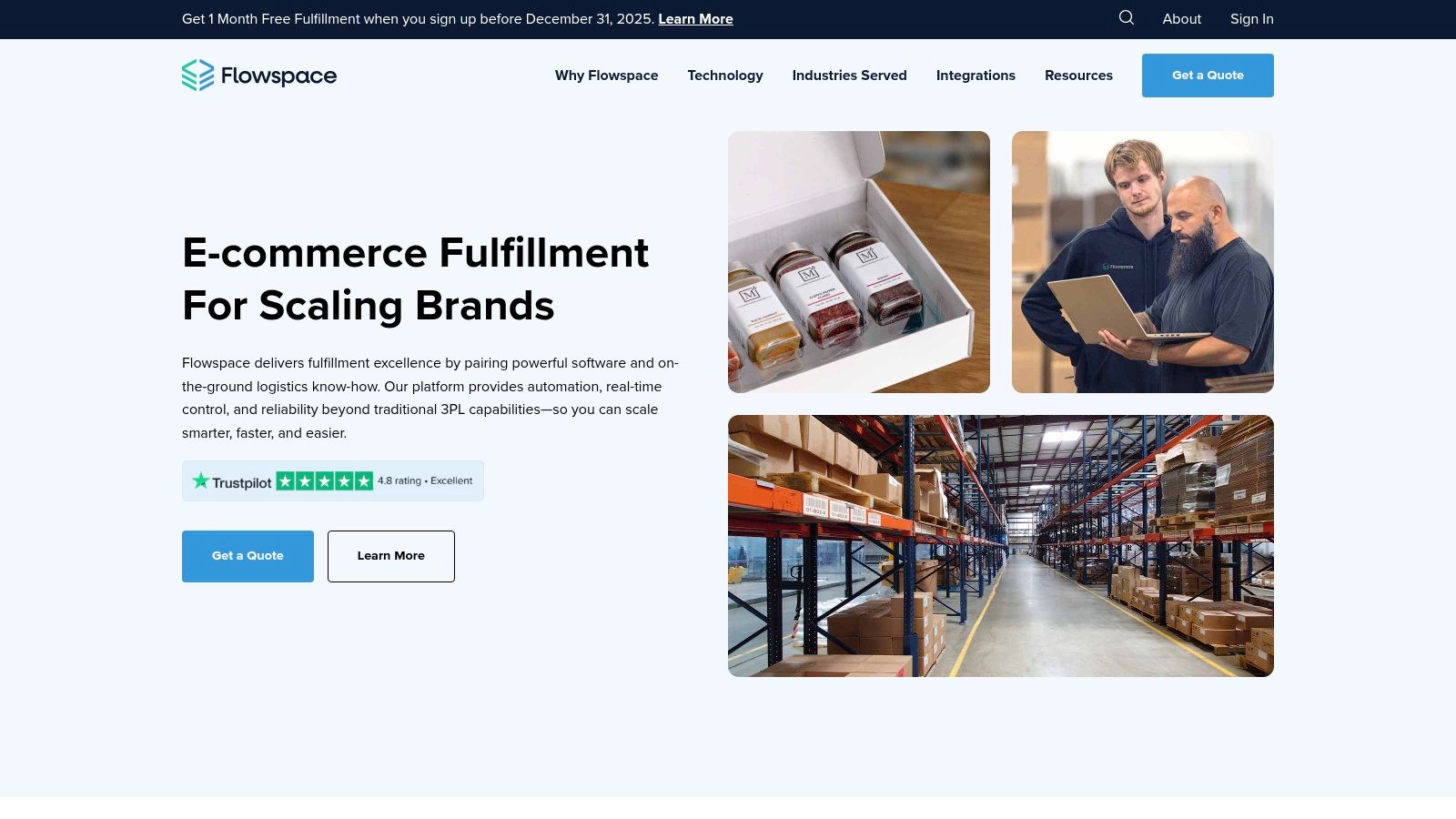
Unlike traditional 3PLs that may rely on varied, legacy systems, Flowspace ensures every partner in its network operates on its centralized WMS. This technology-first approach is key to its value proposition, offering a single point of integration and control for inventory, orders, and analytics. It is one of the best warehousing options for businesses that need to rapidly deploy inventory nationwide without the complexity of managing multiple 3PL relationships and system integrations. The model supports fast spin-ups and scales easily for both seasonal demand and long-term distribution strategies.
Key Features and Strategic Application
Flowspace’s proprietary software acts as a centralized command center, unifying inbound receiving, inventory management, and outbound order processing. This allows supply chain leaders to monitor performance and inventory levels across the entire network through a single dashboard, enforcing consistent KPIs and operational standards regardless of the physical warehouse location.
Primary Use Cases for Industrial & Automotive Sectors:
- Decentralized Inventory: Position parts, components, or finished goods in multiple markets simultaneously to reduce shipping times and costs for B2B replenishment or dealer networks.
- Omnichannel Fulfillment: Manage complex inventory flows for both wholesale distribution and direct-to-consumer after-market parts sales from a single inventory pool.
- Rapid Network Expansion: Quickly establish a warehousing presence in new regions to support market entry or buffer against regional supply chain disruptions.
The software-first model significantly accelerates the onboarding process. A company can connect its ERP or e-commerce platform to Flowspace's system once and gain access to the entire pre-vetted network, bypassing lengthy, one-off IT projects for each new warehouse.
Expert Tip: When evaluating Flowspace, focus on the specific service level agreements (SLAs) for receiving, order processing, and shipping accuracy at the individual warehouse locations you are considering. Since it's a network model, operational excellence can vary between nodes, and clarifying these KPIs upfront is critical.
Pricing and Operational Considerations
Flowspace operates on a quote-based model, with pricing tailored to specific storage, fulfillment, and value-added service requirements. Public pricing is not available. The platform's flexibility often includes month-to-month and per-pallet storage options in many of its locations, offering a lower-commitment alternative to long-term leases.
While the network is extensive, the availability of specialized services such as cold chain storage, hazmat handling, or complex kitting and assembly can differ significantly from one site to another. It is essential for prospective users to conduct thorough due diligence on the specific capabilities of the warehouses being proposed for their program. The platform is ideal for standard pallet-in/pallet-out operations and e-commerce fulfillment, but highly customized needs require careful vetting.
Website: https://flow.space
5. Amazon Warehousing & Distribution (Supply Chain by Amazon)
Amazon Warehousing & Distribution (AWD) represents a significant expansion of Amazon's logistics capabilities beyond its well-known Fulfillment by Amazon (FBA) service. As a core component of "Supply Chain by Amazon," AWD offers a bulk storage and distribution solution designed to streamline inventory management for sellers, including OEMs and suppliers who sell through multiple channels. It operates on a pay-as-you-go basis, providing upstream storage that can automatically replenish FBA centers or distribute to non-Amazon sales channels.
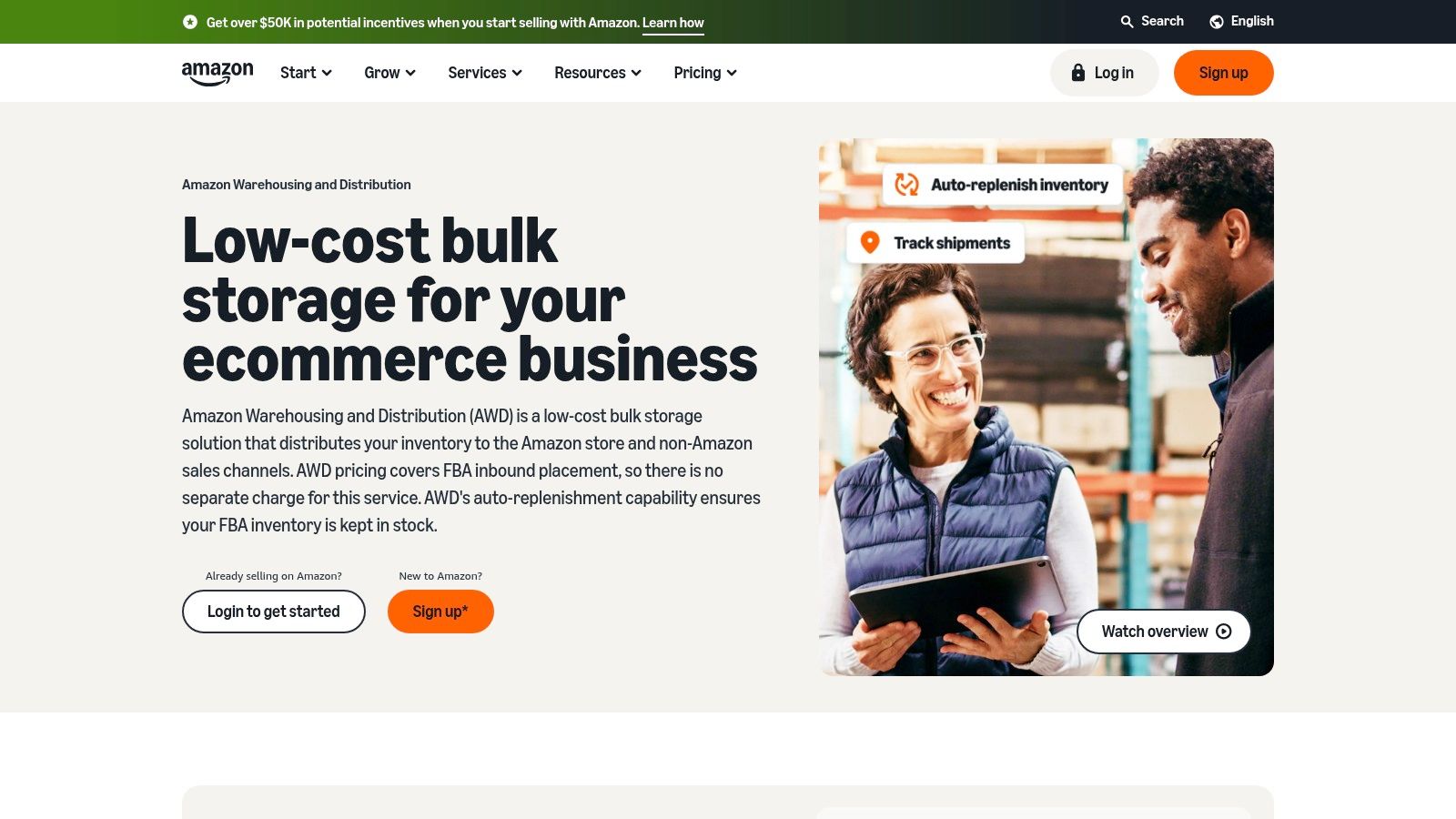
The platform’s key distinction is its deep integration into the Amazon ecosystem. For companies selling service parts or finished goods on the Amazon marketplace, AWD offers a cohesive, single-pool inventory system. This is one of the best warehousing strategies for sellers looking to optimize their Prime eligibility and reduce stockouts. By using Amazon's demand models, the system automatically sends the right amount of inventory to FBA fulfillment centers, potentially lowering storage fees and improving in-stock rates.
Key Features and Strategic Application
AWD is engineered to unify inventory management across diverse sales channels. Its technology enables a single stock of goods to serve Amazon FBA, wholesale partners, retail stores, and other e-commerce platforms through its Multi-Channel Distribution (MCD) feature. This consolidation can significantly reduce the complexity and total inventory carrying costs associated with managing separate stock for each channel.
Primary Use Cases for Industrial & Automotive Sectors:
- Unified B2C/B2B Inventory: Manage a single pool of aftermarket parts or components that can be sold directly to consumers via Amazon and also distributed to repair shops or other business customers.
- FBA Inbound Optimization: Use AWD as an upstream buffer to automatically feed FBA centers, ensuring consistent Prime availability for critical SKUs without incurring FBA’s higher per-unit storage costs for bulk inventory.
- Multi-Channel Fulfillment: Leverage Amazon’s logistics network to fulfill orders from a company’s own website or other marketplaces, consolidating outbound operations under one provider.
The platform leverages Amazon's managed transportation for inbound shipments, creating a streamlined, end-to-end logistics flow from the factory to the end customer. This integration simplifies logistics coordination and can offer competitive transportation rates.
Expert Tip: Before committing inventory to AWD, thoroughly review the program's product eligibility requirements and fee structure within Seller Central. Certain product categories or dimensions may be restricted, and understanding the processing, transportation, and storage fees is crucial for accurate cost modeling.
Pricing and Operational Considerations
AWD uses a pay-as-you-go pricing model, with specific rates for storage, processing, and transportation available within Amazon Seller Central. While the official site advertises benefits like no holiday surcharges, all fees are subject to change and must be verified. A Professional Amazon seller account, which carries a monthly subscription fee, is a prerequisite for using the service.
The primary advantage is leveraging Amazon’s immense scale and sophisticated logistics technology. However, this comes with less operational control and customization compared to a traditional 3PL. For suppliers with complex kitting, sequencing, or specific compliance needs, the standardized nature of AWD may be a limiting factor. Rate transparency also requires careful review directly within the Seller Central interface.
Website: https://sell.amazon.com/programs/warehousing
6. Thomasnet – Warehousing Services Directory
Thomasnet distinguishes itself not as a direct logistics provider but as North America’s most extensive industrial sourcing platform. For supply chain leaders, it serves as a powerful initial research and vetting tool, offering a comprehensive directory of over 1,000 warehousing and distribution service providers. This platform is less about on-demand capacity and more about strategic, compliance-driven procurement for long-term partnerships.
The platform is engineered for deep discovery and qualification, making it one of the best warehousing resources for OEMs and Tier 1 suppliers with strict compliance mandates. Its true value lies in the granular filtering capabilities, allowing users to identify potential partners based on critical criteria like certifications (ISO 9001, IATF 16949), diversity ownership status (woman-owned, veteran-owned), and specific industry experience. This dramatically streamlines the initial request for information (RFI) and request for proposal (RFP) stages of procurement.
Key Features and Strategic Application
Thomasnet’s core function is to facilitate the connection between industrial buyers and qualified suppliers. The platform provides detailed company profiles, capability summaries, and direct contact tools, allowing users to build a qualified shortlist of potential warehousing partners before engaging in direct negotiations. The directory model empowers users to control the procurement process from start to finish.
Primary Use Cases for Industrial & Automotive Sectors:
- Compliance-Driven Sourcing: Quickly identify and shortlist 3PLs that hold essential automotive (IATF 16949) or quality (ISO) certifications required for supply chain integration.
- Supplier Diversity Initiatives: Filter for and engage with providers that meet specific diversity criteria, helping to fulfill corporate social responsibility and supplier diversity program goals.
- Regional Partner Discovery: Pinpoint warehousing services in specific geographic corridors, such as near key manufacturing plants in the Midwest, to optimize inbound logistics and just-in-time delivery.
Unlike a managed marketplace, Thomasnet allows for direct, off-platform communication. This is a significant benefit for companies with established procurement workflows who prefer to manage negotiations and contracting themselves, rather than through an intermediary platform.
Expert Tip: Use Thomasnet’s "Supplier Discovery" tool to create and save shortlists of potential partners. When creating an RFI through the platform, be explicit about your core requirements like EDI/API integration capabilities, specific value-added services (e.g., kitting, sequencing), and expected volume to receive the most relevant responses.
Pricing and Operational Considerations
Thomasnet is free to use for buyers; its revenue model is based on supplier advertising and enhanced profile listings. All pricing and contract negotiations occur directly between the buyer and the warehousing provider. This means buyers must conduct their own due diligence, qualification, and rate negotiation for every shortlisted vendor.
While the directory offers unparalleled breadth, the depth of information can vary significantly from one supplier profile to another. Some listings are highly detailed, while others may be sparse, requiring more direct follow-up. For industrial buyers, the platform is an indispensable starting point for building a competitive and compliant bidding process for warehousing services.
Website: https://www.thomasnet.com
7. Warehouse Exchange
Warehouse Exchange operates as a transactional, real estate-style marketplace designed for sourcing flexible warehouse space. It directly connects businesses needing storage with warehouse operators offering available capacity, ranging from individual pallet positions to small- and mid-bay units. This model is particularly effective for organizations requiring a straightforward, rapid solution for inventory overflow, project staging, or seasonal demand without the complexity of a full-service 3PL agreement.
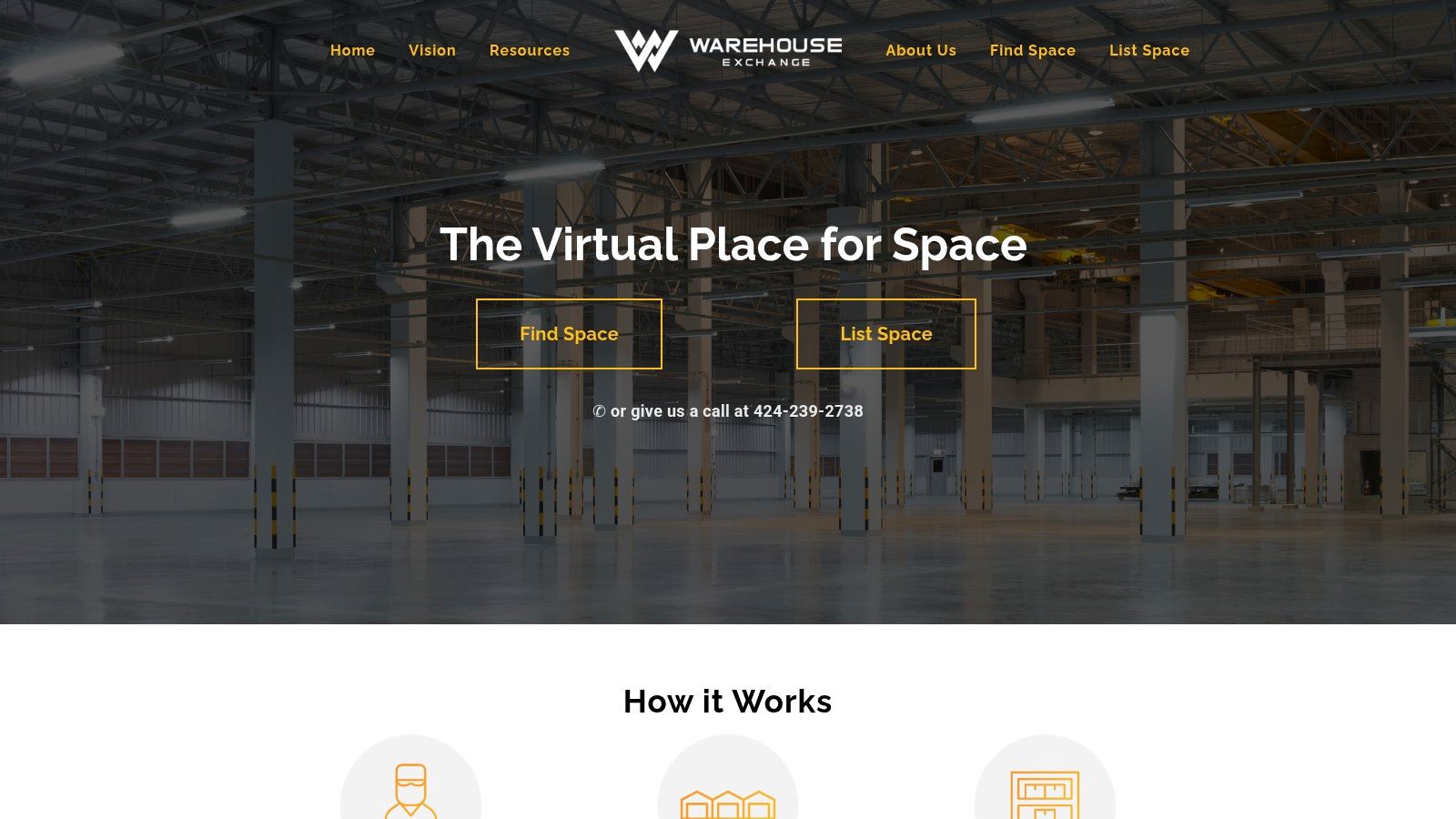
The platform’s core strength is its transparency and speed. Listings often include detailed specifications such as square footage, dock door availability, security features, and included amenities like forklift access or racking. This granular detail allows supply chain leaders to quickly identify and secure suitable space. By handling agreements and payments on-platform, Warehouse Exchange significantly reduces the typical time-to-occupancy, making it one of the best warehousing tools for tactical, short-term space acquisition.
Key Features and Strategic Application
The platform functions like a commercial real estate search engine but is purpose-built for warehousing, with a focus on flexible, shorter-term commitments. Users can filter listings by metro area and specific operational requirements, streamlining the initial discovery phase that often consumes significant time in traditional procurement processes. The ability to scale space up or down provides crucial agility for managing dynamic inventory levels.
Primary Use Cases for Industrial & Automotive Sectors:
- Buffer Stock & Overflow: Secure space near manufacturing facilities to hold excess raw materials, components, or finished goods during production spikes or demand lulls.
- Project-Based Staging: Find temporary locations to stage equipment, parts, or materials for specific projects, such as plant maintenance, line retooling, or new equipment installations.
- Market Entry Testing: Establish a low-commitment physical footprint in a new geographic market to test distribution strategies before committing to a long-term lease.
The end-to-end digital workflow, from initial search to final payment, is a key differentiator. It simplifies the legal and financial aspects of securing space, allowing teams to move faster than they could through conventional broker-led searches.
Expert Tip: Treat Warehouse Exchange as a tool for securing 'space-as-a-service'. While some listings offer basic material handling, complex value-added services are not the norm. Clearly define whether you need just space or a combination of space and operational services before you begin your search.
Pricing and Operational Considerations
Pricing is determined by the individual lister and often requires a direct inquiry through the platform, though some may provide indicative rates. The model prioritizes flexible terms over the all-inclusive service bundles offered by 3PLs. While this provides cost control for simple storage needs, it also means that labor and equipment are not always included.
The platform's value diminishes for companies requiring integrated services like kitting, sequencing, quality assurance, or specific compliance certifications (e.g., bonded, FTZ). The inventory of available spaces is entirely marketplace-dependent, meaning availability can fluctuate significantly by region and time of year. It is a powerful tool for rapid space acquisition but is not a substitute for a full-service logistics partner.
Website: https://company.warehouseexchange.com
Top 7 Warehousing Providers Comparison
Your Action Plan: From Evaluation to Continuous Improvement
Navigating the landscape of modern logistics to find the best warehousing solution is a formidable task, but it is a mission-critical one for any OEM or Tier 1 supplier. This guide has dissected seven distinct providers, each presenting a unique value proposition. We moved from the high-touch, specialized assembly and sequencing services of a dedicated partner like Wolverine Assemblies to the flexible, technology-driven networks of Stord and Flexe, and the vast, yet standardized, ecosystem of Amazon.
The central takeaway is that there is no single "best" provider, only the best fit for your specific operational DNA. Your ideal partner is the one whose capabilities directly align with your most critical needs, whether that's intricate kitting, stringent quality compliance, deep ERP/EDI integration, or scalable, on-demand capacity. Your evaluation process must be as rigorous and detailed as the operations you intend to support.
From Shortlist to Strategic Partnership
Translating this knowledge into a tangible outcome requires a structured, data-driven action plan. The journey from initial evaluation to a thriving partnership involves several key milestones.
Your Immediate Next Steps:
- Define Your Core Requirements: Use the criteria discussed throughout this article, from capacity and value-added services to technology and quality systems, to create a detailed internal scorecard. Quantify your needs wherever possible. For instance, specify required EDI transaction sets (e.g., 850, 856, 810) and target PPM quality metrics.
- Develop a Comprehensive RFP: Your Request for Proposal is your primary tool for filtering potential partners. It should include your scorecard, detailed operational scenarios, expected service level agreements (SLAs), and a request for a transparent cost model. A well-crafted RFP forces potential partners to demonstrate their expertise rather than just claim it.
- Conduct Rigorous Due Diligence: A proposal is only a document. The real test comes from site visits and deep-dive discussions. Observe the flow of materials on the warehouse floor, interview key personnel (not just the sales team), and request references from customers with similar operational profiles to your own.
Key Insight: The best warehousing relationships are built on a foundation of cultural alignment. Look for a partner who demonstrates a proactive, problem-solving mindset and a commitment to transparency. Their launch and continuous improvement methodologies are often more telling than their static list of services.
The Commitment to Continuous Improvement
Securing a contract is not the end of the journey; it is the beginning. The hallmark of a truly strategic warehousing partnership is a shared commitment to ongoing optimization. This means establishing a robust framework for performance measurement from day one, built around the KPIs and SLAs defined in your agreement.
Regular business reviews should be data-rich and forward-looking, focused on identifying opportunities for efficiency gains, cost reduction, and service enhancement. Furthermore, forward-thinking leaders are increasingly exploring the role of advanced technologies such as AI in Health, Safety, and Environment (HSE) management to optimize warehouse operations and ensure continuous improvement. By integrating technology and maintaining a collaborative focus on innovation, your warehousing function can transform from a cost center into a powerful competitive advantage that drives supply chain resilience and supports your long-term growth.
For OEMs and Tier 1 suppliers in the automotive, industrial, and agricultural sectors, finding a partner who masters complex value-added services is non-negotiable. If your operation demands high-quality kitting, light assembly, and just-in-time sequencing with deep ERP integration, explore how Wolverine Assemblies, LLC can become a seamless extension of your production line. Visit Wolverine Assemblies, LLC to see how their specialized approach delivers the precision and reliability your supply chain requires.
Subscribe to our weekly newsletter