.png)
Your Guide to Value-Added Warehousing Services
Discover how value-added warehousing services transform your supply chain. Learn about kitting, assembly, and sequencing to boost efficiency...

So, what are value-added warehousing services? Think of it this way: a standard warehouse is like a self-storage unit for your business. It’s a safe, static place where pallets of goods sit on racks, waiting to be moved. It serves a single, passive purpose: holding inventory.
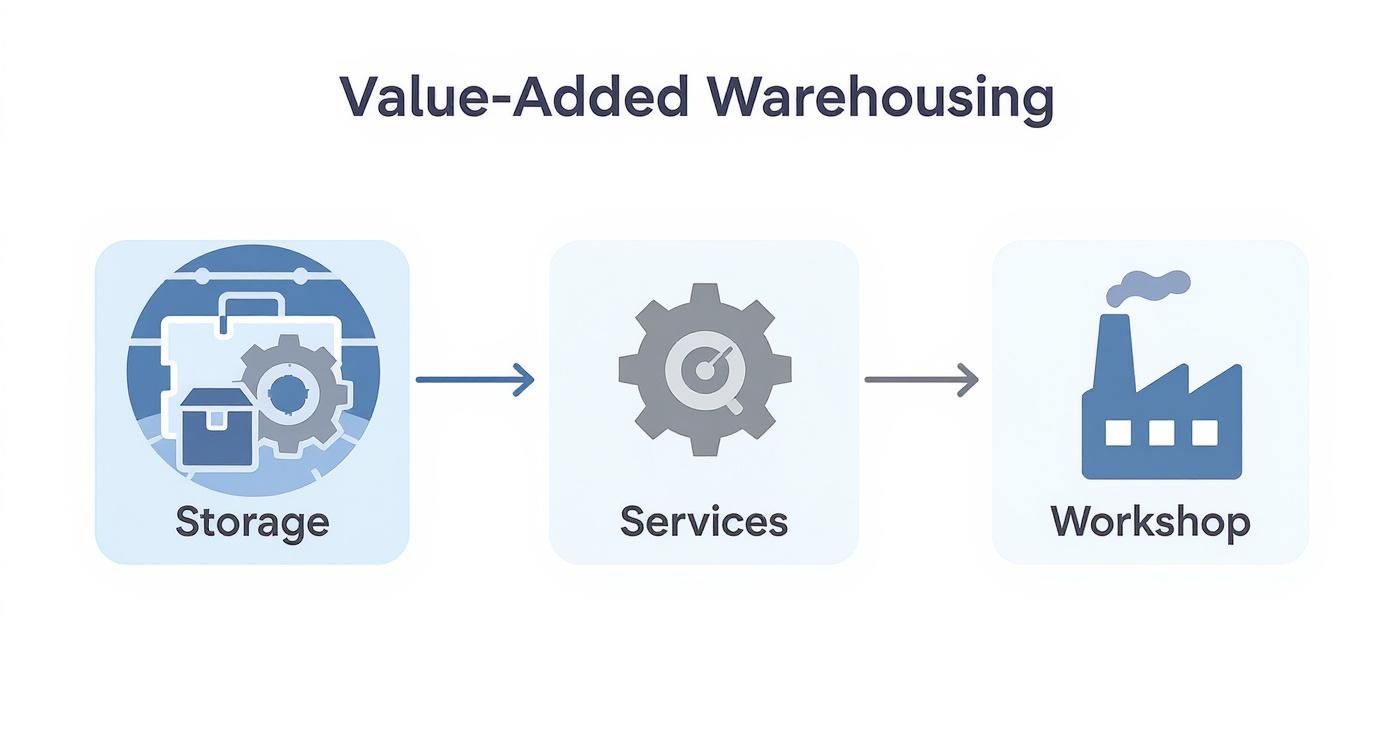
Now, imagine that storage unit has been upgraded into a fully equipped workshop. Instead of just holding parts, this space actively customizes and prepares them for their next destination. That’s the fundamental shift that value-added warehousing services represent.
This "workshop" model moves critical prep tasks away from your crowded factory floor and into a specialized, optimized environment. It’s a strategic move to streamline operations, reduce complexity, and build a more resilient supply chain. For manufacturers, especially in demanding sectors like automotive and electronics, this isn't just a minor tweak—it's essential.
Beyond Storage: From Passive Holding to Active Preparation
The transition from a passive holding area to an active hub is driven by specific activities that add tangible value to your products as they move through the logistics network. These services are designed to solve common production bottlenecks and improve overall efficiency.
Key functions include:
- Customization: Tailoring products with specific labels, packaging, or components to meet unique market or customer requirements.
- Consolidation: Combining multiple components into ready-to-use kits or sub-assemblies, simplifying the final manufacturing process.
- Quality Assurance: Performing detailed inspections, testing, and compliance checks to ensure products meet stringent standards before they ever reach the assembly line.
This shift is more than just outsourcing labor; it's about weaving logistics directly into your core production strategy. By performing these tasks off-site, you can dedicate your valuable factory space to what it does best: final assembly.
A warehouse that adds value isn't a cost center; it's a strategic asset that builds efficiency directly into the supply chain, reducing waste and accelerating speed-to-market.
This table gives a quick breakdown of the difference between the two approaches.
Standard Warehousing vs Value-Added Warehousing
As you can see, the "workshop" model is a fundamentally different way of thinking about logistics. It’s no longer about simply storing goods, but about actively improving them as they flow toward the customer.
The demand for these integrated solutions is exploding. The global value-added logistics service market was estimated at USD 65.17 billion and is projected to hit USD 113.82 billion by 2032, growing at a compound annual growth rate (CAGR) of 7.21%. You can explore more data on this market trend from 360iResearch.
This powerful trend underscores why just-in-time delivery and lean manufacturing principles are no longer optional—they are the standard for modern industry leaders.
A Closer Look at High-Impact Services
Value-added services turn a warehouse from a passive storage space into a dynamic, strategic part of the factory floor. This isn't just about outsourcing a few tasks. It's about intelligently moving work to the right place at the right time to make the entire production process leaner and faster.
When you perform critical prep and customization work off-site, you free up valuable plant space, slash complexity on the assembly line, and get your products to market quicker.
Let's break down the services that make the biggest difference.
Kitting and Component Consolidation
Imagine building a complex part like a vehicle dashboard. The line technician needs dozens of specific components for every single build—screws, clips, wiring, vents, and electronics. Kitting is the simple but powerful act of gathering all those individual pieces into one pre-packaged set.
This kit arrives at the line with a single part number, ready to go. Instead of the technician wasting time hunting through bins for different parts (which is a recipe for mistakes), they get one complete package. This cuts out the guesswork, shrinks line-side inventory, and gives a huge boost to both assembly speed and accuracy.
Want to learn more? Check out our detailed guide on what kitting in manufacturing is all about.
Sequencing for True Just-in-Time Production
Sequencing is the ultimate form of just-in-time delivery. It's not just about getting the right parts to the line—it’s about delivering them in the exact order they're needed for production.
Think about a car assembly line where every vehicle is different. First up is a red sedan with a sunroof, followed by a blue SUV with a premium audio system. Sequencing makes sure the red door panels show up just as the red car's body does, immediately followed by the blue door panels for the next vehicle. It’s perfect synchronization, and it's essential for lean manufacturing.
This flow is how raw storage becomes a ready-to-use workshop output, getting parts prepped and ready for the main event.
Sub-Assembly Operations
Sub-assembly means partially building a product before it gets anywhere near the main factory. A great analogy is prepping ingredients before you start cooking a big meal—it makes the final steps faster and much simpler.
A warehousing partner, for example, could build a car's entire center console—gear shifter, climate controls, infotainment screen, and all—into a single unit. That finished module is then shipped to the OEM, where it can be installed in a fraction of the time it would take to build it from scratch on the main line.
This approach effectively outsources a slice of the manufacturing process. It lets OEMs focus their people and resources on final assembly and testing, which is where they add the most value.
The demand for these services is skyrocketing. Market projections show the value-added warehousing sector growing from USD 48.9 billion to USD 75 billion, fueled by services like assembly and quality control. Automation is a big part of this, with the potential to cut warehouse task times by 30–40%.
Quality Inspections and Containment
Product quality is everything. But catching a defect on a fast-moving assembly line causes expensive shutdowns and chaos. Value-added warehousing acts as a crucial firewall by moving quality control further upstream.
A 3PL partner can perform detailed checks on incoming parts, making sure they meet every spec before they're kitted or shipped to your factory. This includes:
- Visual Inspections: Spotting cosmetic flaws, damage, or incorrect labels.
- Functional Testing: Making sure electronic or mechanical parts work correctly.
- Dimensional Checks: Using precise tools to confirm parts meet engineering tolerances.
If a bad part is found, it's immediately quarantined. This stops it from ever reaching the assembly line, preventing a costly stoppage or, even worse, a product recall.
Specialized Packaging and Security
The final steps are just as critical as the first. Specialized packaging ensures finished products or sensitive components are fully protected during shipping and arrive ready for use. This is way more than just putting something in a box.
These services often include:
- Custom Dunnage: Creating foam or plastic inserts that hold fragile parts securely.
- Labeling and Compliance: Applying barcodes, RFID tags, or specific regulatory labels.
- Protective Wrapping: Using anti-static or anti-corrosion materials for sensitive parts.
On top of that, a great warehousing partner will implement comprehensive cargo theft prevention strategies to keep your goods safe. It's one more way these services build a more efficient, reliable, and secure production environment.
The Strategic Benefits for OEMs and Suppliers
Bringing value-added warehousing services into your supply chain isn't just about outsourcing a few tasks. It's a strategic move that delivers real, measurable results to your bottom line. These services are built to solve the biggest headaches for OEMs and Tier-1 suppliers, turning a logistics cost center into a powerful tool for operational excellence.
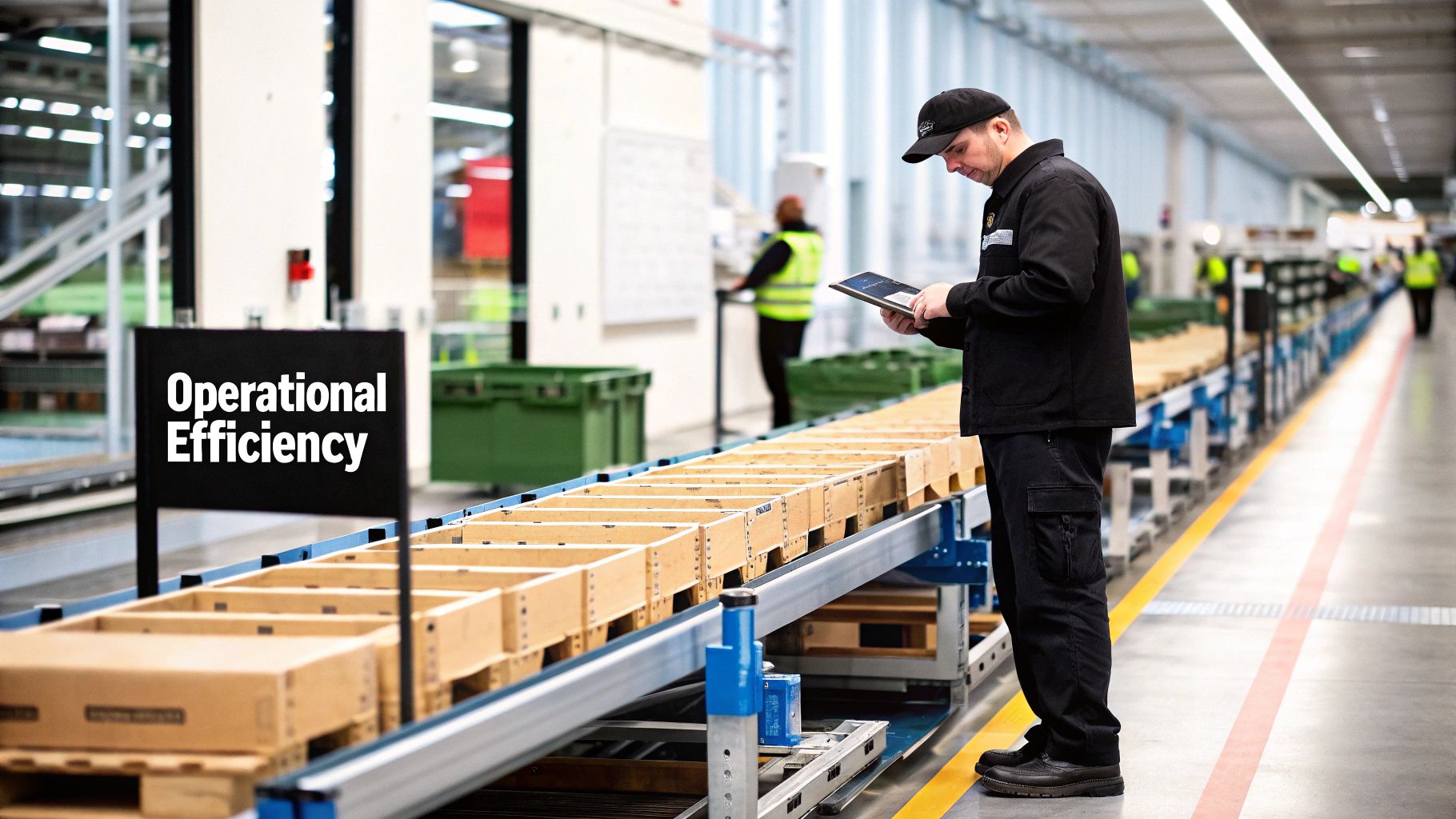
When you move key prep work off-site, you create a ripple effect of benefits across your entire production system. The biggest win? Your team gets to focus. With a partner handling kitting, sub-assembly, and quality control, your people can dedicate their time to high-value work—final assembly and innovation. That focus is what creates a leaner, more agile manufacturing floor.
Reduce Your Operational Costs
One of the first things you'll notice is how it frees up your plant. Factory floor space is expensive real estate. Every square foot dedicated to storing parts or doing basic assembly is space you can't use for your core production.
By shifting those jobs to a specialized warehousing partner, you reclaim that valuable space. Suddenly, you have the room to boost production capacity without a costly expansion or reconfigure lines for better flow. You also cut direct labor costs for material handling and picking, letting you move skilled workers to more critical roles on the line.
Improve Production Efficiency
Assembly line stops are a manufacturer's worst nightmare. For automotive OEMs, downtime can cost tens of thousands of dollars per minute. Value-added services are designed to stop these problems before they start by making sure every component is 100% line-ready upon arrival.
This means:
- No Guesswork: Technicians get pre-kitted and sequenced parts, eliminating time wasted searching for the right component.
- Fewer Defects: Upstream quality checks catch bad parts long before they can halt your assembly process.
- Simpler Workflows: Pre-assembled modules can be installed in a single motion, slashing cycle times at each station.
Improving your flow is one of the most powerful strategies to improve operational efficiency available.
When parts arrive perfectly prepared and sequenced, the assembly line becomes a smooth, continuous flow. This predictable rhythm is the foundation of lean manufacturing and maximum throughput.
Enhance Supply Chain Flexibility
Modern manufacturing has to be agile. Market demand shifts, and engineering changes are a fact of life. A value-added warehousing partner gives you the buffer you need to adapt without derailing your entire operation.
Need to roll out a new product variation? Your provider can adjust the kitting or assembly process off-site, with no disruption to your floor. Facing a sudden demand surge? They can scale up labor to meet it, saving you the headache of hiring and training temporary staff. It creates a far more resilient supply chain that can handle volatility.
Lower Your Inventory Levels
Holding onto excess inventory is a slow financial bleed. It ties up capital and racks up costs for storage, insurance, and the risk of obsolescence. Value-added services are the perfect partner for just-in-time (JIT) and other lean inventory strategies.
Instead of keeping weeks of raw components on your books, you can trust your partner to manage and prepare parts for delivery exactly when you need them. This works hand-in-hand with systems like Vendor Managed Inventory (VMI) to slash stock levels. As we explain in our guide on why Vendor Managed Inventory (VMI) is the future of warehousing, this approach frees up working capital and cuts the risk of getting stuck with obsolete parts after a design change.
How to Measure the ROI of Value-Added Services
Investing in value-added warehousing isn't just about making life easier—it’s a strategic move that should deliver a real, measurable return. But how do you prove it? You can’t just rely on a gut feeling that things are running smoother. You need hard numbers.
The trick is to connect the dots between the services you're outsourcing and their direct impact on your bottom line. You have to translate operational wins, like better quality control or faster assembly, into dollars and cents.
Identifying Your Core KPIs
To get a clear picture, you need to track the right metrics. Vague goals won't do. You need specific Key Performance Indicators (KPIs) that directly show how your warehousing partner is performing. Think of these as the dashboard for your supply chain's health.
Here are a few of the most critical KPIs every manufacturer should be watching:
- Cost Per Unit Assembled: This is your bottom-line metric. It calculates the total cost your partner charges for each kit or sub-assembly they build. This gives you a direct, apples-to-apples comparison to what it would cost you to do the same work in-house, once you factor in your own labor, space, and overhead.
- Order Accuracy Rate: What percentage of orders show up exactly as they should? This KPI measures error-free shipments—the right parts, right quantity, right packaging. A high accuracy rate, ideally 99.5% or better, means fewer mistakes on the production line and less costly downtime.
- On-Time, In-Sequence (OTIS) Delivery: For any just-in-time operation, this is everything. It tracks how often shipments arrive not just on schedule, but in the exact order your line needs them. A high OTIS score is a sure sign of a locked-in, reliable supply chain.
These aren't just numbers for a report; they're the vital signs of your entire operation.
To really dig into performance, it's helpful to organize your metrics in a clear way. A simple table can provide a quick, at-a-glance view of what you're tracking and why it's so important for your business.
Essential KPIs for Value-Added Warehousing
Tracking these metrics gives you the data you need to hold your partner accountable and justify the investment to your leadership team. It’s all about turning operational improvements into undeniable financial proof.
Calculating a Real-World ROI
Let's walk through a quick example. Imagine an OEM was handling its own component kitting before bringing on a value-added warehousing partner. The numbers tell the story.
First, you need to establish the baseline—the real cost of doing it yourself:
- In-House Labor: Five employees at $25/hour spend four hours a day just on kitting. That’s $500 per day.
- Production Downtime: Incorrect kits cause about two line stoppages a week, each costing $1,000. Averaged over a 5-day week, that's another $400 per day.
- Inventory Holding Costs: All that extra inventory sitting line-side costs an estimated $100 per day in tied-up capital and wasted space.
Your total daily cost for that "in-house" kitting process comes out to $1,000.
Now, let's look at the numbers with a value-added partner:The provider charges a flat fee of $600 per day. For that, they handle everything—kitting, sequencing, and delivery—while guaranteeing 99.8% accuracy. The downtime from bad kits is completely gone.
ROI Calculation:(Daily Savings - Daily Cost) / Daily CostDaily Savings = $1,000 (old cost) - $600 (new cost) = $400ROI = ($400 / $600) = 66.7%
Suddenly, it's crystal clear. When you translate abstract benefits into real numbers, you can prove that value-added warehousing services aren't just another expense. They're a strategic investment that directly boosts your profitability.
Choosing the Right Warehousing Partner

Picking the right third-party logistics (3PL) partner for value-added warehousing services goes way beyond a simple price comparison. You’re not just hiring a vendor; you’re choosing a strategic ally who will become a true extension of your production floor.
The right partner slots into your operations seamlessly. The wrong one can inject risk, delays, and surprise costs right into the heart of your supply chain.
Making a smart choice means you have to look past the sales pitch and dig into a provider's operational DNA. It's about asking tough questions and demanding proof of their capabilities, from their tech stack to their quality control chops.
This isn't a niche strategy anymore. Today, 3PL providers occupy about 33% of organized warehouse capacity worldwide, offering the kind of specialized, flexible logistics that modern manufacturers depend on to stay sharp. These services are what help companies manage complexity and react faster. Discover more insights about this growing market landscape.
Assess Their Technological Capabilities
A modern value-added warehouse is built on data. Period. Without a powerful Warehouse Management System (WMS) and solid integration capabilities, a provider simply can't deliver the precision and visibility needed for complex jobs like sequencing or sub-assembly.
Your evaluation has to confirm their systems can talk to yours. Look for:
- WMS Sophistication: Can their system handle complex inventory rules, track individual components for kitting, and give you real-time visibility?
- ERP Integration: Do they have a proven track record of connecting their WMS with major ERPs like SAP, Oracle, or PLEX? Ask to see case studies.
- EDI/ASN Proficiency: Electronic Data Interchange (EDI) and Advance Shipping Notices (ASN) are non-negotiable. They ensure smooth, automated communication between your facilities.
A partner that hesitates on tech integration is a partner that will create manual work and open the door for errors.
Verify Quality Control and Certifications
When you outsource assembly or inspection, you’re handing over your brand's reputation. That trust has to be earned with a real, measurable commitment to quality. Vague promises won’t cut it; you need to see hard evidence of a quality-first culture.
The most important question isn't "Do you have quality control?" but "Can you prove your quality control processes work?" That proof comes from internationally recognized certifications and a history of meeting tough industry standards.
Key credentials to look for include ISO 9001 certification, which signals a commitment to consistent processes and continuous improvement. For automotive suppliers, IATF 16949 is often a must-have. Ask potential partners to walk you through their quality documents, error-proofing methods (poka-yoke), and how they handle corrective actions. For a deeper dive, check out our guide on what to look for in the right 3PL partner.
Evaluate Their Industry Specialization
Finally, make sure a potential partner actually gets your industry's specific challenges. A provider that’s great at e-commerce fulfillment might be completely lost when it comes to automotive sequencing.
Industry specialization means they speak your language, know the compliance rules, and understand the operational tempo of your world. It also means they’re ready to scale with you, whether you’re launching a new product or dealing with a sudden spike in volume.
Integrating These Services into Your Operations
Bringing value-added warehousing services into your operation isn’t like flipping a switch. It’s a deliberate process that needs a clear, phased approach to make sure the transition is smooth and delivers results from day one.
Think of it less like hiring a vendor and more like bringing a new, specialized department into your company. A solid plan moves past handshakes and contracts to focus on the real-world details of execution, building a partnership where information flows just as seamlessly as the physical parts.
Establishing the Digital Handshake
The absolute foundation of a great partnership is the connection between your Enterprise Resource Planning (ERP) system and your provider’s Warehouse Management System (WMS). This digital link is the central nervous system for the whole operation, automating communication and cutting out the manual work that leads to costly errors.
Getting this right involves a few key steps:
- Defining Data Flows: Map out exactly what information needs to be shared—from purchase orders and production schedules to Advance Shipping Notices (ASNs).
- System Integration: Build a solid connection, usually through Electronic Data Interchange (EDI), for real-time, accurate data exchange.
- Testing and Validation: Before going live, you have to rigorously test every single transaction type to iron out any bugs.
This initial setup ensures that when you signal a need for parts, that signal is sent, received, and acted on without anyone having to step in. That’s what makes just-in-time reliability possible.
A strong integration isn’t just about technology. It's about creating a single source of truth for inventory, orders, and shipments. This level of visibility stops surprises in their tracks and lets both partners make proactive decisions.
Aligning on Quality and Communication
Once the systems are talking to each other, the focus shifts to people and processes. You need clear rules for quality control and open lines of communication to manage the day-to-day work. It’s about getting beyond high-level agreements and documenting exactly how things will run.
You’ll want to define and agree on:
- Quality Protocols: Document everything from inspection criteria and defect handling to what happens during a containment event.
- Communication Channels: Set up regular meetings and name the key contacts for daily operations and problem-solving.
- Performance Metrics: Finalize the KPIs you’ll use to measure success, so both teams are aiming for the same targets.
Done right, a thoughtful integration turns value-added warehousing from a simple expense into a strategic advantage. By focusing on data, process, and communication, you build a more resilient, efficient, and competitive manufacturing operation.
Frequently Asked Questions
Digging into value-added warehousing services always brings up a few key questions. Let's clear up some of the most common ones so you can see exactly how these services could fit into your operation.
3PLs vs. Specialized Providers
One of the first points of confusion is the difference between a standard 3PL and a true value-added specialist. Sure, a lot of 3PLs can handle basic kitting. But for a specialist, complex tasks like sub-assembly, parts sequencing, and rigorous quality control aren’t just add-ons—they're the core of their business.
That specialization means you’re getting a much deeper level of expertise. They invest in the right equipment, the tightest process controls, and the skilled technicians needed for work that supports manufacturing. Think of them less as a logistics arm and more as a genuine extension of your factory floor.
Impact on Product Quality
It seems counterintuitive, right? How can moving work off-site actually improve the quality of your final product? It comes down to creating a dedicated quality firewall.
A specialized provider’s entire job is to execute inspections, testing, and assembly flawlessly, far away from the pressures and pace of the main production line.
By catching a non-conforming part or an assembly error before it ever gets near your facility, these services prevent incredibly expensive line-down situations. This proactive approach guarantees only 100% compliant components hit your workflow, which drives up final product quality and slashes rework.
Accessibility for Small and Mid-Sized Businesses
There's a myth that these services are only for massive, global companies. The reality is that value-added warehousing is often a total game-changer for small and medium-sized businesses (SMBs) that need to scale up without breaking the bank.
Here’s how they help smaller players punch above their weight:
- Avoids Capital Expenditure: SMBs get access to advanced assembly, kitting, and QC capabilities without needing to sink a fortune into new buildings, specialized machinery, or a trained workforce.
- Enables Scalability: As your orders ramp up, a warehousing partner can add labor and space on demand. That kind of agility is tough and expensive to manage on your own.
- Frees Up Resources: Outsourcing these detailed logistical and light manufacturing jobs lets your core team focus their time and energy on what they do best—product development, engineering, and sales.
For a growing business, this is a direct path to competing with the big guys by building operational muscle without all the overhead.
At Wolverine Assemblies, LLC, we build precision directly into your supply chain with expert value-added services built for the tough demands of modern manufacturing. Discover how our assembly, kitting, and sequencing solutions can stabilize your operations and drive efficiency.
Subscribe to our weekly newsletter