.png)
Boost Your Business with warehouse management system benefits
Discover warehouse management system benefits that boost accuracy, cut costs, and streamline your supply chain.

Ever tried to find a specific book in a library with no catalog? That's what a warehouse feels like without a Warehouse Management System (WMS)—a space run by expensive, manual chaos. The core warehouse management system benefits are all about turning that chaos into complete control. It transforms a disorganized floor into a high-efficiency hub where you know exactly where every single item is, all the time.
From Warehouse Chaos to Command Central
A warehouse running on spreadsheets and paper pick lists is fighting an uphill battle. It's a constant struggle with misplaced inventory, inefficient labor, and shipping errors that chip away at customer trust. That friction doesn't just slow things down; it hits the bottom line hard through wasted time, excess stock, and lost sales. A WMS isn't just another piece of software. It's the central nervous system for your entire operation, orchestrating every move with precision.
The image below shows this journey from operational mess to streamlined command.
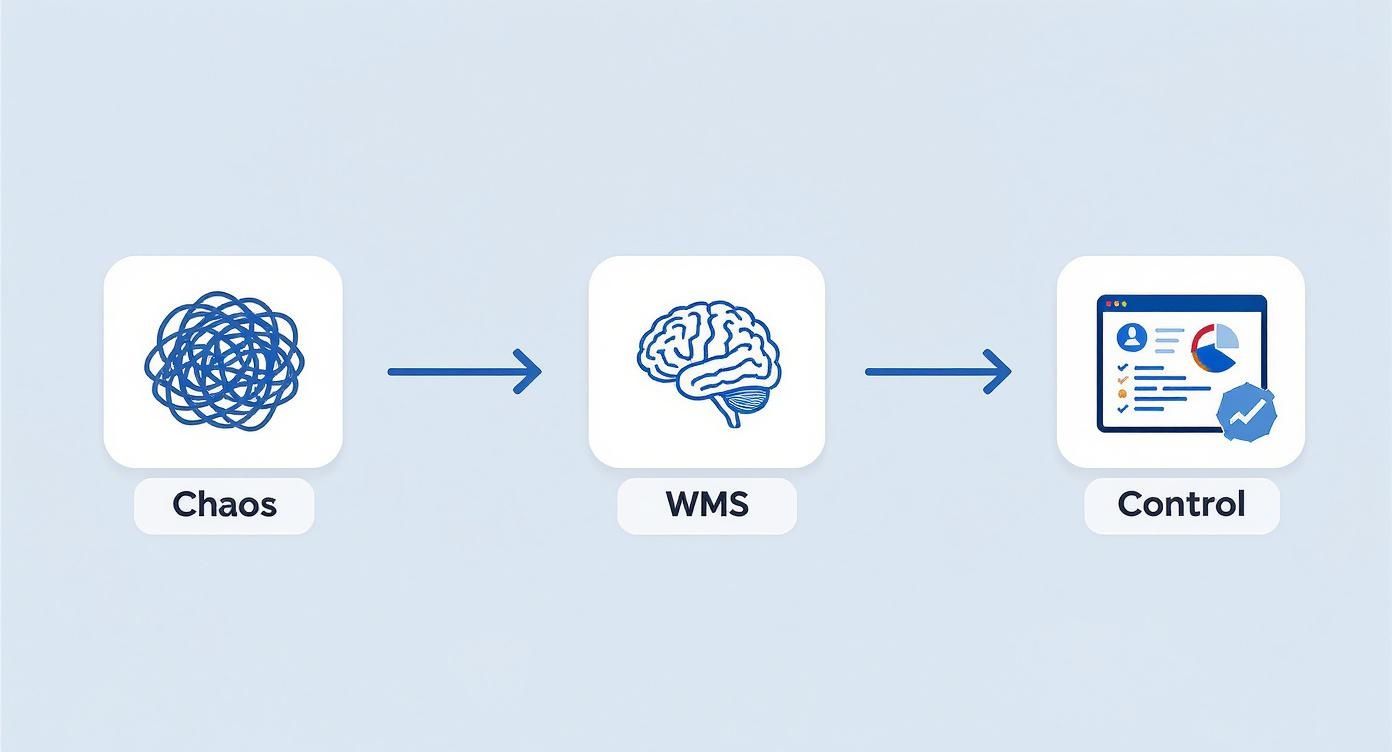
You can see how a WMS acts as the intelligent bridge, converting tangled, confusing processes into a clear, manageable control system.
The Foundation of Modern Logistics
A WMS is the bedrock of any efficient Warehouse and Distribution sector operation. It brings order to complexity, giving you the structure needed to manage inventory, labor, and space effectively.
Without this digital foundation, trying to scale up or meet modern fulfillment demands is nearly impossible. For OEMs and Tier 1 suppliers, where precision and timeliness are everything, a WMS is an absolute necessity. It ensures the right parts are in the right place at the right time. Every time.
A WMS moves your team from guessing to knowing. It replaces reactive fire-fighting with proactive, data-driven decisions that stop problems before they even start, from receiving all the way to final shipment.
This guide will break down the specific advantages a WMS delivers and show how those benefits ripple through your entire supply chain. You’ll see how advanced warehouse management system benefits can sharpen your operations, whether you run your own facility or work with a 3PL partner.
We'll explore how these systems help with:
- Inventory Accuracy: Hitting near-perfect stock counts without constant manual cycle counting.
- Labor Productivity: Guiding workers to get tasks done with maximum efficiency.
- Order Fulfillment: Speeding up picking and shipping to crush customer deadlines.
- Traceability: Gaining end-to-end visibility for rock-solid compliance and quality control.
For any business looking to optimize its supply chain, understanding what expert warehouse services can do is a great next step.
Achieving Flawless Inventory Accuracy and Visibility
Inventory is the lifeblood of any manufacturing operation. But when you're relying on manual tracking, it's also a huge source of financial drain and operational chaos.
A spreadsheet can't tell you if a pallet of critical components was misplaced, and a clipboard won't stop an incorrect part from being shipped to a customer. This is where a Warehouse Management System (WMS) makes all the difference, delivering near-perfect inventory accuracy.

A WMS replaces guesswork with certainty. Using technologies like barcode scanning, every single item is tracked from the moment it hits the receiving dock until it ships out. You get a live, digital twin of your physical inventory, accessible 24/7.
From Manual Errors to Digital Precision
Think about an automotive supplier needing an exact count of a specific fastener for a just-in-time production run. A manual count might be off by just 1%, but that tiny error can halt an entire assembly line, triggering massive financial penalties. A WMS eliminates this risk by providing a real-time, unerring count.
This level of precision is quickly becoming the industry standard. Companies using a WMS report inventory accuracy rates up to 99.9%. It's no surprise that by 2025, over 90% of warehouses are expected to be running on one.
A WMS gives you a single source of truth for your inventory. It ends the debates over what you have and where it is, allowing your team to focus on fulfilling orders instead of searching for lost stock.
This precision has a direct impact on the bottom line. It drastically reduces the carrying costs tied to safety stock—that "just in case" inventory that eats up capital and warehouse space. When you know exactly what you have, you can run leaner and with more confidence.
Before we go further, let's look at a quick side-by-side comparison. It really highlights the night-and-day difference between old-school manual methods and a modern WMS.
Manual vs WMS-Managed Inventory Control
As you can see, a WMS doesn't just improve on manual processes—it fundamentally changes how a warehouse operates, shifting it from a reactive cost center to a proactive, data-driven asset.
Gaining True End-to-End Visibility
Inventory accuracy is just the start. A WMS gives you complete visibility into the status of your inventory. You don't just know the quantity; you know if an item is on-hand, in-transit from a supplier, allocated to a work order, or undergoing quality inspection.
This big-picture view allows for smarter, proactive decisions.
- Enforce FIFO/LIFO Strategies: The system can automatically direct pickers to the oldest stock first (First-In, First-Out) to prevent obsolescence or the newest stock (Last-In, First-Out) depending on your needs.
- Prevent Stockouts and Overstocking: Set automated alerts and reorder points to replenish inventory at the perfect moment, avoiding both costly production delays and the financial burden of excess stock.
- Improve Demand Planning: Accurate historical data on inventory movement makes forecasting far more precise, helping you anticipate customer demand and plan purchasing accordingly.
For companies managing complex supply chains, this visibility is a game-changer. It builds a more resilient operation that can adapt to disruptions. It also lays the groundwork for more advanced inventory models. You can learn more about how this visibility supports strategic approaches in our guide on why Vendor Managed Inventory (VMI) is the future of warehousing.
Ultimately, a WMS is the engine that makes collaborative strategies like VMI possible, providing the real-time data partners need to manage stock levels effectively and drive down costs for everyone.
Sure, having accurate inventory is a great start, but let's talk about the real game-changer: the immediate and massive impact a WMS has on your labor costs. For most warehouses, labor is the single biggest line item on the expense sheet. A Warehouse Management System takes that cost center and transforms it into a powerhouse of efficiency.
It does this by turning every task—from put-away to picking—into a simple, guided process.
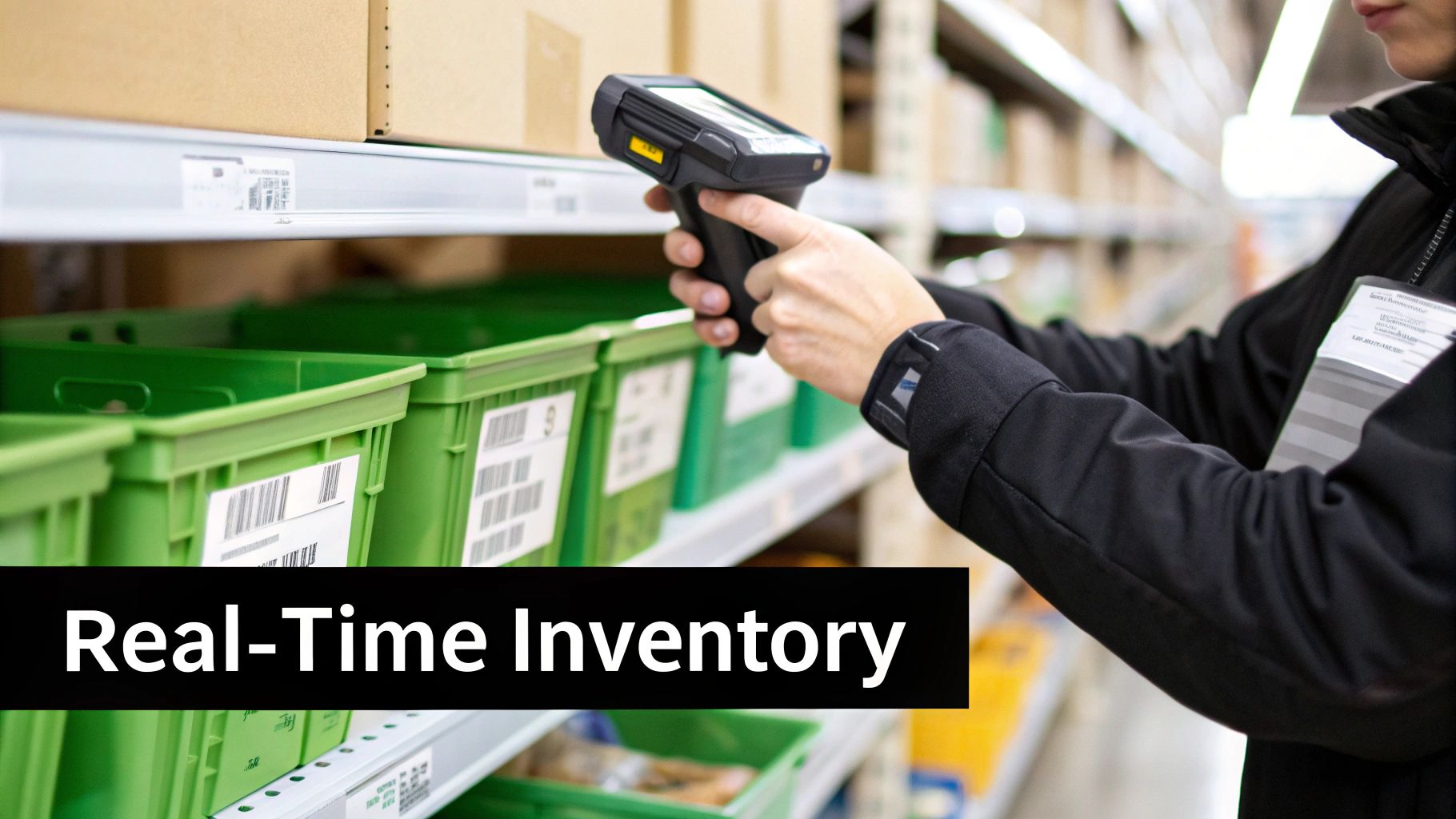
Think about a warehouse running on paper and tribal knowledge. A huge chunk of every worker's day is spent just walking around, searching for the right part, and trying to figure out what to do next. All that travel time is dead time. It adds cost without adding a single bit of value.
A WMS acts like a GPS for your team. It gives each employee the most efficient path for every single task, right on their handheld scanner. No more wandering, no more guessing.
This system-directed workflow slashes all that wasted movement and drives up key metrics like picks per hour. Your team goes straight to the correct location, every time.
Slashing Wasted Steps with Smart Picking Strategies
A WMS unlocks powerful picking strategies that are just plain impossible to pull off with a clipboard. These methods are all about one thing: minimizing travel time to fulfill the maximum number of orders in a single trip.
Consider batch picking. It's like sending a personal shopper into a grocery store with five different shopping lists. Instead of doing five separate trips through every aisle, they plan one optimized route to grab everything at once—all five jars of sauce, all three bags of chips, and so on. This simple logic crushes the total distance traveled.
Then there's zone picking. Here, the warehouse is carved into specific zones, and each picker stays within their assigned area. Orders move from one zone to the next, almost like a mini-assembly line, until they're complete. It keeps workers highly efficient within a smaller, more focused footprint.
The results are immediate and impressive:
- Reduced Travel Time: Your team spends their time handling products, not walking empty-handed down long aisles.
- Increased Picks Per Hour: Grouping orders intelligently means workers can fulfill more lines in less time, boosting your overall throughput.
- Minimized Worker Fatigue: Less walking and searching means a more focused, less physically drained team.
A WMS doesn't just make workers faster; it makes their work smarter. It systematically removes guesswork and inefficiency from daily tasks, allowing your team to achieve more with the same amount of effort.
All this optimization feeds directly into your bottom line with lower payroll costs. Plus, you can handle higher order volumes without having to hire more people.
Reducing Errors and Onboarding Time
The financial wins go far beyond just speed. System-guided tasks nearly eliminate picking errors. When an employee scans a bin location and then scans the product, the WMS confirms it's the right item for that order—instantly. It catches mistakes before they can become expensive problems.
Fewer picking errors mean fewer costly returns, no wasted shipping expenses, and much happier customers. More importantly for Tier 1 suppliers, it prevents the wrong component from ever reaching a sensitive assembly line.
A WMS also radically shortens the learning curve for new hires. Forget memorizing thousands of SKUs and bin locations. A new employee can be productive on day one just by following the clear instructions on their scanner. This cuts down your training overhead and gets new team members contributing almost immediately.
The Hidden Benefit of Intelligent Put-Away
Finally, a WMS optimizes more than just labor—it also optimizes your physical space, another huge cost driver. Its intelligent put-away logic tells workers exactly where to store incoming inventory based on things like size, weight, and how often it's picked.
This stops disorganized aisles before they start and ensures every square foot of your warehouse is being used effectively. For facilities tied to production, understanding how a WMS connects with systems like ERP in manufacturing is crucial. That link ensures inventory data flows seamlessly, allowing the WMS to support production schedules with absolute precision.
Better space utilization might even let you delay—or completely avoid—a costly facility expansion, delivering a massive return on investment all on its own.
Accelerating Order Fulfillment and Delighting Customers
Having accurate inventory and a productive team is a great start. But where the real magic happens is when those efficiencies translate into faster, more reliable order fulfillment. An organized warehouse is one thing; a fast one is what keeps customers happy and gives you a serious competitive edge.
This is where a Warehouse Management System (WMS) really shines. It acts as the brain of your fulfillment operation, intelligently prioritizing every order that comes in. It can automatically sort and release work based on shipping deadlines, customer priority, or transport schedules. This guarantees your most critical shipments always jump to the front of the line, so you can easily meet—and even beat—demanding Service Level Agreements (SLAs).
It’s not just about moving faster. It’s about executing perfectly.
From Inventory Accuracy to Shipping Perfection
That flawless inventory accuracy we talked about earlier? It has a direct, powerful impact on customer satisfaction. When your system shows 200 units of a critical part are in stock, you can be 100% confident they’re actually on the shelf, ready to go. This completely eliminates the painful scenario of discovering a stockout after an order has been placed, which is the number one cause of backorders and frustrating delays.
That kind of reliability builds incredible trust with your customers.
A WMS closes the gap between what your system says you have and what’s actually on the shelf. This certainty is the bedrock of fast, error-free fulfillment that keeps customers coming back.
On top of that, system-guided picking and verification processes slash shipping errors. By requiring a simple barcode scan at each step, the WMS confirms that the right product in the right quantity is packed every single time. This simple check prevents the costly domino effect of a bad shipment, which includes:
- Expensive reverse logistics to get the wrong item back.
- Added freight costs to rush the correct order out.
- Damaged customer trust and a hit to your reputation.
Getting these errors down to near-zero is one of the most immediate and tangible benefits you’ll see from a WMS.
Becoming a Strategic Partner with Value-Added Services
A modern warehouse isn't just a place to store things—it's an active hub that adds real value to the supply chain. A WMS provides the strong operational backbone you need to confidently offer the kinds of complex services that make you indispensable to your clients.
These services turn your warehouse into a crucial part of your customer's production process. The system’s ability to track individual components, manage complex bills of materials, and direct specific workflows makes these offerings not just possible, but highly efficient.
A few examples include:
- Kitting: The WMS generates work orders to assemble multiple separate SKUs into a single new kit, directs workers to pick the right parts, and tracks the finished kits as new, sellable inventory.
- Light Assembly: For sub-assemblies, the system manages the consumption of raw components and the creation of the finished product, ensuring inventory levels for all related parts are updated in real-time.
- Sequencing: For automotive and manufacturing clients, a WMS is essential for sequencing parts for just-in-time delivery to an assembly line, ensuring the right part arrives in the exact order it’s needed.
When you can expertly manage these tasks, you stop being just another supplier and become an integrated partner in your customer's success. Exploring these possibilities is a fantastic way to find new revenue streams. You can learn more about the strategic advantages of value-added warehousing services and how they build stronger customer relationships. Ultimately, a WMS gives you the control and precision needed to turn your fulfillment center into a true profit center.
Building Bulletproof Traceability and Compliance
In high-stakes industries like automotive and aerospace, there are no second chances. A single bad component can trigger catastrophic failures, forcing expensive recalls and causing irreversible damage to your brand. This is where a Warehouse Management System (WMS) provides one of its most critical benefits: building an unbreakable chain of custody for every part you touch.
Think of a WMS as the digital historian for your entire inventory. It creates a detailed, time-stamped footprint for every single item, capturing critical data from the moment it hits your receiving dock until the final product ships out.
This digital log is meticulous, tracking identifiers that matter:
- Lot Numbers: To group products made in the same batch.
- Serial Numbers: For a unique identity on each individual item.
- Expiration Dates: To ensure time-sensitive materials are handled correctly.
- Supplier Information: Logging the origin of every single component.
This data isn't just sitting in a database; it’s actively linked to every move. The WMS knows precisely which lot was used in a specific kitting project, which serial numbers went into a shipment, and exactly where the rest of that batch is sitting in your facility right now.
From Recall Nightmare to Rapid Response
Imagine the chaos of a product recall without a WMS. A supplier calls to tell you a specific batch of fasteners is defective. Suddenly, your team is digging through mountains of paperwork and physically searching thousands of bins, trying to track down every single affected part. The process could take days, bringing production to a screeching halt and delaying critical customer shipments.
Now, picture that same scenario with a WMS. You run a simple query for the defective lot number, and in seconds, you have a complete list of every location where those fasteners are stored. You can isolate the entire batch in minutes, not days. This ability to respond instantly is non-negotiable for protecting your brand, your customers, and your bottom line.
A WMS transforms traceability from a reactive, manual fire drill into a proactive, surgical response. It gives you the power to contain problems instantly, minimizing disruption and demonstrating total control over your inventory.
Enforcing Compliance and Creating Flawless Audit Trails
Beyond recalls, a WMS is your best tool for enforcing industry rules and maintaining compliance. In highly regulated sectors, certain materials often have strict handling or storage requirements. A WMS can be configured to automatically direct these items to designated zones, ensuring the rules are followed every single time.
This creates a perfect, digital audit trail. Every touch, every move, and every transaction gets recorded. When an auditor shows up, you can pull a complete history for any item with a few clicks, effortlessly proving compliance with standards like ISO 9001 or IATF 16949.
This level of digital record-keeping is vital for any modern supply chain. The real-time insights from a WMS support smarter decision-making and traceability, which in turn leads to significant cost reductions. In fact, some studies suggest operational costs can be lowered by up to 25% through better data management. To learn more, check out this overview of how a WMS improves modern supply chains on fynd.com.
Ultimately, the traceability from a WMS isn't just a feature—it's operational insurance. It proves you have the systems in place to guarantee quality, meet regulations, and protect your customers every step of the way.
You’ve got the big picture on WMS benefits, but now the practical questions start popping up. How does this actually work? What’s the real cost? Does it fit my business?
Let's cut through the noise. Here are the straight answers to the questions we hear most from OEMs and Tier 1 suppliers when they're looking at this kind of technology.
How Is a WMS Different from an ERP Inventory Module?
This is the most common question we get, and for good reason. It's easy to see them as overlapping, but they have very different jobs.
Think of it this way: your ERP is the company’s accountant, tracking the big-picture financials. Your WMS is the on-the-ground floor manager, directing the real-time physical movement of every single part.
Your ERP’s inventory module is built for the "what" and the "why." It knows what you own, what it cost, and its value on the books. It answers questions like, “How many widgets do we have in total?” and manages the financial side of purchasing and sales.
A WMS, on the other hand, is obsessed with the "where" and the "how." It knows the exact bin location of every widget. It tells your team the most efficient path to pick an order and tracks every single touch in real time.
Your ERP tells the financial story of your inventory. Your WMS tells the operational story—executing every move with total precision on the warehouse floor.
That granular level of control is something a standard ERP module just can't handle. A WMS directs complex strategies like batch picking or zone picking, manages recalls down to a specific lot number, and powers value-added services like kitting and sequencing. It provides the deep, operational intelligence needed to run a tight ship.
What Is the Typical ROI for a Warehouse Management System?
While every operation is different, most businesses see a full payback on their investment within 12 to 24 months. That’s a fast return, and it comes from direct, measurable savings you’ll see on your P&L statement.
These aren't fuzzy, theoretical gains. They are hard numbers. Here's where the savings come from:
- Labor Cost Reduction: This is usually the biggest win. Optimizing travel paths and automating task assignments can cut labor costs by 15% to 35%. Your team gets more done without working harder.
- Inventory Accuracy Gains: When you move from spreadsheets to a WMS, inventory accuracy can jump to over 99%. That means less money tied up in safety stock, fewer write-offs, and no more expensive emergency freight to cover a stockout.
- Fewer Shipping Errors: A wrong shipment is a costly mistake. A WMS uses barcode verification to make mis-picks nearly impossible, which means fewer returns, no wasted freight, and happier customers.
- Better Space Utilization: Smart put-away logic helps you use every square foot of your warehouse more effectively. This can put off a costly facility expansion for years—a massive capital expense avoided.
Is a WMS Only for Large Corporations?
That used to be true, but not anymore. A decade ago, a WMS meant a massive upfront investment in servers and a dedicated IT staff, putting it out of reach for most smaller companies.
Today, that's all changed. The rise of cloud-based, Software-as-a-Service (SaaS) WMS solutions has leveled the playing field. These systems run on a subscription model, which means no huge capital expense to get started.
Instead of a giant upfront bill, you pay a predictable monthly or annual fee. This model is a game-changer for growing businesses:
- Lower Upfront Costs: No need to buy and maintain your own expensive servers.
- Faster Implementation: Cloud systems get you up and running in a fraction of the time.
- Easy to Scale: You can add users or connect new facilities as your business grows.
- Automatic Updates: The vendor handles all the maintenance, so you always have the latest features.
The core warehouse management system benefits—accuracy, efficiency, and happy customers—are just as critical for a growing business as they are for a global enterprise. A modern WMS gives you the tools to compete.
How Does a WMS Integrate with Other Systems?
A WMS can't be an island. To deliver real value, it has to talk to the other software that runs your business, creating a single source of truth for your entire supply chain.
Think of it as a team of specialists who are in constant communication. A modern WMS is built to connect with your key systems through APIs and EDI.
- ERP Integration: Your WMS pulls sales and purchase orders from the ERP. Once an order ships, the WMS pushes that real-time data back to the ERP to update financial records and inventory counts instantly.
- TMS Integration: It talks to your Transportation Management System (TMS) to schedule shipments, print labels, and send tracking information back to the customer.
- E-commerce Platforms: For companies selling online, the WMS syncs inventory with platforms like Shopify or Magento, preventing overselling and making sure customers see accurate stock levels.
This connected system ensures everyone from sales to shipping is working with the same up-to-the-minute information. It breaks down data silos and makes your whole operation run smoother.
At Wolverine Assemblies, LLC, we integrate advanced WMS capabilities with our PLEX ERP system to deliver the precision OEM and Tier 1 suppliers demand. Our technology-first approach guarantees flawless execution for your kitting, sequencing, and assembly needs.
Discover how our expert 3PL services can stabilize your supply chain and drive down costs. Learn more at https://www.wolverine-llc.com.
Subscribe to our weekly newsletter