.png)
A Leader's Guide to Build a Warehouse from Scratch
Ready to build a warehouse? This complete guide walks operations leaders through strategy, site selection, design, construction, and launch.
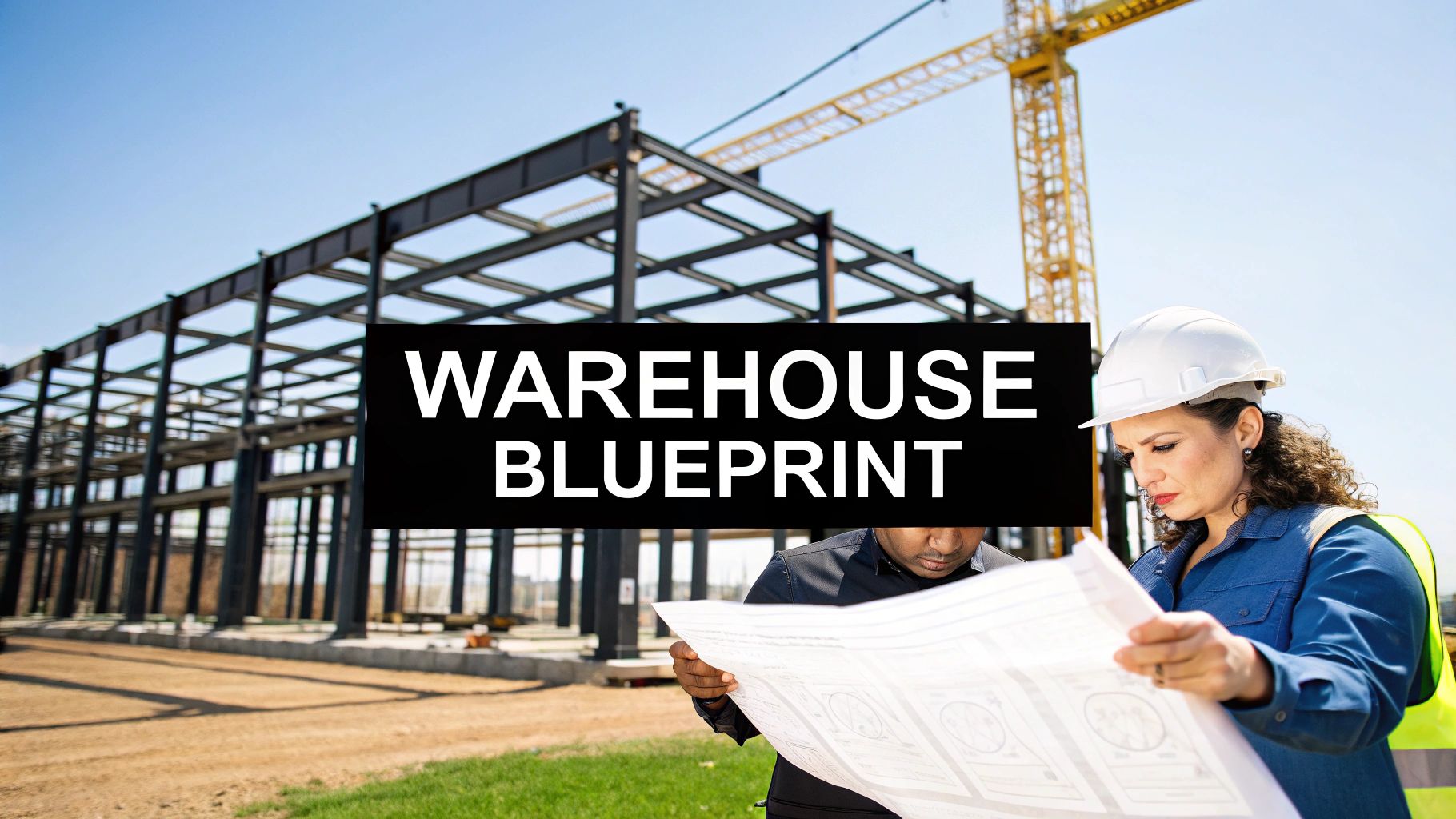

Before you even think about blueprints or breaking ground, the real first step is asking one tough question: does building a new warehouse actually make sense for your business? This isn't just a real estate decision; it's a strategic move that will lock in capital and define your operational flexibility for years, maybe even decades.
You have to weigh the total cost of ownership, operational control, and long-term vision against the agility of leasing or partnering with a third-party logistics (3PL) provider.
Is Building a New Warehouse the Right Move?
So, what’s pushing you to even consider this? Usually, it comes down to a few common pain points.
Maybe you're constantly fighting for space in your current facilities. Or perhaps the e-commerce boom is creating fulfillment headaches your old setup just can't handle. We also see companies shifting their inventory strategy from a lean "just-in-time" model to a more defensive "just-in-case" approach, which means they suddenly need a lot more room to buffer against supply chain shocks.
If any of that sounds familiar, it’s time to seriously evaluate your options.
Financial Analysis: Build vs. Lease vs. 3PL
Once you know why you need more space, the next step is a head-to-head comparison of your three main paths: building, leasing, or outsourcing to a 3PL. Each one comes with its own set of very different trade-offs.
Building gives you total control and a facility designed for your exact needs, but it comes with a massive upfront capital investment. Leasing is the middle ground—less cash required upfront, but you also get less say in the layout and future modifications.
Then there's the 3PL option. Partnering with a logistics expert takes the real estate burden completely off your plate, turning a huge capital expense into a predictable, variable operating cost. This is a game-changer for businesses with fluctuating demand or those looking to test new markets without heavy investment.
A good 3PL can also provide a whole suite of value-added warehousing services—things like kitting, assembly, and quality control that would be expensive and complex to set up from scratch in a new facility.
At this stage, you also have to decide between a ground-up project and renovating an existing building. There's a lot to consider there, and this breakdown of remodel vs new construction offers some great insights on the costs, timelines, and hidden challenges of both.
This isn't just about comparing a monthly lease payment to a mortgage. You have to calculate the true Total Cost of Ownership (TCO), factoring in maintenance, insurance, taxes, staffing, and tech systems over a 10- to 15-year horizon. That's where the real numbers come out.
For a clearer picture, let's break down the core differences in a simple table.
Warehouse Strategy Comparison: Build vs. Lease vs. 3PL
This table gives a high-level look at the financial and operational implications of each option.
Ultimately, the best choice is the one that aligns with your specific operational needs and long-term business goals.
Making the Strategic Call
The warehouse construction market is always shifting. The post-pandemic e-commerce frenzy drove a massive building boom, but things have cooled off since. After peaking in 2022, construction slowed significantly, with a forecasted 25% year-on-year drop in new facilities in 2023.
But the market is already showing signs of a comeback. Both construction and automation investments are projected to climb again starting in 2024, signaling a return to more sustainable, balanced growth.
So, how do you decide? It all comes back to your long-term strategy.
- Build if: You have stable, predictable growth, need highly customized workflows or automation, and see the facility as a core strategic asset.
- Lease if: You need to get up and running quickly, want to avoid a huge capital hit, and can work effectively within a standard building layout.
- Use a 3PL if: Your demand is unpredictable, you need to scale up or down on a dime, or you want to enter a new market with minimal risk.
Alright, you've made the big call to build. Now comes the decision that will make or break your entire supply chain: location.
This is so much more than just finding an affordable piece of dirt. The right spot acts as a force multiplier, slashing transit times and costs. The wrong one? It will saddle your operations with permanent headaches and inefficiencies that no amount of fancy tech can fix.
The starting point is a deep-dive network analysis. Your goal is to find your company's true "logistical center of gravity." This isn't just about being close to customers. It’s a balancing act between your inbound suppliers, your key customer markets, and the transportation arteries—highways, ports, rail lines—that connect them all.
For example, if you're importing parts from Asia but your customer base is on the East Coast, you'd zero in on sites near major ports like Savannah or Norfolk. From there, you'd layer in data on access to I-95 and proximity to your top ten customer DCs to pinpoint the sweet spot. This data-first approach takes the guesswork out of a multi-million dollar decision.
This decision tree shows the high-level strategic options a company faces when addressing its warehousing needs, highlighting the different paths of building, leasing, or outsourcing.
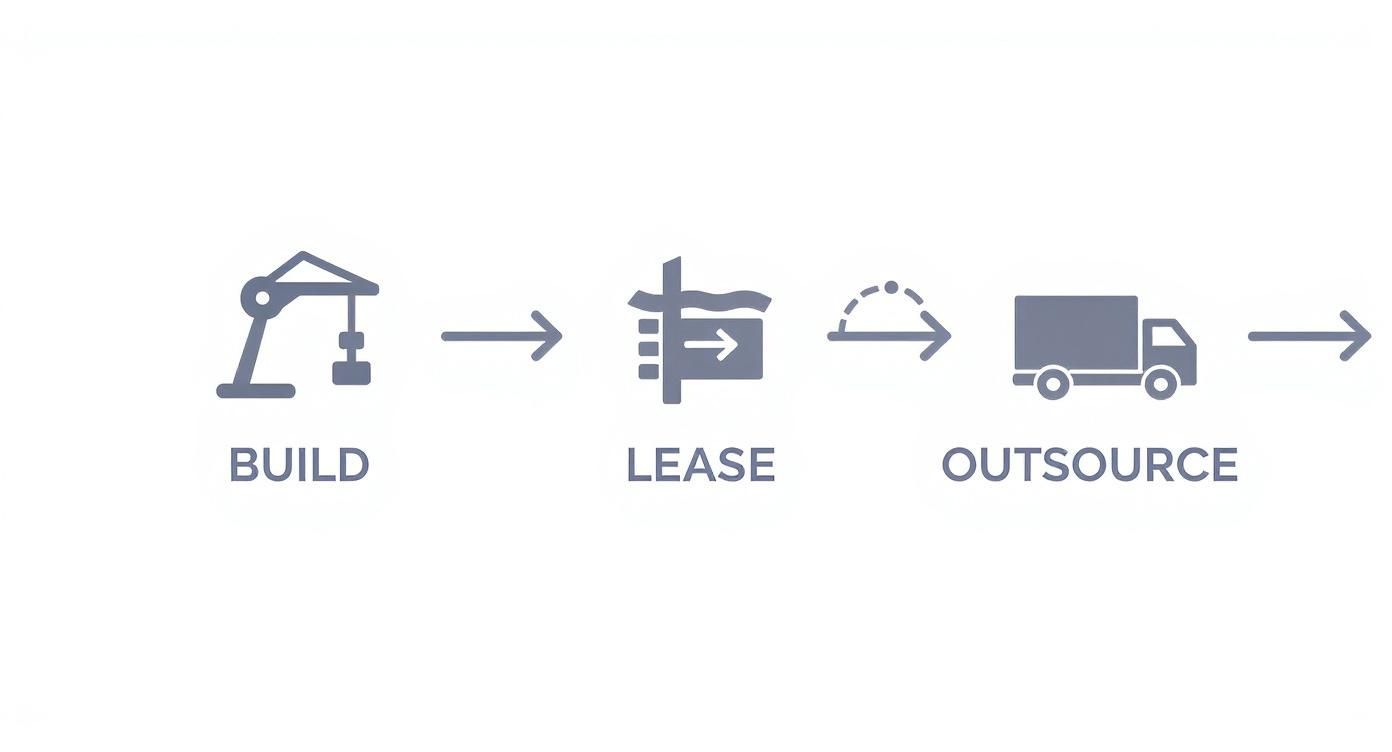
Each path—building, leasing, or outsourcing—presents a distinct trade-off between capital investment, operational control, and long-term flexibility, making the initial strategic choice critical.
Conducting Thorough Due Diligence
Once you’ve got a shortlist of promising locations, the real detective work begins. Due diligence is where you protect your investment by uncovering the deal-breakers hiding just below the surface. This is where you get your boots on the ground.
Your checklist here needs to be relentless.
- Zoning and Permitting: First, confirm the land is zoned for industrial use. A quick call to the local planning department can save you months of headaches by revealing the permitting process and any potential roadblocks upfront.
- Environmental Assessments: A Phase I Environmental Site Assessment is non-negotiable. It’s designed to spot potential contamination from previous land use that could turn into a costly cleanup nightmare later on.
- Utility and Infrastructure Access: Does the site have enough power, water, sewer, and high-speed internet? Don't assume. Call the local utility providers and confirm they can handle the load of a modern warehouse.
- Geotechnical Surveys: A soil analysis is crucial. It tells you if the ground can support a massive, heavy structure and will directly impact your foundation design and costs.
A critical mistake is underestimating local regulations. We once saw a project delayed by six months because the chosen site had unforeseen wetland protection statutes that weren't caught in the initial review. This highlights the importance of partnering with local civil engineers and legal experts who know the regional landscape inside and out.
Analyzing Financial and Future-Proofing Factors
Beyond the physical land, you need to run the numbers. This isn't just about the purchase price. Dig into local property tax rates—this will be a recurring operational cost for years to come.
On the flip side, many municipalities and states offer economic incentives like tax abatements or infrastructure grants to attract new employers. Chasing these down can seriously boost your project's ROI.
This is also the time to think five, ten years down the road. Does the site offer room to expand? The logistics world doesn't stand still. The number of warehouse facilities in the U.S. grew by over 50% between 2007 and 2023, driven by e-commerce and shifting supply chains. You need that foresight. You can learn more about the trends shaping warehouse construction costs and market growth.
Finally, get practical. Make sure there’s ample space not just for the building, but for truck maneuvering, trailer parking, and employee vehicles. An otherwise perfect site can become a daily bottleneck if your yard is too cramped.
Choosing the right site is the foundation everything else is built on. Get this right, and you've won half the battle.
Designing a High-Performance Warehouse

You’ve got the land. Now, the real work begins: turning an empty plot into the operational heart of your supply chain. This is where your strategy gets a physical blueprint. The design choices you make here will echo for a decade or more, directly hitting your efficiency, speed, and bottom line.
A great warehouse isn’t just a big, empty box. It’s an engineered system built for one thing: getting goods from receiving to shipping with the least amount of time, effort, and handling. That process starts with the building’s bones.
Mastering the Building Shell
Before you start sketching out aisles and racking, you have to define the container itself. Three core elements will set the stage for everything that happens inside.
- Clear Height: This is your usable vertical space, measured from the floor to the lowest hanging beam or sprinkler head. Today, 32-36 feet is the standard, but if you're planning for very-narrow-aisle (VNA) systems or automation, you should be pushing for 40 feet or more.
- Column Spacing: This dictates how big your bays are, which in turn impacts your racking options and aisle widths. Wider spacing, like 50' x 50', gives you much more flexibility for forklifts and future layout changes.
- Building Footprint: Your total square footage needs to cover more than just your current inventory. You have to plan for growth plus dedicated zones for receiving, quality control, kitting, and shipping.
The structure itself is a huge decision. Many modern facilities use pre-engineered steel frames because they’re durable, cost-effective, and go up fast. For a deeper dive on this, check out a comprehensive guide to warehouse steel buildings—it covers the structural options in great detail.
Optimizing Your Interior Layout and Flow
With the shell defined, you can start on the real art of warehouse design. The goal is simple: create a clean, one-way path for your products that cuts out backtracking, traffic jams, and wasted motion.
Start by mapping your core processes from end to end. A U-shaped flow is one of the most common and effective layouts, putting receiving and shipping docks on the same side of the building. This keeps all truck traffic in one area and lets you share staff and equipment between inbound and outbound teams.
Next, you'll want to place your key operational zones strategically.
- Receiving: Give this area plenty of floor space for staging, inspecting, and breaking down inbound shipments.
- Storage: This is the main event. Your racking here should be based on your product velocity and physical dimensions.
- Picking & Packing: This is where most of your labor hours will be spent, so it needs to be located centrally to cut down on travel time for your team.
- Shipping: Position this with easy access for outbound trucks, with enough space for staging and consolidating orders before they're loaded.
The biggest mistake I see is when companies design a layout for the products they have today, with no thought for tomorrow. Your design has to be flexible. Use modular racking and create open zones you can easily reconfigure when your inventory or fulfillment model changes.
Selecting the Right Racking Systems
Your racking isn't just about storing things. It's a strategic trade-off between storage density, product accessibility (selectivity), and cost. There's no single perfect solution; the best warehouses use a mix of systems for different products and turnover rates.
This physical plan—your layout and racking—is just one half of the equation. It has to mesh perfectly with your operational software. The flow you design on the floor is what your Warehouse Management System (WMS) will use to direct traffic, assign tasks, and optimize inventory placement.
Take some time to explore the key warehouse management system benefits to see how the right software amplifies a smart physical design. When you build a warehouse, it's this connection between the physical layout and digital intelligence that creates a truly high-performance operation.
Navigating the Construction Process and Budget
With the design locked in, it’s time to turn those blueprints into a building. This is where the project shifts from strategic vision to disciplined execution. Success now depends on having the right team on the ground, crystal-clear communication, and a budget that’s ready for anything.
This phase is all about project management, transforming drawings into a tangible, operational asset.
Assembling Your Construction A-Team
First things first: build your core project team. This is more than just hiring a builder; it's about forging a partnership between three critical players: the architect, the structural engineer, and the general contractor (GC). These are the experts who will translate your operational needs into a safe, efficient, and fully compliant building.
The glue holding everything together is communication. You need to establish a regular meeting schedule—weekly or bi-weekly works best—with a fixed agenda. Cover progress, track the budget, flag potential risks, and review upcoming milestones. This simple routine ensures everyone is on the same page and catches small issues before they snowball into major delays.
Hard Costs vs. Soft Costs: Don't Get Blindsided
One of the biggest mistakes I see is building a budget that only covers the obvious stuff—the steel, concrete, and labor. These are your hard costs, and yes, they make up the bulk of your spending.
But a smart budget goes deeper, accounting for all the soft costs. These are the less-visible expenses that can absolutely wreck a project if you ignore them.
- Design and Engineering Fees: What you pay your architect and engineers.
- Permitting and Inspection Fees: The cost to get your plans approved and inspected by the local municipality.
- Insurance: Builder’s risk and liability insurance are non-negotiable. They protect your investment while the site is active.
- Utility Hook-Up Fees: The price to connect your shiny new facility to the local power, water, and sewer grids.
Here’s a piece of advice I give every client: build in a contingency fund. No project, and I mean no project, goes exactly as planned. Setting aside 5-10% of the total project cost for surprises—like discovering poor soil conditions or a sudden spike in material prices—isn't being pessimistic. It's smart business.
Building a Comprehensive Warehouse Budget
So, how does this all fit together? A well-structured budget helps you track every dollar and see exactly where your capital is going. Below is a sample breakdown that provides a solid starting point for organizing your expenses.
Sample Warehouse Construction Budget Breakdown
This framework gives you a clear way to manage project spending. It's also worth noting the bigger picture: the industrial construction market, which includes warehouses, was valued at a massive $179.48 billion in 2024 and is still growing. You can explore the full industrial construction industry analysis to see what trends are driving this expansion.
This kind of structure isn’t just for tracking; it’s a tool for control.
Mapping the Construction Timeline
Most new warehouse builds follow a fairly standard sequence. Knowing the major milestones helps you set realistic expectations and keep a close eye on progress.
- Site Prep & Foundation (1-2 Months): This is ground-zero. The land is cleared, graded for drainage, and the concrete foundation and slab are poured.
- Structural Erection (2-3 Months): Next, the steel skeleton goes up. Walls and roofing follow, enclosing the structure and making it weather-tight.
- Interior Work & Systems (3-4 Months): This is usually the longest phase. Crews are busy installing electrical wiring, plumbing, HVAC, fire sprinklers, and lighting. Dock doors and levelers get installed here, too.
- Final Inspections & Handover (1 Month): The finish line. Local authorities conduct their final inspections to issue a certificate of occupancy. Once you have that, the contractor officially hands you the keys.
Staying on top of this process is what keeps you on schedule and on budget. Address problems the moment they appear, formally approve any changes, and keep those lines of communication open with your team. This disciplined approach ensures the facility you designed is the one you actually get—ready to power your supply chain. In fact, many are now building with an eye toward the future, incorporating features to support electric trucks and other green warehousing initiatives.
Launching Your New Facility for Success
The concrete is cured, the racking is up, and the lights are on. You've got a building. But the hardest part of your project to build a warehouse is just beginning.
A building is just a shell. The real work is turning that shell into a high-performance logistics hub, and that comes down to two things: the right technology and the right people. This final stage is where your operational strategy comes to life. A smooth launch doesn’t happen by accident—it’s the result of meticulous planning.
Integrating Your Technology Stack
Your warehouse's nervous system is its tech. The heart of it all is the Warehouse Management System (WMS), the software that directs every single inventory movement. Selecting and implementing a WMS is a massive project on its own.
But the key isn't just the WMS itself; it's how it talks to everything else. It can't operate in a silo. Your WMS needs a rock-solid, real-time connection to your company’s Enterprise Resource Planning (ERP) system. This link is what keeps inventory levels, sales orders, and purchase orders perfectly synched up across the business. No connection, no control.
Beyond the software, your physical IT infrastructure has to be flawless.
- Robust Networking: This means high-speed wired connections for servers and workstations. No exceptions.
- Comprehensive Wireless Coverage: Don't even think about skimping here. Wi-Fi dead spots mean your scanners and tablets are dead in the water, and that grinds operations to a halt. A professional site survey is non-negotiable to guarantee a strong signal in every corner.
- Hardware Deployment: Plan the rollout of every device—handheld RF scanners, forklift-mounted terminals, label printers, and supervisor workstations.
Building Your A-Team
Technology is only half the battle. A warehouse runs on its people, and you need a solid strategy to find, train, and keep a great team. This has to start long before the first pallet shows up.
First, write detailed and accurate job descriptions. Don't just post for a "warehouse associate." What specific skills does a receiving clerk need versus a picker? What equipment will they use? Getting this right attracts better candidates and sets clear expectations from day one.
Next, get creative with your recruiting plan.
- Local Job Boards: Target candidates right in your community.
- Employee Referrals: Your best people often know other great people. Incentivize it.
- Partnerships: Connect with local community colleges or vocational schools that have logistics programs.
Once you’ve hired your crew, training is everything. A structured onboarding program is essential. It needs to cover more than just WMS tasks; it should drill down into your company's specific procedures and, most importantly, your safety protocols. A strong safety culture is built from day one.
The most successful warehouse launches I've been a part of treat training as a continuous process, not a one-and-done event. They use the go-live as a starting point and immediately build a continuous improvement program, gathering feedback from the floor to make workflows better.
Executing a Flawless Go-Live
The moment you switch from an empty building to a live facility is incredibly high-stakes. Your best defense against chaos is a detailed go-live checklist. This isn't just a to-do list; it's a sequenced plan that tests every part of your operation before you flip the switch.
Think of it as a series of dress rehearsals, each one getting more complex.
- Systems Testing: Run an end-to-end test of your entire tech workflow. Create a PO in the ERP, receive it in the WMS, put it away, create a sales order, pick it, pack it, and ship it. This "conference room pilot" proves data is flowing correctly before anything physical moves.
- Inventory Migration: Plan the physical move of your inventory like a military operation. Will it be a phased move over a few days or a full shutdown over a weekend? Clear labeling, staging areas, and a precise data migration plan for the WMS are critical.
- Operational Dry Runs: Get your newly trained team on the floor. Give them test orders to practice the physical process—receiving, scanning, putting away, picking. These dry runs build muscle memory and expose any gaps in your training or workflow before you’re handling real customer orders.
After a successful launch, your job shifts to managing performance. Define your Key Performance Indicators (KPIs) from the start. Track metrics like Dock-to-Stock Time, Order Accuracy, and On-Time Shipping to keep a pulse on the health of your operation and drive improvement from the very first day.
Your Top Questions About Building a Warehouse, Answered
Even the most thorough playbook can't anticipate every single question that pops up on a project this massive. Over the years, I've seen operations leaders and supply chain managers wrestle with the same tough questions. Let's tackle some of the most common ones head-on.
How Long Does It Really Take to Build a Warehouse?
This is the million-dollar question, and the only honest answer is: it depends. If you've got a straightforward build on a prepped site, you could be looking at 12 to 18 months from the first blueprint to getting the keys.
But that's the best-case scenario. It’s not uncommon for that timeline to stretch to 24 months or even longer when reality hits.
Here’s where things usually get held up:
- Permitting and Zoning: Dealing with local government approvals can be a slow, painful process. These delays are incredibly common and can add months to your project before a single shovel hits the ground.
- Site Complexity: Is the land you bought perfect, or does it need serious work? Extensive excavation, fixing soil issues, or bringing in new utility lines will tack on significant time right at the start.
- Material Availability: We’ve all seen it. Supply chain hiccups can delay crucial components like structural steel or specific roofing materials, bringing construction to a dead stop for weeks.
- Weather: Mother Nature always has the final say. A harsh winter or an unexpectedly rainy season can halt all site work and exterior construction, and there’s nothing you can do but wait.
What Is the Average Cost Per Square Foot?
Trying to pin down an exact cost per square foot is tough because it swings wildly depending on your location, the complexity of the build, and how you finish the interior.
As a rough starting point, a basic industrial shell in the U.S. Midwest might run you anywhere from $75 to $130 per square foot.
But be careful with that number. That’s just for the shell—the walls, the roof, the floor. It doesn’t include the price of the land, major site prep, or any of the stuff that actually makes it a warehouse: racking, automation, or the tech infrastructure. A fully kitted-out modern facility can easily double that initial per-square-foot cost.
Can We Phase the Construction to Manage Cash Flow?
Absolutely, and it's a smart move. Phasing is a great strategy for large or complex projects because it lets you manage your capital spend instead of dumping it all at once.
For instance, you could build out your core storage and shipping/receiving areas in Phase One just to get the doors open and product moving.
Then, once you’re operational and generating revenue, you can kick off Phase Two—maybe adding a section for value-added services or a specialized temperature-controlled zone. This approach gets you up and running faster and lets the business fund its own expansion. The trick is to have the complete master plan designed with these future phases in mind from day one.
Navigating the complexities of whether to build, lease, or outsource requires a partner who understands the operational realities of your supply chain. Wolverine Assemblies, LLC provides flexible 3PL and warehousing solutions that allow you to scale without the massive capital investment and risk of a new build. Learn how our end-to-end services can stabilize your operations and improve throughput.
Subscribe to our weekly newsletter