.png)
7 Best Automotive Logistics Solutions for OEMs & Tier 1s in 2026
Discover the top automotive logistics solutions to reduce costs, mitigate risks, and improve launch discipline.

In the high-stakes world of automotive manufacturing, the difference between a successful vehicle launch and a costly delay often comes down to logistics. A single missing component can halt a multi-million-dollar assembly line, making supply chain resilience non-negotiable. For Original Equipment Manufacturers (OEMs) and Tier 1 suppliers, the complexity of coordinating just-in-time deliveries, sub-assembly, and international freight requires a robust framework of specialized partners and technologies. The right strategy can transform a volatile supply chain into a competitive advantage.
This comprehensive guide demystifies the ecosystem of automotive logistics solutions, breaking down the core components from third-party logistics (3PL) partnerships to sophisticated Electronic Data Interchange (EDI) integrations. We will explore the critical business benefits, such as reducing your total cost-to-serve, mitigating operational risks, and enforcing strict launch discipline. To truly optimize your automotive logistics, it's essential to understand and implement leading fleet management best practices to ensure your transportation network operates at peak efficiency.
This article provides a practical framework for evaluating and implementing the right partners and platforms, including a detailed look at:
- Wolverine Assemblies, LLC
- Ryder
- Penske Logistics
- DHL Supply Chain
- CEVA Logistics
- project44
- SAP Transportation Management (SAP TM)
Consider this your roadmap to building a more stable, efficient, and predictable supply chain. We will examine each solution's core offerings, integration requirements, and unique value propositions, complete with direct links and actionable insights to help you make an informed decision for your operational needs.
1. Wolverine Assemblies, LLC
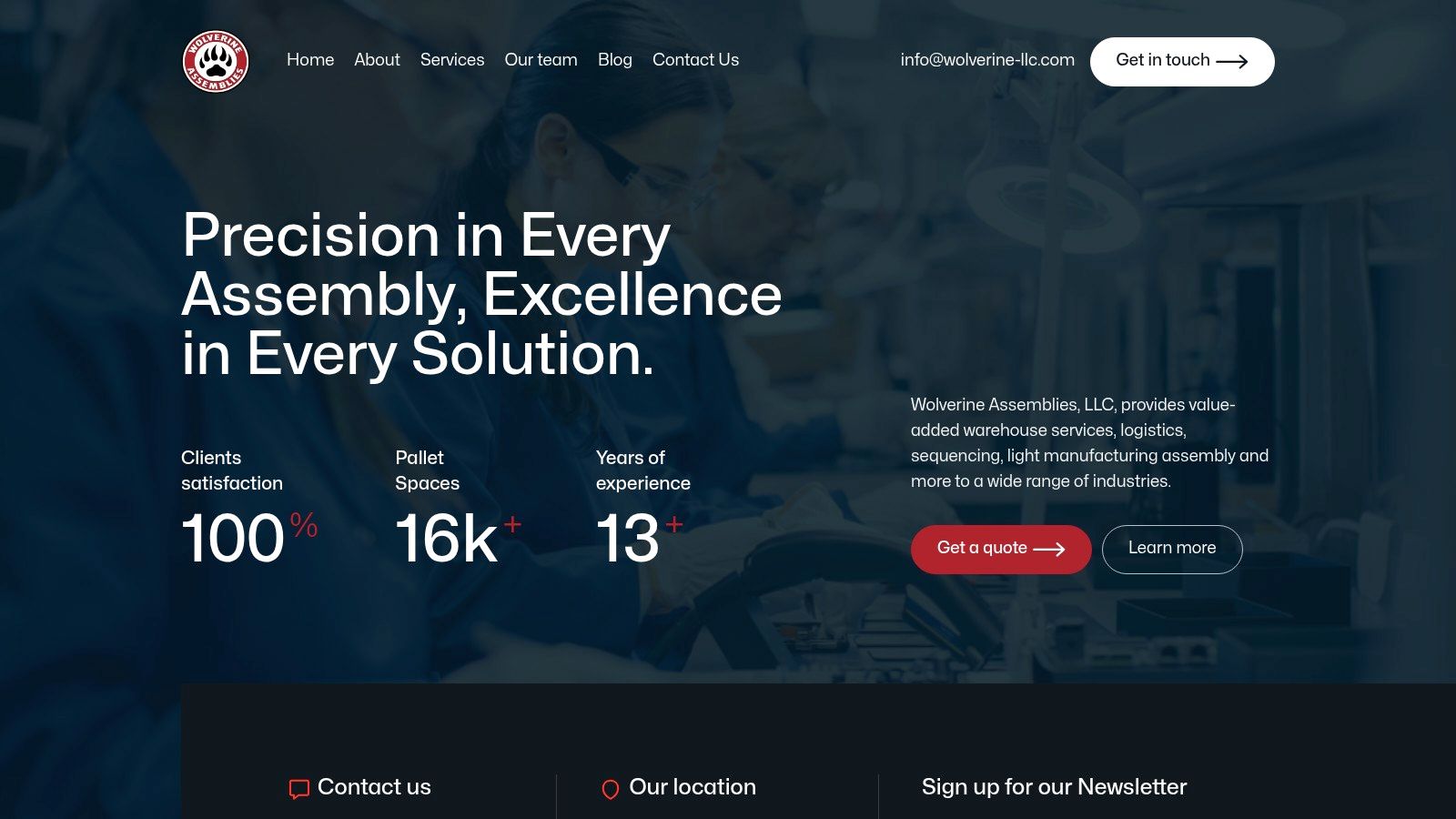
Wolverine Assemblies, LLC stands out as a premier partner for OEMs and Tier-1 suppliers, offering a robust suite of integrated services that go far beyond standard warehousing. Based in Wixom, Michigan, the heart of the automotive industry, Wolverine has built a reputation over 13+ years for precision, reliability, and an unwavering commitment to lean manufacturing principles. This focus makes them an exceptional choice for companies seeking comprehensive automotive logistics solutions that directly address supply chain complexity and cost pressures.
Their operations are designed from the ground up to meet the stringent demands of the automotive sector. Running on the powerful PLEX ERP system and offering full EDI/ASN integration, Wolverine ensures seamless communication and data exchange with client systems. This technological foundation, combined with a disciplined approach to quality control and product launches, provides the operational certainty required for just-in-time (JIT) and just-in-sequence (JIS) manufacturing environments.
Key Strengths and Capabilities
Wolverine distinguishes itself by merging traditional third-party logistics (3PL) with value-added light manufacturing. This hybrid model allows clients to consolidate multiple supply chain functions under one roof, simplifying vendor management and reducing total landed costs.
- Integrated Value-Added Services: Beyond storage, Wolverine excels in component consolidation, sub-assembly, testing, and inspection. This enables them to receive disparate parts, perform necessary assembly or quality checks, and deliver a finished sub-component directly to the production line.
- Kitting and Sequencing Excellence: A core competency is the precise execution of kitting and sequencing. By preparing and organizing components into production-ready kits, they help OEMs minimize line-side inventory, reduce assembly errors, and increase throughput. You can explore a deeper dive into their process and find out more about kitting in manufacturing on their blog.
- Substantial and Scalable Infrastructure: Their 200,000+ sq. ft. facility with over 16,000 pallet positions provides the physical capacity to handle large-scale programs for automotive, agriculture, and industrial clients. The space is flexible, accommodating complex workflows for assembly, warehousing, and international logistics management.
Strategic Advantages for OEMs and Tier-1 Suppliers
Choosing Wolverine provides more than just operational support; it offers a strategic partnership. As a certified Minority Business Enterprise (MBE), they help clients meet supplier diversity goals without compromising on quality or capability.
Furthermore, their collaboration with Gentex Corporation, a leader in electronics and automotive technology, extends their service portfolio into specialized electronics manufacturing and warehousing. This unique partnership provides clients access to a broader range of expertise, particularly for projects involving advanced vehicle components.
Service Highlights
Access and Engagement
Wolverine Assemblies does not offer public pricing, as their solutions are tailored to specific client needs, scope, and complexity. To engage their services, prospective customers must request a custom quote. This process allows for a detailed discovery phase where Wolverine’s team can analyze a client’s unique supply chain challenges and engineer a solution that maximizes efficiency and cost-effectiveness.
Pros:
- OEM-Ready Operations: PLEX ERP, EDI/ASN, and rigorous quality discipline ensure full compliance.
- Flexible, High-Capacity Facility: Accommodates large-scale kitting, assembly, and warehousing programs.
- Broad Value-Added Services: Reduces supply chain complexity and total landed cost for clients.
- MBE Certification & Gentex Partnership: Adds supplier diversity benefits and electronics expertise.
- Proven Customer Satisfaction: Testimonials confirm a track record of reliability and on-time delivery.
Cons:
- No Public Pricing: Requires direct contact for a quote, which may slow initial cost analysis.
- Single Primary Facility: Centrally located in Michigan, but multi-region programs may require additional logistics planning.
Learn more at Wolverine Assemblies, LLC
2. Ryder – Automotive Supply Chain Solutions
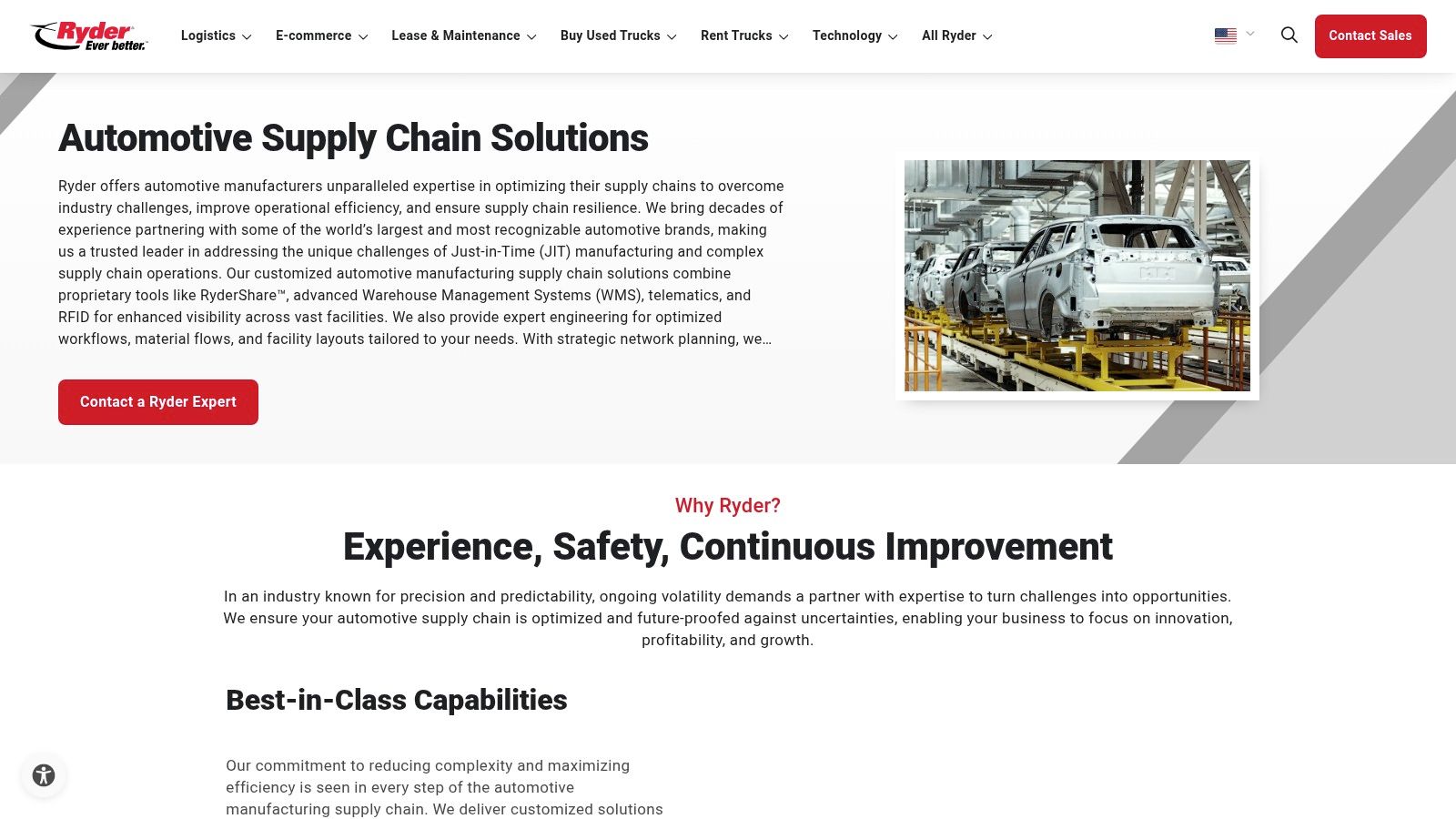
Ryder stands out as an integrated, end-to-end provider of automotive logistics solutions, particularly for OEMs and Tier 1 suppliers with complex, high-volume operations spanning North America. The company leverages its massive asset base, including a dedicated fleet and extensive warehousing network, to offer a bundled service model that consolidates transportation, logistics, and fleet management under a single, accountable partner. This integrated approach is ideal for enterprises seeking to simplify vendor management and achieve network-wide visibility.
Ryder’s core strength lies in its ability to engineer and execute inbound-to-manufacturing logistics with precision, supporting Just-in-Time (JIT) and Just-in-Sequence (JIS) delivery models. This includes in-plant services where Ryder manages material flow directly on the factory floor, ensuring components arrive at the line exactly when needed. This service is a key differentiator, as it deeply integrates Ryder's operations with the client's production schedule, a critical factor in modern lean manufacturing environments.
Key Features and Strategic Advantages
Ryder’s service portfolio is designed for comprehensive supply chain control, managed through its proprietary technology platform, RyderShare™. This platform provides a unified view of all logistics activities, integrating data from its Warehouse Management System (WMS), Transportation Management System (TMS), and vehicle telematics for real-time tracking and exception management.
- Integrated Fleet and Transportation: Ryder offers dedicated transportation, fleet leasing, rentals, and maintenance. This provides operational flexibility, allowing clients to scale capacity up or down without significant capital investment in their own fleets.
- Value-Added Warehousing: Beyond standard storage, Ryder performs critical value-added services like sub-assembly, kitting, and sequencing. This pre-production preparation helps streamline the final assembly process for OEMs.
- North American Footprint: A significant advantage is Ryder’s deep expertise in cross-border logistics between the U.S., Mexico, and Canada. They manage customs, compliance, and transportation complexities, providing a seamless corridor for parts and finished vehicles.
- End-to-End Solutions: Ryder covers the entire lifecycle, from inbound parts logistics and aftermarket parts distribution to finished-vehicle yard management.
Engagement and Implementation
Engaging with Ryder typically involves a formal enterprise-level process, starting with a Request for Proposal (RFP) and detailed solution design. Pricing and Service Level Agreements (SLAs) are customized based on the scope and complexity of the required services, meaning there is limited public transparency on costs. This model is best suited for large-scale, long-term partnerships rather than smaller, ad-hoc projects. This comprehensive approach is a hallmark of a mature third-party logistics provider, designed for deep operational integration. For effective implementation, stakeholders should prepare detailed process maps and volume forecasts to facilitate an accurate solution design.
Website: Ryder Automotive Supply Chain Solutions
3. Penske Logistics – Automotive Logistics Services
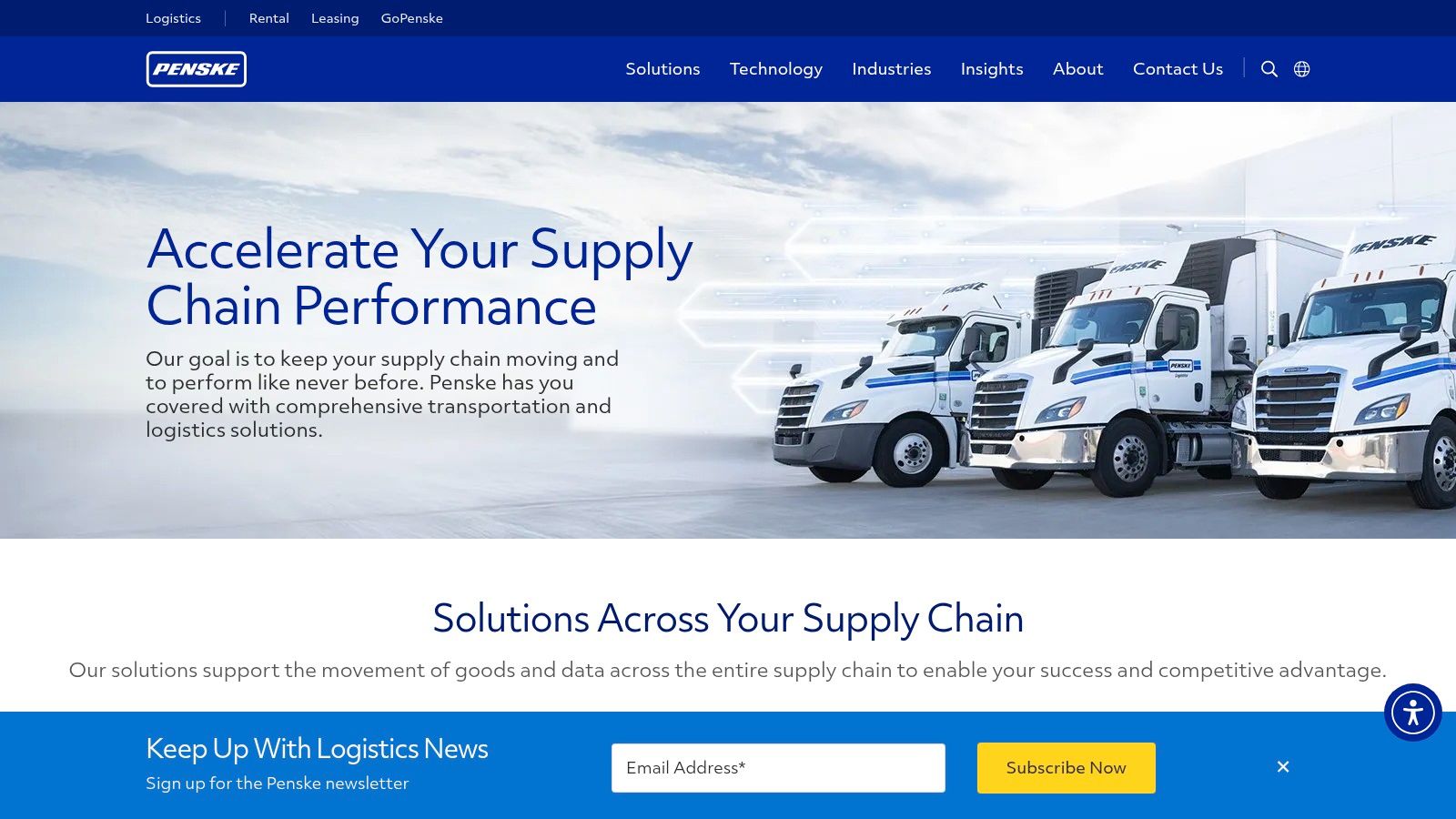
Penske Logistics provides a powerful suite of automotive logistics solutions tailored for OEMs and Tier 1 suppliers that require operational scale and proven execution, particularly within the U.S. The company has a long-standing history working with major automakers, offering a robust playbook for transportation management, distribution center operations, and sophisticated lead logistics (LLP/4PL) services. Their approach is ideal for organizations seeking a partner with deep experience in managing complex inbound-to-manufacturing flows and service-parts distribution networks.
Penske's primary strength lies in its ability to engineer and manage high-velocity supply chains, specifically through its Just-in-Time (JIT) and Just-in-Sequence (JIS) programs. These services are designed to feed production lines with absolute precision, minimizing on-site inventory and maximizing manufacturing efficiency. By blending transportation, warehousing, and visibility tools, Penske acts as a central command for critical component and material movements, making them a strategic choice for manufacturers focused on lean operational models.
Key Features and Strategic Advantages
Penske’s service offerings are built for large-scale, intricate supply chains, providing centralized management through its control-tower visibility tools and advanced analytics. This technological layer allows for proactive monitoring and management of the entire logistics network, from supplier shipments to final delivery at the assembly plant.
- Engineered JIT/JIS Solutions: Penske excels at designing and executing production-feeding programs that deliver parts to the line at the exact moment and in the correct sequence, a critical requirement for modern automotive assembly.
- Lead Logistics (LLP/4PL): As a lead logistics provider, Penske can manage a client's entire supply chain, including other 3PLs, carriers, and suppliers. This single point of contact simplifies complex network management.
- Production Warehouse Management: Their services extend beyond simple storage to include managing in-plant or near-plant warehouses responsible for feeding the production line, ensuring a seamless flow of materials.
- Control-Tower Visibility: Penske provides sophisticated visibility tools and analytics, giving clients a real-time, comprehensive view of their supply chain to identify inefficiencies and mitigate disruptions.
Engagement and Implementation
Engaging with Penske is an enterprise-level endeavor, typically initiated through a formal RFP process where solutions are custom-engineered to meet specific client needs. Pricing is entirely customized based on the scope, scale, and complexity of the required services, with no standard rates available publicly. This model is best suited for large organizations planning long-term, strategic partnerships. Prospective clients should be prepared for a detailed discovery and onboarding phase, as technology integrations and process alignments can take time to implement effectively.
Website: Penske Logistics Automotive Solutions
4. DHL Supply Chain (U.S.) – Auto-Mobility Logistics
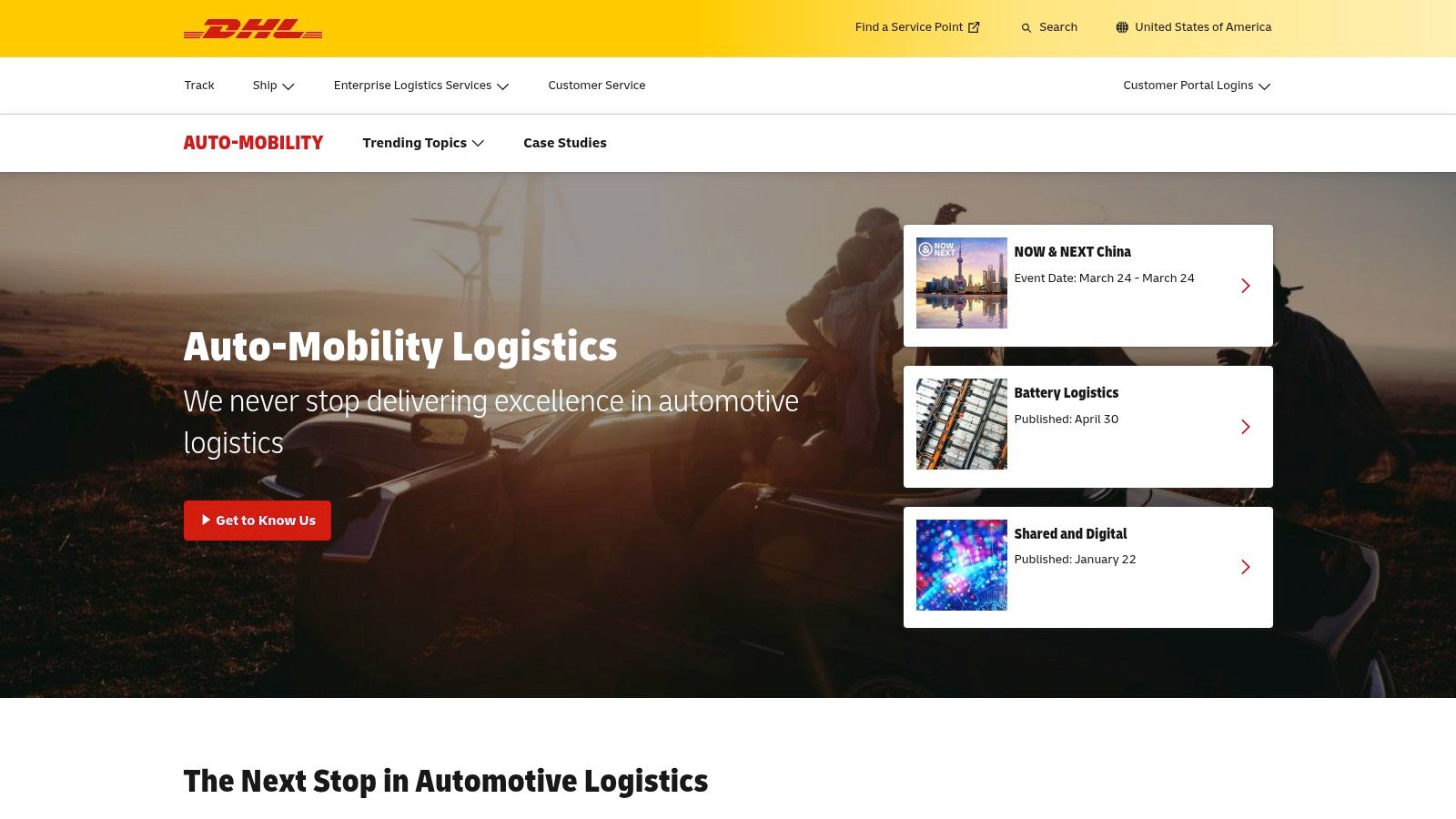
DHL's Auto-Mobility division offers a formidable suite of automotive logistics solutions tailored for global manufacturers with a strong operational presence in the United States. The company distinguishes itself by blending its extensive worldwide network with deep U.S. market specialization, creating a powerful offering for OEMs and Tier 1 suppliers managing multinational programs. DHL focuses on providing highly reliable inbound-to-manufacturing services, including sophisticated Just-in-Time (JIT) and Just-in-Sequence (JIS) delivery models, which are critical for maintaining production velocity in lean manufacturing environments.
A key differentiator for DHL is its forward-looking investment in Electric Vehicle (EV) and battery logistics. As the industry pivots, DHL has developed specialized capabilities for the safe handling, storage, and transportation of lithium-ion batteries and other high-value EV components. This focus makes DHL an ideal partner for manufacturers navigating the unique supply chain challenges presented by vehicle electrification, from raw material inbound to finished battery pack distribution.
Key Features and Strategic Advantages
DHL’s Auto-Mobility solutions are managed through a "control tower" model, which centralizes visibility and decision-making for complex supply chains. This approach, powered by advanced analytics and inventory management tools, provides clients with a holistic view of their logistics network, enabling proactive risk management and optimization. Their vertical-specific experience is backed by a portfolio of robust automotive case studies.
- Comprehensive Service Spectrum: DHL supports the entire automotive lifecycle, from inbound and in-plant logistics to aftermarket parts distribution and specialized EV solutions. This includes essential value-added services like kitting, packing, and sequenced line-side feeding.
- EV & Battery Logistics Expertise: The company offers certified solutions for handling dangerous goods, including battery warehousing, specialized packaging, and compliant transportation, addressing a critical and growing need within the automotive sector.
- Global Network with U.S. Focus: DHL’s ability to manage global supply chains while executing with localized precision in the U.S. simplifies international program design and implementation for multinational corporations.
- Control Tower Visibility: The use of centralized control towers and advanced visibility platforms allows for real-time tracking, performance monitoring, and data-driven insights to improve inventory management and operational efficiency.
Engagement and Implementation
Partnering with DHL for automotive logistics typically follows an enterprise contracting model. The process begins with in-depth consultations to analyze the client's specific supply chain needs, leading to a customized solution design and a formal proposal. This approach is not optimized for small, ad-hoc shipments but is designed for large-scale, strategic partnerships. Prospective clients should be aware that lead times and specific service details can be influenced by broader regulatory changes and parcel market sensitivities. For a successful engagement, it is crucial to provide detailed forecasts and operational data to allow DHL to architect a solution that aligns precisely with production and distribution requirements.
Website: DHL Auto-Mobility Logistics
5. CEVA Logistics – Automotive & Tyres Solutions
CEVA Logistics positions itself as a global specialist in automotive logistics solutions, catering to OEMs and Tier 1 suppliers who require intricate, multi-modal supply chains. The company excels in providing end-to-end management, from inbound component transport to finished vehicle delivery, with a strong focus on global freight management and complex in-plant operations. This makes CEVA a compelling choice for manufacturers with international production footprints, particularly those navigating the complexities of electric vehicle (EV) and battery logistics.
CEVA’s core differentiator is its integrated Lead Logistics Provider (LLP) or 4PL model, where it acts as the primary orchestrator of a client's entire supply chain. This approach goes beyond standard transportation, encompassing network design, carrier management, and in-plant services like line-side feeding, kitting, and sequencing. By managing these critical functions, CEVA enables manufacturers to maintain lean inventories and high-velocity production schedules, a necessity in the competitive automotive landscape.
Key Features and Strategic Advantages
CEVA’s service offerings are built around a control tower methodology, providing centralized visibility and management across disparate logistics functions. This is enabled by robust EDI/API integrations that connect CEVA’s systems with client ERPs and other partner platforms, ensuring a single source of truth for tracking, performance analytics, and exception handling.
- Global Freight and Inbound Management: CEVA manages complex inbound flows using various transport modes, including air, ocean, FTL, and LTL. They specialize in optimizing routes and executing milk runs to consolidate shipments and reduce transportation costs.
- Specialized In-Plant Services: CEVA provides hands-on support directly within the manufacturing plant, including metering parts to the assembly line, sub-assembly, sequencing, and managing reusable packaging programs to minimize waste and cost.
- EV and Battery Logistics: A key advantage is CEVA's proven capability in handling the unique compliance and safety requirements for EV batteries, offering specialized warehousing, transportation, and aftermarket services.
- Finished-Vehicle Logistics (FVL): The company has deep expertise in managing the entire outbound process, from plant exit to dealer delivery, including yard management, post-production modifications, and international shipping for both Completely Knocked-Down (CKD) and Semi-Knocked-Down (SKD) kits.
Engagement and Implementation
Partnering with CEVA is best suited for large-scale, strategic engagements, often spanning multiple sites or countries. The process typically begins with a detailed discovery and solution engineering phase to map out existing processes and design an optimized logistics network. Pricing is highly customized and determined by the scope, scale, and specific service-level agreements required, meaning costs are not publicly available. Potential clients should be prepared for a collaborative implementation process that requires significant data sharing and system integration to unlock the full value of CEVA’s control tower and visibility platforms. This model is ideal for enterprises seeking a long-term partner to manage and continuously improve their global automotive supply chain.
Website: CEVA Logistics Automotive & Tyres Solutions
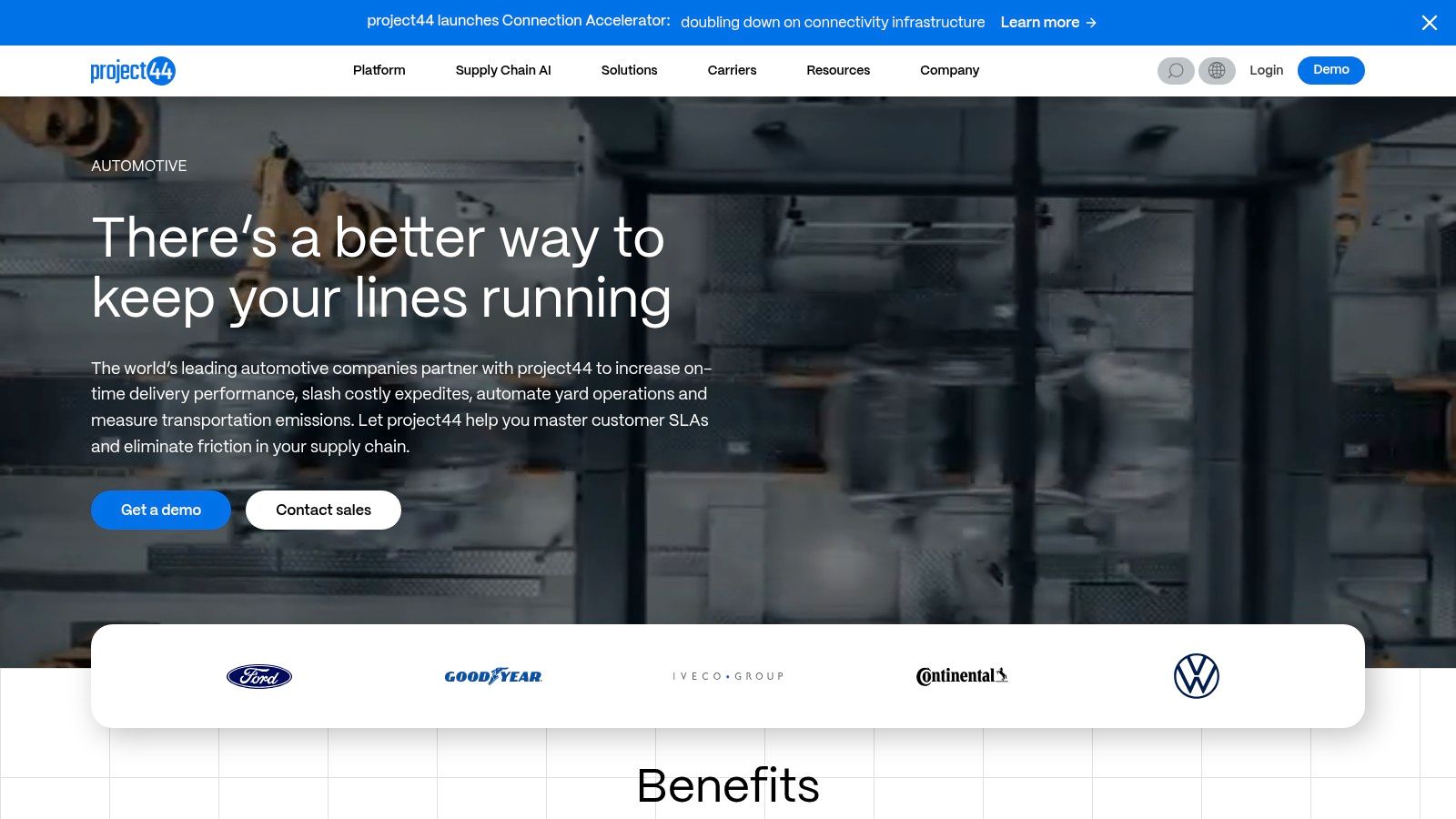
6. project44 – Automotive Supply Chain Visibility Platform
project44 is not a traditional logistics provider but a high-fidelity, real-time transportation visibility platform that offers powerful automotive logistics solutions by layering intelligence over existing carriers and 3PLs. It is designed for OEMs and Tier 1 suppliers who need to consolidate data from disparate sources (ocean, air, rail, truck, RoRo) into a single pane of glass. The platform’s primary value is in transforming reactive supply chain management into a proactive, predictive model, enabling users to prevent plant disruptions and manage dynamic ETAs for inbound parts.
The core differentiator for project44 is its focus on pure visibility and decision intelligence. Unlike asset-based providers, it does not manage physical freight. Instead, it ingests and normalizes vast amounts of data from a massive network of connected carriers, telematics devices, and TMS/ERP systems. This allows automotive supply chain managers to track inbound components with precision, identify potential delays before they impact production, and reduce costly expedited freight by improving planning and exception management.
Key Features and Strategic Advantages
project44’s Movement Platform provides end-to-end visibility and workflow automation, with specific use cases tailored for the high-stakes automotive industry. It helps answer the critical question, "Where is my stuff, and when will it actually arrive?" by leveraging machine learning to provide more accurate, predictive ETAs than standard carrier updates.
- End-to-End Multimodal Visibility: The platform tracks shipments across all modes, including ocean containers, air freight, railcars, and truckloads. This is crucial for global automotive supply chains where a single part may travel via multiple modes.
- Automotive-Specific Use Cases: Features are designed to address key industry pain points like inbound parts visibility for Just-in-Time manufacturing, shutdown prevention through proactive alerting, and finished vehicle tracking (including RoRo).
- Yard and Appointment Orchestration: The platform can help manage and optimize dock scheduling and yard movements, reducing carrier dwell times and demurrage fees, which are common issues at large manufacturing plants.
- Large Connected Network: project44’s key asset is its extensive network of pre-integrated carriers and data sources, which accelerates implementation and provides broad coverage without requiring one-off integrations for each logistics partner.
- Emissions Reporting: It provides detailed emissions dashboards based on GLEC methodology, helping companies track and report on their Scope 3 transportation emissions, a growing requirement for automotive OEMs.
Engagement and Implementation
Engaging with project44 is an enterprise-level commitment. The process involves a discovery phase to understand the client's existing technology stack, carrier network, and key visibility gaps. Pricing is usage-based and customized, typically requiring a significant investment. As it serves as a visibility layer, successful implementation requires dedicated IT resources to manage API integrations with existing ERP, TMS, and WMS systems. The platform is best suited for large organizations that already have a complex network of logistics partners but lack a unified way to see and manage it. This approach highlights the critical difference between the tools for logistics with supply chain management and the physical execution of services.
Website: project44 Automotive Industry Solutions
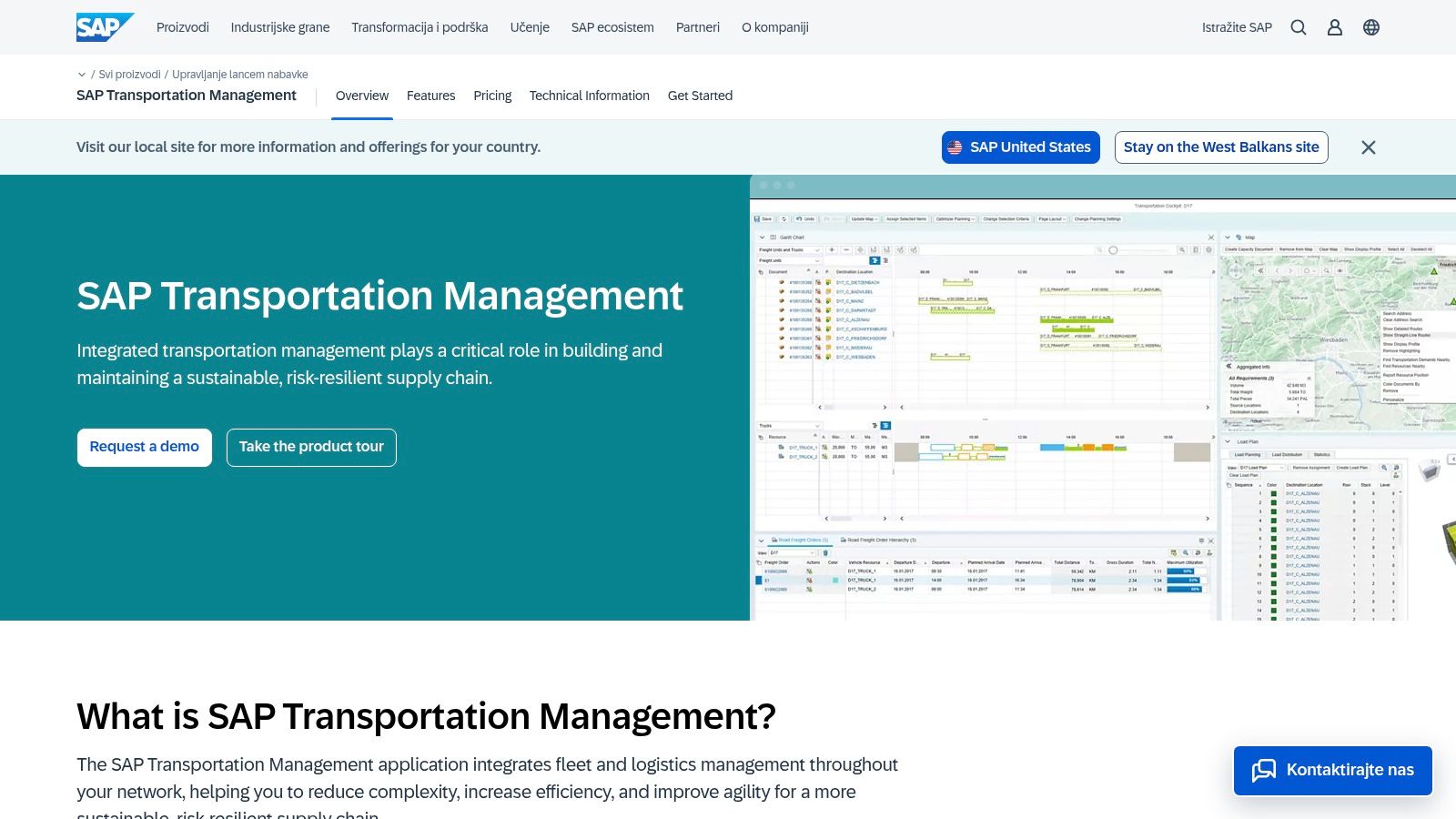
7. SAP Transportation Management (SAP TM)
For OEMs and Tier 1 suppliers already invested in the SAP ecosystem, SAP Transportation Management (SAP TM) offers a deeply integrated automotive logistics solutions platform. It operates not as a standalone 3PL service but as an enterprise software system designed to centralize and optimize all transportation activities within an organization's existing SAP S/4HANA environment. This native integration makes it the logical choice for companies seeking to manage transportation planning, execution, and settlement using the same master data and financial frameworks that govern their production and supply chain operations.
SAP TM's primary distinction is its ability to create a single source of truth for all freight-related processes, from demand planning to carrier settlement. It provides a robust framework for managing complex inbound and outbound logistics, including multi-modal and international shipments. For the automotive industry, this means tighter control over component flows, better visibility into in-transit inventory, and streamlined financial reconciliation, all within a familiar enterprise resource planning (ERP) interface.
Key Features and Strategic Advantages
SAP TM is architected to handle the scale and complexity of global automotive supply chains. It provides advanced planning and optimization engines that automate load building, carrier selection, and route determination based on cost, transit time, and business constraints. The platform is designed for logistics and supply chain managers who need to translate production schedules into actionable transportation plans.
- Deep S/4HANA Integration: SAP TM shares master data (e.g., vendors, materials, plants) with SAP S/4HANA, eliminating data silos and ensuring consistency between logistics, finance, and manufacturing modules. This is its most significant competitive advantage.
- Comprehensive Lifecycle Management: The system covers the entire transportation lifecycle, including demand planning, optimization, interactive tendering with carriers, freight execution and tracking, and automated freight settlement and auditing.
- Compliance and Hazardous Goods: It includes embedded functionalities for managing trade compliance documentation and handling regulations for hazardous materials, a critical requirement for transporting items like batteries and chemicals.
- Embedded Analytics: The platform provides real-time dashboards and KPI monitoring, allowing transportation managers to track performance, identify bottlenecks, and make data-driven decisions to improve efficiency and reduce costs.
Engagement and Implementation
Adopting SAP TM is a significant enterprise IT project, not a simple software subscription. Engagement typically begins with a detailed business case analysis and solution architecture design, often involving SAP implementation partners. The process requires substantial investment in licensing, integration, configuration, and change management to align the system with specific business processes.
Licensing and implementation costs are not publicly listed and are subject to multi-year enterprise agreements tailored to the user count and functional scope. This model is exclusively suited for large enterprises that are committed to the SAP platform for their core business functions. A successful implementation requires dedicated project teams, strong executive sponsorship, and a clear understanding of existing transportation workflows to ensure the system is configured to deliver the expected ROI.
Website: SAP Transportation Management
7-Provider Automotive Logistics Comparison
Choosing Your Partner for a Resilient Supply Chain
Navigating the landscape of modern automotive logistics solutions is less about finding a single "best" provider and more about architecting a resilient, integrated ecosystem. The tools and partners discussed in this guide, from full-service 3PLs like Wolverine Assemblies and Penske to specialized visibility platforms like project44, represent distinct but potentially complementary pieces of a complex operational puzzle. Your final decision must be anchored in a clear understanding of your specific production needs, technological infrastructure, and strategic growth objectives.
The core takeaway is that a reactive approach to logistics is no longer viable. Proactive, data-driven partnerships are the new standard for success. A truly effective logistics strategy is one that transforms the supply chain from a cost center into a competitive advantage, enabling you to reduce total cost-to-serve, mitigate risks from global disruptions, and maintain the rigorous launch discipline that OEMs demand.
From Strategy to Implementation: Your Actionable Next Steps
The transition from evaluating options to implementing a new logistics framework requires careful planning. The most successful integrations are not merely technology deployments; they are strategic changes that align people, processes, and platforms. As you move forward, prioritize these critical steps:
- Conduct a Comprehensive Needs Analysis: Before engaging any provider, map your current process flows. Identify specific pain points, whether they are in warehousing efficiency, kitting accuracy, sub-assembly quality, or international freight visibility. Quantify the impact of these issues in terms of cost, time, and risk.
- Evaluate Technological Compatibility: Your logistics partner must integrate seamlessly into your existing tech stack. For many Tier 1 suppliers, this means native compatibility with ERP systems like PLEX. Assess a potential partner’s EDI capabilities, ASN protocols, and API readiness to ensure a smooth flow of critical data without manual intervention.
- Scrutinize Quality and Compliance Records: In the automotive sector, quality is non-negotiable. Request documentation on quality management systems (like IATF 16949 certification), review performance KPIs from similar clients, and understand their processes for non-conformance and continuous improvement. This diligence is crucial for protecting your own reputation and production continuity.
Key Factors for Selecting Your Automotive Logistics Solutions Partner
Beyond the services offered, the right partner brings strategic value that enhances your operational capabilities. As you vet your options, weigh these factors heavily:
- Geographic Proximity and Network Reach: For Midwest-based operations, a partner with a strong regional footprint can significantly reduce transit times and costs. Conversely, for global supply chains, a provider’s international network and customs expertise are paramount. For OEMs and Tier 1s, selecting the right partner is crucial, and utilizing a specialized vehicle import broker can significantly streamline cross-border movements of vehicles or components.
- Scalability and Flexibility: Your production volumes will fluctuate. Your logistics partner must demonstrate the ability to scale services up or down in response to demand shifts, new model launches, or unexpected disruptions. A rigid, one-size-fits-all solution introduces risk.
- Expertise in Value-Added Services: The greatest efficiency gains often come from value-added services like kitting, sequencing, and light sub-assembly. A partner who masters these disciplines, like Wolverine Assemblies, can deliver production-ready components just-in-time, directly to your line, simplifying your internal processes and reducing floor space requirements.
Ultimately, the goal is to build a partnership, not just to hire a vendor. The ideal collaborator for your automotive logistics solutions will function as an extension of your own team, deeply invested in your operational success and committed to driving efficiency and resilience into every link of your supply chain.
Ready to enhance your Midwest manufacturing operations with a partner dedicated to precision and quality? Discover how Wolverine Assemblies, LLC provides expert value-added services, including kitting, sequencing, and light assembly, fully integrated with your PLEX ERP. Visit our website to learn how our tailored automotive logistics solutions can strengthen your supply chain.
Subscribe to our weekly newsletter