.png)
Your Guide to a Third-Party Logistics Provider 3PL
Discover how a third-party logistics provider 3PL can transform your supply chain. Learn about core services, benefits, and how...

At its core, a third-party logistics (3PL) provider is an outsourced partner you bring in to manage your company's warehousing, distribution, and fulfillment operations. Think of them as the operational quarterback for your supply chain. They handle the complex plays of getting parts and products where they need to be, when they need to be there, so you can focus on designing and building great things.
Unpacking the Role of a 3PL Partner
Put simply, a third-party logistics provider (3PL) is a specialist you hire to run crucial parts of your supply chain. Instead of sinking capital into your own buildings, equipment, and a dedicated logistics team, you partner with an expert who already has the infrastructure, technology, and people ready to go.
This relationship goes far beyond just renting shelf space. A true 3PL acts as a seamless extension of your own team, integrating deeply into your supply chain. For an Original Equipment Manufacturer (OEM) or a Tier 1 supplier in the automotive world, this means trusting a partner to execute mission-critical tasks with absolute precision. The whole point is to unlock efficiencies that are tough and expensive to build from scratch.
Moving Beyond Basic Storage
A modern 3PL offers much more than just a roof over your inventory. They become a genuine strategic asset by providing value-added services that directly boost your production and delivery speed. It’s this shift from a simple vendor to a true operational partner that really defines a modern 3PL relationship.
Some of their most critical functions include:
- Inventory Management: Using sophisticated software to track every component, prevent stockouts, and ensure parts are on hand the moment they're needed.
- Order Fulfillment: The physical work of picking, packing, and shipping products to end-users or delivering them directly to your assembly lines.
- Specialized Services: Handling complex tasks like kitting (bundling different parts into a single package) or sequencing (delivering components in the exact order needed for manufacturing).
The Strategic Value for Manufacturers
For industrial and automotive companies, bringing on a 3PL is all about sharpening focus and achieving operational excellence. Trying to manage logistics internally can drain massive resources and pull attention away from what you’re actually good at—engineering, product innovation, and quality control.
A partnership with the right 3PL allows a business to focus on what it does best—innovating and manufacturing—while leaving the complexities of logistics to a dedicated expert. This strategic delegation is a powerful lever for growth and efficiency.
Providers like Wolverine Assemblies are a perfect example of this model in action. By taking on the end-to-end supply chain needs for OEMs, they help clients slash their operational headaches, improve on-time delivery, and scale their business more flexibly. Logistics stops being a cost center and starts becoming a competitive advantage.
To dig deeper into the nuts and bolts of these operations, check out our guide to effective distribution and warehousing strategies.
Diving Into the Core Services of an Advanced 3PL Partner
The image of a 3PL as just a big, quiet warehouse is long outdated. While storage is certainly part of the equation, the real power of a modern third-party logistics provider (3PL) comes from a suite of specialized, value-added services that are anything but passive.
For OEMs and industrial clients, these services aren't just convenient add-ons; they are integral to production efficiency, cost control, and supply chain resilience. Think of it this way: a basic warehouse is a storage locker for your parts, but a true 3PL partner is the high-performance pit crew for your assembly line—preparing, organizing, and delivering everything with precision timing.
Let's break down the key services that make this happen.
A Breakdown of Key 3PL Value-Added Services
A skilled 3PL integrates several key functions to create a seamless flow from their facility to your production floor. The table below outlines how these core services work and the direct benefits they bring to your operation.
These services don’t operate in silos. They are woven together to form a cohesive, strategic extension of your own manufacturing capabilities.
From Simple Storage to Strategic Distribution
At its foundation, any 3PL operation needs a top-notch warehouse. But an advanced partner treats this space as a dynamic hub, not just a holding area. Every square foot is optimized for efficiency, powered by a robust Warehouse Management System (WMS) that provides a live, accurate view of all your inventory.
For an industrial client, this means components aren't just sitting on a shelf. They are being actively managed to prevent the stockouts that can shut down a line or the overstock that eats into your cash flow. Distribution becomes a strategic function, engineered to move parts from the warehouse to your factory with maximum speed and reliability.
The Fine Art of Kitting and Sequencing
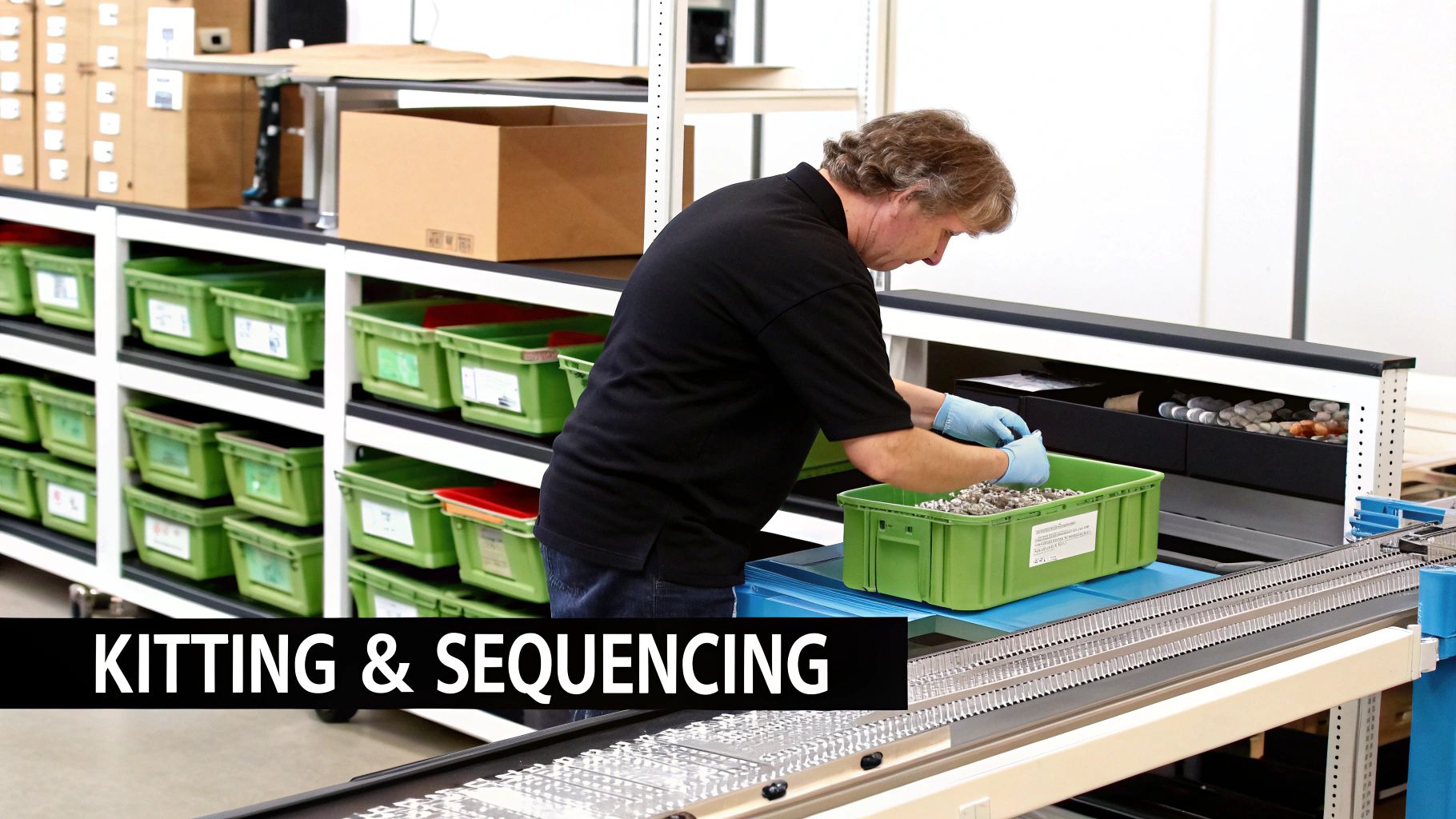
For any company with a complex assembly process—especially in automotive and industrial manufacturing—kitting and sequencing are game-changers. These services take raw inventory and transform it into production-ready sets, delivered just-in-time and just-in-sequence.
Kitting: This is the process of collecting all the individual parts needed for one assembly task and packaging them together into a single unit or "kit." An assembly worker no longer has to hunt for 20 different parts in various bins; they simply grab one organized kit.
Sequencing: Taking it a step further, sequencing means delivering these kits or individual parts to the line in the precise order they’ll be used. This is mission-critical for building products with multiple variations, like a car with different trim levels.
By taking on these meticulous tasks, a third-party logistics provider (3PL) strips complexity away from your factory floor. It allows your team to focus on what they do best: building your product. If you want to dig deeper, you can explore the strategic benefits of kitting and assembly in our detailed guide.
Smart Outsourcing With Light and Sub-Assembly
Another high-impact service is light assembly, where the 3PL handles preliminary assembly work before the parts even get to you. This might involve combining a few components into a sub-assembly, performing a basic quality inspection, or adding labels.
This pre-assembly work effectively extends your production line into the 3PL's facility. It offloads non-core tasks from your team, freeing up valuable space and labor for more critical manufacturing stages and helping you eliminate bottlenecks.
By outsourcing light assembly, a manufacturer can reduce bottlenecks and reallocate internal resources to more complex, higher-value production stages. It’s a powerful strategy for improving overall operational velocity.
Tying It All Together With Technology: EDI and ERP
Technology is the glue that holds all these services together. A sophisticated third-party logistics provider (3PL) doesn’t just work for you; it integrates with you, creating a seamless, transparent flow of information.
Two key technologies make this happen:
Electronic Data Interchange (EDI): Think of EDI as a direct, automated language that lets the 3PL's systems and your systems "talk" to each other. It replaces manual emails and paperwork with a standardized, error-free exchange of purchase orders, invoices, and other crucial data.
Advance Shipping Notice (ASN): An ASN is an EDI document that gives you a heads-up about an incoming shipment. It details precisely what's in the shipment and when it will arrive, allowing your receiving team to be fully prepared.
When a 3PL integrates these tools directly with a client’s Enterprise Resource Planning (ERP) system, like PLEX, it creates a powerful, unified view of the entire supply chain. This gives you the real-time data and control needed to make smart decisions and drive continuous improvement.
The Strategic Edge of a 3PL Partnership
Making the move to a third-party logistics (3PL) provider isn't just about outsourcing a function—it's a strategic play to build a more resilient, efficient, and scalable business. For OEMs and Tier 1 suppliers, a great 3PL partnership transforms logistics from a necessary evil and massive cost center into a genuine competitive advantage. The benefits ripple through your entire operation, from the balance sheet all the way to the factory floor.
Think about it. Instead of tying up millions in capital to build warehouses, buy forklifts, and hire specialized staff, you get immediate access to top-tier infrastructure. This frees up your capital for what you do best: research, product development, and engineering. You're essentially converting a huge fixed cost into a predictable, variable expense that scales with your actual business volume.
Drive Down Your Operational Costs
Let's be honest, one of the biggest draws of a 3PL is the direct impact on your bottom line. These providers operate at a scale most individual companies simply can't achieve on their own, and that scale creates efficiencies that put real money back in your pocket. A key advantage here is having an expert focused on finding effective strategies for reducing operational costs throughout your supply chain.
By working with a 3PL, you gain access to:
- Better Freight Rates: 3PLs bundle shipments from all their clients, giving them serious bargaining power with carriers. The result? Lower transportation costs for you.
- Smarter Labor Management: You sidestep the entire headache of hiring, training, and managing a logistics team, not to mention the costs of benefits and payroll taxes.
- Lower Overhead: All those nagging expenses—facility maintenance, utilities, insurance, and warehouse technology—are handled by the provider.
This model plugs you into a culture of lean, continuous improvement, where the primary goal is to strip out waste and lower your total landed cost.
Unlock True Operational Flexibility
Market demand is anything but predictable. It skyrockets during a new program launch and can pull back just as quickly during economic shifts. A 3PL partner gives you the operational elasticity you need to ride these waves without breaking a sweat.
When a sudden surge in demand hits, a 3PL can ramp up labor, warehouse space, and transportation almost instantly. On the flip side, during slower months, you’re not stuck paying for a massive, half-empty facility and an idle workforce. This kind of agility is invaluable for de-risking complex launches and ensuring you can scale up production without being bottlenecked by your own logistics footprint.
The ability to scale operations up or down seamlessly is a defining benefit of outsourcing to a 3PL. It allows businesses to remain agile and responsive to market demands without the burden of fixed infrastructure costs.
Gain an Edge with Specialized Expertise
Logistics is its own complex world, and mastering it requires 100% focus. A third-party logistics provider (3PL) brings that dedicated expertise, along with battle-tested processes and advanced technology. For your business, that expertise translates directly into higher efficiency.
There's a reason this industry is booming. The global third-party logistics market was valued at around USD 1.15 trillion and is on track to hit USD 2.57 trillion. That growth is fueled by companies needing this exact kind of specialized knowledge. With 95% of online retailers now using 3PLs, businesses are reporting 91% improved customer satisfaction, all thanks to the optimization and real-time tracking these partners deliver.
A 3PL's singular focus allows them to perfect services like just-in-time sequencing and kitting, which can dramatically improve your assembly line throughput. Their investments in powerful Warehouse Management Systems (WMS) and EDI integration provide a level of inventory accuracy and supply chain visibility that's incredibly expensive and difficult to replicate in-house. By handing off these functions, you let your team get back to focusing on their core strengths, driving innovation and better overall performance.
What's Fueling the Global 3PL Market?
The explosive growth of the third-party logistics (3PL) industry isn't happening by chance. It's a direct response to some massive economic forces that are fundamentally changing how business gets done across the globe. For any company, especially in manufacturing, seeing these trends clearly is the first step to understanding why a 3PL partner isn't just a vendor—it's a strategic necessity.
At the heart of this shift are two major trends: the unstoppable rise of e-commerce and the tangled web of today's global supply chains. As businesses sell to customers on every continent, the simple act of moving parts and products becomes incredibly complex. This is where a specialized partner becomes essential, bringing the infrastructure, technology, and deep-seated expertise needed to cut through the chaos.
The New Map of Global Manufacturing
Manufacturing isn't just happening in one place anymore. Production is spreading out across the world, and logistics networks have to keep up. You might have a component made in one country, shipped to another for assembly, and finally sold in a dozen others. Each step introduces new transportation hurdles, customs paperwork, and compliance headaches.
A great 3PL partner acts as the central nervous system for these sprawling supply chains. They orchestrate the movement of goods and information, giving companies the agility to thrive no matter how spread out they are.
The market numbers tell the same story. The Asia Pacific region is set to command the global 3PL market, projected to hold a 42.4% share as it grows from USD 550 billion to USD 1,110 billion. While North America is the next largest market, its importance can't be understated, with the U.S. alone making up 86% of the activity here. This highlights just how critical strong regional logistics partners are. You can dive deeper into these trends in the full global 3PL market research from Precedence Research.
Technology Is No Longer Optional
You can't solve modern logistics problems with clipboards and forklifts alone. The constant demand for more visibility, faster turnarounds, and near-perfect accuracy has made technology the backbone of any serious 3PL operation. The best providers are pouring resources into systems that create a seamless data connection between their operations and their clients'.
This focus on technology is a primary reason the industry is booming. Sophisticated 3PLs now offer capabilities that were once unheard of:
- AI-Powered Optimization: Artificial intelligence crunches massive amounts of data to find the smartest shipping routes, forecast inventory needs, and even redesign warehouse layouts for peak efficiency.
- Real-Time Visibility Platforms: Clients now expect to know exactly where their inventory is at all times, whether it's sitting on a warehouse shelf or moving on a truck. This level of transparency is vital for just-in-time manufacturing and smart planning.
- Deep ERP Integration: A modern third-party logistics (3PL) provider doesn't just wait for a purchase order. Their systems talk directly to their client's ERP, automating everything from order entry to final invoicing.
For manufacturers in high-stakes industries like automotive or heavy equipment, finding a tech-forward 3PL in a crucial region like North America isn't just a nice-to-have. It’s a foundational requirement for staying competitive in a world that’s moving faster than ever.
How to Choose the Right 3PL Provider
Picking a third-party logistics (3PL) provider is a huge decision, one that ripples through your entire operation, affecting everything from efficiency to customer happiness and, ultimately, your bottom line. This isn't just about finding a place to store your inventory. It’s about finding a strategic partner whose skills, culture, and technology actually fit with where your business is headed.
Rushing this process or just picking the cheapest option is a recipe for disaster. You need a methodical approach to find a partner who can help you grow and navigate the inevitable supply chain disruptions.
The search starts by looking past the price tag and really digging into what a potential partner can do. If you're an OEM or a Tier 1 supplier, you need someone who gets the high-stakes world of automotive or industrial manufacturing. The right partner already speaks your language, understands your pain points, and has proven systems to meet your non-negotiable quality and delivery deadlines.
Define Your Non-Negotiable Criteria
Before you even start looking at providers, you need to know exactly what you’re looking for. Take a hard look at your current needs and where you see yourself in a few years. From there, you can build a detailed profile of your ideal third-party logistics provider.
This profile should nail down a few key things:
- Industry Expertise: Do they live and breathe your industry, whether it's automotive or heavy industrial? Ask for proof—case studies and references from companies that look like yours are a must.
- Technological Integration: How well will their systems talk to yours? If you run on an ERP like PLEX, you need to know they can integrate without a hitch. Confirm they're experts in essential data protocols like EDI and ASN.
- Quality and Compliance: Is ISO 9001 certification part of their DNA? This isn't just a piece of paper; it’s a baseline sign that they're serious about disciplined processes and getting better every day.
These aren't just nice-to-haves; they're the foundation of a solid partnership. If a provider can't deliver on these, even the best price will eventually be a weak substitute for operational excellence.
As you get serious, you’ll likely issue Requests for Proposals (RFPs) and Requests for Quotations (RFQs). To get the most out of this process, it's worth understanding the best practices. This resource offers a practical guide to RFPs and RFQs in procurement.
Evaluate Cultural and Operational Fit
Beyond the technical specs and certifications lies something just as important: cultural fit. You’re handing over a critical piece of your business. Their approach to safety, how they solve problems, and their commitment to service have to align with your own company’s values. A provider with a weak safety culture is a risk to your people and your product.
A partner’s approach to launch discipline is a critical tell. A well-documented, rigorous launch process indicates a provider that values precision and proactive planning over reactive problem-solving, de-risking your new programs from the start.
Don't be afraid to ask tough questions. How do you handle a sudden supply chain crisis? Show me your continuous improvement process in action. A provider that can clearly explain their operational philosophy is one that has built a reliable, high-performing organization. To see how top-tier providers measure up, check out this analysis of the best 3PL companies and what sets them apart.
Still on the fence? This decision tree can help you quickly assess if a 3PL partner is the right move for your business right now.
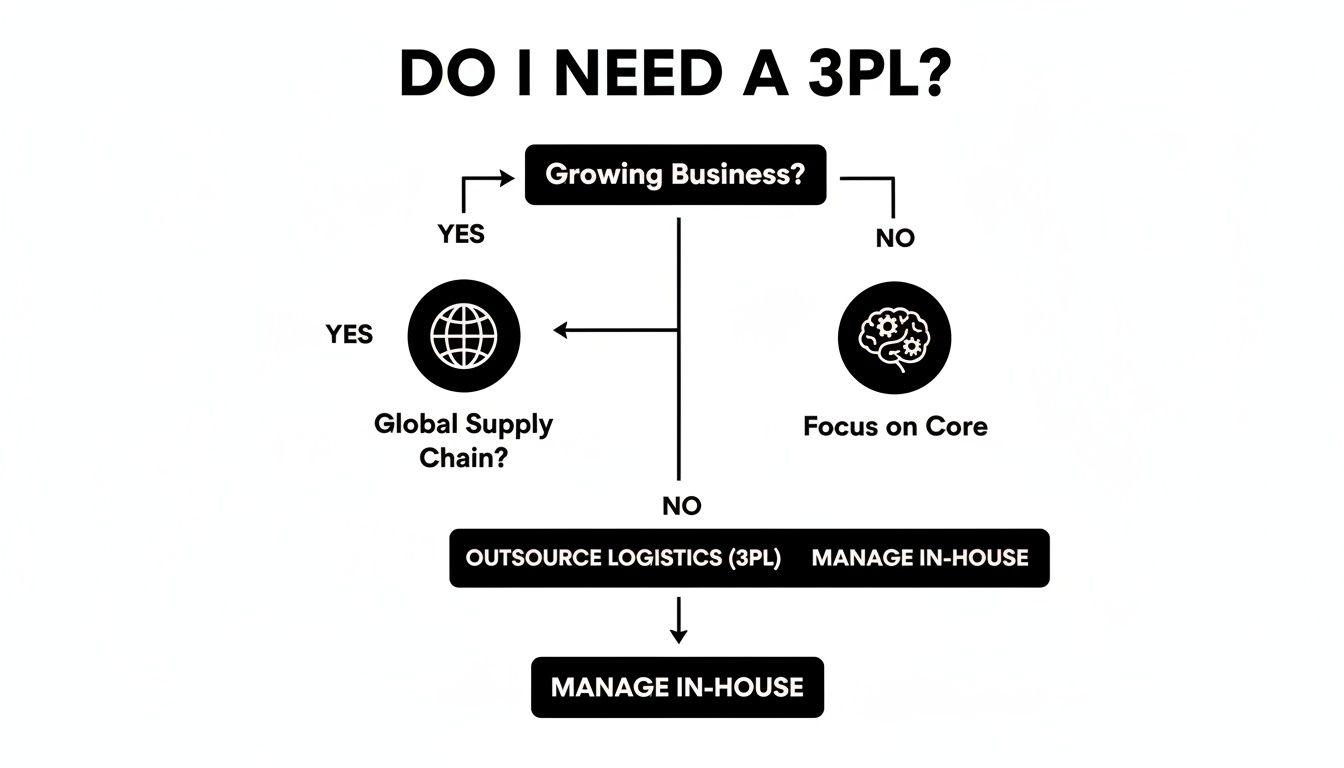
Whether you’re wrestling with a global supply chain or just need to get back to focusing on your core business, a 3PL can be a game-changing asset.
Your 3PL Provider Evaluation Checklist
To keep your evaluation process organized and objective, use a checklist. It helps you compare potential partners apple-to-apples, making sure no critical details fall through the cracks. This turns a complex, gut-feel decision into a data-driven one.
Use this checklist to systematically evaluate and compare potential 3PL partners based on their most critical capabilities.
By using a structured tool like this, you move from guesswork to a confident, well-informed decision, setting the stage for a partnership that delivers real results.
Measuring Success and ROI with Your 3PL Partner
Handing off a piece of your supply chain to a third-party logistics provider (3PL) is a major business decision. It’s an investment, and like any smart investment, you need to measure its performance. A great partnership goes far beyond just cutting a few costs; it should deliver tangible, data-driven results that prove a clear return on investment (ROI).
Think of these metrics as the vital signs of your supply chain’s health. They offer a clear, objective picture of how well your partner is managing your operations—from the moment a component hits their dock to the second it arrives on your assembly line. This is what continuous improvement is all about.
Key Metrics That Define 3PL Performance
To really understand if a partnership is working, you have to move past gut feelings and dig into the data. A solid 3PL won't just track these numbers; they’ll give you the tools and visibility to see them for yourself in real time.
Here are the essential KPIs you should be watching:
- On-Time In-Full (OTIF) Rate: This is the gold standard. It’s the percentage of orders that show up on the right day, with the right quantity, and with zero damage. A top-tier partner will consistently hit an OTIF rate of 99% or higher, which is a direct reflection of their discipline and reliability.
- Inventory Accuracy: This one is simple: does the number in their system match the physical count on the shelf? You need this to be at 99.5% or better. Anything less, and you risk a surprise part shortage that could shut down your entire production line.
- Order Fill Rate: This shows what percentage of your orders can be filled completely from the stock they have on hand. When this number is high, it means your 3PL’s inventory management is perfectly synced with your production schedule.
Translating Metrics into Tangible ROI
So, how do these numbers actually save you money? Every percentage point increase in your OTIF rate means fewer production delays and less time your assembly team spends waiting for parts. When your third-party logistics provider 3PL nails kitting and sequencing, you’ll see a direct, measurable boost in your production line’s throughput.
The Domestic Transportation Management (DTM) space is still the biggest piece of the 3PL pie, making up 45% of the market. In the U.S. alone, we're talking about a USD 246.25 billion market, where the best providers are using AI to sharpen their operations. It’s no surprise that 91% of companies using 3PLs report being more satisfied, mostly because of lower costs and quicker turnaround times—a massive win for Tier 1 suppliers under constant pressure. You can dive deeper into these trends and the impact of AI in logistics on Mordor Intelligence.
At the end of the day, it's all about lowering your total landed cost—the true, all-in expense of getting a product where it needs to go. A data-first 3PL gives you the visibility to track this, proving their services aren't just a line item expense, but a genuine driver of profitability.
Your 3PL Questions, Answered
When you're looking to hand over a piece of your operation, it’s only natural to have questions. Let's tackle some of the most common ones we hear from businesses trying to figure out if a third-party logistics provider (3PL) is the right move for them.
What’s the Real Difference Between a 3PL and a 4PL?
Think of it like this: a 3PL is the hands-on crew. They’re the ones physically running the warehouse, packing the kits, assembling components, and getting your products out the door. They own the trucks, the buildings, and the systems needed to execute your day-to-day logistics.
A 4PL, on the other hand, is more like a general contractor or an architect for your entire supply chain. They don't typically own the physical assets. Instead, they manage the big picture, often hiring and coordinating multiple 3PLs to handle different parts of the process. For most OEMs and industrial companies needing direct control over their parts and processes, a specialized 3PL is usually the most direct and effective partner.
How Does a 3PL Actually Connect with Our Systems, Like Our ERP?
This is where the right technology makes all the difference. Top-tier 3PLs don't just move boxes; they move data. Integration happens through well-established protocols like Electronic Data Interchange (EDI) and tools like Advance Shipping Notices (ASN).
Essentially, these systems allow your ERP—whether it's PLEX or something else—to talk directly to the 3PL's warehouse management system (WMS) in real-time. Purchase orders, inventory updates, and shipping confirmations all flow back and forth automatically. No more manual data entry, fewer errors, and a clear, live view of your inventory.
The goal of integration is to create a single source of truth. When your ERP and the 3PL's WMS speak the same language, you eliminate guesswork and gain the data needed for proactive decision-making.
Our Industry Has Very Specific Needs. Can a 3PL Handle That?
Absolutely. In fact, this is one of the most important questions you can ask. A generalist 3PL might not cut it. A partner who specializes in your industry already knows the rulebook.
For our automotive clients, that means they understand the high-stakes world of just-in-time (JIT) delivery, the critical precision of sequencing parts for the assembly line, and the intense quality standards demanded by OEMs. For other industrial clients, it might be about handling sensitive electronics or maintaining specific compliance in the warehouse. Before you sign anything, make sure your potential partner has a proven track record in your world.
Ready to stabilize your supply chain and de-risk your next program launch? Wolverine Assemblies, LLC provides the precision, technology, and expertise your operation demands. Learn more about our value-added services and partnership approach.
Subscribe to our weekly newsletter