.png)
The Modern Logistics 3PL Playbook for Supply Chains
Discover how a modern logistics 3PL partner can transform your supply chain. Learn proven strategies for outsourcing, reducing costs, and...

A 3PL, which stands for Third-Party Logistics, is an outside partner that takes over critical parts of your supply chain—like warehousing, transportation, and all the services that go with them. The best way to think about a 3PL is as a strategic extension of your own operations. They handle the complex journey your products take from point A to point B, freeing you up to concentrate on what your business does best.
What Is a Logistics 3PL and Why It Matters Now
Let's say your company designs and engineers world-class automotive parts. Your team is brilliant at innovation, but running a warehouse, scheduling freight, and making sure components hit the assembly line at the exact right moment? That's a completely different skill set. This is precisely where a logistics 3PL comes in.
A true 3PL isn't just another vendor; they're more like a co-pilot for your entire supply chain. They take the controls of the operational flight plan—from managing inventory levels and kitting parts for production to handling every detail of transportation. This lets your team keep their eyes on the prize: engineering incredible products. For today's manufacturers and industrial suppliers, this kind of partnership is essential for staying competitive.
The Strategic Choice: Outsourcing vs. In-House Operations
Trying to manage all your logistics internally means carrying the full burden of massive fixed costs. You're on the hook for buying or leasing warehouses, hiring and training staff, investing in complex warehouse management systems (WMS), and maintaining a fleet of vehicles. These expenses don't go away when demand dips, which can create serious financial pressure during slow periods.
Working with a 3PL, on the other hand, transforms those heavy capital investments into flexible, variable costs. You only pay for the space and services you actually use, which makes it incredibly easy to scale your operations up or down as the market dictates. This model gives you the agility and financial predictability that are so crucial in today's often-volatile industries. To really appreciate what a 3PL offers, it helps to understand the bigger picture of modern supply chain management.
By outsourcing, you're not just cutting costs. You're gaining immediate access to a partner's deep expertise, established infrastructure, and advanced technology—all without the massive upfront investment. It’s about tapping into a team whose entire business is built around achieving logistical excellence.
The table below breaks down the fundamental differences between these two models and shows why so many industrial leaders now rely on an outsourced partner to fuel their efficiency and growth.
Comparing In-House Logistics and an Outsourced 3PL Partnership
This table breaks down the operational, financial, and strategic differences between managing your supply chain internally and outsourcing to a specialized 3PL provider.
Ultimately, the choice comes down to a simple question: should you invest your capital and attention in becoming a logistics expert, or should you partner with one? For most companies, the answer is clear.
What Does a Modern 3PL Actually Do? The Core Services
Beyond the big-picture strategy, the real value of a logistics 3PL partnership is in the day-to-day execution. These core services are the gears that make the supply chain machine run smoothly, transforming a tangle of complex processes into a predictable flow of parts and information. A modern 3PL doesn’t just rent out warehouse space; it orchestrates a series of precise, value-added activities that are absolutely vital for industries like automotive and heavy manufacturing.
These are the very services that handle the operational headaches that can pull an OEM's focus away from its true mission: engineering, innovation, and building great products. This diagram perfectly captures the relationship.
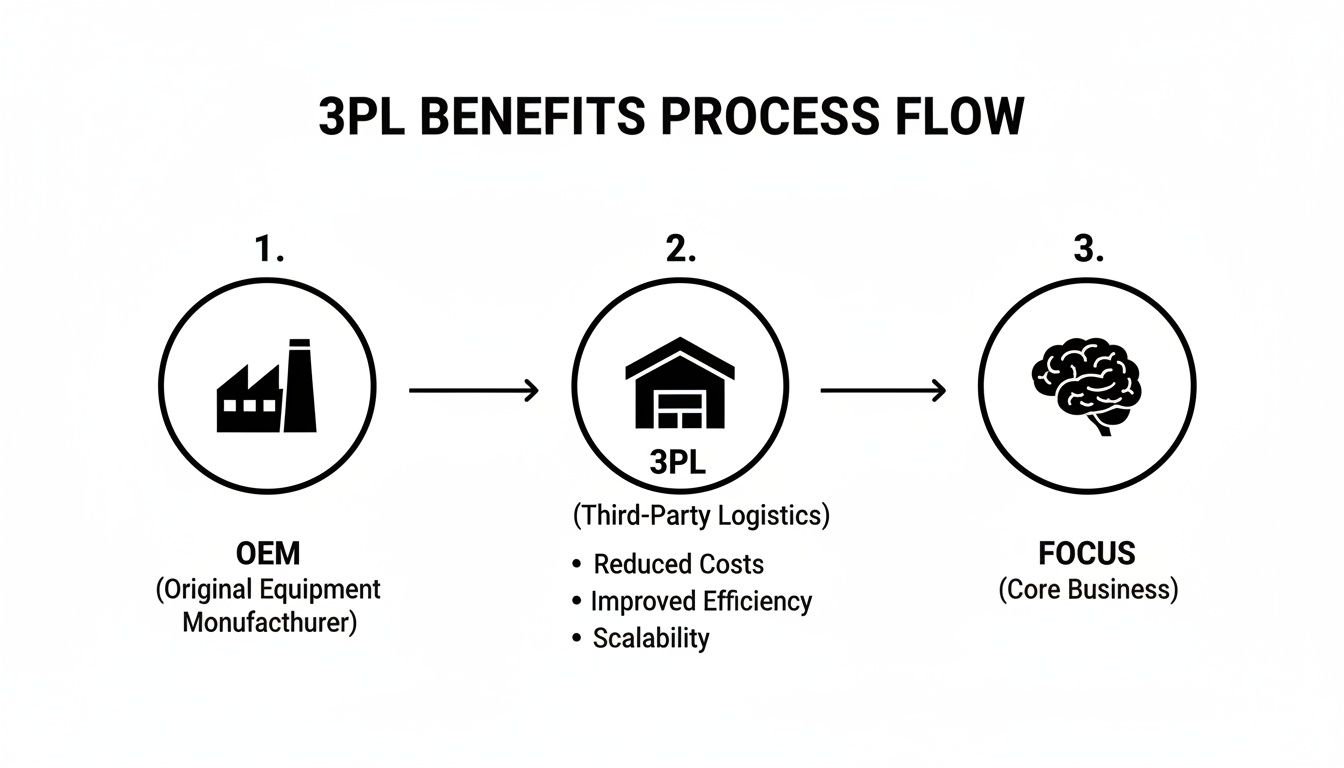
As you can see, the OEM offloads the logistical burden, freeing up internal teams and capital to focus on what they do best. Let's break down the key services that make this happen.
Dynamic Warehousing and Inventory Management
When people think of a 3PL, warehousing is usually the first thing that comes to mind. But it's so much more than just storage. Modern warehousing and inventory management is a dynamic, high-stakes process of receiving, organizing, tracking, and deploying assets with pinpoint accuracy. Think less of a static storage locker and more of a bustling air traffic control tower for your parts.
For an automotive supplier, this means their 3PL partner is managing thousands of individual SKUs from dozens of vendors. They ensure every single component is accounted for, stored correctly, and ready to go at a moment's notice. The operation is powered by a robust Warehouse Management System (WMS) that gives you real-time visibility into inventory levels, which is critical for preventing the stockouts or overages that can grind a production line to a halt.
A world-class 3PL doesn’t just give you square footage; they provide an operational command center for your inventory. They track every part from the receiving dock to the shelf, maintaining 99.9% inventory accuracy to ensure the right components are available the exact moment you need them.
This obsessive level of control is the bedrock on which all other value-added services are built.
Component Kitting and Production Sequencing
In today’s fast-paced manufacturing plants, every second counts. That's where component kitting and sequencing come in. These services are all about feeding the assembly line with the right parts, at the right time, and in the right order.
Picture an automotive plant where every vehicle rolling down the line is unique—different trim, color, and features. Instead of line-side workers fumbling through bins to find the right parts for each car, a 3PL prepares everything ahead of time.
- Kitting: This is the process of gathering all the necessary parts for a specific assembly into one neat package or "kit." For a vehicle's center console, a kit might contain the main housing, the correct infotainment screen, a specific wiring harness, and all the clips and fasteners, all bundled together.
- Sequencing: This takes it a step further. The 3PL delivers those completed kits to the assembly line in the exact order of production. If a red SUV is followed by a blue sedan and then a black truck, the corresponding kits arrive in that precise sequence.
This just-in-time, just-in-sequence delivery system declutters the factory floor and removes guesswork, which dramatically boosts throughput and slashes error rates. To see how this works in more detail, you can explore the nuances of kitting and assembly services in our detailed guide.
Value-Added Sub-Assembly Services
Many leading 3PLs also offer value-added sub-assembly services, taking another major step out of the final manufacturing process. Instead of shipping a box of individual components to the factory, the 3PL performs preliminary assembly work right in its own facility. This effectively extends your production line into your partner's warehouse.
For example, a 3PL might assemble a vehicle's entire door panel—installing the window motor, speaker, wiring, and interior trim—before shipping it as a single, ready-to-install unit. This simplifies final assembly, reduces the number of SKUs you have to manage at your plant, and can shave significant time off your production cycle.
The Technology Backbone: EDI and ASN Integration
Of course, none of this intricate choreography would be possible without a rock-solid technology backbone. Seamless data flow between the client and the logistics 3PL is non-negotiable. Two key pieces of technology make this happen:
- Electronic Data Interchange (EDI): Think of EDI as the universal digital language that lets the 3PL's systems talk directly to your company’s Enterprise Resource Planning (ERP) system. It automates the back-and-forth of purchase orders, invoices, and shipping notices, which kills manual data entry and drastically reduces the chance of human error.
- Advance Ship Notice (ASN): An ASN is an EDI message sent ahead of a physical shipment. It's a digital heads-up that tells the receiving dock exactly what's coming, how it's packed, and when it will arrive. This information is gold for a busy facility, allowing them to schedule labor and clear space to get parts off the truck and onto the shelf faster.
Together, these integrations provide the real-time visibility and data integrity required to manage a complex, high-speed supply chain. Every physical movement is mirrored by a precise digital transaction.
The Strategic Business Case for a 3PL Partnership
Bringing a 3PL on board is far more than just outsourcing a few tasks—it's a strategic move that can fundamentally change your business. The real goal is to transform your supply chain from a necessary expense into a powerful competitive edge. It’s about freeing up your focus, reallocating capital, and tapping into deep expertise to fuel growth that your internal team simply can't manage alone.
This strategic shift rests on four key pillars. Each one directly tackles a common headache for manufacturers and industrial suppliers, from rigid finances to operational blind spots. Once you see how they all work together, you'll understand how a 3PL partnership strengthens your business from the inside out.
From Fixed Costs to Flexible Operations
One of the most immediate financial wins you’ll see with a 3PL is flipping your fixed costs into variable ones. When you run your own logistics, you're saddled with heavy, unchanging expenses: long-term warehouse leases, full-time salaries, and money sunk into equipment and technology. That bill comes due every month, whether you’re busy or slow.
A 3PL partnership shatters that rigid model. You pay for what you actually use—the square footage you occupy, the labor you need, the trucks you fill. This creates an operational budget that breathes with your business.
- Got a huge product launch or a seasonal spike? You can scale up capacity in a snap.
- Things slow down? Your costs automatically shrink, protecting your cash flow.
That kind of agility is a massive advantage. It lets you navigate choppy market waters without the dead weight of underused assets, which is a cornerstone of effective supply chain cost reduction strategies.
Gaining Expertise and Advanced Technology
When you partner with a specialized 3PL, you're not just hiring a vendor. You’re instantly plugging into a team of seasoned supply chain experts. These pros bring years of hard-won knowledge, proven best practices, and a deep understanding of the complex world of compliance and quality control. They’ve already solved logistical puzzles for dozens of other companies and can bring that experience straight to your operation.
On top of that, a top-tier 3PL has already invested heavily in technology that would be hard for a single company to justify. A major strategic business case for a 3PL partnership is leveraging their expertise and access to advanced supply chain optimization software to turn logistics into a competitive advantage. This tech stack includes sophisticated Warehouse Management Systems (WMS) and integrated ERPs like PLEX that deliver real-time visibility and sharp data analytics.
Tapping into a 3PL's technology stack means you can benefit from enterprise-level tools without the enterprise-level price tag. This gives you better data, improved efficiency, and more informed decision-making capabilities from day one.
Unlocking Scalability and Market Access
Growth is always the goal, but scaling your own logistics is often a slow, costly, and painful ordeal. It means hunting for new real estate, hiring and training huge teams, and navigating complex IT projects. A 3PL gives you a shortcut to rapid, efficient growth.
Their existing infrastructure and skilled workforce let you push into new markets or ramp up production without a massive upfront capital drain. This is especially vital today. The global 3PL market is projected to hit around $1.1–1.4 trillion by the mid-2020s, which shows just how much capacity and expertise is out there. A capable partner can secure the space, labor, and tech you need to grow, even when things get tight.
Refocusing on Core Business Growth
Maybe the biggest strategic win is the freedom it gives your team. When you’re no longer buried in the daily grind of warehousing, transportation, and inventory, your best people can finally focus on what they do best—driving the business forward. This frees them up for what really matters:
- Product Innovation: Designing the next generation of your core products.
- Customer Relationships: Building stronger partnerships and delivering better service.
- Sales and Marketing: Winning market share and strengthening your brand.
By handing off the operational nuts and bolts to a specialist, you reclaim your most precious resource: focus. It allows you to concentrate on the big-picture initiatives that create lasting value and cement your position as an industry leader.
Measuring Performance in Your 3PL Partnership
Once you've handed over a piece of your supply chain to a logistics 3pl, how do you know if it's actually working? Trust is a good starting point, but data tells the real story. The only way to ensure accountability and drive continuous improvement is to establish a clear, data-driven framework for measuring performance.
This isn't about micromanaging; it's about creating a shared understanding of what success looks like. By tracking a handful of specific Key Performance Indicators (KPIs), you get a real-time health check on your logistics operations. These metrics cut through the noise and give both you and your partner a common language to discuss what's going well and where things need a tune-up.
Key Performance Indicators That Matter Most
You could track a hundred different data points, but that often leads to analysis paralysis. The key is to zero in on the vital few KPIs that directly reflect the core functions of your 3PL: speed, accuracy, and efficiency.
In any complex supply chain, especially in automotive or industrial manufacturing, these three metrics tell you almost everything you need to know.
On-Time Delivery (OTD): This is the ultimate test of reliability. It's a simple percentage: how many shipments arrived exactly when they were supposed to? For an OEM, a single late delivery can shut down a multi-million-dollar production line, which is why the industry benchmark is an unwavering 98.5% or higher.
Inventory Accuracy: This KPI measures the difference between what your partner’s Warehouse Management System (WMS) says you have and what's physically on the shelf. A high accuracy rate—the gold standard is 99.9%—is critical. It prevents stockouts, keeps carrying costs in check, and ensures the data you rely on for forecasting is rock solid.
Dock-to-Stock Time: How fast can your 3PL get incoming parts off the truck, processed, and ready for use? That’s what dock-to-stock measures. A swift cycle time, ideally under 24 hours, means your components are available for the assembly line or outbound shipment that much faster, making your entire operation more agile.
To get a clear, objective view of your 3PL's performance, it's helpful to track these metrics in a structured way. Comparing their numbers against industry standards gives you a powerful baseline for performance conversations.
Here's a quick look at some critical KPIs and what good looks like:
By focusing on these numbers, your performance reviews can shift from subjective feelings to objective facts. It moves the conversation from, "How are things going?" to "Our Dock-to-Stock time improved by 15% last quarter," which is how real, data-driven partnerships thrive.
Understanding the 3PL Cost Structure
Alongside performance, a transparent cost model is the other pillar of a strong 3PL relationship. Most logistics 3pl providers don't just charge a single flat fee. Instead, their billing is typically tied directly to the services you use, which aligns their costs with your actual business activity.
Getting familiar with the common cost components helps you budget more effectively and spot opportunities to optimize your spending. While every agreement is a little different, the costs are usually built from a few core drivers.
Here’s a breakdown of what you can expect to see on an invoice:
Warehousing and Storage: This is the "rent" for your inventory's space. It's often billed per pallet, per square foot, or by cubic foot, giving you flexibility as your stock levels rise and fall.
Handling and Labor: These fees cover the physical work of moving your products. Inbound charges apply to receiving and putting away goods, while outbound fees cover picking, packing, and loading trucks. This is usually billed per unit, per order, or by the hour.
Transportation Management: If your 3PL handles your freight, you'll see charges based on distance, shipping mode (like LTL vs. full truckload), fuel surcharges, and any special requirements like temperature control.
Value-Added Services: This is where specialized tasks like kitting, sequencing, light assembly, or custom labeling come in. These are typically billed separately, often on a per-unit or per-project basis, so you only pay for the extra work you actually need.
How to Choose the Right Logistics 3PL Partner
Picking a third-party logistics (3PL) partner is one of the most critical supply chain decisions you'll ever make. This isn't just about finding a warehouse to rent space in; you're handing over a vital piece of your operation to an outside team. The right partner becomes a true extension of your business, boosting your efficiency and making you more resilient.
A bad fit, on the other hand, can create a ripple effect of costly disruptions that ultimately damage your reputation with your customers.
The evaluation has to go way beyond a simple price sheet. You need a solid framework for vetting potential partners on their real-world capabilities, their company culture, and how well they align with your specific operational needs. That means digging into their industry experience, how fluent they are with technology, and their genuine commitment to quality.
Choosing wisely requires a methodical approach. Your goal is to find a partner who not only solves today's problems but has the vision and capacity to support your growth for years to come.
Crafting Your Evaluation Checklist
Before you ever get on the phone with a potential 3PL, you have to define what a "win" actually looks like for your business. A detailed checklist is the best tool you have for covering all your bases and making sure you can compare providers in an apples-to-apples way. Think of it as the blueprint for your ideal partnership.
Start with your non-negotiables—the absolute must-haves for your operation. From there, you can build out a more detailed list of criteria that will help you separate a decent vendor from a true strategic partner.
Your checklist should be organized into a few key areas to ensure nothing gets missed.
- Industry-Specific Experience: Do they have a proven track record in your world, whether it's automotive, industrial, or energy? Don't be afraid to ask for case studies or references from companies that have faced the same challenges you do.
- Technology Stack: What Warehouse Management System (WMS) and ERP software do they run? You need to confirm they have full EDI/ASN capabilities to ensure a smooth, automated connection with your own systems.
- Quality Certifications: Keep an eye out for relevant certifications like ISO 9001:2015. These aren't just plaques on a wall; they're hard proof of a disciplined commitment to repeatable processes and quality control.
- Geographic Location: Is their facility located where it needs to be? A strategic location can dramatically cut down transit times and shipping costs, whether you're moving parts to your plants or finished goods to customers.
- Scalability and Flexibility: Can they handle your business when it's booming and when it's quiet? Look into their facility size, how they manage labor, and their ability to adapt to your needs on the fly.
Asking the Right Questions
Once you’ve narrowed down your list, it's time to start the interviews. This is your chance to get past the glossy brochures and sales pitches to understand how a potential logistics 3pl really operates day-to-day. The questions you ask should be designed to reveal their operational discipline, how they solve problems, and whether their culture will mesh with yours.
This is where you find out who can walk the walk.
A potential partner's answers should be specific, backed by data, and rooted in real-world examples. Vague responses or a lack of detail around critical processes are major red flags that suggest they don't have their act together.
These questions will help you dig deeper:
- Program Launch Discipline: "Walk me through your exact process for a new program launch. What are the key milestones, who is on the team, and how do you guarantee a smooth transition without messing up our supply chain?"
- Continuous Improvement: "Can you give me a specific example of a continuous improvement project you implemented for a client? What was the problem, what did you do to fix it, and what were the measurable results?"
- Safety and Compliance: "What are your main safety protocols and the metrics you track? How do you train your team on safety, and what’s your process for investigating and preventing incidents?"
- Problem Resolution: "Tell me about a time a major operational issue happened for one of your clients. How did your team spot it, communicate it, and what steps did you take to resolve it?"
For an even deeper look at vetting providers, check out our guide on finding the best 3PL companies for your specific needs.
The Importance of Cultural and Strategic Fit
At the end of the day, a successful 3PL relationship is a partnership. Beyond the KPIs and contracts, you need a strong cultural and strategic alignment. Does their team communicate proactively? Are they open and honest when things go wrong? Do they share your obsession with quality and getting better every day?
This alignment is even more critical in highly demanding industries. With over 86–90% of Fortune 500 firms now using at least one 3PL, the pressure is on for providers to be technologically advanced and laser-focused on compliance. This drives heavy investment in automation and visibility, forcing regional 3PLs to manage massive facilities with military precision to hit their KPIs and lower total costs for their clients.
Choosing the right logistics 3PL is a foundational business decision. By using a structured checklist, asking sharp questions, and making cultural fit a priority, you can select a partner who won't just store your products, but will actively help your company succeed.
Answering Your Top 3PL Logistics Questions
When you start exploring a partnership with a logistics 3PL, the questions come fast. It's only natural. You're thinking about how different providers stack up, what the transition actually looks like, and what the real value is for a business like yours. Making the right call depends on getting clear answers.
Let's cut through the noise and tackle the most common questions supply chain leaders ask when they're thinking about moving from an in-house model to an outsourced one. Getting these right is the first step toward building a partnership that lasts.
What Is the Real Difference Between a 3PL and a Freight Broker?
It's easy to see why people mix these two up, but they play fundamentally different roles. A freight broker is essentially a matchmaker. They connect a shipper with a truck for a single load. Their job is transactional—find a truck, book the load, and move on to the next one.
A logistics 3PL, on the other hand, is a true operational partner. They’re woven into your supply chain, managing a whole suite of activities that can include everything from warehousing and inventory control to kitting, sub-assembly, and full-scale transportation management.
Think of it this way: a freight broker solves one specific problem—getting a single truckload from A to B. A 3PL manages your entire logistics ecosystem, making sure all the different pieces work together as a single, efficient machine.
How Long Does It Take to Onboard with a New 3PL Partner?
The onboarding timeline really depends on the complexity of your operation, but a good ballpark is anywhere from a few weeks to several months. A few key things will set the pace:
- Scope of Services: If you just need basic warehousing and fulfillment, you can get up and running pretty quickly. But if the project involves intricate component sequencing, sub-assembly, and deep IT work, expect a longer, more detailed implementation plan.
- System Integrations: Connecting your ERP to the 3PL’s warehouse management system (WMS) is often the long pole in the tent. The amount of work needed to get EDI and ASN data flowing smoothly is a major factor.
- Inventory Transition: The sheer volume of product that has to be moved, counted, and slotted into the new warehouse plays a big part in the schedule.
A solid 3PL with a disciplined launch process will give you a detailed project plan with clear milestones. This makes the whole transition feel smooth and transparent, with minimal disruption to your day-to-day business.
Can a 3PL Help Us Manage Unpredictable Seasonal Demand?
Absolutely. In fact, this is one of the biggest reasons companies partner with a 3PL. They give you the flexibility to scale your warehouse space, labor, and transportation capacity up or down almost on a dime. For any business with seasonal spikes, that kind of agility is a game-changer.
Instead of carrying the massive cost of an empty warehouse and idle staff during your slow season, you only pay for what you use. It turns rigid, fixed operational costs into flexible, variable expenses that move in lockstep with your revenue.
Is My Business Too Small to Get Value from a Logistics 3PL?
Not a chance. Small and mid-sized businesses often see the biggest proportional benefits from a logistics 3PL partnership. Why? Because it gives them instant access to resources that would be incredibly expensive or complicated to build from scratch.
You get to tap into enterprise-level technology, an optimized warehouse network, and a team of experts without the seven-figure investment. It levels the playing field, helping smaller companies boost their efficiency, lower their costs, and compete head-to-head with much larger players on service and reliability.
Ready to stabilize your supply chain and focus on your core business? Wolverine Assemblies, LLC delivers precision 3PL, warehousing, and assembly solutions that de-risk programs and drive efficiency. Learn how our Midwest-based expertise can empower your operations.
Subscribe to our weekly newsletter