.png)
A Guide to Logistics with Supply Chain Management for OEMs
Discover how mastering logistics with supply chain management drives efficiency for OEMs. This guide covers key strategies, tech, and KPIs...

To really get a handle on operational excellence, you have to start by clearing up two terms that are constantly mixed up: logistics and supply chain management. It’s easy to use them interchangeably, but they represent two very different levels of thinking.
Think of it this way: logistics is all about the tactical side of things—the movement, storage, and handling of goods. It’s the hands-on work. Supply chain management, on the other hand, is the big-picture strategy that orchestrates everything from sourcing raw materials all the way to delivering the final product.
The real magic happens when you integrate logistics with supply chain management. You can't have one performing at its peak without the other.
Defining Logistics and Supply Chain Management
Let's use an orchestra analogy to make this crystal clear.
Logistics is like the individual sections of the orchestra—the strings, the brass, the woodwinds. Each section has a specific job and must execute it perfectly. They are focused on the precise details: hitting the right notes (transportation), maintaining the right tempo (warehousing), and coming in at the exact right time (delivery). It’s the tangible, tactical execution.
Supply chain management is the conductor. The conductor isn't playing a single instrument. Instead, they’re directing the entire ensemble, making sure every section works in perfect harmony to create a beautiful, cohesive piece of music. This is the strategic layer that involves planning, managing supplier relationships, procurement, and forecasting demand to align all the moving parts with the company's goals.
The Core Difference in Scope and Focus
Logistics is a critical piece of the supply chain puzzle. Its main job is to ensure the efficient and cost-effective flow and storage of goods.
Key logistical activities usually include:
- Transportation Management: Choosing carriers, planning shipment routes, and managing freight costs.
- Warehousing: Storing inventory safely, keeping track of stock levels, and fulfilling orders.
- Inventory Control: Monitoring goods to prevent running out of stock or carrying too much.
- Fleet Management: Maintaining and scheduling the vehicles that make the deliveries.
Supply chain management (SCM) casts a much wider net. It's the active, strategic management of all supply chain activities, all designed to deliver maximum value to the customer and build a real competitive edge. It’s a holistic approach that connects everything from product development to after-sales service.
To put this into perspective, let's look at a simple side-by-side comparison.
Logistics vs Supply Chain Management at a Glance
This table breaks down the fundamental differences in their focus, scope, and ultimate goals.
Seeing them laid out like this makes it clear: logistics is about doing things right, while supply chain management is about doing the right things.
Why This Distinction Matters for OEMs
For Original Equipment Manufacturers (OEMs) and their Tier 1 suppliers, thinking of logistics as just "shipping" is a massive missed opportunity. When you manage logistics under the strategic umbrella of supply chain management, it transforms from a necessary cost into a powerful competitive tool.
The ultimate goal of SCM is to synchronize customer requirements with the flow of materials from suppliers. It’s about striking that perfect balance between high customer satisfaction, low inventory, and low unit costs.
This strategic oversight is what turns a logistical function into a true value-driver. A more in-depth look can be found in this essential guide to supply chain logistics management.
An integrated approach ensures that transportation isn’t just about moving parts from Point A to Point B. It’s about timing those deliveries perfectly to support a just-in-time assembly line, which in turn slashes inventory carrying costs and boosts production throughput.
Ultimately, effective logistics with supply chain management isn't an "either/or" situation. It's a symbiotic relationship. One provides the "how," and the other provides the "why."
Integrating Your Inbound and Outbound Logistics
Think of your manufacturing operation like a high-performance engine. Inbound logistics is the fuel intake, pulling in the exact mix of raw materials and components needed to run. On the other side, outbound logistics is the exhaust system, pushing finished goods out to the market. For that engine to perform at its peak, both systems have to be perfectly timed and synchronized.
This synchronization is really the heart of integrated logistics. The inbound side covers everything coming through the door—coordinating with suppliers, receiving shipments, inspecting for quality, and storing materials. The outbound side handles the reverse: pulling customer orders, picking and packing products, and arranging the final shipment.
When these two functions are walled off from each other, the whole operation starts to sputter. One team has no idea what the other is doing, which inevitably leads to production delays, bloated inventory, and expensive bottlenecks. A truly effective strategy for logistics with supply chain management demands that these two streams merge into a single, cohesive current of information and materials.
This diagram shows a simplified view of how goods move, from sourcing through the logistics process to the final delivery.
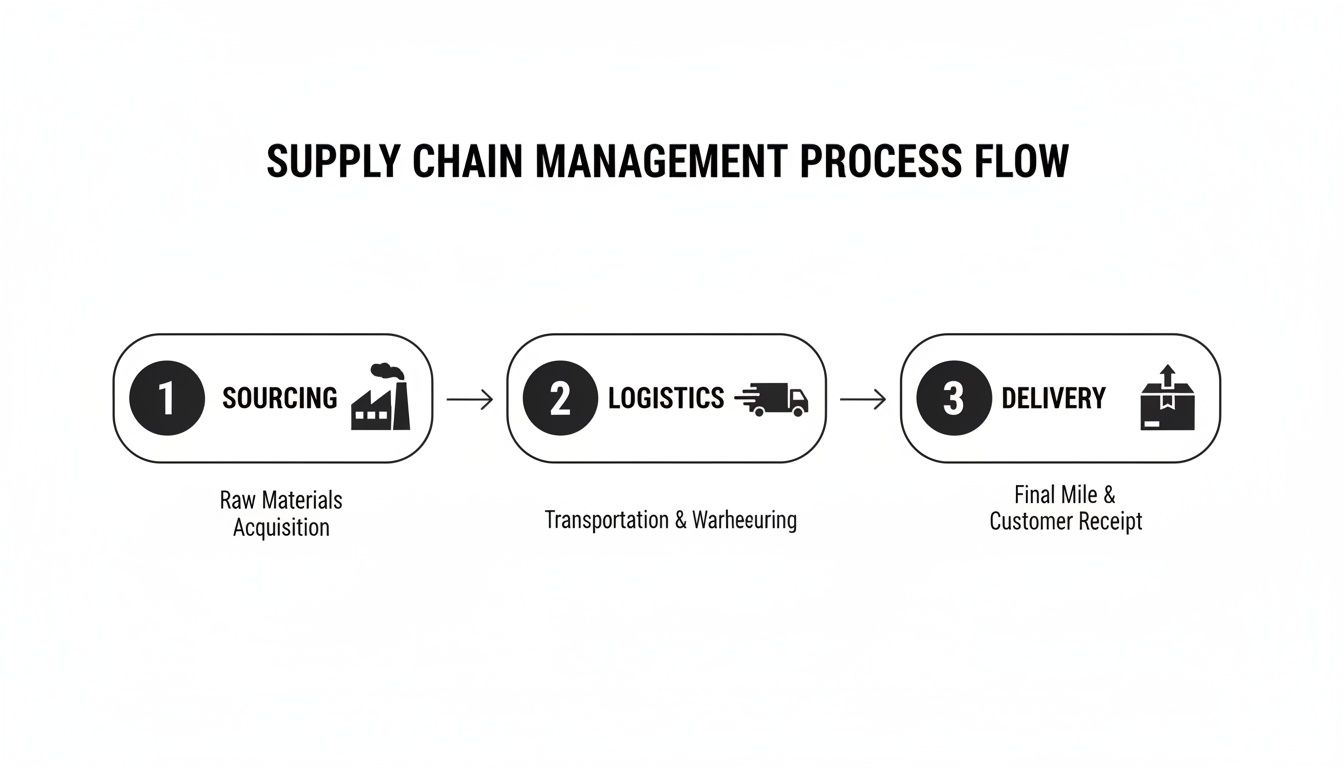
As you can see, logistics is the critical connective tissue holding everything together, from the moment a part is sourced to the moment it reaches the end user.
Achieving Seamless Integration
The secret to making it all work in harmony is total visibility. This usually comes from a combination of the right partners and the right technology. For an OEM, it means getting a real-time, end-to-end picture of the entire process. A 3PL partner like Wolverine Assemblies often steps in to act as the central coordinator, making sure both inbound and outbound activities are perfectly aligned with production schedules.
This integration is built on a solid technology stack. Systems like PLEX ERP serve as the operational brain, creating a single source of truth for inventory, orders, and production plans. That data then flows smoothly between all partners using tools like Electronic Data Interchange (EDI) and Advance Shipping Notices (ASN).
An ASN is a perfect, everyday example of this. When a supplier’s truck leaves the dock, an ASN is sent electronically. It’s essentially a digital heads-up that tells the warehouse team exactly what’s coming and when. This allows them to prepare—clearing space and scheduling labor—before the truck even backs up to the bay. That simple piece of communication prevents surprises and keeps the receiving dock from becoming a bottleneck that could shut down the entire plant.
Real-World Impact for OEMs and Tier 1s
In the automotive world, the stakes are incredibly high. The whole business model is often built on Just-in-Time (JIT) delivery, where parts show up precisely when they’re needed on the assembly line—not hours early or, worse, a few minutes late.
A single delayed shipment of a critical component can bring a multi-million-dollar assembly line to a grinding halt. Integrated logistics isn't just about efficiency; it's about mitigating catastrophic risk.
Picture this common scenario: an automotive OEM needs a specific wiring harness for the next batch of vehicles on the line.
- Inbound Trigger: The PLEX ERP system sees the production schedule and automatically sends an EDI signal to its 3PL partner (Wolverine Assemblies).
- Precise Execution: Wolverine's team pulls the correct harnesses from inventory, sequences them in the exact order they’ll be installed on the line, and loads the truck for a JIT delivery.
- Outbound Confirmation: The shipment is dispatched to arrive at a specific station on the assembly line at the exact scheduled time, with every movement tracked and confirmed along the way.
This kind of precision is flat-out impossible without flawless communication between what you have on hand (inbound) and what you need to ship out (outbound). To keep things moving smoothly, it helps to look at strategies for centralizing driver and dispatch communication for logistics teams to tighten up that coordination.
By syncing these two flows, OEMs and Tier 1 suppliers can slash the amount of inventory they have to keep on-site, cut carrying costs, and make sure production lines are never starved for parts. This integrated approach turns logistics from a simple cost center into a real strategic advantage.
Warehousing Is More Than Just Storage—It's a Value Creation Hub
The days of viewing warehouses as dusty, static storage buildings are long gone. Today, a modern warehouse is a dynamic, active hub where real value is created, directly influencing production speed and the responsiveness of your entire supply chain. For any OEM or Tier 1 supplier, seeing a warehouse as just a roof over your inventory is a massive missed opportunity. It's a strategic asset that can prep, organize, and streamline parts right before they hit the assembly line.
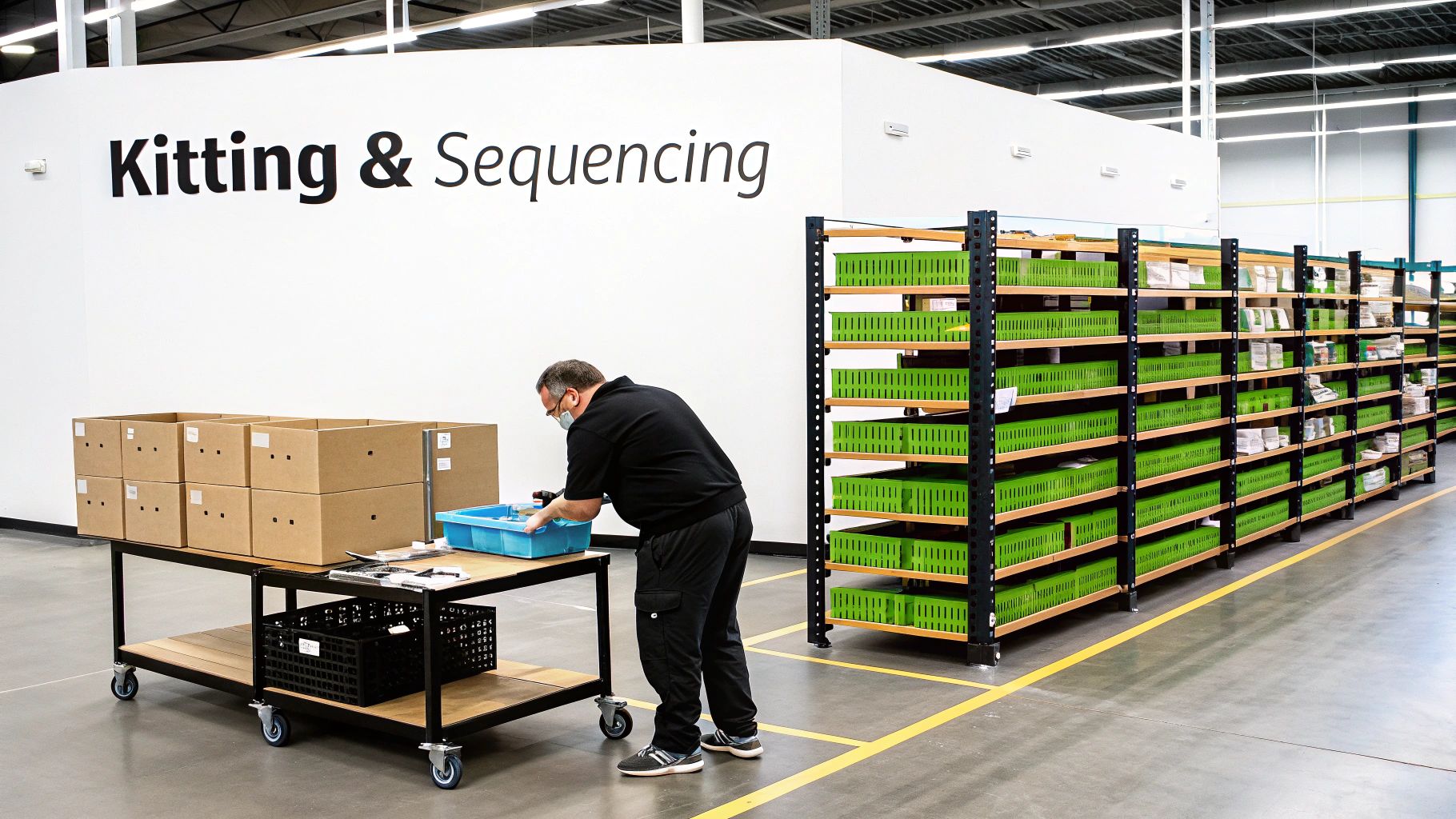
This is where the true power of integrating logistics with supply chain management comes to life—when a 3PL partner performs value-added services off-site. Suddenly, your warehouse isn't a cost center anymore. It becomes a seamless, powerful extension of your own manufacturing floor, cutting complexity and boosting throughput without you having to lift a finger.
Moving Beyond Storage to Strategic Execution
So what are "value-added services?" Simply put, they are any tasks your logistics partner handles that go beyond the basic inbound/outbound flow of goods. These activities are all about preparing or finalizing products closer to the point of consumption, saving you critical time, space, and labor inside your own plant.
For manufacturers, a few key services make all the difference:
- Kitting: This is the process of gathering multiple, separate SKUs and bundling them together as a single new unit—a "kit." Think of an automotive plant creating a complete "door assembly kit." Instead of a line-side operator juggling a handle, wiring harness, window motor, and a bag of fasteners, they get one neat package with everything they need.
- Sequencing: This takes kitting to the next level. It’s not just about creating the kits; it's about arranging those parts or kits in the exact order they'll be needed on the assembly line. This is absolutely essential for any Just-in-Sequence (JIS) manufacturing model, where a specific component has to arrive at a specific station at a precise moment.
- Light Sub-Assembly: Here, your 3PL performs minor assembly tasks right in the warehouse. Instead of your team wrestling with five tiny, separate components, they receive a single, pre-assembled sub-component. It’s a simple shift that makes the final assembly process that much faster and less prone to error.
By outsourcing these detail-oriented tasks, manufacturers can reclaim valuable floor space, slash material handling time, and let their highly-skilled production teams focus on what they do best. These benefits are magnified when you’re trying to manage the immense complexities of distribution and warehousing at scale.
A Practical Example in Automotive Manufacturing
Let's walk through how this all comes together on the ground. Imagine a modern auto plant where every single vehicle coming down the line is different—unique trim levels, infotainment systems, and interior options.
Without a 3PL partner handling value-added services, that OEM is drowning in complexity. They have to manage thousands of individual part SKUs inside their own four walls, dedicating huge amounts of space to inventory and labor just to pick, sort, and deliver the right components to the right place. It's organized chaos.
Now, picture this: by shifting kitting and sequencing to a 3PL, the OEM stops receiving messy pallets of bulk components. Instead, a single, perfectly sequenced kit arrives at the line, timed precisely to the vehicle being built.
Here’s how a partner like Wolverine Assemblies makes that happen:
- Receiving the Build Schedule: The OEM’s PLEX ERP system shoots the daily vehicle build schedule over to Wolverine via EDI. This isn't just a list; it's a detailed blueprint specifying the exact components needed for every car, in the correct build order.
- Executing Kitting and Sequencing: Back at the Wolverine facility, our team gets to work. They pull every necessary component from warehouse stock, assemble them into vehicle-specific kits, and load them onto specialized carts in the exact sequence the assembly line requires.
- Just-in-Sequence Delivery: The fully sequenced carts are loaded onto a truck for a precisely timed delivery. The cart is rolled straight from the truck to the line-side station, where an operator can grab what they need and get to work—no searching, no sorting, no delays.
This methodical, almost surgical, approach eliminates waste, nearly eradicates the risk of line-side errors, and ultimately lowers the OEM's total landed cost by optimizing both labor and inventory. It transforms the warehouse from a passive holding area into a proactive, value-generating engine that proves just how powerful smart logistics with supply chain management can be.
The Technology Driving Modern Supply Chains
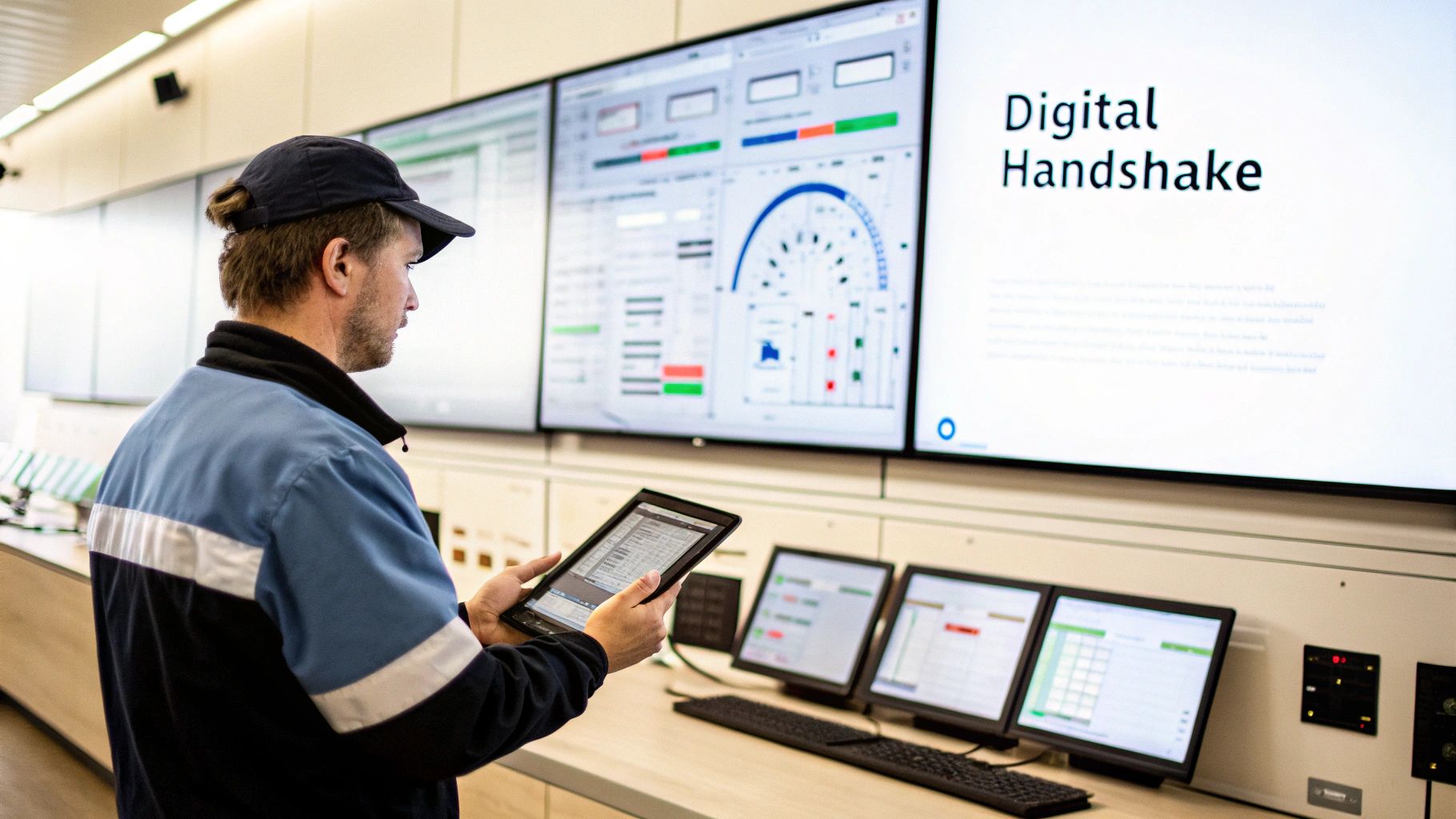
Technology is the central nervous system of any modern supply chain. It's the invisible force coordinating every part, every shipment, and every deadline. Trying to manage the incredible complexity of global manufacturing without an integrated tech stack is like flying blind. These aren't just digital filing cabinets; they're intelligent, active platforms that give you the visibility and control needed to perform at the highest level.
Think of an Enterprise Resource Planning (ERP) system like Plex as the brain of the operation. It’s the central hub that pulls together critical data from finance, production, and inventory, creating a single source of truth for the entire company. This master plan then informs and directs all the specialized tools handling the day-to-day logistical work.
The Digital Handshake Connecting Partners
For logistics and supply chain management to truly work in sync, communication between partners has to be instant and automatic. That’s where Electronic Data Interchange (EDI) and Advance Shipping Notices (ASN) come in. They create a 'digital handshake' that automates the flow of crucial information, getting rid of manual data entry and the costly mistakes that come with it.
An ASN is automatically sent the moment a shipment leaves a supplier’s dock, detailing exactly what’s on the truck and when it’s expected to arrive. This simple alert gives your team a heads-up to prepare receiving bays and staff, preventing the kinds of bottlenecks that can derail an entire production schedule. It’s this digital foresight that builds a truly resilient operation.
WMS and TMS: The Hands of Logistics Execution
While the ERP sets the overall strategy, other systems get their hands dirty with the tactical, on-the-ground execution. This is where a Warehouse Management System (WMS) and a Transportation Management System (TMS) are absolutely essential.
Warehouse Management System (WMS): A WMS is the command center for everything inside the four walls of a warehouse. It directs put-away, optimizes picking routes, tracks every piece of inventory with laser precision, and manages labor. It ensures every single item is exactly where it needs to be, when it needs to be there. Understanding the fundamental warehouse management system benefits is a game-changer for any OEM looking to tighten up operational control.
Transportation Management System (TMS): A TMS, on the other hand, takes over once a shipment leaves the warehouse. Its job is to optimize shipping routes, find the most cost-effective carriers, track shipments in real time, and handle the complexities of freight auditing and payment.
These systems don't operate in silos. They constantly feed data back to the ERP, creating a closed-loop system of planning, execution, and analysis. This deep integration is what gives OEMs the agility and control to navigate market shifts and unexpected disruptions.
The real power of this tech stack is its ability to create a single, unified view of the entire supply chain. It moves an organization from reacting to problems to proactively preventing them.
Recent geopolitical issues, like renewed US-China tariffs, have put global supply chains to the test. A recent study found that 82% of companies felt the impact, with 39% seeing a spike in supplier costs. For chains with a US connection, the disruption was even more severe, affecting 70% of operations. This reality underscores the urgent need for flexible, resilient systems. Partners like Wolverine Assemblies rely on this technology to shield OEMs from such shocks, using their international management expertise to maintain stability. You can explore the full findings on how supply chain risk is being managed today.
Ultimately, the goal of all this technology is to create an environment where information flows as freely and efficiently as the physical goods themselves. In today's market, that level of visibility isn't a luxury—it's an absolute necessity for survival.
How to Measure Supply Chain Performance
"You can't improve what you don't measure." It's an old business cliché for a reason—it’s true. In the tangled world of supply chain management, flying blind is a recipe for disaster. Without clear metrics, you have no way to spot the hidden inefficiencies bleeding your budget dry, diagnose operational bottlenecks, or seize opportunities to get ahead. This is where Key Performance Indicators (KPIs) become your navigation system.
Think of KPIs as the vital signs for your supply chain. They give you an objective, data-driven picture of how your day-to-day operations line up with your big-picture goals. When leaders track the right numbers, they can finally move beyond guesswork and make sharp, informed decisions that boost both customer satisfaction and the bottom line.
Core KPIs Every OEM Should Live By
There are a million things you could measure, but a few KPIs are simply non-negotiable for any serious manufacturing operation. These metrics give you a balanced scorecard, covering the critical areas of speed, cost, quality, and efficiency. Mastering these is the first step toward building a genuinely high-performing supply chain.
At a minimum, you need to be tracking:
- On-Time In-Full (OTIF): Did the complete, correct, and undamaged order arrive exactly when it was supposed to? This is a direct measure of your promise to the customer.
- Inventory Turnover: How quickly are you selling through your entire stock? A high turnover rate is a sign of healthy demand and lean, efficient inventory management.
- Order Accuracy Rate: What percentage of your orders go out the door and arrive at the customer’s facility without a single error? This metric is a cornerstone of customer trust.
- Total Landed Cost: What is the true cost to get a product into your hands? This goes far beyond the purchase price to include freight, duties, insurance, and handling.
Why These Metrics Actually Matter
Let’s get real about what these numbers tell you.
On-Time In-Full (OTIF) is, without a doubt, the ultimate report card on customer experience. A consistently high OTIF rate—you should be aiming for 95% or better—is proof that your logistics are humming along reliably. If you’re constantly falling short, it’s a massive red flag pointing to problems somewhere in your system, whether it's poor forecasting, a shaky transportation partner, or chaos in the warehouse.
A low OTIF score isn't just a logistical hiccup; it's a broken promise to your customer. It destroys trust and gives them a very good reason to start looking elsewhere.
Then there’s Inventory Turnover. This KPI is all about how well you manage your cash. Inventory sitting on a shelf is cash you can't use. Too much of it, and you're paying carrying costs for dead weight. Too little, and you're losing sales and frustrating customers. The "right" number varies by industry, but a chronically low turnover ratio is often a symptom of overbuying, weak sales, or obsolete parts clogging up your warehouse.
Finally, Total Landed Cost gives you an honest look at your financial efficiency. By tracking every single expense from the supplier’s dock to your own, you can uncover hidden costs you never knew you had. It forces you to ask the tough questions: Can we find a better shipping route? Are we getting the best freight rates? Are our warehouse processes adding unnecessary costs? This is where the integration of logistics and supply chain strategy really proves its worth.
Recent global shocks have been a tough lesson in resilience. The good news? Companies are learning. Supply chain losses have dropped to about $184 billion a year—a staggering 88% decrease from their peak during the height of the disruptions. This isn't luck; it's the result of smart strategies like multi-shoring and sophisticated risk management that stabilize operations against everything from geopolitical turmoil to climate events. You can dig into the data and see how businesses are adapting in the latest supply chain resilience statistics. It’s hard proof that measuring what matters and making proactive adjustments is the key to thriving, not just surviving.
Building a Resilient Supply Chain Strategy
In today’s market, a resilient supply chain isn’t just a nice-to-have; it's the foundation for survival. We have to move past simply reacting to problems and start building a proactive, strategic framework. It’s about designing a system that can take a punch, adapt to constant change, and keep delivering for your customers, no matter what gets thrown at it. This is where a smart strategy turns the basic ideas of logistics with supply chain management into a serious competitive edge.
The first step is to be brutally honest about your current weaknesses. Where are your single points of failure? Relying too heavily on one supplier or a single region is a recipe for disaster. The objective is to bake redundancy and flexibility into your network from the very beginning.
Key Pillars of a Robust Strategy
A supply chain that can truly bend without breaking rests on a few core pillars. For OEMs and Tier 1 suppliers, focusing on these areas is the key to building a structure that’s both strong and agile.
- Supplier Diversification: The days of single-sourcing critical components are over. You need to build a diverse supplier base spread across different geographic locations. This simple step can insulate your entire operation from regional shutdowns, whether they're caused by politics, economics, or even weather. It gives you options when a crisis hits.
- Investing in Visibility: You can't manage what you can't see. Putting money into technology that gives you true end-to-end visibility is non-negotiable. Real-time tracking and solid data analytics let you spot potential bottlenecks early and react before a small issue becomes a full-blown catastrophe.
- Strategic Partnerships: Building strong relationships with expert 3PL partners is one of the smartest ways to de-risk your operations. The right partner provides flexible capacity, deep expertise, and established networks, which can be a lifeline during volatile periods or when launching a new program.
A resilient supply chain isn't about avoiding all risk—that's impossible. It's about building the capacity to anticipate, adapt, and recover from disruptions so you can thrive in spite of them.
This proactive mindset is absolutely critical in high-stakes industries. For a closer look at how these ideas work in the real world, check out our complete guide to the automotive supply chain and see how these strategies apply in a just-in-time environment.
At the end of the day, building this strategy is about turning your supply chain from a cost center into a strategic asset. By focusing on diversification, visibility, and partnerships, you create a system that doesn’t just survive market shocks—it capitalizes on them.
Frequently Asked Questions
What's the Real Difference Between Logistics and Supply Chain Management?
It’s easy to use these terms interchangeably, but they represent two very different levels of thinking. Logistics is the hands-on work—the moving, storing, and handling of goods. Think of it as the tactical execution: getting parts from Point A to Point B, managing the warehouse, and keeping track of inventory. It’s the essential, physical side of the operation.
Supply chain management, on the other hand, is the big-picture strategy. It’s the overarching framework that connects everything from raw material sourcing and supplier relationships to manufacturing schedules and final customer delivery. Logistics is a crucial piece of the supply chain, but supply chain management is the master plan that ensures all the pieces work together to create a competitive edge.
Why Would an OEM or Tier 1 Supplier Even Need a 3PL?
For most OEMs and Tier 1s, the core business is designing and building incredible products, not running warehouses or managing freight networks. Partnering with a specialized Third-Party Logistics (3PL) provider allows you to hand off these complex, non-core tasks to an expert. A good 3PL lives and breathes warehousing, kitting, sequencing, and transportation management.
This isn't just about offloading work. It's about gaining expertise and flexibility. You get access to sophisticated technology like a WMS or TMS without the massive upfront investment. More importantly, a 3PL partner gives you the agility to scale your operations up or down with market demand, so you’re not stuck with the costs of fixed infrastructure during a downturn.
How Do Technologies Like EDI and ASN Actually Help on the Floor?
Think of Electronic Data Interchange (EDI) and Advance Shipping Notices (ASN) as the digital conversation that keeps your entire operation in sync. Without them, you’re relying on emails, phone calls, and manual data entry—all of which are slow and prone to human error. This automated "digital handshake" connects you, your suppliers, and your logistics partner seamlessly.
An ASN is basically a digital heads-up. It tells your warehouse precisely what’s coming and when it's going to hit the dock. That simple piece of information is gold. It lets the team plan labor, clear dock space, and prepare for receiving, killing the bottlenecks that can bring a production line to a screeching halt.
This constant, accurate flow of data is the backbone of any lean manufacturing model, whether it’s just-in-time (JIT) or just-in-sequence (JIS). The tight integration of logistics with supply chain management absolutely depends on this kind of real-time visibility.
What Are the KPIs That Truly Matter?
You can track a hundred different metrics, but a handful really tell the story of your supply chain's health. If you’re only going to focus on a few, make them these four:
- On-Time In-Full (OTIF): This is the ultimate measure of customer satisfaction. Are you delivering the complete, correct order exactly when you promised?
- Inventory Turnover: This shows how fast you’re moving through stock. A high turnover rate is a great sign of efficient inventory management and strong demand. A low one might mean you have cash tied up in products that aren't selling.
- Order Accuracy Rate: This one is simple: what percentage of your orders go out the door perfectly? Every error erodes customer trust and racks up costs in returns and remediation.
- Total Landed Cost: This goes beyond the sticker price. It calculates the true cost to get a product into your hands, including shipping, duties, insurance, and handling. It’s brilliant at uncovering hidden costs that are eating into your margins.
Ready to turn your supply chain from a cost center into a competitive advantage? The team at Wolverine Assemblies, LLC specializes in delivering precision logistics and value-added services that stabilize operations and lower your total landed cost. Discover our end-to-end solutions.
Subscribe to our weekly newsletter