.png)
A Modern Guide to Distribution and Warehousing
Explore our complete guide to distribution and warehousing. Learn about modern tech, essential services, key metrics, and how to choose the...
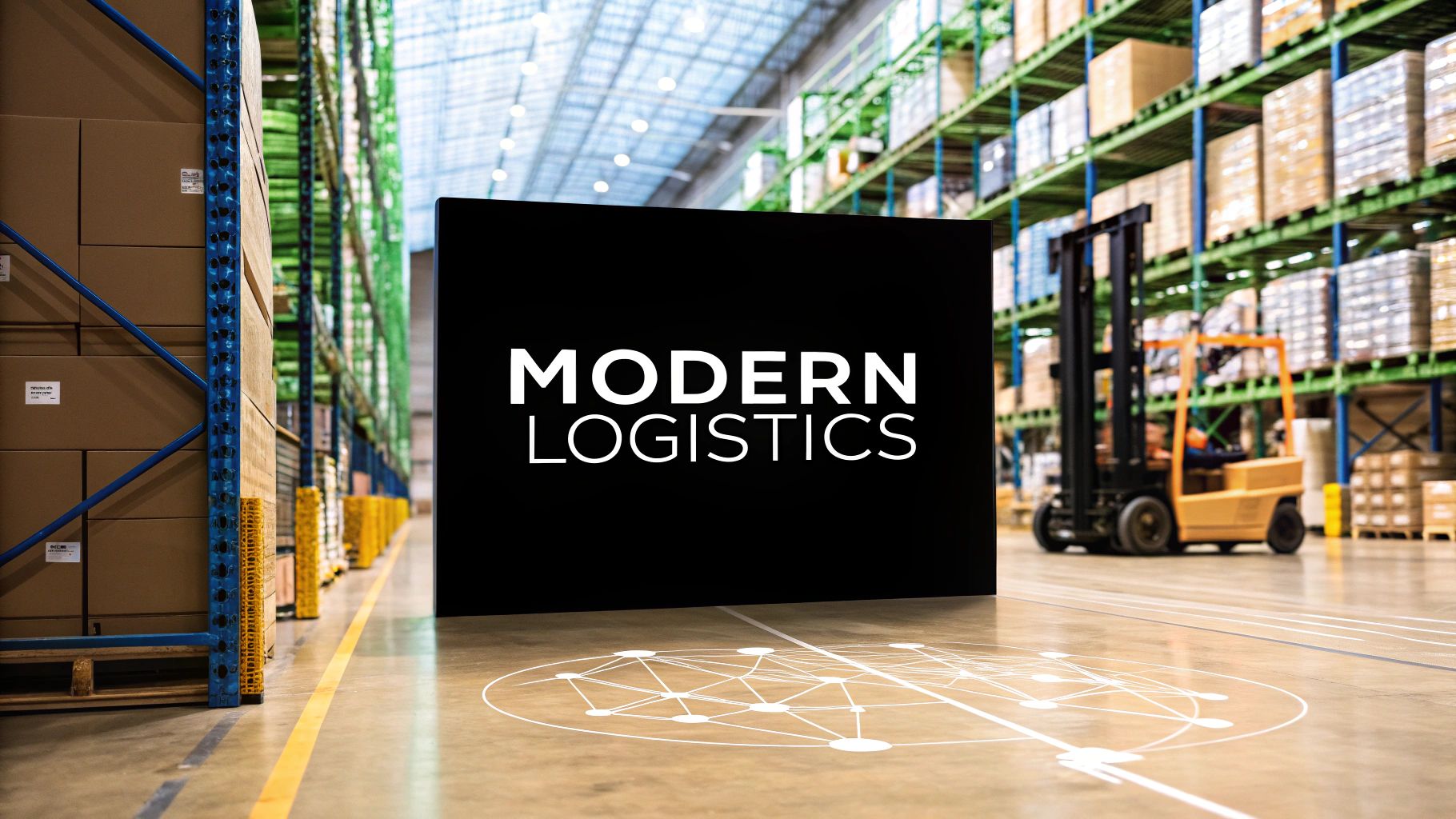

If you think of your supply chain as a body's circulatory system, then distribution and warehousing are its heart—the powerhouse that pumps products exactly where they need to go, right when they're needed. These two functions are the critical link between making a product and getting it into a customer's hands.
Understanding Distribution and Warehousing in Modern Supply Chains
At its core, warehousing is about the strategic storage of goods. Distribution, on the other hand, is the process of moving those goods out to their final destination. While they sound simple, these two functions have evolved far beyond basic storage sheds. Today, they are high-tech nerve centers that fuel e-commerce, manufacturing, and global trade.
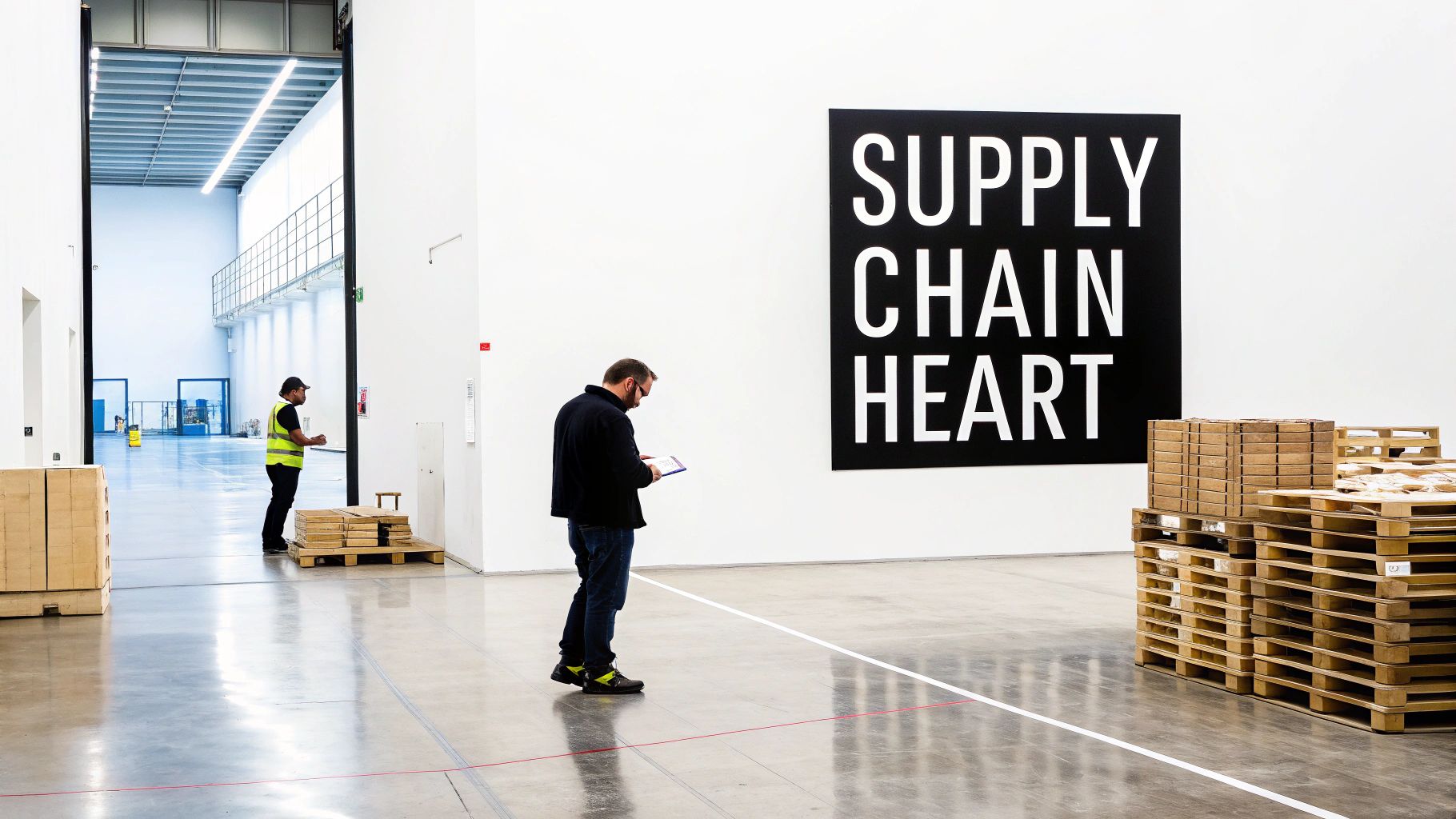
Think about a manufacturer producing thousands of automotive parts. Without a warehouse, those components would just pile up at the factory, creating chaos. Warehousing provides a safe, organized space to hold that inventory until it’s needed on the assembly line or shipped to a customer.
Distribution is the action-oriented partner in this relationship. It covers everything from processing an order and picking products off the shelves to packaging them up and coordinating the final shipment. It’s the last-mile hustle that guarantees timely and accurate delivery, which has a huge impact on customer satisfaction.
From Storage to Strategy
The role of distribution and warehousing has completely transformed. With the rise of omnichannel retail and just-in-time manufacturing, these facilities are now powerful strategic assets. They're no longer just a cost on a balance sheet; they are essential for building a competitive edge.
This shift is clear from the industry’s explosive growth. The number of warehouses worldwide was projected to hit about 180,000 by 2025, a direct response to the intense demands of modern retail and e-commerce. It’s a massive global industry, valued at roughly $1.0–$1.2 trillion, and that number is only expected to climb as companies lean more heavily on smart inventory strategies.
A modern warehouse isn’t just a place to store things. It's a dynamic environment where inventory is managed, orders are fulfilled, and value is added. It acts as a shock absorber for the entire supply chain, ensuring products are available even during unexpected demand spikes or shipping delays.
Distinct Yet Interconnected Roles
Even though we often talk about them together, it’s helpful to see where warehousing and distribution differ. Understanding their specific functions helps pinpoint where your business can become more efficient. If you’re thinking about expanding your own facilities, our guide on how to build a warehouse offers a detailed roadmap.
To see how they fit together, it helps to compare their core functions side-by-side.
Core Functions of Distribution vs Warehousing
While warehousing is focused on holding and protecting inventory, distribution is all about speed and flow. Both are absolutely essential for a healthy, responsive supply chain.
The Spectrum of Distribution and Warehousing Services
Think a warehouse is just a big building full of boxes? Think again.
Modern distribution and warehousing services have evolved far beyond simple storage. They’re dynamic hubs that turn a logistics facility into a strategic asset, designed to boost efficiency, keep customers happy, and give you a serious competitive edge.
These services can be broken down into three core areas: foundational storage, dynamic movement, and specialized value-added services. Each layer builds on the last, creating a complete logistics solution that manages your product’s entire journey.
Foundational Storage Solutions
At its heart, a warehouse stores things. But "storage" isn't a one-size-fits-all game. The right environment is crucial for maintaining product integrity and meeting compliance standards.
- Ambient Storage: This is your standard, room-temperature dry storage. It’s perfect for most non-perishable goods like industrial components, electronics, and packaged foods.
- Temperature-Controlled Storage: For products sensitive to heat or cold, this is non-negotiable. We're talking about refrigerated or heated environments for things like pharmaceuticals, certain chemicals, and agricultural products.
- Hazardous Materials (Hazmat) Storage: This is a whole different level. It requires highly regulated facilities and specially certified teams to safely store flammable, corrosive, or otherwise dangerous materials, ensuring 100% compliance with safety protocols.
Dynamic Distribution and Fulfillment
While storage is static, distribution is all about motion. This is where the real action happens, transforming the warehouse into a high-activity hub focused on moving inventory to its destination—fast.
A warehouse's value is no longer measured just by its storage capacity, but by its throughput—the speed and precision with which it can process orders and move goods. This velocity is what directly impacts the end customer's experience.
Core distribution services include:
- Order Fulfillment: This is the classic "pick, pack, and ship." It’s the engine of modern commerce, involving grabbing the right items, preparing them for transit, and getting them out the door.
- Cross-Docking: Think of this as the express lane for your inventory. Inbound products are moved directly to outbound shipping with almost no storage time, often in less than 24 hours. It’s perfect for high-volume goods and slashes handling costs.
- Last-Mile Delivery: This is the final, critical step—getting the product from the warehouse to the customer’s doorstep. For many businesses, mastering route optimization for last-mile delivery is the key to winning on speed and cost.
Value-Added Services That Create an Edge
This is where a true logistics partner goes from being a vendor to an extension of your own team. Value-Added Services (VAS) are specialized tasks that customize products and prepare them for specific markets, saving you an incredible amount of time and money.
Instead of shipping products to another facility for final touches, these services happen right inside the warehouse. This cuts out entire steps in your supply chain, reducing both lead times and costs.
Some of the most common value-added services include:
- Kitting and Assembly: Combining multiple separate items into a single new package. This is essential for promotional bundles, electronics, and automotive sub-assemblies.
- Custom Labeling and Packaging: Applying brand-specific labels, price tags, or unique packaging to meet retail or regulatory needs.
- Reverse Logistics (Returns Management): Handling the entire returns process is a huge, often overlooked, part of the business. This includes receiving returned products, inspecting them, and deciding whether to restock, rework, or dispose of them.
By integrating these services, a 3PL becomes a seamless part of your operations. To dig deeper, check out our full guide on value-added warehousing services and see how they can drive real results for your business.
Essential Technology Driving Modern Logistics
In today's logistics, technology isn't just helpful—it's the backbone of the entire operation. It's what provides the accuracy, speed, and clear visibility needed to manage a modern supply chain without constant fires to put out. These digital tools aren't just add-ons; they are fundamental.
Without the right systems, a warehouse is just four walls and a roof full of products. With them, it becomes a data-driven hub that can process thousands of orders with absolute precision. Let's break down the core technologies that make this a reality.
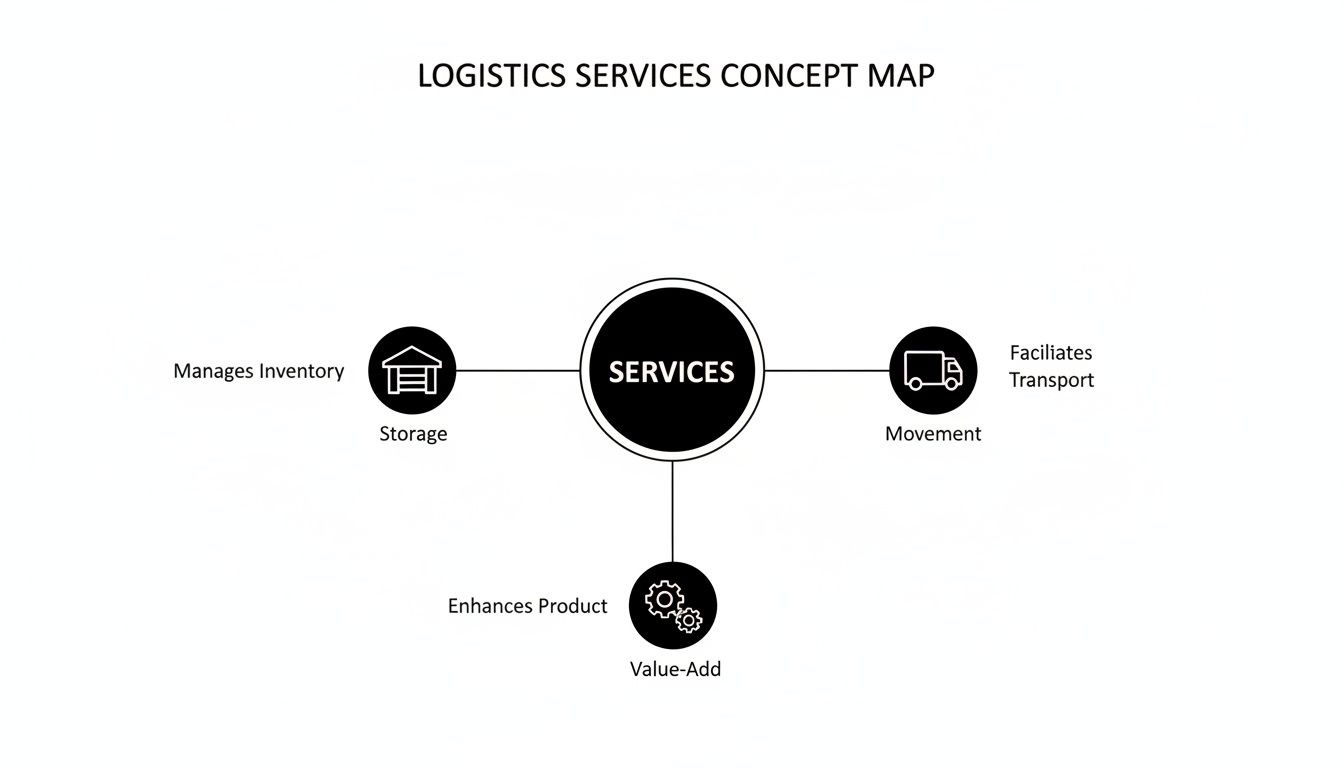
As you can see, technology is the thread connecting all these different services, turning separate tasks into one smooth, efficient flow.
The Brain Of The Operation: Warehouse Management Systems
At the core of any modern warehouse is the Warehouse Management System (WMS). Think of it as the operational brain, directing every single physical move inside the building. A WMS is the software that gives you real-time visibility into your entire inventory, from the moment a truck backs up to the dock until the finished product ships out.
This one system optimizes all the critical processes:
- Inventory Tracking: It knows the exact location of every part, down to a specific bin on a specific shelf. Guesswork is gone, and picking times drop dramatically.
- Order Management: When an order drops, the WMS maps out the most efficient pick path for the team, slashing travel time across the floor.
- Labor Allocation: The system assigns tasks based on an employee's location, skills, and current workload, making sure your team is used effectively.
A solid WMS is non-negotiable for keeping inventory accurate and fulfillment rates high. Understanding the full range of warehouse management system benefits shows just how much it impacts the bottom line.
Connecting The Dots With EDI And ASN
While a WMS runs the show inside the warehouse, other tech ensures it communicates smoothly with the outside world. Electronic Data Interchange (EDI) is what allows different companies’ computer systems to talk to each other directly. It replaces old-school processes like emailing purchase orders or faxing invoices with an automated, standardized data exchange.
Think of it as a secure digital handshake between partners. When a customer places an order, their system sends an EDI purchase order directly to the supplier's system. No one has to type anything in, which cuts errors, speeds up the whole transaction, and leaves a perfect digital trail.
An Advance Ship Notice (ASN) is a crucial EDI transaction for any distribution center. It's a heads-up sent from the shipper to the receiver before a truck arrives, detailing exactly what's on board and when it's expected. This allows the receiving warehouse to plan labor and clear dock space, making the unloading process fast and organized instead of chaotic.
By automating communication with EDI and ASN, companies kill the delays and human errors that come with manual data entry. This digital efficiency is the bedrock of a supply chain that can actually keep up.
The Rise Of Automation And Robotics
The physical warehouse floor is also getting a major tech upgrade, thanks to automation and robotics. This isn't science fiction anymore; it’s a practical answer to real-world problems like labor shortages and the relentless demand for speed. From autonomous mobile robots (AMRs) that shuttle goods around to robotic arms that help pack boxes, automation is taking over the repetitive, back-breaking tasks.
This push is a direct response to industry pressures. By 2025, an estimated 4 million commercial warehouse robots will be in use globally. The trend is driven by persistent labor shortages, where 30-40% of warehouses report they can't find enough people. To cope, nearly 90% of modern warehouses are already using or plan to adopt WMS and automation tools to handle the grind, boost throughput, and shrink order cycle times.
Measuring Success with Key Performance Indicators
You can't improve what you don't measure. In warehousing and distribution, relying on guesswork leads to blown deadlines, bloated costs, and unhappy customers. To run a tight ship, you need hard data—and that data comes from Key Performance Indicators (KPIs) and Service Level Agreements (SLAs).
Think of KPIs as the dashboard for your supply chain. They are specific, measurable metrics that give you a real-time look at the health and efficiency of your logistics. They don't just tell you what happened; they dig into the why, pointing you straight to what needs fixing.
An SLA, on the other hand, is the handshake that turns those metrics into a promise. It’s a formal agreement between you and your logistics partner, defining the exact level of service you can expect and holding everyone accountable. It’s where performance goals become guarantees.
The Most Critical Warehouse KPIs
While you could track dozens of metrics, a few core KPIs tell most of the story. Nailing these is the first step toward driving real improvements and knowing if your 3PL partner is truly on top of their game. These numbers are direct indicators of operational discipline.
- Inventory Accuracy: This is the difference between what your system says you have and what’s actually on the shelf. The gold standard here is an accuracy rate of 99% or higher. Anything less invites trouble.
- Order Fill Rate: This shows the percentage of orders shipped completely on the first try. A low fill rate is a red flag for inventory shortages or poor management, and it's something your customers will feel immediately.
- On-Time Shipping Rate: This tracks the percentage of orders that leave the warehouse on or before the requested ship date. It's a fundamental measure of reliability and a make-or-break factor for meeting customer deadlines.
KPIs are more than just numbers on a report; they are the language of accountability. When a 3PL consistently hits its targets for inventory accuracy and on-time shipping, it’s a clear sign of deep operational control.
To give you a clearer picture, here are some of the most common and impactful KPIs we track for our clients to ensure everything is running smoothly.
Tracking these metrics is the only way to get an honest assessment of performance. Without them, you’re just hoping for the best.
From Metrics to Mutual Agreements
This is where an SLA becomes so valuable. An SLA takes a KPI and turns it into a hard target. For instance, instead of just tracking the on-time shipping rate, an SLA might lock in a commitment that "99.5% of all orders must ship on time each month."
This simple step formalizes expectations and creates a clear benchmark for success. If that target is missed, a good SLA will also outline the remedies, ensuring issues are fixed fast. This framework builds a strong, transparent partnership based on shared goals.
Ultimately, combining sharp KPIs with a solid SLA is the foundation of any successful logistics partnership. It’s how you stop guessing and start managing your supply chain as a true competitive advantage. Without this data-driven approach, you’re flying blind.
How to Select the Right 3PL Partner
Picking a third-party logistics (3PL) partner is a huge decision. Get it right, and you’ll accelerate growth. Get it wrong, and your supply chain could grind to a halt. This isn’t just about finding some extra warehouse space; it’s about trusting another company with a core piece of your business—your inventory, your customer promises, and your brand reputation.

The right partner becomes a true extension of your team, bringing the infrastructure, tech, and expertise you need to scale. The wrong one? Well, that leads to damaged goods, blown deadlines, and a reputation that’s hard to fix. That's why a thorough evaluation process is absolutely essential.
Verifying Industry-Specific Expertise
Let’s be clear: not all distribution and warehousing services are the same. The needs of an automotive manufacturer are worlds apart from an agricultural equipment supplier. Your very first filter should be finding partners with direct, hands-on experience in your industry.
A 3PL with deep automotive or industrial roots will already get the pressures of just-in-time (JIT) delivery, the complexities of kitting, and the strict compliance rules you live by. They’ll speak your language from day one, which is a massive leg up over a generalist provider.
Don’t just ask if they've worked in your sector; ask for specific case studies and references. A truly experienced partner will be able to show you a proven track record of solving problems just like yours for companies of a similar size.
Assessing Technological Capabilities
Modern logistics runs on data, period. A 3PL’s technology stack tells you everything about their efficiency, accuracy, and transparency. You need a partner whose systems can plug directly into yours for a seamless flow of information.
Here’s what to look for:
- ERP Integration: They have to be fluent in systems like PLEX ERP to ensure operational data flows right into your business management software. No excuses.
- EDI/ASN Competency: Full Electronic Data Interchange (EDI) and Advance Ship Notice (ASN) capabilities are non-negotiable. This is how you automate orders and shipments.
- Warehouse Management System (WMS): A sophisticated WMS gives you real-time inventory visibility and optimizes every single move on the warehouse floor.
Without this digital foundation, you’re flying blind and relying on manual updates. A real partnership is built on shared visibility and automated communication.
Analyzing the Strategic Network Footprint
Where a 3PL’s facilities are located has a direct impact on your shipping costs and delivery speed. The goal is to find a partner whose network places your inventory closer to your key suppliers or end customers, slashing both transit times and freight spend.
This has become even more critical lately. To build resilience, 70-80% of companies are now holding more safety stock or finding secondary sources. This has created intense demand for logistics real estate, especially near major cities, with transactions in the U.S. hitting tens of billions annually. This trend highlights just how vital a 3PL's location is for both speed and stability.
Non-Negotiable Partner Qualities
Beyond the technical skills and dot on a map, the best partners all share a few core values that signal they're in it for the long haul.
- Scalability and Flexibility: Can they grow with you? A solid partner should have the space, labor, and systems to handle your seasonal peaks and long-term growth without breaking a sweat.
- Financial Stability: Do your homework. A financially healthy 3PL is less likely to cut corners on maintenance, technology, or people, which means you get consistent, reliable service.
- A Strong Safety Culture: A clean, organized, and safe facility isn’t just for show—it’s a sign of a well-run operation. Strong safety records almost always correlate with higher accuracy, lower staff turnover, and better care for your products. For businesses focusing on efficient last-mile delivery, a crucial aspect of selecting the right 3PL partner involves understanding how to go about finding a reliable courier for your business.
Specialized Needs for Industrial and Automotive Sectors
In distribution and warehousing, a one-size-fits-all approach is a recipe for disaster, especially in heavy industry. The high-stakes worlds of industrial and automotive manufacturing demand a level of precision that goes far beyond standard logistics.
These sectors run on razor-thin margins and complex production schedules. A single late part can bring an entire assembly line to a screeching halt.
For these companies, a warehouse isn't just a place to store things—it's a critical control point for keeping production moving. A delay in consumer goods might mean a customer waits an extra day for a package. A similar delay in the automotive world could cost a manufacturer thousands of dollars per minute. Specialized logistics isn't a luxury; it's a necessity.
Precision for the Production Line
Nowhere is logistical precision more critical than in the automotive sector. The entire industry is built on demanding philosophies like Just-in-Time (JIT) and Just-in-Sequence (JIS) inventory management. These aren’t just buzzwords; they’re the operational bedrock.
- Just-in-Time (JIT): This is all about delivering parts to the assembly line exactly when they’re needed—not a moment sooner. It slashes inventory costs but leaves absolutely zero room for supply chain errors.
- Just-in-Sequence (JIS): This takes JIT one step further. JIS ensures parts arrive not only on time but in the exact order they will be installed. Think of a line building cars with different colored interiors—the corresponding door panels must arrive in that specific sequence.
This level of coordination demands a logistics partner that acts like an extension of the manufacturing team. The warehouse becomes a vital part of the factory floor, handling kitting, sub-assembly, and sequencing services that feed the line without a hitch.
Supporting Complex Industrial Operations
Industrial manufacturing brings its own unique set of challenges, shifting the focus from high-speed sequencing to managing complexity, scale, and specialized handling. We're talking about everything from massive machinery components to tiny, mission-critical spare parts.
A key function here is supporting Maintenance, Repair, and Operations (MRO). This means managing a huge, often unpredictable inventory of spare parts needed to keep heavy equipment up and running. A specialized 3PL needs bulletproof systems to track these parts and get them on-site immediately to prevent costly downtime.
Beyond that, handling oversized and heavy goods requires specific equipment, reinforced storage, and trained teams to manage it all safely. Strategic facility placement is also key, especially for supporting remote energy or agricultural operations where getting a critical part to a job site quickly makes all the difference.
Your Top Questions About Distribution and Warehousing, Answered
Even with the best strategy, the real-world details of distribution and warehousing can get complicated. Let’s clear up a few of the most common questions we hear, so you can make smarter decisions for your supply chain.
What Is the Main Difference Between a Fulfillment Center and a Warehouse?
While they both hold inventory, a warehouse and a fulfillment center are built for completely different jobs. Think of a traditional warehouse as long-term storage—a vault for your goods. Its main purpose is to safely and efficiently store bulk inventory for extended periods.
A fulfillment center, on the other hand, is all about speed and turnover. It's designed to process a high volume of small, individual customer orders as fast as humanly—or robotically—possible. It’s less of a storage vault and more of a high-speed sorting hub, built to get products out the door.
How Does Cross-Docking Improve Supply Chain Efficiency?
Cross-docking is a lean logistics tactic that practically eliminates the storage step. Instead of receiving goods and putting them away on racks, products are moved directly from an inbound truck to an outbound one, often in less than 24 hours.
This move bypasses nearly all the labor and time associated with traditional warehousing. Goods are sorted on the receiving dock and immediately loaded for their next destination. It’s an incredibly effective strategy for pre-tagged goods, perishable items, or any high-volume products with predictable demand.
By eliminating the need to store inventory, cross-docking turns the warehouse from a storage point into a high-speed sorting hub. This lean approach is a powerful tool for accelerating your entire supply chain and cutting unnecessary costs.
What Should I Consider When Calculating the ROI of Outsourcing Warehousing?
Figuring out the ROI of outsourcing your warehousing goes way beyond comparing a 3PL’s quote to your current rent. A true cost-benefit analysis has to look at the total value you unlock.
You need to factor in everything you stop paying for:
- Reduced Capital Expenditure: You avoid the massive upfront cost of buying or building a facility.
- Lower Labor Costs: No more hiring, training, and managing a full warehouse team.
- Access to Technology: You get the full power of advanced Warehouse Management Systems and automation without paying for the licenses or hardware.
- Improved Scalability: You pay only for the space and services you use, making it easy to scale up or down with demand.
Finally, don’t forget the opportunity cost. When you hand off logistics to an expert partner, your team is free to focus on what they do best: engineering, sales, and growing the business. That’s where the real ROI comes from.
Ready to stabilize your supply chain and scale your production with a trusted partner? Wolverine Assemblies, LLC delivers precision assembly, warehousing, and end-to-end logistics solutions for the most demanding industries. Learn more about our services.
Subscribe to our weekly newsletter