.png)
Consolidation in Warehouse: Reduce Costs and Boost Efficiency
Discover consolidation in warehouse strategies that cut shipping costs, improve inventory control, and boost supply chain efficiency.

Picture this: instead of making a dozen small, expensive trips to the grocery store, you do one big, perfectly planned haul for the week. That’s the core idea behind warehouse consolidation. It’s a powerful logistics strategy that merges smaller shipments into larger, more economical loads, or centralizes scattered inventory into one super-efficient hub.
What Is Warehouse Consolidation and Why It Matters
Warehouse consolidation is all about strategically combining inventory or shipments to slash costs and boost efficiency. Don't think of it as just tidying up; it's a complete redesign of your logistical footprint. You’re moving away from managing multiple, fragmented operations—each with its own overhead, staff, and transport costs—and creating one streamlined, central system.
This approach hits some of the biggest pain points in today's supply chains head-on. It's a direct counter to rising transportation fees, redundant stock, and the sheer complexity of managing multiple facilities. A business often ends up with several warehouses for a few common reasons:
- Acquisitions: Inheriting a competitor's facility after a merger.
- Capacity Issues: Opening a second location just to handle overflow or safety stock.
- Geographic Expansion: Setting up satellite warehouses to serve regional markets faster.
While these scenarios are normal, they almost always breed inefficiency. Juggling multiple sites is labor-intensive, expensive, and spreads your resources way too thin.
The Driving Force Behind Consolidation
The supply chain disruptions of the last few years have put these inefficiencies under a microscope, forcing companies to rethink their warehouse strategies. The goal now is to build resilience and get costs under control by bringing everything under one roof. When you centralize inventory, you get a much clearer, more accurate picture of stock levels—something that's absolutely critical for just-in-time (JIT) manufacturing and avoiding the shortages that kill customer satisfaction.
By merging scattered inventory into a single, well-managed location, companies can significantly reduce redundant stock, improve data accuracy, and streamline fulfillment processes, turning a complex network into a competitive advantage.
This push for efficiency is happening inside a booming industry. The global warehouse market was valued at about $1.08 trillion in 2024 and is expected to hit $1.87 trillion by 2030. That explosive growth puts huge pressure on operators to optimize every square foot and every single shipment. You can read more about the latest warehouse statistics and see why so many businesses are using consolidation to get ahead.
At the end of the day, mastering consolidation is no longer just a nice way to save a few bucks. It's now a fundamental strategy for building a more agile, cost-effective, and dependable supply chain that can handle market swings and meet ever-increasing customer demands.
Understanding the Three Types of Consolidation
Warehouse consolidation isn't a one-size-fits-all solution. It’s a flexible strategy with different approaches designed to solve specific supply chain headaches. To figure out where your operation can find the biggest cost savings and efficiency boosts, you need to understand the three core types: inbound, outbound, and facility consolidation.
Each one tackles a different piece of the logistics puzzle, but they all share the same goals.
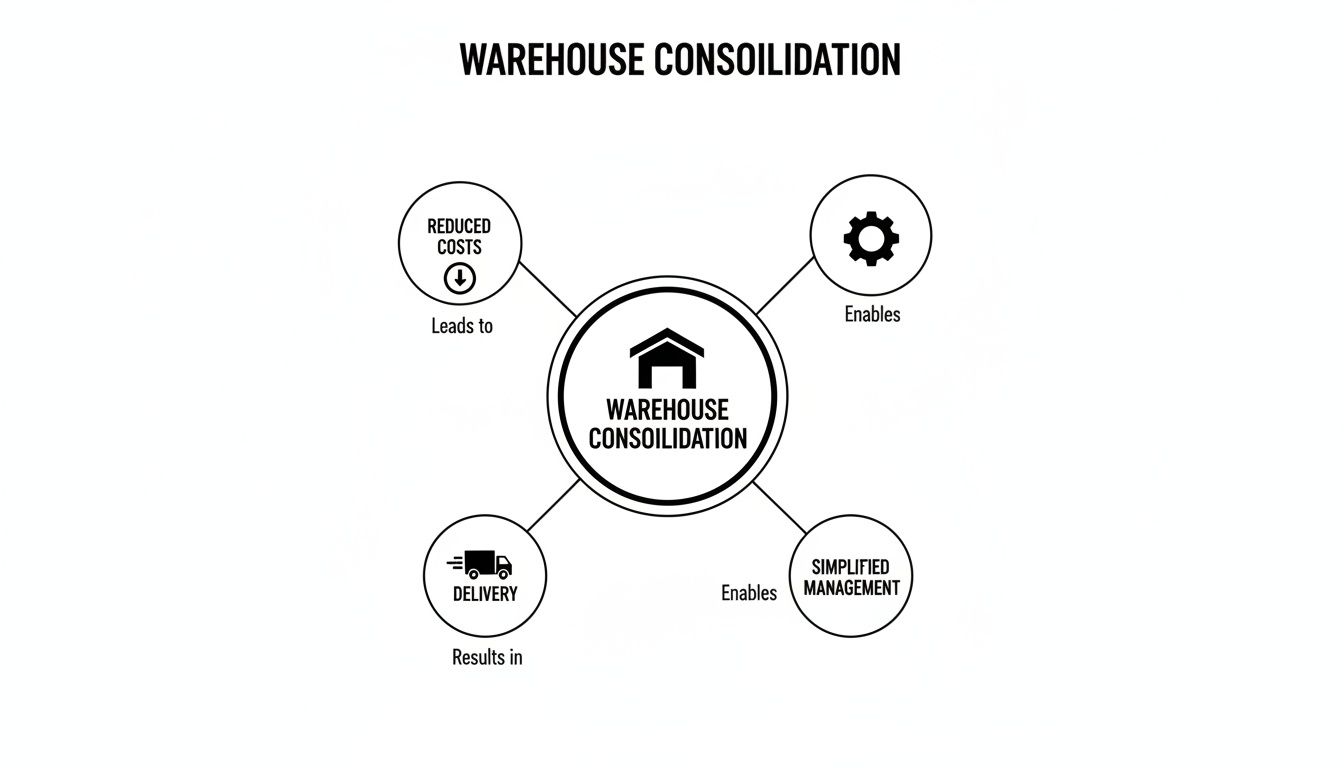
As you can see, centralizing operations is a direct path to lower costs, easier management, and faster deliveries—the building blocks of a supply chain that can actually keep up.
Inbound Consolidation
Think of inbound consolidation like a carpool for your incoming parts. Instead of ten different suppliers sending ten separate, half-empty trucks to your loading dock, you coordinate them. All those smaller shipments get combined into one full truckload at a nearby hub before making the final trip to your facility.
This approach is a game-changer for any company managing a wide net of suppliers. The benefits are immediate:
- Massively Lower Freight Costs: You're paying for one full truckload (FTL) instead of multiple less-than-truckload (LTL) shipments, which always come with a higher per-unit price tag.
- A Clearer, Calmer Dock: One truck showing up instead of ten clears up congestion, cuts down on labor, and gets rid of those frustrating driver wait times.
- Smoother Inventory Flow: Your parts arrive in a predictable, organized batch, making putaway and inventory management a whole lot simpler.
Outbound Consolidation
Now, just flip the script for outbound consolidation. This time, the focus is on combining multiple small customer orders heading to the same general area into one big, efficient shipment. It's the same logic a smart delivery driver uses when planning a route to hit every house in a neighborhood without backtracking.
Instead of sending dozens of individual parcel shipments out the door, the warehouse holds onto orders until there's enough volume to build a full or multi-stop truckload. For e-commerce and direct-to-consumer businesses, this is huge. You get to tap into economies of scale on your outgoing freight, which means big savings and often faster, more reliable deliveries for your customers.
By grouping smaller orders destined for the same region, outbound consolidation transforms costly individual shipments into a single, efficient delivery run, directly boosting profitability and enhancing the customer experience.
Facility Consolidation
The boldest move of all is facility consolidation. This is when a company merges the operations of several smaller, scattered warehouses into one large, centralized distribution center. It often happens after a company merger, when a business outgrows its existing network, or when it's time to trade outdated buildings for a single, modern hub.
This isn't just about moving inventory around; it's a total operational reset. A great real-world example is Kao USA, which consolidated its warehousing into a single in-house facility. The project required them to retool their entire system to manage over 10,000 storage bins and integrate more than 500 delivery routes. The payoff was huge: major cost optimizations, better inventory forecasting, and quicker delivery times. If you want to dig deeper into these kinds of operational wins, you can check out some comprehensive industry statistics on SpeedCommerce.
Merging facilities creates a single source of truth for all your inventory. It streamlines management and allows you to invest in automation and technology that would never be practical across multiple smaller sites. It’s a major strategic play that sets a company up for long-term growth and stability.
Each consolidation strategy offers unique advantages. The table below breaks down how they compare to help you identify which approach might be the best fit for your operational goals.
Comparing Warehouse Consolidation Strategies
Ultimately, choosing the right strategy—or combination of strategies—depends on where the biggest pain points are in your supply chain. Whether it's taming inbound freight chaos or streamlining outbound deliveries, consolidation provides a clear path to a leaner, more effective operation.
The Real-World Benefits of a Consolidation Strategy

Let's move past the theory. A smart consolidation in warehouse strategy delivers powerful, real-world returns that you can see on the balance sheet. These aren't just abstract ideas—they're measurable gains in transportation, inventory management, and even customer satisfaction.
The first and most obvious win is a massive cut in transportation spending.
By bundling multiple less-than-truckload (LTL) shipments into one full truckload (FTL), you stop paying the premium for piecemeal freight. Think of it like buying in bulk; the cost per unit plummets, often slashing freight bills by 20% or more.
But the savings don't stop there. Fewer trucks at your dock means lower labor costs for receiving, less paperwork, and fewer surprise fees for things like driver detention.
Sharpened Inventory Control and Visibility
When your inventory is spread across multiple facilities, getting a clear picture of what you actually have is a nightmare. You end up with redundant safety stock in every building, which ties up cash and raises the risk of products becoming obsolete.
Consolidation fixes this by creating a single source of truth. With everything under one roof, you can:
- Slash Overall Inventory Levels: No more separate safety stock for each location. You can finally operate with a leaner, more efficient inventory.
- Improve Order Accuracy: Centralized picking means fewer mistakes. Your team gets familiar with one optimized layout, leading to better fulfillment.
- Increase Inventory Turnover: Better visibility lets you make smarter purchasing decisions and move goods faster, freeing up capital locked in slow-moving stock.
This kind of control is vital in today's market. The August 2025 Logistics Managers' Index showed Warehousing Utilization climbing to 62.1 and Inventory Costs soaring to 79.2. Those numbers make consolidation a must-have strategy, not just a nice-to-have.
Enhanced Customer Satisfaction and Reliability
A smooth-running supply chain always leads to happier customers. Consolidation isn't just about cutting your own costs—it creates a better, more predictable delivery experience for your clients.
Centralizing distribution shortens lead times. Outbound consolidation, for instance, allows for more frequent, direct shipments that bypass the typical delays of multi-stop LTL routes. That reliability builds trust and gives you a real competitive advantage.
A consolidated logistics network is a promise to your customer. It signals that your operations are efficient, reliable, and capable of meeting their delivery expectations consistently, turning supply chain performance into a powerful brand asset.
A key benefit here is unlocking greater storage density by maximising space with smart storage solutions. This isn't just about saving on rent; it means pickers can fulfill orders faster, shrinking the time from click to shipment.
A Greener, More Sustainable Footprint
Finally, the operational wins from consolidation align perfectly with modern sustainability goals. Fewer, fuller trucks mean a smaller carbon footprint—it’s that simple.
By maximizing the capacity of every vehicle on the road, you drastically cut fuel consumption and emissions. This isn't just good for the planet; it's smart business. More and more customers and partners want to work with companies that take environmental responsibility seriously.
A greener supply chain can become a powerful brand differentiator while driving down operational waste. In the end, the efficiency of consolidation is the bedrock of a more sustainable logistics model.
How to Implement Your Warehouse Consolidation Plan
Turning the idea of consolidation into reality takes more than a whiteboard session. It demands a clear, methodical playbook that moves from high-level strategy to on-the-ground operational changes. This isn't just about moving boxes or re-routing trucks; it's a strategic project.
A successful rollout hinges on careful analysis, the right technology, and a focus on both processes and people. Let's break down the essential steps for turning your plan into a powerful operational advantage.
Step 1: Analyze Your Current Network
Before you change a single thing, you need a complete picture of your existing operations. This is the diagnostic phase—a deep dive into your data to find the true sources of inefficiency and map out every strength and weakness in your supply chain.
Your analysis should hit a few key areas:
- Shipment Data: Dig into your LTL and FTL history. Look for frequent routes, shipping volumes, and carrier costs to see where inbound or outbound consolidation offers the biggest payoff.
- Inventory Levels: Examine stock levels across every location. You're hunting for redundant safety stock, slow-moving products, and other signs of a fragmented system.
- Operational Costs: Go beyond freight. Tally up the total cost of each facility—rent, utilities, labor, equipment, the works. This data builds the financial case for making a change.
This review gives you a data-backed foundation, highlighting the specific pain points your consolidation strategy needs to solve.
Step 2: Define Clear and Measurable Goals
With a clear "before" picture, you can set specific, measurable targets for the "after." Vague goals like "improve efficiency" are useless here. You need concrete numbers that define what success looks like for your consolidation in warehouse project.
Strong goals sound like this:
- Reduce overall transportation spend by 15% within the first year.
- Decrease average order fulfillment time from 48 hours to 24 hours.
- Lower total safety stock levels by 30% within six months.
- Improve order picking accuracy to 99.8% or higher.
These targets guide your implementation and become the KPIs you'll use to measure your return on investment down the road.
A well-defined goal acts as a compass for your entire project. It aligns your team, justifies the investment, and provides a clear benchmark to measure success against long after the implementation is complete.
Step 3: Redesign Workflows and Select Technology
Consolidation will absolutely change how work gets done. Merging facilities or combining shipments means redesigning your workflows for receiving, putaway, picking, and shipping. This is the perfect moment to scrap outdated processes and build leaner, more effective methods from the ground up. Optimizing your physical space is a huge part of this, a topic we cover in our guide to warehouse layout and design.
Technology is the backbone of this new operational model. A robust Warehouse Management System (WMS) is non-negotiable for managing centralized inventory with any real accuracy. It orchestrates everything. Likewise, making sure your ERP and EDI systems are fully integrated is critical for a seamless flow of data between your warehouse, suppliers, and customers.
Step 4: Manage Change and Train Your Team
The human element is easily the most overlooked—and most critical—part of any consolidation project. Your team will have questions and concerns about changes to their roles, locations, and daily routines. Get ahead of it with proactive change management.
Your plan absolutely must include:
- Clear Communication: Keep everyone in the loop on the "why" behind the move, the timeline, and how it impacts them personally. Transparency builds trust.
- Comprehensive Training: Your staff will need solid training on new workflows, new software (like the WMS), and maybe even new equipment. A well-trained team is a confident team.
- Defined Roles: Clearly map out new roles and responsibilities in the consolidated structure. It eliminates confusion and ensures everyone knows who owns what.
When you invest in your team through this transition, you ensure the operational wins you designed on paper actually happen on the warehouse floor.
The Technology That Powers Modern Consolidation

Effective consolidation isn’t about brute force; it runs on a sophisticated digital nervous system. Without the right tech, trying to manage a central inventory or coordinate complex shipments is like navigating a maze blindfolded. These tools are what provide the visibility and control to make a consolidation in warehouse strategy actually work.
These systems all talk to each other, creating a data-driven foundation that turns a good plan into a high-performing reality. Let’s break down the essential pieces of this tech stack and see how they create a seamless, efficient operation.
The Warehouse Management System (WMS)
Think of the Warehouse Management System (WMS) as the brain of the entire operation. This software is the command hub that directs and tracks every single piece of inventory from the moment it hits the dock to the second it’s shipped out. In a consolidated environment, its job gets even more critical.
A solid WMS orchestrates complex, high-volume activities with precision. It manages everything from finding the best storage spot to mapping out the most efficient picking paths, making sure labor and equipment are used wisely. For a deeper dive, you can explore the many benefits of a warehouse management system that drive this kind of operational excellence.
A WMS transforms your warehouse from a simple storage space into a dynamic, data-rich environment. It provides the real-time visibility and control needed to manage consolidated inventory, reduce errors, and accelerate fulfillment cycles.
The Enterprise Resource Planning (ERP) System
If the WMS is the brain, the Enterprise Resource Planning (ERP) system is the central nervous system connecting the warehouse to the rest of the business. An ERP ties together key functions like finance, procurement, and sales with your logistics, creating one unified view of the entire organization.
This integration is non-negotiable for consolidation. For example, when sales data in the ERP shows a spike in demand, it can automatically trigger procurement and signal the WMS to prepare for incoming shipments. This seamless communication ensures your consolidated warehouse isn’t operating in a silo. At Wolverine Assemblies, we run on a robust system like PLEX ERP to guarantee this level of integration.
Essential Communication Protocols
Smooth consolidation depends on flawless, automated communication between you, your suppliers, and your carriers. Two key technologies make this happen:
Electronic Data Interchange (EDI): This is the universal digital language that lets different companies' computer systems talk to each other. EDI automates the back-and-forth of documents like purchase orders and invoices, cutting out manual data entry and costly errors.
Advance Shipping Notices (ASN): An ASN is a specific EDI message a supplier sends before a shipment arrives. It details exactly what’s in the shipment, how it’s packed, and when it will get there. This gives the warehouse a digital heads-up to plan labor and dock space for a quick and efficient receiving process.
These tools create a transparent and predictable supply chain. For an even greater layer of automated data capture, advancements in Radio Frequency Identification (RFID) technology are also becoming crucial for tracking goods inside the warehouse. Together, this tech ecosystem ensures that a modern consolidation strategy isn't just efficient—it's intelligent.
Seeing Consolidation in the Real World
Theories are great, but seeing warehouse consolidation solve real-world headaches is where the lightbulb really goes on. This isn't just about shaving a few points off a spreadsheet; it's about delivering tangible results in some of the most demanding industries out there, from high-stakes automotive lines to sprawling industrial operations.
These examples show how a smart consolidation strategy can turn a clunky, expensive supply chain into a serious competitive advantage. Let's look at how this plays out in three different high-pressure environments.
Automotive Just-in-Time Delivery
Picture a fast-moving automotive assembly line. Every second is money. A delay of just a few minutes can grind the entire operation to a halt, costing thousands. In this world, a single original equipment manufacturer (OEM) is juggling components from dozens, sometimes hundreds, of different suppliers.
Instead of having 50 different suppliers send 50 separate, half-empty trucks to the plant—creating a traffic jam at the docks and chaos for receiving—a consolidation partner changes the game.
Here's how it works:
- Component Collection: The partner gathers all the smaller shipments from those 50 suppliers at one central warehouse.
- Strategic Sequencing: Parts are received, inspected, and organized precisely according to the OEM's production schedule. No guesswork involved.
- Just-in-Time Shipment: All those components are then loaded onto a single, full truck and delivered to the assembly line exactly when they're needed.
This inbound consolidation model saves the OEM a massive amount of time, dock space, and on-site inventory headaches. It creates a lean, predictable flow that keeps the line moving smoothly.
Centralized MRO Supply Hub
Industrial manufacturers with multiple plants face a constant battle managing their Maintenance, Repair, and Operations (MRO) supplies. Think spare parts, lubricants, safety gear—all the essentials that keep machinery running. Each plant often orders its own supplies, leading to redundant inventory and inefficient purchasing across the board.
A facility consolidation strategy cleans this up perfectly. The manufacturer centralizes all its MRO supplies into a single distribution hub.
This central hub acts like an internal superstore. It becomes the single source of truth for inventory, allowing the company to buy in bulk, slash redundant safety stock, and ensure every plant gets critical parts without delay.
Not only does this cut procurement costs, but it also boosts uptime by making sure essential repair components are always ready to go.
Kitting for a Better Customer Experience
Finally, let's look at kitting—a perfect example of value-added consolidation. Imagine a company selling a product that requires some assembly by the customer, with parts coming from several different vendors.
A consolidation partner can take all those separate parts, assemble them into a single ready-to-use kit, add instructions, and ship the finished package directly to the customer. This turns a box of confusing components into a simple, single-SKU product.
This process is one of the most powerful value-added warehousing services because it directly improves the customer's experience and makes the product feel more premium. It’s a brilliant reminder that consolidation isn't just an internal cost-saver; it can be a customer-facing win.
A Few Common Questions About Warehouse Consolidation
Jumping into a major operational shift like consolidation always brings up questions. It's smart to have them. Getting clear answers upfront helps you move forward with confidence. Here are a few of the most common things we hear from clients.
How Long Does a Consolidation Project Take?
This really depends on what you're trying to do. If you're focusing on shipment consolidation, you can often get a program planned and running in just 2 to 4 months. It's a quick win.
But if you're talking about a full facility consolidation—shutting down multiple warehouses to open one central hub—that's a much bigger lift. A project of that scale typically takes 12 to 24 months when you factor in finding the site, integrating technology, and moving all that inventory.
What Are the Biggest Risks to Avoid?
The two biggest pitfalls we see are operational hiccups and unhappy people. You absolutely cannot let the transition delay customer orders, and you need to manage the change carefully to keep your team on board. Another classic mistake is underestimating how tricky it is to get your WMS and ERP systems talking to each other correctly.
A detailed, phased implementation plan is your best defense against these risks. It lets you tackle the transition in controlled stages, test everything thoroughly, and give your team the training they need. This approach prevents system-wide chaos and makes for a much smoother rollout.
Is Consolidation Only for Large Companies?
Not at all. While the big players get headlines for their massive facility consolidations, small and mid-sized businesses (SMBs) can see huge benefits from shipment consolidation.
Many SMBs work with a third-party logistics (3PL) partner who specializes in bundling freight from multiple smaller companies. This gives them access to the cost savings of full truckloads that they could never hit on their own. It’s a powerful way to level the playing field.
Ready to unlock the cost savings and efficiencies of a consolidated supply chain? Wolverine Assemblies provides expert component consolidation, kitting, and warehousing services to streamline your operations. Learn how we can build a more resilient supply chain for your business.
Subscribe to our weekly newsletter