.png)
Best 3pl Companies: Find the best 3pl companies for your logistics needs
Discover the best 3pl companies for OEMs and industrial clients. Compare capabilities, tech, and services to choose your ideal logistics partner.

Choosing a third-party logistics (3PL) partner is a critical strategic decision that directly impacts your supply chain's efficiency, cost, and resilience. For Original Equipment Manufacturers (OEMs) and industrial clients, the stakes are significantly higher. You need more than just generic storage and shipping; you require a partner with robust quality systems, full EDI/ASN capabilities, and value-added services like kitting, sequencing, and sub-assembly to meet demanding just-in-time production schedules.
A one-size-fits-all solution simply won't suffice for complex industrial needs. This guide cuts through the noise to evaluate the best 3PL companies based on criteria that matter most to your operations: technological integration, compliance standards (like IATF 16949), regional expertise, and the ability to act as a true extension of your team. While many 3PLs focus on direct-to-consumer fulfillment, this analysis hones in on providers capable of handling the intricate demands of B2B and industrial supply chains.
We will analyze seven top providers, from specialized industrial experts to technology-driven platforms, helping you identify the partner best equipped to stabilize your operations and reduce total landed costs. Each profile includes a breakdown of core capabilities, pros and cons, and specific guidance on when to choose them. For many businesses, selecting the right partner is the most impactful step you can take to improve e-commerce customer experience through reliable, on-time fulfillment. This curated list provides the actionable insights needed to make an informed decision and find a logistics partner that can scale with your business's unique requirements.
1. Wolverine Assemblies, LLC
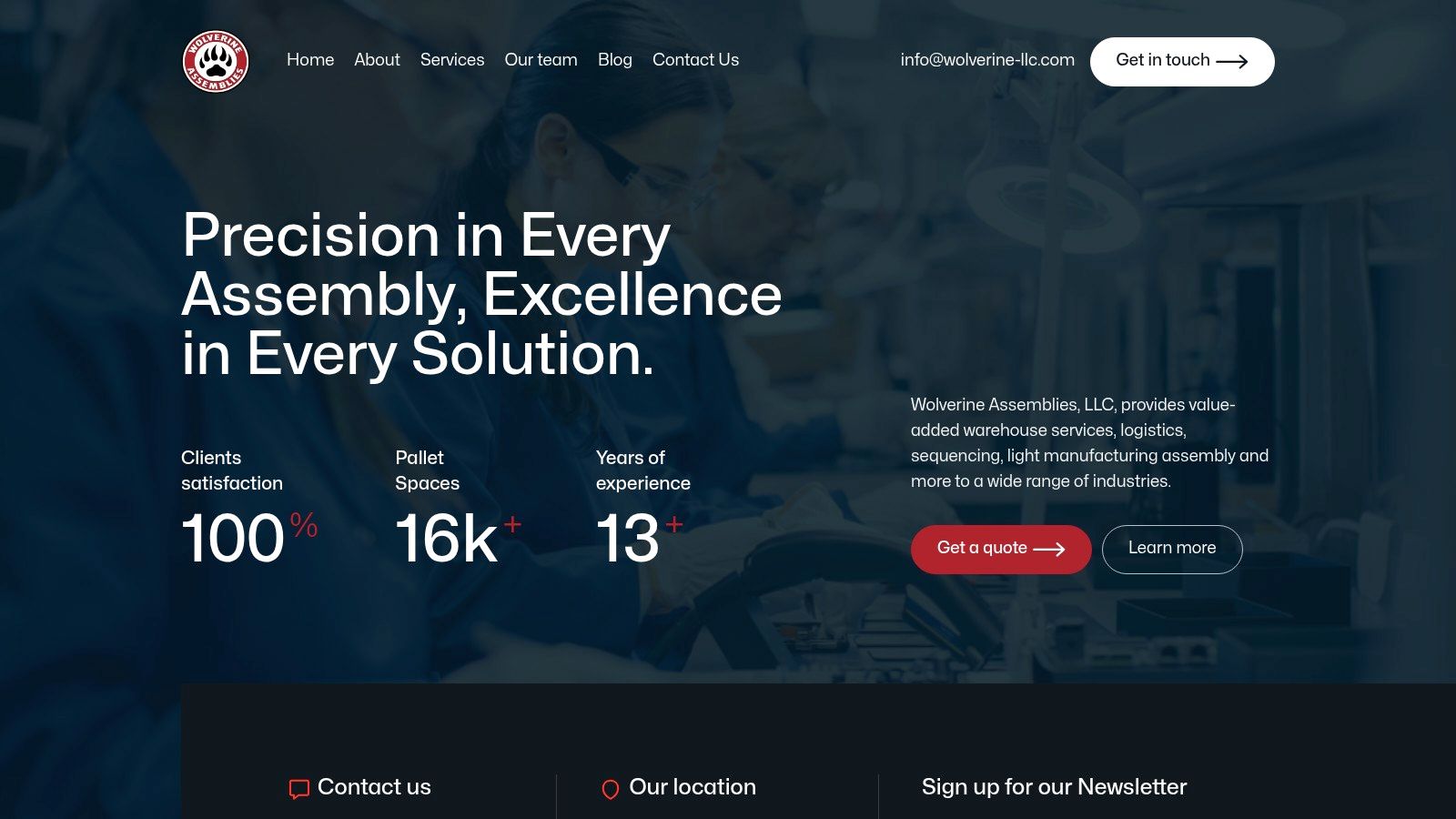
Wolverine Assemblies, LLC stands out as a premier regional 3PL partner, particularly for OEMs and industrial clients in the automotive, agricultural, and energy sectors. Headquartered in Wixom, Michigan, the company combines robust warehousing capabilities with a suite of high-touch, value-added services, positioning itself as a strategic extension of its clients' supply chains. Rather than simply storing goods, Wolverine actively enhances them through processes engineered to meet rigorous OEM and Tier-1 supplier standards.
This dual focus on logistics and light manufacturing makes Wolverine a compelling choice for businesses seeking to consolidate vendors, reduce total landed costs, and improve production velocity. The company operates from a substantial 200,000+ sq. ft. campus, providing the physical capacity needed to manage complex inventory and assembly programs. Its services are not just an add-on; they are a core competency designed to stabilize and streamline demanding supply chains.
Why It Excels: Technology and Process Discipline
A key differentiator for Wolverine is its deep integration of OEM-grade technology and processes. The entire operation runs on the PLEX ERP system, a platform trusted by manufacturers for its precision and control. This foundation enables seamless EDI/ASN connectivity, allowing Wolverine to integrate directly into client systems for real-time data exchange. This is critical for just-in-time (JIT) delivery, sequencing, and maintaining supply chain visibility.
This technological backbone supports a culture of launch discipline and continuous improvement. The company’s processes are documented and repeatable, ensuring that quality and compliance are maintained from program launch to final delivery. This systematic approach is vital for clients in highly regulated industries where errors can lead to significant disruptions and costs. This disciplined execution is a cornerstone of why it ranks among the best 3pl companies for industrial applications.
Core Capabilities and Value-Added Services
Wolverine's service portfolio is designed to address multiple pain points in the industrial supply chain. By offering these capabilities under one roof, they enable clients to simplify their vendor network and reduce logistical complexity.
- Component Consolidation & Warehousing: With over 16,000 pallet positions, Wolverine manages inbound components from global suppliers, providing a centralized hub for inventory management and distribution.
- Sub-Assembly & Kitting: The company performs light manufacturing tasks, such as sub-assembly, kitting, and module building. This pre-assembly work offloads complexity from the client’s main production line, freeing up floor space and labor.
- Sequencing: For automotive and other assembly-line-driven industries, Wolverine delivers parts in the precise sequence required for production, a critical JIT service that minimizes line-side inventory.
- Quality Control & Inspection: Rigorous testing and inspection protocols are embedded in their workflows to ensure all components and assemblies meet strict quality specifications before they reach the client.
Strategic Advantages
Beyond its operational prowess, Wolverine offers unique strategic benefits. As a certified Minority Business Enterprise (MBE), it helps clients meet supplier diversity goals. Furthermore, its collaboration with electronics manufacturing leader Gentex Corporation expands its capabilities into higher-touch electronic assemblies, providing a rare combination of logistics and specialized manufacturing expertise. For those evaluating potential partners, Wolverine offers guidance on key selection criteria. You can learn more about choosing the right 3PL partner on their blog.
Pros:
- OEM/Tier‑1 Readiness: PLEX ERP, full EDI/ASN capabilities, and documented launch discipline ensure compliant, on-time deliveries.
- Large, Flexible Capacity: A 200,000+ sq. ft. facility with 16,000+ pallet positions is suited for warehousing, sequencing, and light assembly.
- End‑to‑End Value‑Added Services: Kitting, sub-assembly, and inspection simplify complex vendor networks.
- Credibility & Partnerships: MBE certification and a collaboration with Gentex provide strong social proof and expanded capabilities.
Cons:
- No Public Pricing: Prospective customers must request a quote to evaluate cost-competitiveness.
- Regional Focus: Specialization in the Wixom, MI area may be less suitable for clients needing multiple, geographically distributed hubs.
Website: https://www.wolverine-llc.com
2. Amazon Multi-Channel Fulfillment (MCF) / Buy with Prime
For businesses aiming to leverage a vast, established fulfillment infrastructure, Amazon Multi-Channel Fulfillment (MCF) offers a compelling solution. It allows companies to use Amazon’s massive network to pick, pack, and ship orders not just from Amazon.com but also from their own direct-to-consumer (DTC) websites, other marketplaces like Walmart and eBay, and even B2B channels. This service effectively unbundles Amazon's logistics prowess from its marketplace, positioning it as a powerful contender among the best 3PL companies for distributed fulfillment.
The "Buy with Prime" feature enhances this offering for DTC sites, enabling merchants to display the Prime logo and offer the fast, free shipping that millions of consumers trust. This can significantly boost conversion rates by providing a familiar and reliable delivery promise. For industrial and OEM clients, this model is particularly useful for managing fulfillment of aftermarket parts, service components, or direct-to-technician shipments where speed and reliability are paramount.
Core Capabilities and Features
Amazon's key advantage is its sheer scale and technological sophistication. The network provides nationwide 1-2 day delivery coverage, backed by a greater than 97% on-time delivery rate for Buy with Prime orders. This level of service is difficult for most single providers to match consistently across the entire U.S.
Key features include:
- Unified Inventory: Businesses can maintain a single pool of inventory with Fulfillment by Amazon (FBA) to serve both Amazon marketplace orders and off-Amazon MCF orders. This simplifies inventory management and reduces the risk of stockouts.
- Neutral Packaging: To avoid channel conflict, all orders shipped via MCF can be sent in unbranded, neutral packaging, ensuring the brand experience remains consistent with the point of sale.
- Broad Integrations: MCF integrates directly with major e-commerce platforms and ERP systems, including Shopify, BigCommerce, and others, streamlining order management across multiple sales channels.
Pricing and Strategic Considerations
Amazon MCF provides transparent, public rate cards, allowing businesses to model costs accurately without lengthy contract negotiations. However, it's critical to monitor for fee updates and seasonal surcharges, which can impact profitability. For a comprehensive understanding of Amazon's core fulfillment capabilities that complement MCF, explore this guide on What Is FBA? A Practical Guide to Amazon’s Fulfillment Engine.
While powerful for standardized fulfillment, MCF is less suited for clients needing complex value-added services like kitting, light assembly, or sub-assembly, which are often better handled by specialized providers. For deeper insights into customized solutions, you can explore more on warehouse and supply chain strategies.
Pros:
- Vast U.S. fulfillment network with fast, reliable SLAs.
- Transparent, publicly available pricing simplifies cost analysis.
- Unified inventory with FBA streamlines multi-channel sales.
Cons:
- Fee structures are subject to frequent updates and surcharges.
- Less flexibility for custom value-added services or specialized handling.
- Marketplace and carrier restrictions can add complexity.
3. ShipBob
For businesses prioritizing a technology-first approach to fulfillment, ShipBob offers a robust platform tailored for small to mid-market e-commerce brands. Its strength lies in a proprietary merchant dashboard that provides real-time visibility into inventory, orders, and shipping performance across a nationwide network of fulfillment centers. This positions ShipBob as one of the best 3PL companies for brands that require a high degree of self-service control and data-driven logistics management.
ShipBob’s model is built around speed and broad coverage, highlighted by its 2-Day Express program that guarantees two-day shipping across the contiguous U.S. This is achieved through a multi-node distribution strategy, where inventory is strategically split across multiple warehouses to be closer to end customers, reducing transit times and costs. While its core focus is DTC, ShipBob also supports B2B and retail fulfillment, offering EDI compliance to manage shipments to larger retail partners.
Core Capabilities and Features
The platform's key differentiator is its user-friendly technology stack, designed to simplify complex logistics operations. The dashboard provides comprehensive analytics, helping businesses understand fulfillment costs, shipping performance, and inventory turnover without needing a dedicated logistics analyst. This self-service model empowers businesses to manage their supply chain directly.
Key features include:
- 2-Day Express Program: Provides 100% coverage across the contiguous U.S., enabling brands to offer Amazon Prime-like shipping speeds on their own websites.
- Real-Time Inventory and Order Management: A centralized dashboard offers a single source of truth for inventory levels and order status, with over 50 direct integrations to major e-commerce platforms and tools.
- Multi-Node Distribution: Smart inventory placement algorithms suggest the optimal distribution of stock across ShipBob’s network to improve delivery speed and reduce shipping costs.
- Analytics and Reporting: Detailed reports on fulfillment performance, shipping costs, and inventory trends help businesses make informed operational decisions.
Pricing and Strategic Considerations
ShipBob's pricing is quote-based, tailored to a business's specific order volume, storage needs, and product profile. While this means there is no public flat-rate card, the company provides educational resources to help merchants understand common 3PL cost drivers. It is important to account for potential surcharges for value-added services or special handling.
The platform is highly effective for standardized e-commerce fulfillment but may require more coordination for complex projects. Services like custom kitting or specialized assembly are available but often come with additional fees. For a deeper look into the nuances of these services, you can find more information about kitting and assembly strategies.
Pros:
- Strong self-service technology stack with a merchant-friendly dashboard.
- Flexible network supporting both DTC and B2B/retail EDI fulfillment.
- Excellent educational resources to help brands understand 3PL costs.
Cons:
- Pricing is quote-based, lacking the transparency of a public rate card.
- Additional fees can apply for value-added services like kitting and branded packaging.
- Best suited for SMBs and mid-market brands with standardized product catalogs.
4. ShipMonk
For direct-to-consumer (DTC) and omnichannel merchants who require transparent operations and scalable fulfillment, ShipMonk presents a strong technology-first platform. It is particularly adept at serving high-growth ecommerce brands, subscription box companies, and retailers needing a 3PL partner that can manage both B2C and B2B order flows. ShipMonk's emphasis on a clear pricing structure and robust software makes it a notable option among the best 3pl companies for businesses prioritizing visibility and control over their logistics.
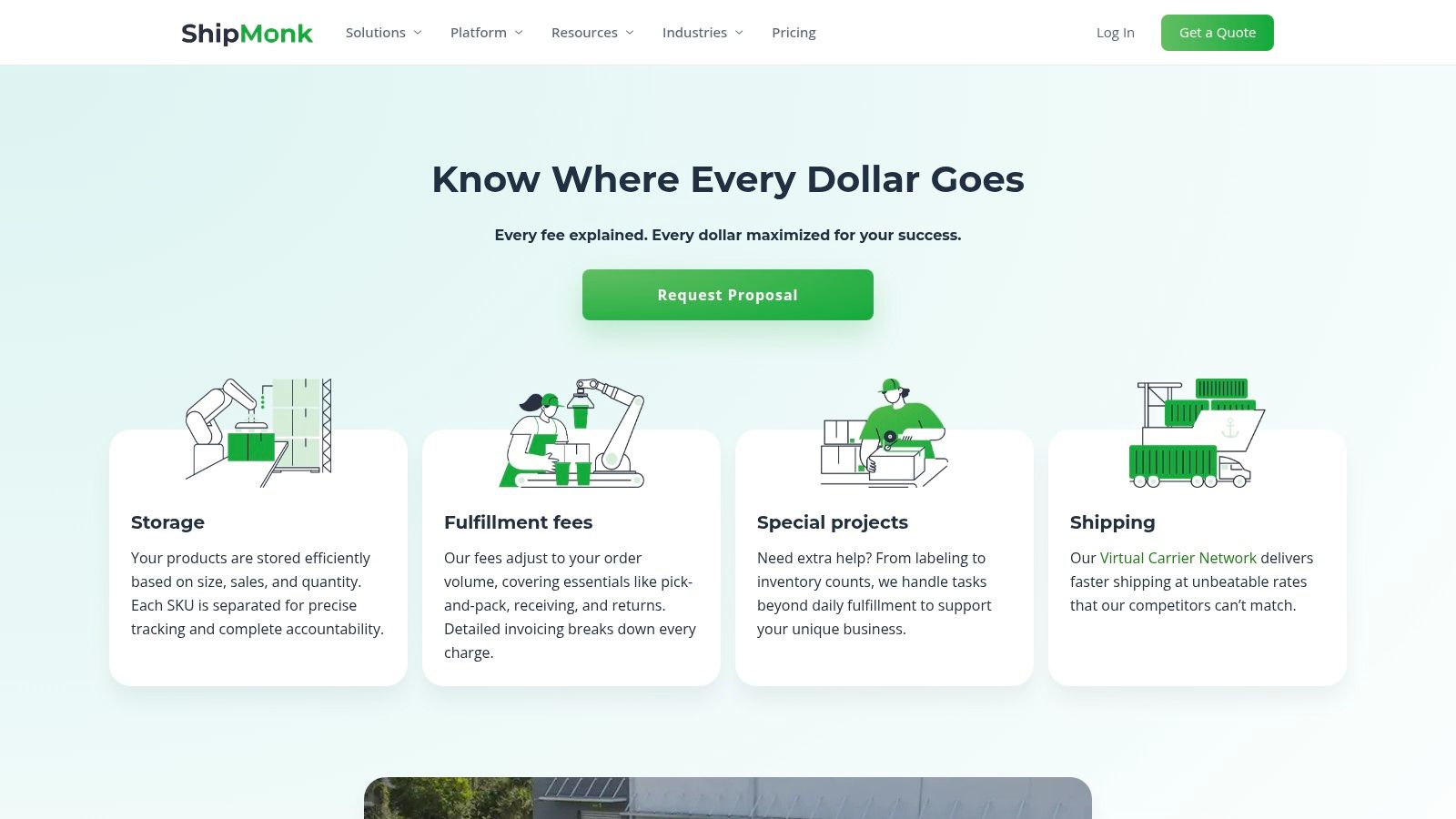
The company’s platform is designed to simplify complex fulfillment challenges, from managing high-SKU inventories to executing intricate kitting and subscription box assembly. This capability is valuable for industrial clients managing aftermarket parts kits or OEMs distributing accessory packages that require precise assembly before shipment. ShipMonk’s international shipping capabilities, reaching over 200 countries from its U.S. network, also provide a streamlined solution for brands looking to expand their global footprint without managing multiple logistics partners.
Core Capabilities and Features
ShipMonk’s primary differentiator is its proprietary software platform, which provides clients with real-time data on inventory, orders, and shipping. This technological foundation is complemented by a "Virtual Carrier Network," which automatically selects the most cost-effective and efficient shipping service for each order, optimizing both speed and expense.
Key features include:
- Specialized Workflow Support: Strong native support for subscription boxes, crowdfunding campaigns, and flash sales, with workflows designed to handle high-volume, complex kitting requirements.
- Value-Added Services: Offers a range of services including kitting, light assembly, branded packaging, gift messaging, and lot control, enabling a customized unboxing experience.
- Omnichannel Fulfillment: The system is built to process orders from various channels, including DTC websites, marketplaces, and B2B retail partners, from a single inventory pool.
- Transparent Pricing Model: Publishes clear pricing categories for core services like storage, pick and pack, and returns, helping businesses model their baseline fulfillment costs.
Pricing and Strategic Considerations
ShipMonk provides a publicly accessible breakdown of its pricing structure on its website, detailing costs for storage, fulfillment, returns, and special projects. While the categories are transparent, the exact per-unit rates are volume-based and require a formal quote to determine precise costs. Businesses should be mindful that ancillary services, such as kitting or specialized packaging, will add to the base rates.
This model is ideal for companies that value clear service definitions and need a partner capable of scaling from a few hundred orders a month to tens of thousands. However, for industrial clients with highly irregular or oversized freight requirements, the model may be less optimized than a 3PL specializing in heavy goods or LTL/FTL shipments.
Pros:
- Transparent fee categories simplify initial cost analysis.
- Strong technology platform with robust inventory and order management features.
- Excellent support for value-added services like kitting and subscription boxes.
- Scales effectively from growing SMBs to high-volume enterprises.
Cons:
- Exact per-unit pricing is quote-based and varies with volume.
- Additional fees for value-added services can significantly increase overall costs.
- Primarily focused on parcel fulfillment, may be less ideal for complex freight needs.
5. Flexport Fulfillment (Deliverr by Flexport)
For businesses seeking an integrated solution that bridges global freight with domestic fulfillment, Flexport presents a unique and compelling model. Following its acquisition of Deliverr, Flexport merged international logistics capabilities with a robust U.S. e-commerce fulfillment network. This creates a single-provider ecosystem for managing the entire supply chain, from overseas manufacturing to final-mile delivery, making it a strong contender among the best 3PL companies for importers.
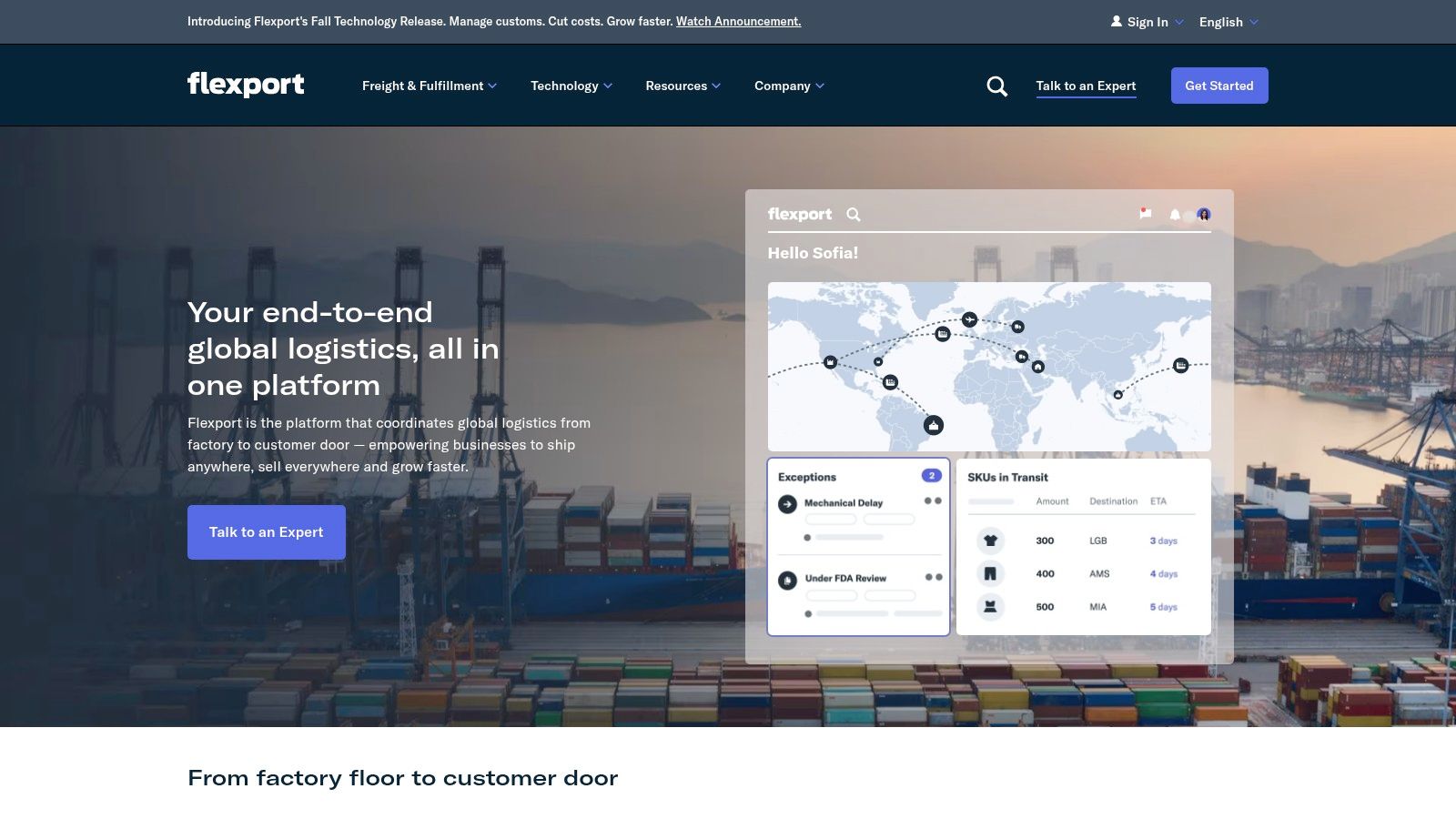
The platform is engineered to simplify the complexities of importing goods and distributing them through direct-to-consumer and multi-channel marketplaces. For industrial and OEM clients that source components or finished goods internationally, this unified approach can drastically reduce handoffs between freight forwarders and 3PLs. This integration minimizes delays, improves visibility, and streamlines inventory management from the factory floor to the end customer's door.
Core Capabilities and Features
Flexport’s primary advantage lies in its technology-driven, end-to-end logistics platform. It offers a unified view of freight movement and fulfillment operations, a significant benefit for supply chain managers needing real-time data for planning and execution. The nationwide fulfillment capabilities inherited from Deliverr provide fast and reliable shipping across the U.S.
Key features include:
- Integrated Freight and Fulfillment: The platform combines ocean, air, and truck freight forwarding with warehousing, picking, packing, and parcel shipping, all managed through a single interface.
- Transparent Fee Documentation: Flexport maintains extensive help-center articles that clearly outline fees, surcharges, and policy changes, allowing for more predictable cost modeling.
- Nationwide Fulfillment Network: Leveraging the former Deliverr network, the service provides distributed inventory placement to enable fast, cost-effective shipping to consumers and business partners across the country.
Pricing and Strategic Considerations
Flexport’s pricing model is designed for businesses with significant volume, but its public documentation helps clarify costs. However, a key consideration is the introduction of monthly minimum fulfillment spend requirements. These minimums, which are stated to increase over time (from $500 to a planned $5,000 per month by 2026), may make the platform less accessible for smaller businesses or those with highly seasonal demand.
The ongoing integration of Deliverr and strategic shifts within the company mean that potential clients should carefully evaluate the platform's stability and long-term fit for their specific operational needs. While the all-in-one model is powerful, it may be less suitable for companies requiring complex, high-touch value-added services like specialized kitting, sub-assembly, or compliance-heavy handling, which are often better managed by specialized 3PLs.
Pros:
- Single provider for import logistics and U.S. fulfillment, simplifying the supply chain.
- Clear documentation on surcharges and pricing policies offers transparency.
- Competitive for brands importing containerized freight for U.S. distribution.
Cons:
- Rising monthly minimum fulfillment spend may price out smaller merchants.
- Strategic restructuring may impact service stability and long-term business fit.
- Less focus on complex industrial value-added services compared to specialized providers.
6. Ware2Go (now part of Stord)
For small to mid-market businesses and industrial suppliers needing a rapid-deployment fulfillment solution, Ware2Go, now integrated into the Stord platform, presents a compelling on-demand model. Originally launched by UPS, Ware2Go built its reputation on offering a flexible, multi-node network that provides 1-2 day ground shipping coverage across the continental U.S. Its acquisition by Stord has combined this agile network with a more comprehensive, tech-forward supply chain platform, making it one of the best 3PL companies for brands that prioritize speed-to-market and scalable infrastructure.
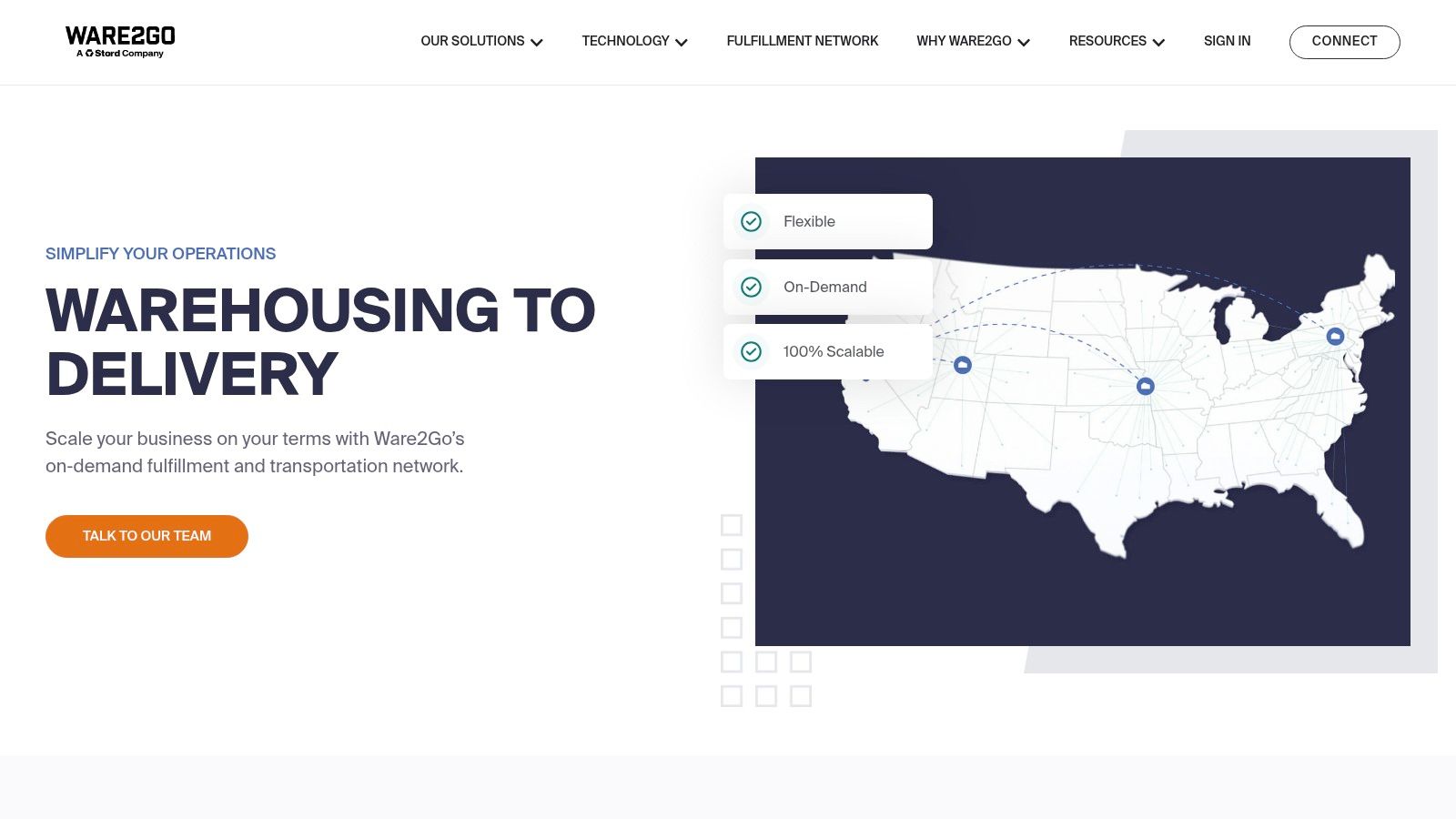
This model is particularly advantageous for industrial clients launching new product lines or expanding into new geographic regions without committing to long-term leases or capital-intensive infrastructure. By leveraging a distributed network of pre-vetted warehouses, businesses can strategically position inventory closer to end-customers, whether they are consumers, distributors, or field technicians. This reduces shipping times and costs while improving service levels.
Core Capabilities and Features
Ware2Go’s key differentiator is its on-demand flexibility combined with sophisticated network management software. It allows businesses to adapt their fulfillment footprint dynamically based on demand shifts. The platform's analytics tools help guide optimal inventory placement, ensuring that products like aftermarket parts or service components are stored in the most efficient locations for rapid deployment.
Key features include:
- Nationwide Multi-Node Network: Access to a network of warehouses designed to provide 1-2 day delivery coverage to the majority of the U.S. population, reducing transit times and last-mile costs.
- Amazon Program Expertise: Specialized support for Fulfillment by Merchant (FBM), Seller Fulfilled Prime (SFP), and FBA prep services, including a dedicated support team to navigate Amazon's compliance requirements.
- Software and Analytics: A robust technology platform provides tools for network design, inventory allocation, and order management, giving clients visibility and control over their distributed supply chain.
- Quick Setup and Flexible Model: The on-demand nature of the service allows for faster onboarding compared to traditional 3PLs, with more flexible terms that avoid lengthy contractual commitments.
Pricing and Strategic Considerations
Pricing for Ware2Go is customized and requires a direct quote, as it depends on volume, storage needs, and the specific services required. While minimum volume thresholds apply, the model is built for scalability, accommodating growth as a business expands. The integration with Stord’s broader cloud supply chain platform adds end-to-end logistics capabilities, from port-to-porch, for clients who need more than just fulfillment.
While the flexibility is a major draw, businesses requiring highly specialized value-added services, such as complex assembly or custom industrial packaging, will need to verify that the specific nodes within the network can meet their exact requirements. It is a strong choice for companies that need a modern, tech-enabled partner to manage distributed inventory for e-commerce, B2B, and marketplace channels simultaneously.
Pros:
- Fast setup and broad U.S. coverage without requiring long-term contracts.
- Strong alignment and compliance support for Amazon marketplace sellers.
- Backed by Stord's scaled fulfillment platform and advanced technology.
Cons:
- Minimum volume thresholds may be a barrier for very small businesses.
- Custom, quote-based pricing means rates are not publicly listed.
- Specific value-added service capabilities can vary by warehouse location.
7. Extensiv Fulfillment Marketplace
For businesses navigating the complex process of selecting a logistics partner, the Extensiv Fulfillment Marketplace serves as a powerful research and matching tool rather than a direct provider. It is a curated directory of over 1,500 pre-vetted U.S. 3PL warehouses, helping merchants quickly identify and compare potential partners based on highly specific criteria. This platform streamlines the often-overwhelming task of finding the best 3PL companies by transforming a broad search into a qualified shortlist.
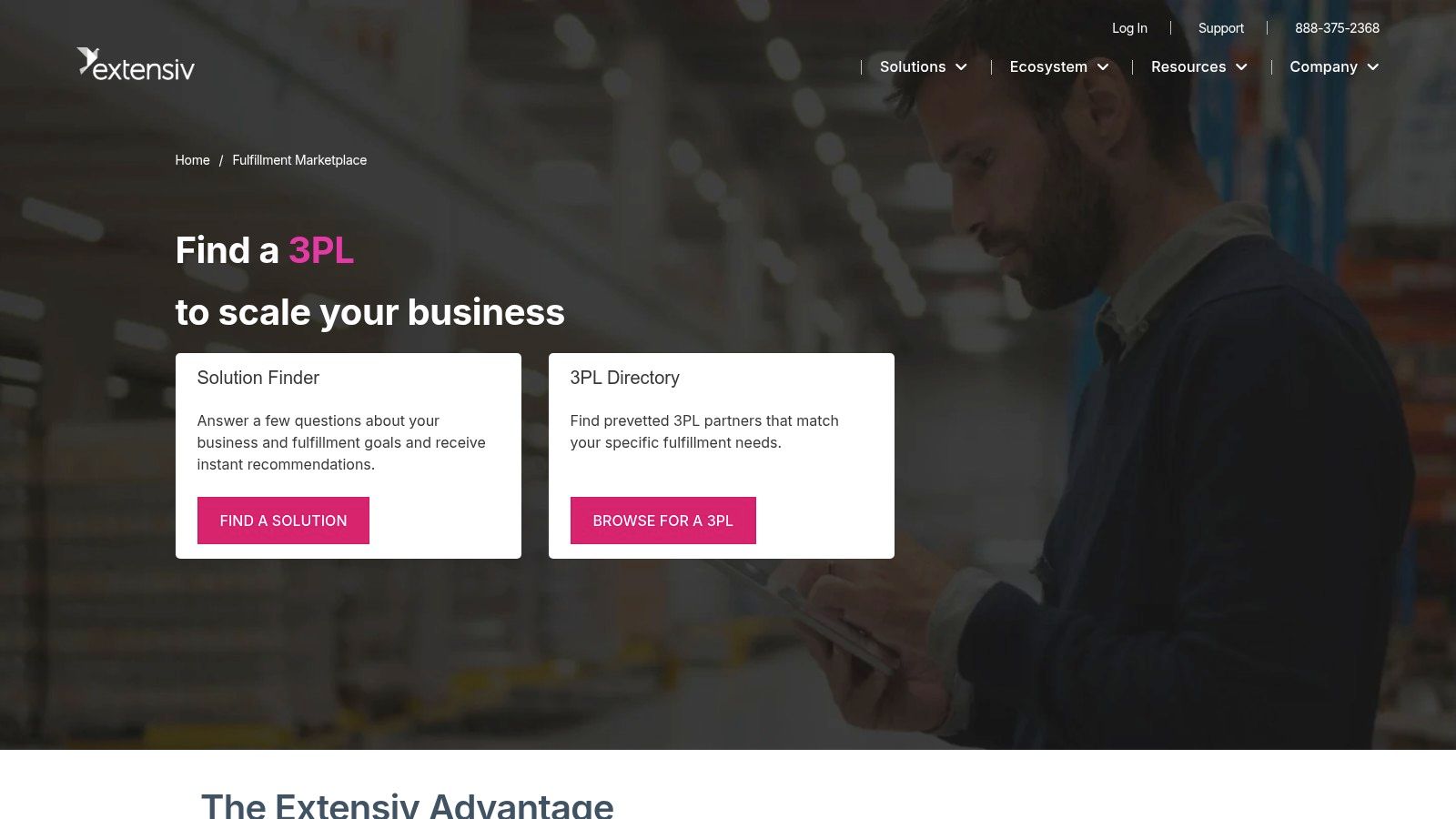
The service is particularly valuable for industrial clients with precise needs, such as B2B fulfillment, climate-controlled storage, or hazmat handling. Instead of cold-calling dozens of potential vendors, a business can filter providers by vertical, geographic footprint, and core capabilities to receive a curated list of suitable options. This approach helps ensure that initial conversations and RFPs are directed only at partners equipped to handle the company's specific product and operational requirements.
Core Capabilities and Features
Extensiv’s strength lies in its extensive network and sophisticated matching algorithm, backed by its position as a leading provider of 3PL warehouse management system (WMS) software. This gives them deep insight into the capabilities and performance of the 3PLs on their platform, adding a layer of credibility to their vetting process.
Key features include:
- Granular Filtering: Users can search and filter the network of 1,500+ connected 3PLs by industry specialization (e.g., automotive, electronics), order volume, B2B vs. DTC focus, and specific services like hazmat storage or FDA compliance.
- Assisted Matching and RFP Support: For more complex needs, Extensiv offers expert assistance to help define requirements, issue RFPs, and facilitate introductions to well-matched 3PLs, ensuring a more efficient and effective procurement process.
- Standardized Comparisons: The platform helps businesses gather comparable bids by aligning assumptions and service-level expectations from the outset, preventing apples-to-oranges comparisons during contract negotiations.
Pricing and Strategic Considerations
The Extensiv Fulfillment Marketplace is free for merchants to browse, request matches, and receive introductions. The business model relies on the 3PL partners who use Extensiv's software and pay to be part of the network. This allows companies to leverage a powerful sourcing tool without any upfront investment.
However, it is crucial to remember that Extensiv is a matchmaking service, not the end provider. The user must still conduct their own due diligence, negotiate contracts, and manage the relationship directly with the chosen 3PL. The quality of service, pricing, and contract terms will ultimately depend on the individual partner selected through the marketplace. For more details on the service, you can visit the Extensiv Fulfillment Marketplace website.
Pros:
- Provides fast access to a large, pre-vetted network of 3PLs.
- Helps gather comparable bids and align assumptions to simplify vendor selection.
- Free for businesses to use for browsing and requesting matches.
Cons:
- It is a marketplace, so you still must negotiate contracts and pricing directly with 3PLs.
- The ultimate quality of service depends on the individual 3PL selected.
- Best suited for the discovery and shortlisting phase, not ongoing partner management.
Top 7 3PL Providers Comparison
Making Your Final Decision: Partnering for Long-Term Success
Navigating the landscape of the best 3pl companies is a mission-critical task for any OEM, Tier 1 supplier, or industrial manufacturer. The choice you make extends far beyond simple warehousing and shipping; it directly impacts your operational efficiency, product quality, and supply chain resilience. This roundup has demonstrated that the "best" partner is entirely dependent on your specific operational DNA. A one-size-fits-all approach simply doesn't work when dealing with complex, high-stakes logistics.
We've analyzed a spectrum of providers, from e-commerce powerhouses like ShipBob and Amazon MCF to technology-driven networks like Flexport and Stord. While these platforms excel at high-volume, standardized fulfillment for direct-to-consumer brands, they often lack the specialized capabilities required by industrial clients. For sectors like automotive, agriculture, and energy, the essential requirements shift from speed-to-consumer to precision, compliance, and deep systems integration.
From Shortlist to Strategic Partner
The journey from evaluating options to forging a successful partnership involves a structured, analytical process. Merely comparing rate sheets is a recipe for long-term failure. Instead, focus your internal team on a more holistic evaluation framework that weights criteria according to your business priorities.
Key Takeaways for Your Evaluation Framework:
- Define Your Core Need: Are you solving for DTC scalability (ShipMonk, ShipBob), international freight complexity (Flexport), or high-touch industrial services? Clarity here immediately narrows your list of viable candidates.
- Evaluate Value-Added Services (VAS): For OEMs and Tier 1 suppliers, services like light assembly, kitting, sequencing, and sub-assembly are not optional add-ons; they are essential functions. Scrutinize a 3PL's proven experience and quality control processes in these specific areas. A provider like Wolverine Assemblies, built around these services, operates with a different level of precision than a standard pick-and-pack warehouse.
- Scrutinize Technology and Integration: True partnership hinges on seamless data flow. Assess each 3PL's EDI/API capabilities. Can they integrate directly with your ERP, MRP, and production scheduling systems? Ask for case studies or technical documentation demonstrating their integration prowess with systems like SAP, Oracle, or proprietary manufacturing platforms.
- Prioritize Regional Expertise: For companies with a significant footprint in the Midwest's industrial corridor, a regional specialist offers tangible advantages. They provide deeper market understanding, established local carrier relationships, and the agility to respond rapidly to production line needs-a level of service national networks struggle to match.
Actionable Next Steps for Selection
With these insights, your team can move from passive research to active engagement. The goal is to transform this list of the best 3pl companies into a single, trusted partner.
- Develop a Detailed Request for Proposal (RFP): Go beyond basic volume metrics. Include your specific quality standards (e.g., ISO 9001:2015 certification requirements), detailed workflows for kitting and assembly, and precise EDI transaction set needs.
- Conduct On-Site Visits: For complex operations, a site visit is non-negotiable. Observe their warehouse organization, quality control stations, and employee training programs. This is where you can validate the claims made in their marketing materials.
- Request Pilot Program Proposals: Before committing to a full-scale, multi-year contract, ask your top two or three candidates to outline a paid pilot program for a specific product line or component. This de-risks the transition and provides real-world performance data, allowing you to measure KPIs like order accuracy, on-time delivery, and quality acceptance rates.
Choosing a 3PL is not a vendor procurement task; it is a strategic alignment. The right partner becomes an extension of your own operations, a dedicated team invested in your success, and a critical component in building a resilient and competitive supply chain for the future.
If your operations demand precision, value-added services, and deep integration within the Midwest's industrial heartland, it’s time to look beyond generic fulfillment. Discover how Wolverine Assemblies, LLC provides the specialized kitting, light assembly, and compliant warehousing solutions that top OEMs and Tier 1 suppliers rely on. Contact Wolverine Assemblies, LLC today to discuss a partnership built for industrial excellence.
Subscribe to our weekly newsletter