.png)
Unpacking Kitting & Assembly Services for Modern Supply Chains
Discover how kitting & assembly services streamline your supply chain. Learn how to boost efficiency, cut costs, and find the perfect 3PL partner.

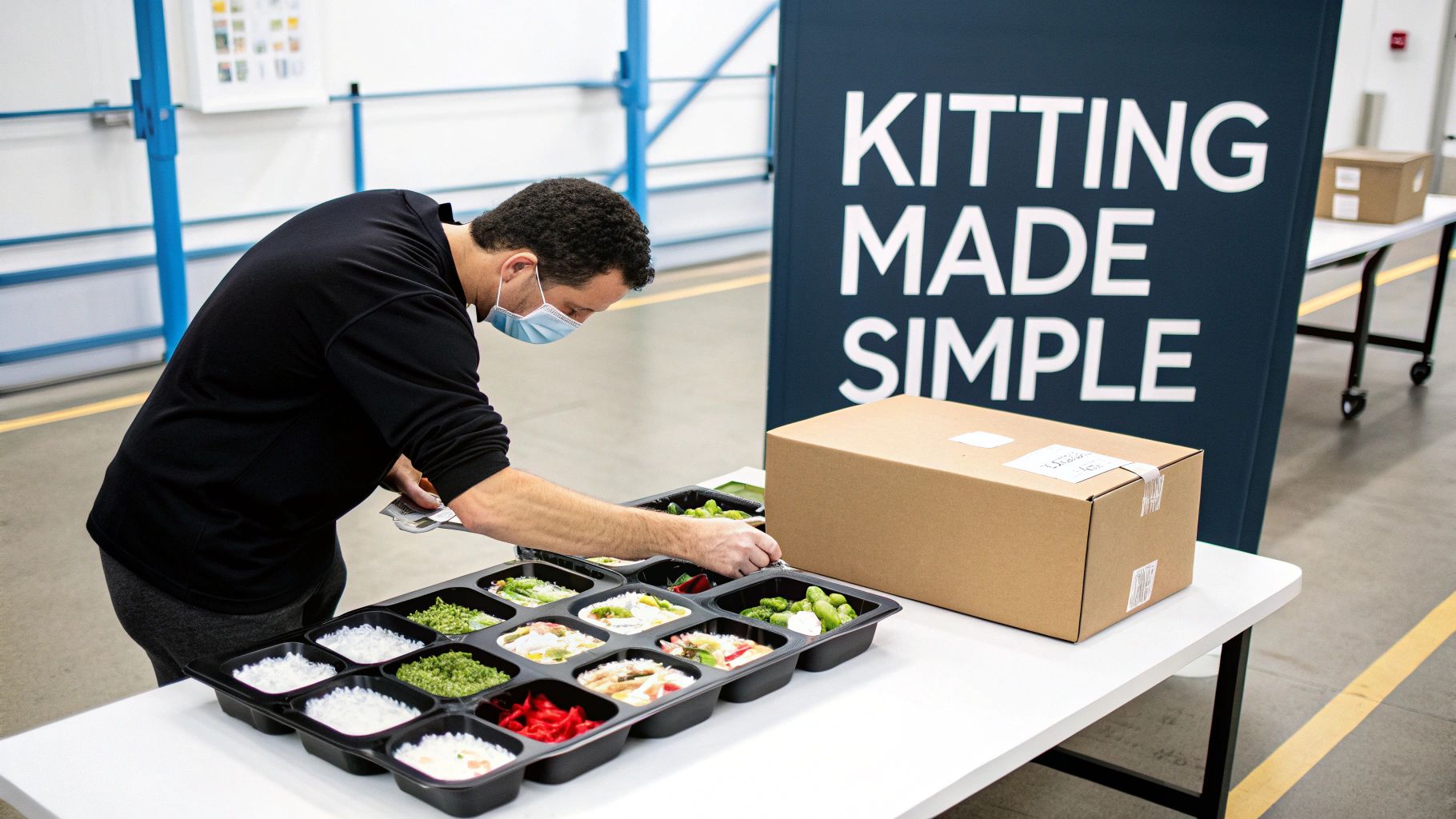
Kitting and assembly are two of the smartest ways to make a supply chain more efficient. Think of them as fulfillment services that group individual items into a ready-to-ship package (kitting) and, when needed, put them together into a final product (assembly).
It's a simple concept with a huge impact. This process takes a bunch of separate SKUs and turns them into a single, organized unit. It’s a lot like a meal-prep service that gathers every ingredient for a recipe into one box, saving the chef a ton of time and hassle.
How Kitting and Assembly Transform Your Supply Chain
Picture your assembly line right now. Workers probably move between different bins, searching for the right nuts, bolts, and electronic components for each unit. Every search takes time, and every grab is a chance for error.
Now, imagine a different scene: a single, pre-packaged kit arrives at each workstation. It contains every single part needed for that specific task, no searching required. That’s the power of a well-run kitting and assembly strategy.
This is more than just putting items in a box; it's a complete shift in how you run your operations. Instead of treating logistics as an afterthought, you’re integrating fulfillment directly into your manufacturing or sales process. This approach is so critical that the global market for these services was estimated between $8.7 billion and $11.2 billion in 2024. You can explore more data on the kitting services market growth on growthmarketreports.com.
The Key Difference: Kitting vs Assembly
Though people often use the terms together, kitting and assembly have distinct jobs that build on one another. Knowing the difference helps you pinpoint exactly what your business needs.
Kitting: This is all about gathering, packaging, and bundling multiple items into a single unit under one new SKU. The goal here is organization and efficiency—making sure all the components for a job are together before they're needed.
Assembly: This is the next step. It’s where the components from a kit are physically put together to create a sub-assembly or even a finished product. If kitting is getting the ingredients ready, assembly is cooking the meal.
Kitting prepares the components for action. Assembly is the action itself. One focuses on grouping and organizing, while the other is all about construction and creation.
To make it even clearer, let's break down the core differences in a simple table.
Kitting vs Assembly At a Glance
This table highlights how each service plays a unique role in streamlining your operations.
Understanding this distinction is key to optimizing your workflow, whether you're managing a production line or a fulfillment center.
Practical Applications Across Industries
This strategy isn’t just for one type of business. An e-commerce brand might use kitting to create promotional gift sets for the holidays. Meanwhile, an automotive Tier 1 supplier relies on it to deliver precise component packages right to the assembly line.
In both cases, they use the process to cut down on complexity, reduce handling time, and boost accuracy. The end result? Faster production and happier customers.
Core Services That Drive Operational Value
While the basic idea of kitting is strong, its real power comes from the specialized, value-added services an expert partner can provide. These aren't just small add-ons; they're strategic moves designed to inject pure efficiency right into your production line.
Think of it like getting a meal kit. One version just gives you the ingredients. The other comes from a chef—everything is prepped and arranged in the exact order you need it, with some steps already done for you. That next-level preparation is what turns a good idea into a game-changer for your operations.
These advanced kitting & assembly services go way beyond just grouping parts. They anticipate what your assembly techs need, simplify complex builds, and embed quality control deep in the supply chain long before a single component hits your floor.
From Simple Kits to Sequenced Deliveries
Sequencing is one of the most powerful value-added services, especially for complex manufacturing like automotive or industrial equipment. It takes a standard kit and organizes the parts in the exact order they'll be used on the line.
Imagine a technician installing a vehicle dashboard. Instead of digging through a bin of wires, they get a kit with the instrument cluster harness on top, followed by the HVAC controls, then the radio connections. Every part is right there, exactly when it's needed.
This meticulous organization eliminates the time and mental energy spent searching for the next part. Those saved seconds add up across thousands of units, leading to huge gains in throughput and a sharp drop in installation errors.
The Power of Pre-Built Sub-Assemblies
Another game-changer is sub-assembly. This is where your logistics partner doesn't just kit loose parts but actually builds them into larger modules before they even get to you. It's like a homebuilder getting pre-built wall sections instead of a pile of 2x4s and drywall.
The final assembly process becomes dramatically simpler and faster. Your team isn't tied up with small, repetitive tasks; they're focused on the high-value, final stages of production.
Here are a few real-world examples:
- Automotive: A 3PL might build a complete door module—with the window regulator, speaker, and wiring—and deliver it as one ready-to-install unit.
- Electronics: A partner could assemble and test a computer’s power supply unit, which is then installed as a single component instead of many small ones.
- Industrial: An agricultural equipment maker could receive a pre-assembled hydraulic valve block, ready to bolt directly onto a tractor.
By outsourcing sub-assembly, companies effectively extend their own production floor. This frees up valuable internal resources and space, letting them boost capacity without a major capital investment.
Integrated Quality Control and Testing
Finally, top-tier kitting & assembly providers bake quality control right into their process. This means parts aren't just kitted; they're inspected, tested, and verified against your exact specs before they're packaged.
This proactive approach catches defective parts at the 3PL's facility, not yours. It stops faulty components from ever reaching your production flow, which is critical for avoiding costly line stoppages, rework, and potential recalls. It's one of the many ways businesses benefit from a deeper dive into the world of value-added warehousing services.
By combining sequencing, sub-assembly, and integrated quality control, a kitting program becomes a powerful engine for operational excellence. It transforms your supply chain from a simple delivery service into a strategic tool that actively boosts production efficiency and product quality.
The Technology Powering Modern Kitting Operations
Behind every smooth kitting & assembly operation is a stack of connected technology. Modern logistics has moved far beyond guesswork and paper checklists. It's now a tightly controlled flow of data and real-time communication that makes sure every part is where it needs to be, exactly when it needs to be there.
This digital foundation transforms kitting from a simple manual job into a strategic, error-proof process. The goal is a completely transparent supply chain where information flows just as smoothly as the physical parts. Without this tech, scaling up for complex OEM and Tier 1 demands would be nearly impossible.
PLEX ERP: The Central Nervous System
At the heart of any serious kitting operation is an Enterprise Resource Planning (ERP) system. You can think of a system like PLEX ERP as the central nervous system for the entire manufacturing and logistics network. It creates a single source of truth that everyone can rely on.
This one platform brings together all the critical data—from live inventory levels and production schedules to bills of materials and quality control reports. Instead of juggling dozens of different spreadsheets, everyone from the warehouse floor to the client’s planning team works from the same live information. This wipes out confusion and makes sure decisions are based on what's happening right now. To dig deeper into how these platforms work, it’s helpful to explore the core benefits of a robust warehouse management system.
An integrated ERP system ensures that every department and every partner is reading from the same playbook. This unity of data is the foundation for eliminating waste, preventing stockouts, and maintaining lean operations.
EDI and ASN: The Digital Messengers
If the ERP is the brain, then Electronic Data Interchange (EDI) and Advance Ship Notices (ASN) are the digital messengers carrying vital information between you and your partners. These tools automate the communication that used to rely on faxes, emails, and phone calls, which dramatically cuts down on human error.
- Electronic Data Interchange (EDI): This is just a standard digital language that lets the computer systems of different companies—like an OEM and their 3PL partner—talk to each other directly. Purchase orders, invoices, and forecasts are sent instantly and accurately, with no manual data entry needed.
- Advance Ship Notice (ASN): An ASN is a specific EDI message a 3PL sends to a client the second a shipment leaves the dock. It says exactly what’s in the shipment, how it’s packed, and when it’s expected to arrive, giving the receiving team a head start to prepare.
This automated flow of information creates a tightly synchronized operation where orders get processed in an instant and shipments are tracked with precision from one facility to the next.
The Rise of Automation in Kitting
The investment in logistics automation is growing fast. Inside the larger Automated Storage and Retrieval Systems (AS/RS) market, the kitting segment alone was valued at around $849.3 million in 2024. Experts predict this specific market will grow at a compound annual rate of about 7.8% through 2030, which shows just how much the industry is leaning on technology-driven solutions.
All this tech ties everything together. The ERP system tracks inventory, EDI communicates what’s needed, and ASNs confirm what's on its way, creating a closed-loop system that drives real efficiency. For a closer look at the tools that can improve these operations, you can review the features of modern tracking solutions. By connecting these systems, a kitting provider offers unmatched visibility and control, building a supply chain that isn’t just efficient but truly resilient.
Calculating the Real ROI of Outsourced Kitting
Figuring out the return on investment (ROI) for outsourced kitting & assembly goes way beyond looking at the invoice from your partner. It’s about seeing how this move impacts your entire operation, from the warehouse floor right up to your customer’s doorstep. The real value is found in both the obvious cost savings and the powerful operational gains that drive growth.
To get a real sense of the financial impact, you have to take a hard look at your current processes. Every minute your team spends hunting for parts, every dollar tied up in extra inventory, and every mistake that needs a do-over has a real, measurable cost. Outsourcing kitting targets these weak spots and turns those expenses back into savings.
Uncovering Direct Cost Savings
The first and most obvious wins come from cutting direct costs. When you hand off the kitting process, you free up cash and resources that were tied up in tasks that aren't your core business. That capital can then be put to work where it really counts.
These savings are usually hiding in plain sight right in your budget.
Reduced In-House Labor: You’re no longer paying for the labor to pick parts, organize kits, and manage the kitting area. This includes wages, benefits, and training for staff who can now be moved to higher-value jobs like final assembly or quality control.
Minimized Inventory Holding Costs: A good kitting partner consolidates components, which means you can keep a much leaner inventory on-site. This immediately drops your carrying costs—which can be anywhere from 20% to 30% of your inventory's value each year—freeing up cash and lowering the risk of parts becoming obsolete.
Elimination of Waste: A specialized partner using proven processes and technology like PLEX ERP nearly eliminates errors like wrong picks or missing parts. That means less scrap, fewer production delays, and no more surprise costs for shipping replacement parts or reworking bad assemblies.
The true financial advantage of outsourced kitting isn't just about saving money on one task. It's about optimizing your entire cost structure by converting fixed labor and facility costs into a variable expense that scales with your production needs.
Quantifying Powerful Operational Gains
Beyond the direct savings, the improvements from professional kitting services create a ripple effect that strengthens your whole business. These aren't just fuzzy benefits; they boost efficiency and make you more competitive, adding directly to your bottom line.
Think of it like upgrading the engine in your car. A perfectly tuned kitting process lets the entire production machine run faster and smoother, getting more done with the same or even fewer resources.
Improved Production Throughput: When your technicians get perfectly sequenced and pre-assembled kits, they spend less time on setup and more time on the work that actually adds value. This cuts down on wasted time and directly increases the number of units you can produce per shift.
Higher Order Accuracy: Expert kitting providers rely on systems like barcode scanning and EDI/ASN integration to achieve near-perfect kit accuracy. This prevents line stoppages from wrong parts and boosts the quality of your final product, protecting your brand's reputation.
Faster Fulfillment Cycles: For companies selling directly to consumers, pre-built kits mean orders can be picked, packed, and shipped almost instantly. This shorter order-to-ship cycle gets products to your customers faster and keeps them happy.
A Framework for Your ROI Calculation
To build a strong business case, you need to connect these benefits to your own numbers. This simple framework helps you measure the potential return by comparing where you are now to where you could be with an outsourced kitting partner.
This isn’t just guesswork; it's a way to create a data-driven forecast of your potential savings and growth.
Before we dive into the numbers, it’s important to see this as a practical tool. Use your own operational data—labor rates, inventory values, and error costs—to paint a clear picture of the financial upside.
ROI Calculation Framework for Kitting Services
By plugging in your company’s real data, the financial argument becomes crystal clear. Outsourced kitting and assembly isn't just another line-item expense. It's a strategic investment that delivers a real, measurable return by making your entire operation more efficient, resilient, and profitable.
Implementing Your Kitting Program Step by Step
Making the switch to an outsourced kitting and assembly program isn't something you do overnight. It’s a strategic decision. A successful launch depends entirely on a clear, structured plan that connects your goals with your partner's capabilities.
Think of it like building a bridge. You don't just start laying pavement. You need detailed blueprints, you have to survey the land, and you must build a rock-solid foundation first. In the same way, a strong kitting program is built on careful planning, open communication, and a phased rollout that cuts down on risk and boosts results from day one.
Phase 1: Define Your Scope and Objectives
Before you build anything, you need a blueprint. The very first step is to get crystal clear on what you actually want to achieve. Are you trying to slash labor costs? Do you need to push more products out the door? Or is improving order accuracy the main goal? You have to put numbers to these goals so you can measure success later.
This stage means taking a hard look at your current processes to find the real bottlenecks and pain points. Document everything. As you roll out the new program, using the right software to document processes can make implementation much smoother and ensure everyone is on the same page.
Key objectives to define include:
- Target Cost Per Kit: Lock down a baseline for what each completed kit should cost.
- Desired Throughput: Figure out how many kits you need per hour or shift to keep up with demand.
- Accuracy Goals: Set a high bar for kit accuracy, usually aiming for 99.9% or better.
Phase 2: Vet and Select the Right Partner
Once you know what you need, it's time to find a 3PL partner who can deliver. This is about more than just comparing quotes. You need a partner with proven experience in your specific industry, the right tech stack (like PLEX ERP and EDI/ASN capabilities), and the quality certifications to back it up, like ISO 9001.
A crucial part of this phase is getting on-site. Go visit their facility and talk to their current clients. Seeing their operation firsthand and hearing from real customers gives you the confidence that they can actually do what they say they'll do. A true partner acts like an extension of your own team—they bring you solutions before you even know there's a problem.
Phase 3: Technical Integration and Pilot Program
With a partner chosen, the technical work begins. This is where your systems and your 3PL's systems get connected to make sure information flows smoothly and automatically. Setting up EDI for orders and ASNs for shipments is non-negotiable for automating communication and getting rid of manual data entry errors.
A pilot program is your pre-flight check. It’s a small-scale trial run that lets you test the entire process—from order placement to kit delivery—in a controlled environment. It's your chance to find and fix any issues before you go all-in.
This flowchart shows exactly how a successful program delivers returns through labor savings, inventory reduction, and throughput gains.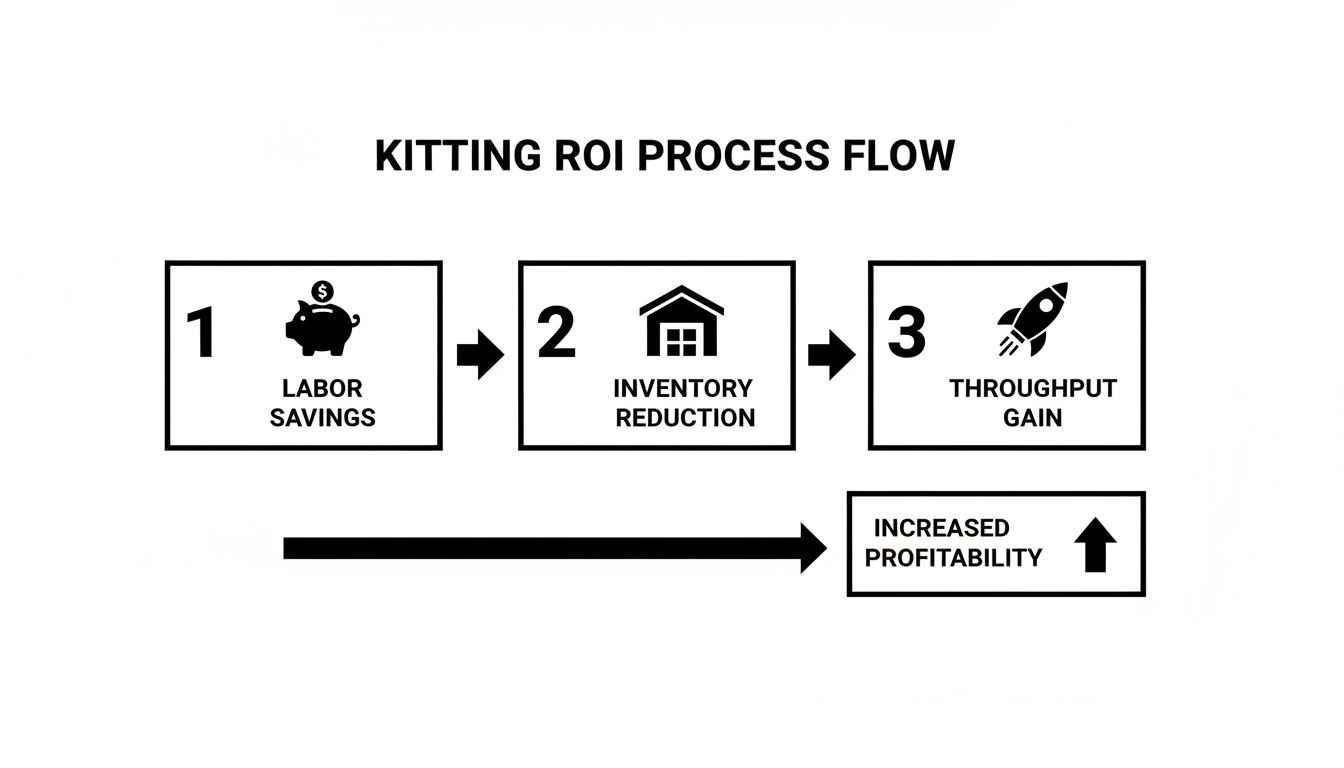
By optimizing each of these areas, a well-run kitting program directly improves your bottom line and makes your operations more resilient.
Phase 4: Full Rollout and Continuous Improvement
After a successful pilot, it’s go-time. This means gradually ramping up production volume while keeping a close eye on your Key Performance Indicators (KPIs). Good management doesn't stop once you launch; it’s a constant cycle of monitoring, analyzing, and fine-tuning the process.
The industry keeps evolving, too. Innovations like ‘fold-to-ship’ packaging, which combines kitting with sustainable shipping solutions, are gaining traction. Market research on these integrated packs projected a jump from about USD 2.4 billion in 2025 to around USD 4.0 billion by 2035, all thanks to e-commerce growth and the big push to cut down on waste.
By following these steps and always looking for ways to get better, you can build a powerful kitting & assembly program that delivers real value and a major competitive edge.
How to Choose the Right Kitting and Assembly Partner
Picking a third-party logistics (3PL) provider for kitting & assembly isn't just about outsourcing a task. It’s about finding a strategic partner who can act as a true extension of your own operations. The right one saves you money, drives efficiency, and improves quality. The wrong one? It can introduce delays, errors, and a world of hurt into your supply chain.
This isn't a decision to take lightly. A top-tier provider does more than just put parts in a box. They integrate with your systems, get the specific demands of your industry, and bring an expertise that strengthens your entire production process. It’s a relationship built on trust.
Evaluate Industry-Specific Expertise
First things first: does this partner have direct experience in your industry? A provider that’s great at assembling consumer electronics probably doesn't understand the intense quality and sequencing demands of an automotive Tier 1 supplier. Deep industry knowledge isn’t a bonus—it's the price of entry.
When you’re vetting partners, ask them straight up about their experience with businesses like yours:
- Automotive: Do they live and breathe just-in-time (JIT) or just-in-sequence (JIS) deliveries? Are they fluent in OEM compliance standards?
- Electronics: Can they handle delicate components, manage ESD (electrostatic discharge) protocols, and perform functional testing?
- Industrial Equipment: Do they have the space and muscle to manage large or heavy components for complex sub-assemblies?
Choosing a partner with proven expertise in your sector means they already speak your language. They get your challenges, anticipate your needs, and have processes ready to go for your specific quality and regulatory requirements.
Verify Quality Certifications and Systems
Quality can't be an afterthought. A reliable partner will have robust quality management systems (QMS) baked into their culture, not just bolted on. The most critical credential to look for is ISO 9001 certification. This international standard is proof of a real commitment to consistent quality and continuous improvement.
Beyond the certificate on the wall, dig into their practical quality controls. Do they use barcode scanning to verify every part? What happens when they find non-conforming materials? A partner who is serious about quality will be totally transparent about their metrics, including a kit accuracy rate that should be 99.9% or higher. This obsession with quality is essential for services like modular assembly, where there is zero room for error.
Assess Technological Capabilities
In today's world, data has to flow seamlessly. A potential partner must have a modern technology stack that can talk to your own systems. This is non-negotiable for getting the visibility and automation needed for efficient kitting & assembly.
Look for these key technological strengths:
- ERP Integration: They should have experience with systems like PLEX ERP to ensure a single source of truth for inventory, orders, and production data.
- EDI/ASN Functionality: The ability to automate communication through Electronic Data Interchange (EDI) and send Advance Ship Notices (ASN) is crucial for killing manual entry errors and giving you real-time visibility.
- Scalability and Proximity: Finally, make sure the partner can handle your current volume and scale up when you need them to. Being physically close to your facilities is also a massive advantage. It slashes transit times and costs, making your whole supply chain more responsive.
Got Questions About Kitting and Assembly? We've Got Answers.
Even when you know kitting and assembly is the right move, a few questions always pop up. Let's clear up some of the most common ones so you can move forward with total confidence.
How Is Kitting Different From Standard Warehousing?
Traditional warehousing is reactive—you store individual parts on shelves and pick them one by one when an order drops. Kitting flips that model on its head. It’s a proactive, value-added service where we pre-group all the necessary components into a single, ready-to-go package before it's even needed.
Think of it like this: a warehouse is a pantry full of separate ingredients. A kitting service is the meal-prep team that portions everything out into a complete kit, ready for the chef. This simple shift from storage to strategic preparation is what makes fulfillment faster, more accurate, and a whole lot leaner.
What Kinds of Products are a Perfect Fit for Kitting?
Just about any product can be kitted, but some get a massive boost from it. The best candidates usually involve complexity, customization, or parts that are always ordered together.
- Subscription Boxes: Kitting is the engine behind every curated subscription box, ensuring each customer gets the right mix of products every month.
- Products Needing Assembly: This is a big one. Think furniture, electronics, or industrial machinery where every last nut, bolt, and bracket has to be present.
- Promotional Bundles: Creating holiday gift sets or special marketing offers becomes incredibly simple with kitting.
- Manufacturing Components: For assembly lines, kitting ensures a technician has every single part for a specific build at their fingertips, eliminating wasted time searching for components.
What's the Onboarding Process Like With a 3PL?
Partnering with a third-party logistics (3PL) provider for kitting is a carefully structured process designed for a seamless transition. We start by sitting down with you to define the exact scope of your project, lock in quality standards, and establish the key performance indicators (KPIs) that matter most to you.
From there, we integrate our systems with yours, often using EDI to automate the flow of information. Before going live, we’ll run a pilot program to test the entire process on a smaller scale. This lets our teams work out any kinks together, ensuring everything is running perfectly before the full-scale rollout. It’s a methodical approach that minimizes disruption and builds the foundation for a rock-solid partnership.
Ready to see what a truly efficient supply chain looks like? Contact Wolverine Assemblies, LLC today. Let’s talk about how our expert kitting & assembly services, driven by precision and technology, can make your operations run smoother than ever.
Find out more at https://www.wolverine-llc.com.
Subscribe to our weekly newsletter