.png)
10 Key Benefits of Outsourcing Manufacturing for OEMs in 2026
Discover the top 10 benefits of outsourcing manufacturing. Learn how OEMs can reduce costs, scale operations, and improve quality with a 3PL partner.


In a competitive global market, OEMs and Tier 1 suppliers face relentless pressure to reduce costs, innovate faster, and build more resilient supply chains. The traditional model of vertically integrated, in-house manufacturing, once a symbol of control, now often represents a significant operational and financial burden, tying up capital and limiting flexibility. This is where strategic outsourcing becomes a critical lever for growth and efficiency.
This article moves beyond generic discussions to provide a detailed breakdown of the ten most impactful benefits of outsourcing manufacturing to a specialized 3PL and light-manufacturing partner. We will not just list advantages; we will provide actionable insights, identify concrete ROI drivers, and explore real-world examples in complex operations like sub-assembly, kitting, sequencing, and component consolidation.
You will learn how a strategic partnership can directly lower your total landed cost, enhance operational scalability, and mitigate supply chain risks. We will demonstrate how outsourcing specific functions allows your team to reclaim focus on core competencies, such as engineering, R&D, and brand growth. This is your definitive guide to leveraging outsourced expertise to achieve sustainable growth and a competitive advantage in the demanding automotive, agriculture, energy, and industrial sectors.
1. Cost Reduction and Lower Total Landed Cost
One of the most immediate and quantifiable benefits of outsourcing manufacturing is the significant reduction in operational expenses and the achievement of a lower total landed cost. By partnering with a specialized third-party provider, OEMs and Tier 1 suppliers can bypass substantial capital expenditures associated with building, equipping, and maintaining their own production facilities. Instead, they leverage the partner's existing infrastructure, technology, and skilled workforce.
This model transforms fixed costs into variable costs, allowing companies to pay only for the services they use. A specialized partner like Wolverine Assemblies operates on economies of scale, meaning they can procure materials and manage labor more efficiently across multiple clients, passing those savings directly to you. This strategic shift is a cornerstone for any company looking to optimize its financial performance and enhance its competitive edge.

Why It Works: Driving Down Per-Unit Costs
Outsourcing partners focus exclusively on lean manufacturing and continuous improvement, which directly translates to lower per-unit costs. Their core competency is optimizing assembly, kitting, and sequencing processes. For instance, automotive OEMs have successfully reduced assembly costs by 15-25% by outsourcing to regional 3PLs that are strategically located near final production plants. This proximity not only cuts transportation expenses but also enables just-in-time (JIT) delivery, minimizing inventory carrying costs.
Actionable Implementation Tips
To maximize financial gains, a structured approach is essential. Consider these practical steps:
- Conduct a Total Cost Analysis: Look beyond the per-unit price. Factor in logistics, quality control, inventory carrying costs, and potential tariff implications to understand the true financial impact.
- Establish Cost-Centric KPIs: Work with your partner to set clear Key Performance Indicators (KPIs) tied directly to cost reduction targets. Regularly review these metrics to drive accountability and continuous improvement.
- Leverage Partner Technology: Utilize your partner’s EDI and ASN capabilities to streamline data exchange, which optimizes inventory levels, reduces holding costs, and improves transportation planning.
By strategically outsourcing non-core manufacturing activities, companies can reallocate capital and internal resources toward innovation, marketing, and core product development. For a deeper dive into specific strategies, you can explore our guide on how to reduce manufacturing costs.
2. Increased Operational Flexibility and Scalability
One of the most powerful strategic benefits of outsourcing manufacturing is gaining the ability to scale production rapidly in response to market dynamics. OEMs and Tier 1 suppliers can pivot quickly, scaling operations up or down without the significant constraints of fixed internal capacity, capital investment, or labor commitments. Outsourcing partners provide a variable capacity model that aligns production output directly with real-time demand.
This approach allows companies to adeptly manage seasonal demand shifts, new program launches, and unexpected market volatility. Instead of maintaining an expensive, underutilized facility during slow periods or struggling to meet peak demand, you tap into a flexible infrastructure. A partner like Wolverine Assemblies acts as an extension of your operations, providing the exact capacity needed, precisely when it's needed, which is a key advantage for lean and agile supply chains.

Why It Works: Elastic Production Capacity
An outsourcing partner's business model is built on shared resources and flexible labor pools, enabling them to absorb demand fluctuations that would cripple a fixed-capacity facility. This elastic model is critical in volatile industries. For instance, industrial manufacturers have successfully scaled production by 30-50% to meet seasonal spikes by using an outsourced partner for sub-assembly, avoiding the need to hire and then lay off temporary staff. Similarly, automotive suppliers can launch new vehicle platforms by leveraging an external assembly partner, eliminating the multi-million-dollar cost and years of lead time required to build a new plant.
Actionable Implementation Tips
To effectively leverage this flexibility, proactive planning and communication are vital. Follow these steps for maximum benefit:
- Establish Clear Capacity Agreements: Define baseline, surge, and peak capacity requirements in your service-level agreement (SLA) to ensure your partner is prepared for fluctuations.
- Share Demand Forecasts Transparently: Implement a shared protocol for demand forecasting. Providing your partner with visibility into your sales pipeline allows them to plan labor and materials more effectively.
- Negotiate Flexible Rate Structures: Work with your partner to create rate structures that incentivize accurate forecasting and accommodate volume changes without excessive penalties.
3. Access to Specialized Expertise and Advanced Capabilities
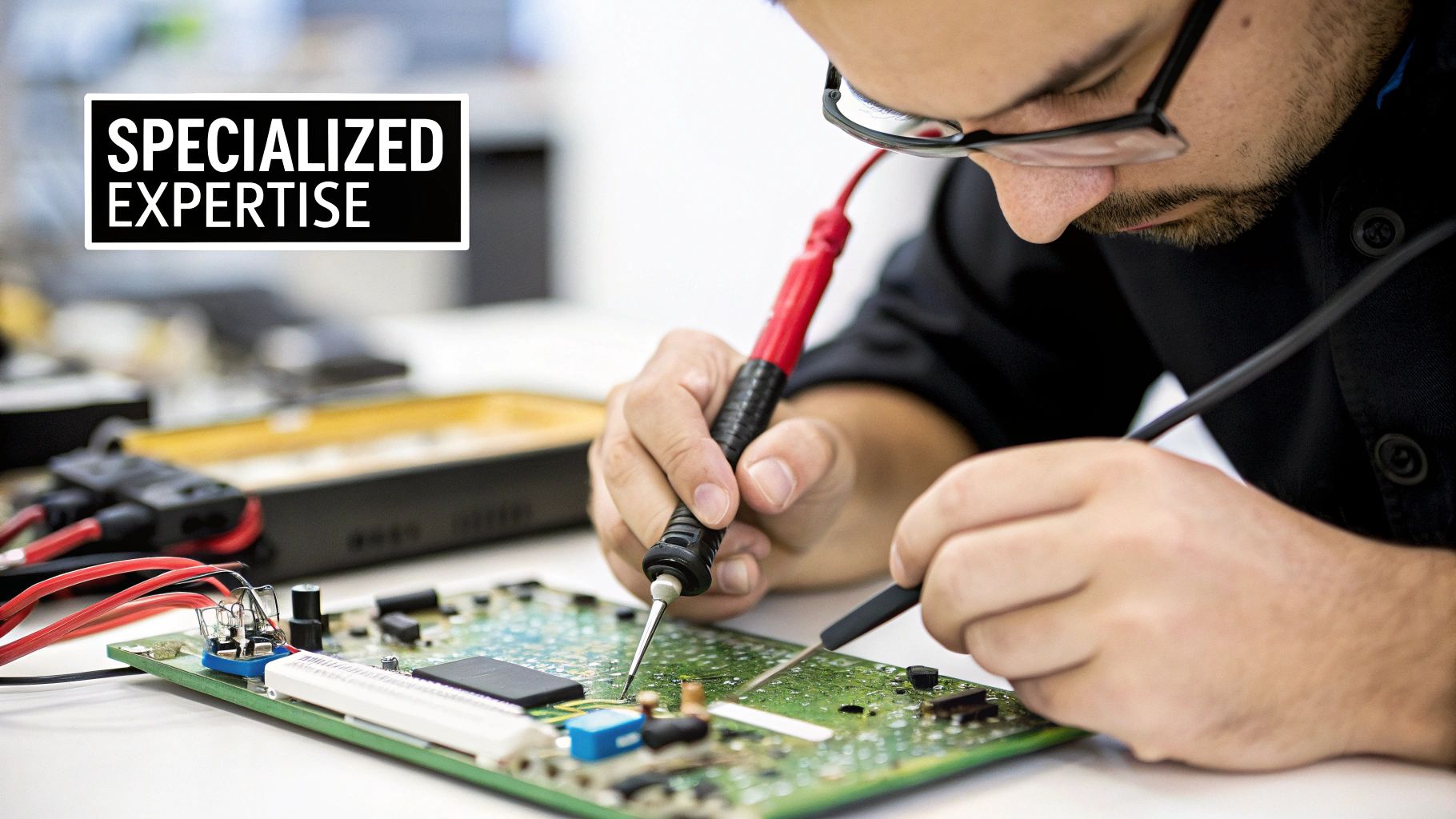
Outsourcing manufacturing provides immediate access to a deep well of specialized knowledge, industry-specific expertise, and advanced operational capabilities. Building these competencies internally is often a slow, expensive, and resource-intensive process. By partnering with a dedicated provider, companies can leverage established excellence in areas like precision assembly, complex kitting, and industry-specific compliance without the associated overhead.
This approach allows OEMs and Tier 1 suppliers to tap into a partner’s focused talent pool and purpose-built infrastructure. A specialist like Wolverine Assemblies brings years of experience in sectors such as automotive, agriculture, and energy, offering refined processes and proven solutions that an internal team would take years to develop. This strategic partnership is a key driver for enhancing product quality and accelerating time-to-market.
Why It Works: Leveraging Focused Competencies
A specialized partner’s core business is perfecting manufacturing support services. This singular focus cultivates a level of proficiency that is difficult for a diversified company to replicate. For example, an automotive OEM can gain immediate access to advanced sequencing expertise for just-in-time (JIT) delivery to their assembly line, ensuring the right components arrive in the exact order needed, minimizing line-side inventory and preventing costly production delays. Similarly, agricultural equipment manufacturers can utilize a partner’s component consolidation expertise to streamline complex bills of materials and improve supply chain efficiency.
Actionable Implementation Tips
To effectively harness a partner's expertise, a proactive approach is crucial. Follow these steps to maximize the value of the partnership:
- Conduct Detailed Capability Assessments: Before engagement, perform a thorough audit of a potential partner’s technical skills, quality certifications, and industry experience to ensure they align with your specific needs and can fill your internal knowledge gaps.
- Establish Knowledge Transfer Protocols: Create formal agreements to document critical processes, quality standards, and operational learnings. This ensures that valuable institutional knowledge is captured and shared, safeguarding process continuity.
- Schedule Regular Capability Reviews: Meet with your partner quarterly or semi-annually to review performance, discuss new technologies, and ensure their capabilities are evolving to meet your future product and market demands.
By strategically leveraging an external partner’s specialized skills, companies can focus their internal resources on core competencies like design, engineering, and brand development. This division of labor is a powerful strategy for driving innovation and maintaining a competitive advantage in a dynamic market.
4. Focus on Core Business and Strategic Priorities
Outsourcing non-essential manufacturing and assembly functions is a strategic decision that allows an organization to redirect its most valuable resources, management attention, and capital toward core competencies. By entrusting operational execution to a specialized partner, leadership teams can concentrate on high-value activities like product innovation, engineering, market expansion, and strengthening customer relationships.
This shift enables a company to excel at what truly differentiates it in the marketplace. Instead of diluting focus with the complexities of production scheduling, labor management, and inventory control, you can channel energy into strategic growth. This is one of the most powerful long-term benefits of outsourcing manufacturing, as it directly supports competitive advantage and sustainable success.
Why It Works: Reallocating Resources for Maximum Impact
An outsourcing partner's core business is operational excellence. They manage the day-to-day execution of assembly, kitting, and sequencing, freeing up your internal teams. For example, a Tier 1 automotive supplier can reallocate its engineering talent from managing production lines to developing next-generation component technology. Similarly, industrial equipment OEMs can focus on research and development while their partner handles the sub-assembly and logistics, ensuring products are built to specification and delivered on time.
Actionable Implementation Tips
To effectively shift focus back to your core business, a clear framework for oversight and alignment is critical.
- Establish Strategic KPIs: Work with your partner to develop Key Performance Indicators (KPIs) that directly reflect your strategic goals, such as time-to-market or R&D investment ratios, not just operational metrics.
- Implement a Governance Structure: Create a governance model that requires minimal daily management from your team. Schedule quarterly business reviews to assess performance against strategic objectives and make high-level adjustments.
- Develop Clear Handoffs: Thoroughly document all processes, quality standards, and communication protocols to create a seamless handoff. This minimizes internal involvement and empowers the partner to operate autonomously within agreed-upon parameters.
By delegating operational responsibilities, companies transform their internal structure to be more agile and innovation-focused. This strategic alignment ensures that every resource is dedicated to activities that drive the most significant long-term value.
5. Risk Mitigation and Business Continuity
Outsourcing manufacturing provides built-in resilience by diversifying supply chain networks and leveraging a partner's expertise in managing disruptions. In an era of increasing volatility, from global pandemics to geopolitical events, relying solely on a single-source internal operation creates significant vulnerability. Partnering with an established 3PL like Wolverine Assemblies introduces stability, redundant capacity, and proven crisis management capabilities.
This strategic approach transfers a portion of the operational risk to a specialist equipped to handle it. A dedicated partner invests in robust business continuity plans and has the flexibility to scale or pivot operations in response to unforeseen challenges. This ensures your production lines keep moving even when faced with labor shortages, material delays, or regional disruptions, safeguarding revenue and market position.
Why It Works: Building a Resilient Supply Chain
A key benefit of outsourcing manufacturing is the immediate access to a more resilient operational framework. Outsourcing partners often operate multi-location networks, providing geographic diversification that insulates your supply chain from localized risks. For example, during the COVID-19 pandemic, automotive suppliers who had outsourced sub-assembly to regional partners were better able to maintain production continuity when their primary facilities faced shutdowns.
These partners are also experts in navigating compliance and regulatory complexities, particularly in sectors like energy or agriculture. By entrusting warehousing and assembly to a compliant provider, companies mitigate the risk of costly penalties and operational delays, ensuring a smoother path from production to market delivery.
Actionable Implementation Tips
To effectively leverage outsourcing for risk mitigation, a proactive strategy is crucial. Implement these practical steps:
- Require Documented Continuity Plans: Before signing a contract, demand and review your potential partner’s business continuity and disaster recovery plans. Ensure they have clear protocols for various risk scenarios.
- Conduct Regular Risk Assessments: Work with your partner to perform joint risk assessments and scenario planning exercises. This collaborative approach helps identify and address potential vulnerabilities before they become critical issues.
- Establish Redundancy: For critical components or programs, consider establishing agreements with partners in different geographic regions to create a truly redundant manufacturing footprint.
By integrating a qualified manufacturing partner into your strategy, you build a more robust and adaptive supply chain. To explore this topic further, read our in-depth guide on effective supply chain risk mitigation strategies.
6. Improved Quality Control and Compliance Management
One of the most critical benefits of outsourcing manufacturing is gaining access to superior quality control systems and dedicated compliance expertise. Specialized partners invest heavily in maintaining rigorous quality assurance protocols, advanced inspection technologies, and the necessary certifications that can be costly and resource-intensive for an OEM or Tier 1 supplier to manage in-house. This strategic partnership offloads the burden of complex quality management and regulatory adherence.
By entrusting these functions to a dedicated provider like Wolverine Assemblies, you leverage a team whose primary focus is maintaining the highest standards. They implement and manage OEM-specific quality requirements, conduct comprehensive testing, and ensure all processes meet or exceed industry and governmental regulations. This focus significantly reduces defect rates, minimizes the risk of costly recalls, and protects your brand's reputation for reliability and excellence.
Why It Works: Embedding Quality into Every Process
Outsourcing partners build their operations around quality assurance, making it an integral part of the process, not an afterthought. Their facilities are often certified to stringent standards like IATF 16949, which is critical for automotive supply chains. For example, Tier 1 suppliers regularly see a measurable reduction in Parts Per Million (PPM) defect rates after outsourcing sub-assembly work to a certified partner who can perform root cause analysis and implement corrective actions more efficiently.
This dedicated approach ensures that every component and finished good is inspected, tested, and documented according to precise customer specifications. For industrial or energy sector clients, this means maintaining meticulous compliance documentation essential for passing regulatory audits and upholding safety standards.
Actionable Implementation Tips
To fully leverage your partner's quality systems, a collaborative framework is key. Implement these steps for optimal results:
- Establish Joint Quality Plans: Develop a shared quality agreement that clearly defines metrics, inspection criteria, and reporting protocols aligned with your end-customer requirements.
- Conduct Regular Audits: Schedule periodic on-site audits and process assessments to ensure ongoing compliance and identify opportunities for continuous improvement in first-pass yield.
- Maintain Transparent Communication: Implement a system for real-time communication on any quality issues, non-conformances, or corrective actions to ensure rapid resolution and prevent disruptions.
7. Enhanced Supply Chain Integration and Visibility
A significant benefit of outsourcing manufacturing is the opportunity to achieve deep, seamless integration within your supply chain. Modern outsourcing partners are not just vendors; they act as strategic extensions of your operations, leveraging advanced ERP systems, EDI/ASN capabilities, and real-time visibility platforms. This creates a fully transparent and responsive supply network.
This level of technological integration moves beyond basic communication to create a unified system for managing inventory, logistics, and production schedules. For complex industries like automotive and energy, this visibility is non-negotiable. It transforms the supply chain from a series of disconnected steps into a cohesive, data-driven ecosystem where information flows freely, enabling proactive decision-making and preventing costly disruptions.
Why It Works: Creating a Transparent, Just-in-Time Ecosystem
Deep integration allows for precise inventory management and optimized logistics, which are cornerstones of lean manufacturing. When a partner’s system is linked directly with yours, they receive real-time demand signals, allowing them to prepare and ship components exactly when needed. Automotive OEMs, for instance, often achieve sub-day inventory levels by using EDI-integrated partners like Wolverine Assemblies to manage component sequencing and delivery timing with pinpoint accuracy.
This real-time data exchange also reduces the need for extensive safety stock. An industrial manufacturer, by sharing demand forecasts through a connected system, can empower its partner to manage component flows more efficiently, cutting carrying costs and minimizing the risk of stockouts.
Actionable Implementation Tips
To fully capitalize on this integration, a clear and collaborative approach is necessary.
- Establish Clear Data Standards: Before integration begins, define the exact data standards, formats (EDI/API), and communication protocols required. This ensures a smooth and error-free connection between systems.
- Implement Robust Cybersecurity: Shared systems require shared security responsibility. Work with your partner to implement robust cybersecurity protocols, including data encryption and access controls, to protect sensitive operational information.
- Leverage Real-Time Dashboards: Utilize the visibility platforms offered by your partner to create shared, real-time dashboards. These tools allow both teams to monitor key supply chain performance metrics, track shipments, and identify potential bottlenecks instantly.
8. Faster Time-to-Market and Reduced Launch Timelines
In industries where market leadership is defined by speed, outsourcing manufacturing is a powerful strategic accelerator. By partnering with an experienced third-party provider, companies can bypass the lengthy and capital-intensive process of facility buildout, equipment procurement, and team training. This allows you to leverage a ready-to-go operational infrastructure, effectively eliminating the internal ramp-up learning curve.
This model enables a parallel-path approach where product development and manufacturing readiness can occur simultaneously, not sequentially. A partner like Wolverine Assemblies has the established processes, skilled labor, and proven launch discipline to begin production almost immediately. This compression of the traditional development timeline is one of the most significant competitive benefits of outsourcing manufacturing, allowing you to capture market share while competitors are still in the setup phase.
Why It Works: Eliminating Launch Bottlenecks
An outsourced partner's core competency is rapid, repeatable deployment. They have refined launch protocols that mitigate common delays and risks. For example, automotive OEMs have successfully launched new vehicle platforms 3-6 months faster by outsourcing sub-assembly and sequencing to a 3PL. This is because the partner handles process validation, quality checks, and workforce scaling, freeing the OEM to focus solely on final vehicle integration and marketing. The result is a more predictable and streamlined path from design to delivery.
Actionable Implementation Tips
To capitalize on this speed advantage, a collaborative and disciplined launch process is critical. Consider these practical steps:
- Establish Joint Launch Governance: Early in the process, create a steering committee with clear decision-making authority and escalation protocols to resolve issues quickly.
- Conduct Collaborative PFMEA: Work with your partner to perform a pre-launch Process Failure Mode and Effects Analysis (PFMEA) to proactively identify and mitigate potential production risks.
- Create Detailed Milestone Schedules: Develop a shared launch schedule with clearly defined milestones, deliverables, and accountable owners for both your team and the partner’s team.
9. Optimization of Working Capital and Cash Flow
A key financial benefit of outsourcing manufacturing is the significant improvement in working capital efficiency and cash flow. By partnering with a specialized provider, companies can drastically reduce their investment in raw materials and finished goods inventory, which directly accelerates their cash conversion cycle. This model frees up capital that would otherwise be tied up in physical assets.
This strategic shift from a capital-intensive (CapEx) to an operational expense (OpEx) model allows for greater financial flexibility. Instead of allocating funds to manage and store inventory, capital can be reinvested into core business activities like R&D, sales, and marketing. A partner like Wolverine Assemblies helps facilitate this by synchronizing production schedules with real-time demand, ensuring cash isn't locked in slow-moving stock.
Why It Works: Unlocking Trapped Capital
Outsourcing to a partner that specializes in just-in-time (JIT) delivery and lean inventory management directly impacts your balance sheet. Their core function is to hold and manage inventory until the moment it's needed, which minimizes your carrying costs and obsolescence risk. For example, OEM manufacturers have successfully reduced on-hand inventory by 20-30% by integrating with a 3PL partner, and Tier 1 suppliers have improved their cash conversion cycles by 15-20 days, freeing up millions in working capital.
Actionable Implementation Tips
To effectively optimize your financial position, a targeted approach is crucial. Consider these practical steps:
- Analyze Working Capital Needs: Understanding your current financial position is the first step, so you can learn how to calculate your working capital needs and establish a baseline for improvement.
- Negotiate Favorable Payment Terms: Work with your partner to establish payment terms (e.g., Net 45-60) that align with your cash flow cycle, allowing you to fund operations with revenue rather than debt.
- Leverage EDI for Real-Time Visibility: Utilize your partner’s EDI integration to gain real-time visibility into inventory levels. This data enables leaner operations and minimizes the need for costly safety stock buffers.
10. Strategic Location and Nearshoring Advantages
One of the most significant benefits of outsourcing manufacturing is the ability to leverage a partner’s strategic geographic location, a key advantage of nearshoring. By selecting a provider situated near your primary markets or final assembly plants, you can dramatically reduce logistics costs, shorten lead times, and mitigate the risks associated with long, complex supply chains. This proximity fosters greater collaboration and responsiveness.
An ideally located partner, like a Midwest-based provider for the automotive or industrial sectors, acts as a logistical linchpin. They offer a central distribution point that minimizes transportation distances and enables rapid deployment of components. This strategic positioning is a powerful tool for companies looking to de-risk their supply chain and enhance operational agility in a volatile global market.
Why It Works: Proximity as a Competitive Edge
A geographically advantageous partner transforms your supply chain from a cost center into a competitive weapon. Their location facilitates just-in-time (JIT) and just-in-sequence (JIS) delivery models, which are critical in industries like automotive manufacturing. For example, automotive suppliers have successfully used Midwest-based nearshoring partners to achieve 40-50% reductions in freight costs while ensuring JIT delivery to major assembly plants in Michigan, Ohio, and Indiana. This model virtually eliminates the need for large on-site inventories and reduces the bullwhip effect across the supply chain.
Actionable Implementation Tips
To fully capitalize on geographic advantages, a strategic approach is necessary. Consider these practical steps:
- Analyze Geographic Clusters: Identify the locations of your key OEM and Tier 1 customers. Partnering with a provider central to that cluster creates opportunities for consolidated shipping and shared logistics, further driving down costs.
- Evaluate Total Landed Cost: Look beyond the price-per-part to include all freight, inventory carrying costs, and potential duties. A domestic or nearshore partner often provides a much lower total cost despite a potentially higher piece price.
- Leverage Regional Supplier Networks: A local partner has established relationships with regional material and service suppliers, enabling rapid issue resolution and faster access to resources without navigating international complexities.
By choosing a partner based on strategic location, companies gain a resilient and efficient supply chain that can quickly adapt to market demands. To better understand these trends, you can explore our analysis of what reshoring and nearshoring means for Michigan manufacturers.
Outsourcing Manufacturing: Top 10 Benefits Comparison
Take the Next Step: Partnering for Manufacturing Excellence
The decision to outsource manufacturing is a significant strategic inflection point, not merely a tactical cost-cutting measure. Throughout this analysis, we have moved beyond the surface-level discussion of expense reduction to uncover the multi-faceted, high-impact benefits of outsourcing manufacturing. From achieving a lower total landed cost and optimizing working capital to gaining critical operational flexibility and mitigating supply chain volatility, the advantages are clear and compelling for today's OEMs and Tier 1 suppliers.
Strategic outsourcing allows you to transform your operational model from a fixed, capital-intensive structure to a variable, agile system. This shift empowers you to scale production up or down in response to market demand without the burdensome overhead of idle facilities or the frantic scramble for labor. By leveraging the specialized expertise of a dedicated partner, you can sharpen your focus on what truly drives your competitive advantage: innovation, engineering, brand development, and customer relationships. The ripple effects are profound, leading to enhanced quality, accelerated time-to-market, and a more resilient, integrated supply chain.
From Theory to Action: Realizing the Benefits
Understanding these benefits is the first step; the next is strategic implementation. This requires a meticulous partner selection process, as the success of your outsourcing initiative is entirely dependent on the capabilities, culture, and reliability of your chosen provider. When considering any form of strategic partnership, the process of selecting the right provider is crucial, much like how businesses approach choosing a DOT compliance company to manage specialized regulatory tasks. You must conduct thorough due diligence, assessing not just their technical skills but also their quality systems, technology stack, and alignment with your long-term goals.
The most critical takeaways from this discussion converge on a single theme: partnership. The true value is unlocked when the relationship evolves beyond a simple transactional agreement into a collaborative alliance. A genuine partner operates as an extension of your own team, proactively identifying opportunities for efficiency gains and providing transparent visibility into every stage of the process. They don't just execute tasks; they contribute to your strategic objectives.
Charting Your Course for Manufacturing Success
To fully capitalize on the advantages we've outlined, your organization must be prepared for this strategic shift. The path forward involves several key actions:
- Conduct a Thorough Internal Assessment: Identify which non-core manufacturing and assembly processes are candidates for outsourcing. Analyze the true internal costs associated with these activities, including overhead, labor, and capital depreciation.
- Define Clear Success Metrics: Establish specific, measurable KPIs for your outsourcing initiative. Will success be defined by a percentage reduction in costs, a faster new product introduction timeline, or improved on-time delivery rates?
- Develop a Robust Vetting Process: Create a detailed Request for Proposal (RFP) that outlines your technical requirements, quality standards (e.g., IATF 16949, ISO 9001), and system integration needs (e.g., PLEX ERP compatibility).
- Prioritize Cultural and Strategic Fit: Look for a partner who shares your commitment to quality, continuous improvement, and customer satisfaction. A misaligned culture can undermine even the most technically proficient partnership.
Embracing the benefits of outsourcing manufacturing is about more than delegating tasks; it is about architecting a more resilient, efficient, and innovative enterprise. By entrusting key operational functions to a specialist, you reclaim your most valuable asset: the focus and resources needed to lead your industry and win in a competitive global market.
Ready to transform your manufacturing operations from a cost center into a strategic advantage? Wolverine Assemblies, LLC provides the specialized light assembly, kitting, sequencing, and warehousing solutions that leading OEMs and Tier 1 suppliers rely on to enhance efficiency and mitigate risk. Contact Wolverine Assemblies, LLC today to discover how our expertise and state-of-the-art facility can be engineered to meet your specific goals.
Subscribe to our weekly newsletter