.png)
How to Reduce Manufacturing Costs for OEMs and Tier 1 Suppliers
Discover how to reduce manufacturing costs with our expert guide. Learn practical strategies for OEMs and Tier 1 suppliers to cut expenses and...


When it comes to cutting manufacturing costs, random budget slashes just don't work. The real gains come from a smarter, more structured approach—one that methodically finds and eliminates waste from the ground up.
For OEMs and Tier-1 suppliers, managing expenses in a world of volatile supply chains and rising material costs is mission-critical. The key isn't just about cutting spending; it's about building a more resilient, efficient, and profitable operation.
Your Blueprint for Slashing Manufacturing Costs
Forget about isolated fixes. A lasting cost-reduction strategy is a journey, not a sprint. It starts with a deep, honest look at your current operations and moves methodically toward smart optimizations and strategic partnerships.
We've seen this work time and again. It’s a framework built on four core pillars that address the entire value chain, creating compounding returns that one-off changes can't match. This is how you shift from reactive cost-cutting to intelligent cost management.
The Four Pillars of Cost Reduction
Think of this as a step-by-step roadmap. Each stage builds on the last, ensuring every action you take is deliberate, measurable, and aligned with your long-term goals.
Here’s how it breaks down:
- Diagnose Inefficiencies: This is the discovery phase. You need to get in the weeds and do a thorough audit of your workflows, material usage, and labor allocation. The goal is to uncover hidden costs and pinpoint exactly where waste is happening.
- Optimize Core Processes: Once you know where the problems lie, you can start making targeted improvements. This is where lean manufacturing principles and smart inventory management really shine, streamlining operations and cutting out unnecessary steps.
- Integrate Smart Technology: Technology is your accelerator. Tools like ERP systems, EDI, and automation don't just add efficiency; they provide the data and control you need to lock in your gains and find new opportunities for improvement.
- Forge Strategic Partnerships: You don't have to—and probably shouldn't—do it all yourself. Outsourcing non-core functions like assembly, kitting, or warehousing to a specialized 3PL partner like Wolverine Assemblies can convert fixed overhead into variable costs and free up your team to focus on what they do best.
This flow shows how you move from analysis to execution, building momentum along the way.

To put this into perspective, here is a quick overview of how these pillars translate into tangible results.
Core Strategies for Immediate Cost Reduction
These pillars provide a clear roadmap for achieving sustainable savings. While this guide focuses on manufacturing, the core principles apply much more broadly. For a wider view on business savings, you can explore other proven strategies on how to reduce operational costs across your entire organization.
Now, let's dig into the practical, actionable steps you can take today.
Uncovering Hidden Costs and Scoring Quick Wins
Before you can slash manufacturing costs, you have to play detective. The real money drains aren't always line items on a balance sheet; they’re hiding in plain sight—in tangled workflows, wasted materials, and idle equipment. Your first move is a deep-dive diagnosis to figure out where your dollars are really going.
This isn’t just about looking at expenses. It's about getting on the floor and understanding the root causes of financial leaks. Pinpoint these specific weak spots, and you can aim your efforts for maximum impact, building momentum with some high-value, low-effort changes right out of the gate.

Visualizing Waste with Value Stream Mapping
One of the most powerful tools in your diagnostic kit is Value Stream Mapping (VSM). Think of it as a flowchart on steroids. It forces you to visualize every single step in your production process, from the moment raw materials arrive to the second the final product ships.
More importantly, it highlights all the non-value-added steps in between. This visual clarity makes it painfully obvious where the common forms of waste are lurking:
- Excessive Transportation: How far are parts really traveling across your facility? I once saw an automotive Tier-1 supplier who was moving a sub-assembly component nearly a quarter-mile between stations. A simple plant layout change cut that travel time by 90%, saving them hundreds of labor hours a year.
- Waiting and Delays: Where are the bottlenecks? A VSM will show you exactly where work-in-progress is piling up, signaling a problem that needs to be fixed.
- Overproduction: Are you making more than you need right now? This bad habit ties up cash in inventory and raises the risk of parts becoming obsolete—a huge problem in industries with constant engineering changes.
Identifying Your Quick Wins Checklist
Once you've mapped your process, it's time to hunt for "quick wins"—those high-impact changes that don’t cost a fortune to implement. Getting these early successes is key for building support for the bigger cost-cutting initiatives down the road.
The goal of a cost diagnosis isn't just to find problems; it's to find the right problems to solve first. Quick wins prove that your efforts are working and create the operational and financial runway for deeper, more systemic changes.
Here’s a practical checklist to guide your search:
Operational Adjustments
- Plant Layout Optimization: Can you rearrange workstations for a more logical, straight-line flow? Cutting down on material handling is almost always the easiest way to trim labor costs.
- Simple Energy Savings: Are machines left idling during breaks? An automated shutdown policy or even just a clear "power down" protocol can lead to surprising savings on your utility bills.
- Scrap and Rework Analysis: Don't just track your scrap rate—dig into the why. Often, you'll find a single faulty jig or a miscalibrated machine is causing most of your defects. Fix the root cause, and you've found a massive cost-saver.
Supplier and Material Management
- Renegotiate Consumables Contracts: Take a hard look at your high-volume, low-cost items like gloves, fasteners, and packaging. You can often score immediate savings by bundling these purchases or renegotiating with suppliers.
- Standardize Common Components: Are different product lines using slightly different—but functionally identical—screws or brackets? Consolidating these parts boosts your purchasing power and makes inventory management a whole lot simpler. You can learn more by exploring these powerful supply chain cost reduction strategies.
Looking Beyond the Obvious
Digging deeper often means connecting operational data with financial results. This is also where sustainability efforts can really pay off. Believe it or not, sustainable manufacturing practices can cut operational costs by 20% through better energy efficiency and smarter resource use.
With the global manufacturing sector generating roughly 7.6 billion tons of industrial waste each year, a lot of which is preventable, the potential for savings is enormous.
By taking a structured approach to cost diagnosis, you turn abstract financial goals into concrete, actionable steps. This foundational work paves the way for the more advanced lean principles and smart inventory controls we'll talk about next.
Once you’ve identified where the money is going, it’s time to start plugging the leaks. This is the part where you move from diagnosis to action, building a leaner, more cost-effective operation from the ground up.
The two best tools for the job? Lean manufacturing principles and smart inventory management. These aren’t just trendy buzzwords; they’re practical, battle-tested frameworks for cutting waste and driving productivity without pouring cash into new equipment.
Think of them as working in tandem. Lean thinking attacks waste in your processes, which naturally reduces the need for bloated inventory. The end result is a faster, smoother, and far more profitable production floor.
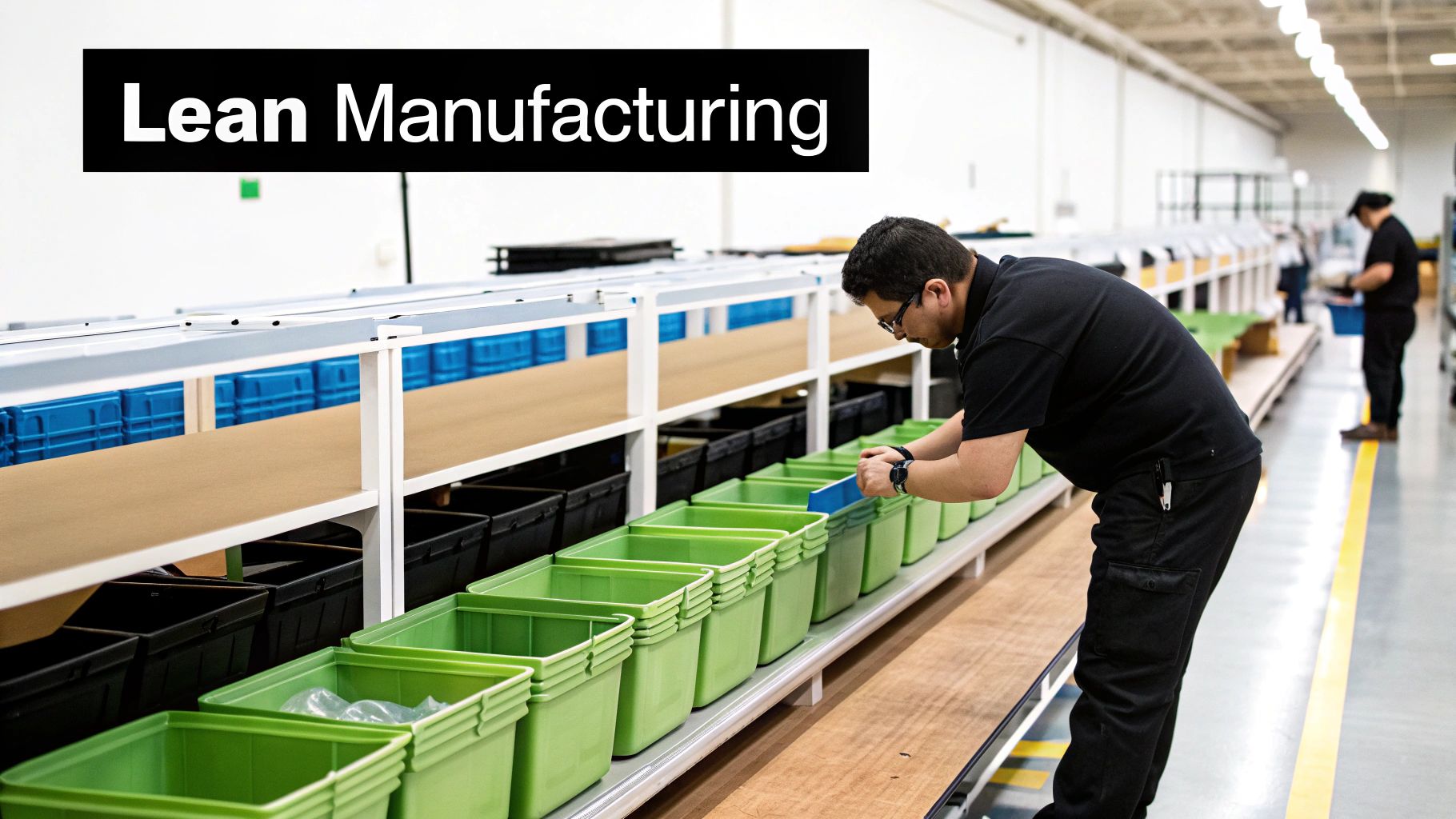
Putting Lean Principles into Action
At its core, lean manufacturing is about one thing: creating more value by eliminating waste. When you get it right, it becomes part of your company's DNA. Let’s translate a few of these core ideas into real-world actions for your shop floor.
- Implement the 5S System: This is about more than just a clean workspace. It’s about creating a hyper-organized environment where inefficiencies have nowhere to hide. By following the five steps—Sort, Set in Order, Shine, Standardize, and Sustain—every tool and part gets a dedicated home. This simple discipline cuts out the time workers waste searching for things, which is a huge source of hidden labor cost.
- Embrace Just-in-Time (JIT) Production: The goal here is simple: make what’s needed, when it’s needed, in the exact amount needed. JIT directly targets the waste of overproduction and the cost of sitting on excess inventory. When you sync your production schedule with real demand, you stop tying up cash in raw materials and finished goods.
- Foster a Kaizen Culture: Kaizen, or continuous improvement, is about empowering every single employee to spot and suggest small, incremental improvements in their daily tasks. It’s a powerful, bottom-up approach to cost-cutting. For a deeper dive, our guide on continuous improvement in manufacturing shows you how to build this culture from the ground up.
Taming Inventory with Strategic Consolidation
Inventory is an asset, but too much of it is a liability. It ties up cash, eats up expensive warehouse space, and carries the risk of obsolescence. A leaner approach to inventory is a direct line to lower manufacturing costs.
One of the most powerful moves you can make is component consolidation. Get your engineers and buyers to take a hard look at the bills of materials (BOMs) across your product lines. You’ll almost certainly find multiple SKUs for parts that are functionally identical, like common fasteners, connectors, or brackets.
Standardizing these components unlocks immediate savings:
- Boost Your Purchasing Power: Buying larger volumes of fewer parts gives you far more leverage to negotiate better prices with your suppliers.
- Simplify Inventory Management: Fewer SKUs means less complexity for everyone—from receiving and warehousing to the teams replenishing the line.
- Reduce On-Hand Stock: When you consolidate parts, you can safely lower your overall safety stock levels without raising the risk of a line-down situation.
A disciplined inventory strategy does more than just cut carrying costs. It simplifies your entire supply chain, making your operation more agile and resilient. Every SKU you eliminate is a win for efficiency.
Accelerating Assembly with Kitting and Sequencing
For OEMs and Tier-1 suppliers, the final assembly line is where costs really add up. Any inefficiency there creates a bottleneck that echoes back through your entire operation. This is where specialized logistics services like kitting and sequencing become game-changers.
Kitting is the process of gathering all the specific components for a particular assembly step into a single, pre-packaged "kit." Instead of an operator picking from dozens of bins, they get one ready-to-go package. It sounds simple, but the impact is massive:
- It Slashes Assembly Errors: The risk of grabbing the wrong part practically disappears.
- It Speeds Up Throughput: Kitting eliminates the time spent searching for and handling individual components, which directly shortens your cycle times.
Sequencing takes this concept a step further by delivering these kits or components to the assembly line in the precise order they’re needed. For a facility running a mixed-model line, this is absolutely critical. It ensures the unique parts for each product variant arrive exactly when needed, eliminating line-side clutter and guesswork for the operator.
Together, kitting and sequencing streamline the most critical phase of your operation. They are perfect examples of how a targeted process change, often managed by a 3PL partner, can drive significant and immediate cost reductions.
Using Technology as a Cost Reduction Tool
In manufacturing today, data and automation aren't just nice-to-haves; they're your best tools for survival and growth. Making smart investments in technology is one of the most direct ways to find lasting savings. It’s about turning operational data into real intelligence and replacing manual bottlenecks with automated precision.
This isn’t about chasing the latest trend. It’s about building a connected, resilient, and genuinely cost-effective operation from the ground up.
Automating Data Flow with ERP and EDI
The whole thing starts with a solid Enterprise Resource Planning (ERP) system. Think of an ERP as the central nervous system for your business, pulling data from procurement, inventory, production, and finance into one single source of truth. This visibility gets rid of the guesswork and lets your team make smarter decisions, faster. For a deeper dive, check out our guide on what is an ERP system in manufacturing.

An ERP really shows its power when you connect it to your supply chain partners through Electronic Data Interchange (EDI). EDI is what automates the back-and-forth of business documents like purchase orders, invoices, and advance ship notices (ASNs).
This direct, machine-to-machine communication cuts costs in a few key ways:
- Wipes Out Manual Entry Errors: It dramatically cuts down on the expensive mistakes that happen when people have to re-key data.
- Speeds Up Transactions: Orders get processed in minutes, not days. That improves cash flow and keeps your partners happy.
- Sharpens Forecasts: Real-time data sharing gives you a much clearer picture of demand, which means more precise production schedules.
When your ERP and EDI are working together, you get a seamless flow of information that slashes administrative overhead and gives you true control over your supply chain.
Embracing Smart Factory Technologies
Beyond just managing data, smart factory tech brings intelligence right onto your shop floor. These tools are designed to fix specific operational headaches, delivering a clear and often rapid return on your investment.
One of the biggest game-changers is predictive maintenance. By putting IoT sensors on critical machinery, you can monitor conditions like vibration and temperature in real-time. This data lets you predict a potential failure before it happens, moving you from a reactive "fix-it-when-it-breaks" model to a proactive one.
Technology shouldn't be seen as a cost center. It's an investment in operational resilience. Every dollar you spend on predictive maintenance or automation is a direct investment in preventing much more expensive downtime and quality problems down the road.
Robotics and Automation for Quality and Savings
Another powerful move is bringing in robotics. Automation is a perfect fit for tasks that are repetitive, physically demanding, or require extreme precision. Using robots for jobs like welding, material handling, or assembly pays off in multiple ways.
First, it directly lowers your labor costs and frees up your skilled team members to focus on more complex, value-added work. But just as important, it drives up consistency and quality, which cuts down on the scrap and rework that eats into your profit margins. For some real-world inspiration, take a look at these practical customer success stories of AI-driven cost reduction to see how companies are doing this right now.
The numbers don't lie. Smart technology is a proven way to reduce manufacturing costs. IoT-based predictive maintenance can slash downtime by 50% and cut maintenance costs by 40%. Meanwhile, 60% of manufacturers are using robotics to boost productivity by an average of 25%, showing a clear link between smart automation and a healthier bottom line.
Building a Leaner Operation Through Strategic Outsourcing
Let’s be honest. The smartest way to cut manufacturing costs is to admit you can’t—and shouldn’t—do everything yourself. Your team excels at your core business, but non-core activities like warehousing, light assembly, or kitting can quickly become a major distraction and a serious drain on your budget.
This is where strategic outsourcing becomes a game-changer. By partnering with a specialized third-party logistics (3PL) provider, you’re not just offloading a task. You’re turning a fixed overhead into a flexible, variable cost and freeing up your team to focus on what actually drives revenue.
Freeing Up Your Resources (and Your Floor Space)
Think about your manufacturing floor. Every square foot is valuable real estate. When you dedicate huge chunks of it to sub-assembly, parts sequencing, or warehousing, you’re tying up space that could be used for your main production lines.
Outsourcing these functions to a 3PL partner like Wolverine Assemblies immediately gives you that space back. Suddenly, you have the capacity to:
- Expand Core Production: Add that new production line you’ve been planning without a costly facility expansion.
- Improve Workflow: Decongest the plant floor, making operations safer and more efficient.
- Reduce Capital Spending: Avoid buying specialized equipment or warehousing infrastructure that isn't central to what you do.
This move allows you to pour capital and attention back into innovation and manufacturing excellence, which directly hits your bottom line.
Transforming Fixed Costs into Variable Expenses
One of the biggest wins from outsourcing is converting stubborn fixed costs into flexible variable ones. Running an in-house assembly or warehousing team means you’re stuck with a long list of fixed bills: facility leases, utilities, equipment maintenance, and permanent labor. Those costs don’t change, whether you’re at peak production or in a slow period.
A smart 3PL partnership isn't just a transaction; it's a fundamental change to your cost model. It gives you the financial agility to scale up or down with market demand, without getting crushed by fixed overhead.
When you partner with a 3PL, you pay for the services you actually use. This creates a much more resilient financial structure, especially in industries where demand swings wildly. If orders slow down, your costs go down too. When demand spikes, your 3PL partner has the people and capacity to scale right alongside you.
Before making the switch, it's helpful to lay out the real-world costs and benefits.
In-House vs Outsourced Assembly: A Cost-Benefit Analysis
This table breaks down the financial and operational differences between keeping assembly in-house and partnering with a 3PL. It’s a clear look at where the value lies.
While in-house assembly offers direct control, outsourcing to a provider like Wolverine Assemblies clearly shifts the financial model from high fixed overhead to a more agile, variable cost structure that adapts to your business needs.
Strengthening Your Supply Chain with Expert Partners
Beyond the balance sheet, strategic outsourcing is a powerful way to de-risk your supply chain. In today’s volatile world, a resilient and responsive supply network isn't a luxury—it’s a necessity. This means looking beyond your direct suppliers and considering the geographic and political factors hitting your costs.
Tariff volatility and trade policy shifts have completely rewritten manufacturing cost structures. We’ve seen recent tariff hikes increase material costs by 2-4.5% in some sectors, pushing more companies to bring production back home. This trend toward onshoring is all about reducing exposure to tariffs, shortening lead times, and getting better control over costs. You can read more about these economic shifts and how they’re impacting manufacturing.
A domestic 3PL partner is crucial to this strategy. By handling assembly or warehousing closer to your end market, they help you build a localized supply chain that’s less vulnerable to international drama. Even better, a good 3PL can help manage supplier relationships, acting as a consolidation point to streamline inbound logistics and drive down costs.
Common Questions on Manufacturing Cost Reduction
Digging into a cost reduction plan always brings up a lot of questions. For OEMs and Tier-1 suppliers, the stakes are high, and getting your strategy right from the start is everything. We’ll cut through the theory and give you straight answers to the most common queries we hear, so you can move forward with confidence.
These are the fundamentals that will help solidify your approach and make a real impact on your bottom line.
What Are the First Steps to Reduce Manufacturing Costs
It’s tempting to jump right in and start changing things, but the best first move is always to diagnose the problem. Before you can cut costs effectively, you need a crystal-clear picture of where your money is actually going.
Start by conducting a thorough audit of your operations. And I don't mean just looking at high-level financial reports—get out on the shop floor. Use a proven tool like Value Stream Mapping (VSM) to visualize your entire workflow from raw material to finished product. This process makes waste, bottlenecks, and non-value-added activities impossible to ignore.
Your main goal here is to identify the "quick wins." These are the low-cost, high-impact changes that deliver immediate results and build momentum for the bigger projects down the road.
- Analyze spending on raw materials and consumables. Are you really getting the best prices?
- Drill down into labor costs. Where is idle time or overtime cropping up most often?
- Calculate your true inventory carrying costs. How much cash is just sitting on shelves as parts?
Once you have this data, you can make targeted improvements—like simple process tweaks or renegotiating supplier terms—that prove the value of your efforts from day one.
How Does a 3PL Partner Help Beyond Lowering Labor Costs
While direct labor savings are a big plus, a strategic 3PL partnership delivers value far beyond that single line item. A common misconception is that outsourcing is just about finding cheaper labor, but its true power lies in completely rethinking your operational structure.
Outsourcing services like light assembly, kitting, and sequencing to an expert partner frees up an enormous amount of your valuable manufacturing floor space. This lets you dedicate that real estate to your core, revenue-generating production activities without needing a costly facility expansion.
A partnership with a specialized 3PL does more than just offload a task; it fundamentally changes your cost model from fixed to variable, giving you the financial agility to adapt to market shifts without being weighed down by overhead.
Even better, it converts fixed costs into variable costs. Instead of carrying the constant financial burden of facility overhead, equipment maintenance, and a permanent workforce, you pay only for the services you use, when you use them. This provides huge financial flexibility. Expert 3PLs also bring their own refined processes, quality control systems, and integrated tech that improve your overall supply chain resilience and dramatically reduce assembly errors.
Is Investing in New Technology Worth It for a Smaller Manufacturer
Absolutely, as long as the investment is strategic and targeted. The key is to avoid chasing trends and instead focus on solving your biggest operational pain points. You don't need a fully automated "lights-out" factory to see a strong return.
Start small by targeting areas where technology can deliver a clear, measurable improvement. For instance, implementing a foundational Enterprise Resource Planning (ERP) system can immediately clean up data flow between departments, eliminate manual errors, and improve decision-making with real-time information.
Another high-impact area is using IoT sensors for predictive maintenance on your most critical machinery. The initial investment is often a fraction of the cost of just one major unplanned downtime event. By predicting failures before they happen, you can schedule maintenance proactively, keeping production lines running and avoiding those catastrophic repair bills. The goal is to focus on tech that measurably improves efficiency, cuts tangible waste, or enhances product quality.
Ready to transform your cost structure and build a more resilient supply chain? The expert team at Wolverine Assemblies, LLC can help you implement strategic outsourcing solutions that free up capital, space, and resources. Discover how our kitting, sequencing, and light assembly services can drive immediate value for your operation by visiting https://www.wolverine-llc.com.
Subscribe to our weekly newsletter