.png)
Continuous Improvement in Manufacturing Explained
A practical guide to continuous improvement in manufacturing. Learn the core methods, tools, and strategies to boost efficiency and drive growth.

Think of continuous improvement in manufacturing not as a one-time project, but as the very heartbeat of a resilient operation. It’s the philosophy that small, consistent enhancements to your processes, products, and people lead to massive, long-term advantages.
This ongoing effort is what separates market leaders from laggards.
Why Continuous Improvement is Your Competitive Edge
In a world of constant supply chain disruptions and shifting customer demands, standing still means falling behind. Continuous improvement is the engine that drives a manufacturing business forward, building momentum with every small adjustment.
It's like a flywheel. The first push takes the most effort, but each tweak adds energy, making future progress smoother and more impactful.
This philosophy transforms the entire organization. It’s not a top-down mandate but a cultural shift that empowers every single person—from the machine operator on the floor to the CEO—to become a problem-solver. Everyone is encouraged to spot inefficiencies, question how things are done, and contribute ideas that drive real change.
From Theory to Tangible Results
Adopting a continuous improvement mindset directly impacts your bottom line and operational stability. This isn't about buzzwords; it's about creating real-world value. The benefits are clear and measurable:
- Enhanced Product Quality: By constantly refining processes, you reduce defects, minimize rework, and deliver more consistent products.
- Increased Process Efficiency: Identifying and eliminating bottlenecks, wasted motion, and unnecessary steps means you produce more with the same resources.
- Reduced Operational Costs: Every bit of eliminated waste—scrap material, excess inventory, or wasted time—translates directly into cost savings.
- Greater Employee Engagement: When employees are empowered to make improvements, they become more invested in their work, leading to higher morale and lower turnover.
The core idea is simple: A business that is constantly getting better, even in small ways, will inevitably outperform competitors who only focus on large, infrequent breakthroughs. It builds a foundation of operational excellence that is tough to replicate.
Bridging the Performance Gap
Despite its proven benefits, many manufacturers struggle to turn the idea of continuous improvement into a daily reality. The gap between knowing and doing is significant.
In fact, a recent Gartner survey revealed that only 29% of supply chain organizations have developed the capabilities needed to meet future performance targets through continuous improvement. This highlights a critical opportunity for companies willing to commit.
To truly gain an edge, it's essential to implement proven strategies to improve operational efficiency. By fostering a culture where every team member is focused on making things a little better every day, you create a powerful, self-sustaining system for growth and resilience.
Your Toolkit for Manufacturing Excellence
Jumping into continuous improvement doesn’t mean you have to invent everything from scratch. Decades of real-world application have given us powerful, proven frameworks that act as a manufacturer’s toolkit. These aren’t competing theories to pit against each other; they’re complementary tools you can pick and choose from to solve specific problems on your shop floor.
Think of it like a master mechanic’s toolbox. You wouldn't use a sledgehammer to fine-tune an engine. You’d select the right wrench for the job. In the same way, understanding these core methodologies lets you apply the right approach to the right challenge, making sure your efforts hit the mark.
This isn't about one giant leap. It's about how small, consistent changes build on each other to create huge gains and unstoppable momentum.
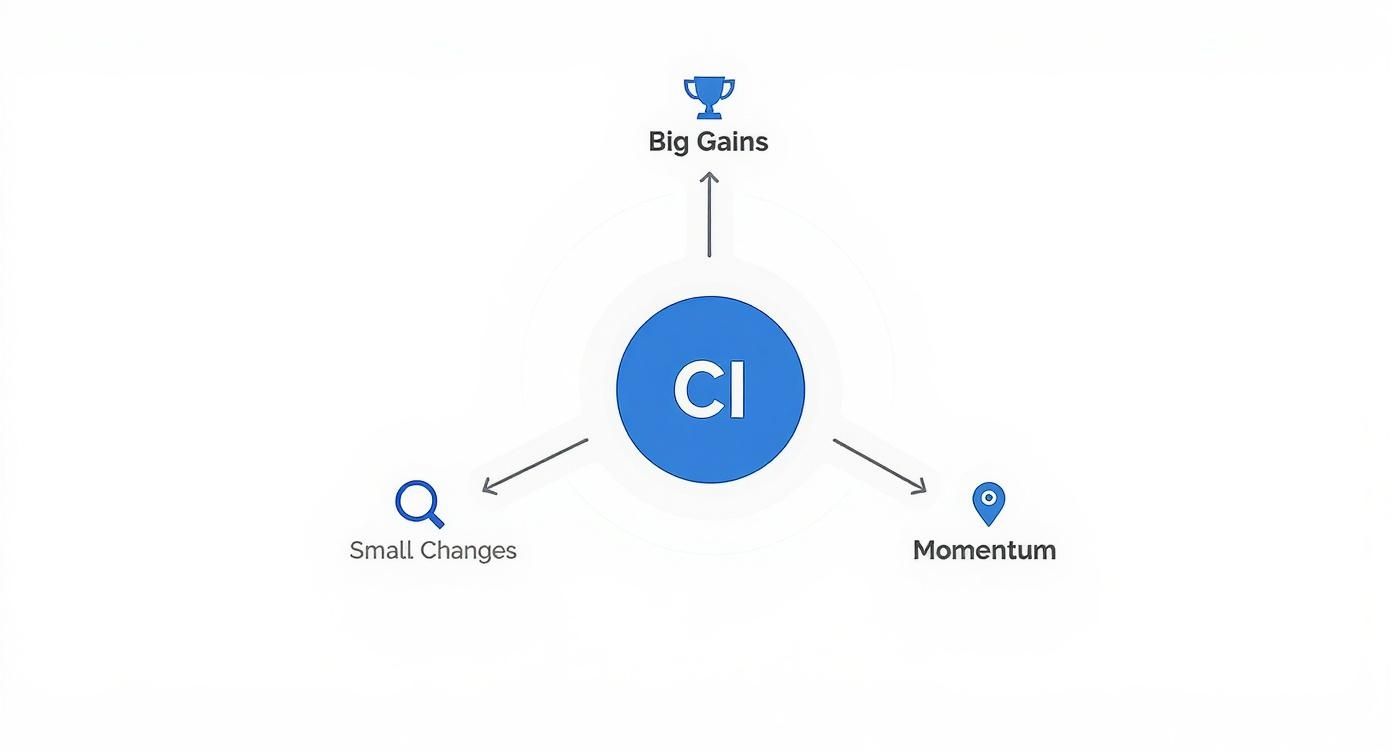
The big takeaway here? Massive success is almost always the result of a disciplined commitment to small, smart improvements. It creates a self-reinforcing cycle of excellence that's hard to beat.
To help you choose the right tool for the job, here's a quick comparison of the most common and effective CI methodologies used in manufacturing today.
Comparing Core Continuous Improvement Methodologies
Each of these frameworks offers a unique lens through which to view your operations. Let's break down how they work in practice.
Kaizen: The Philosophy of Daily Improvement
Kaizen isn't a rigid process; it's a cultural mindset. The word comes from Japan and translates to "change for the better." At its core is the belief that small, ongoing positive changes lead to major improvements over time.
It’s about empowering every single employee—from the person on the assembly line to the CEO—to spot and solve problems in their own work area.
A classic Kaizen example is a machine operator who suggests reorganizing their workstation to reduce wasted motion. That simple change might only save 10 seconds per cycle. But multiply that across thousands of cycles and multiple operators, and the time savings become massive. Kaizen is the engine of grassroots innovation.
Lean Manufacturing: The Relentless Pursuit of Efficiency
Lean is all about one thing: maximizing customer value while ruthlessly eliminating waste. It forces you to look at your entire operation and question anything that doesn't add value from the customer's point of view.
Imagine a professional chef's kitchen—every tool has a purpose and a place, every movement is efficient, and nothing is wasted. That's the essence of Lean. It targets the "Eight Wastes" to make processes smoother and faster:
- Defects: Products that need rework or are scrapped.
- Overproduction: Making more than is needed, sooner than it's needed.
- Waiting: Idle time when people, materials, or machines are not ready.
- Non-Utilized Talent: Failing to tap into the skills and ideas of your team.
- Transportation: Unnecessary movement of parts and materials.
- Inventory: Excess stock that isn't actively being processed.
- Motion: Wasted movement by people, like walking, reaching, or bending.
- Extra-Processing: Doing more work to a product than the customer requires.
To see how these principles apply in a real-world logistics setting, check out our guide on how Lean manufacturing and 3PL work together to cut costs.
Six Sigma: The Quest for Near-Perfect Quality
If Lean is about speed and efficiency, Six Sigma is about quality and precision. Its goal is to reduce process defects to an absolute minimum—specifically, no more than 3.4 defects per million opportunities. It gets there with a highly disciplined, data-driven approach.
Six Sigma treats manufacturing challenges like a science experiment. It uses statistical analysis to dig deep and find the root causes of defects, ensuring problems are truly solved, not just patched over.
This methodology is perfect for those tricky, complex problems where the cause isn't obvious. It stops teams from making changes based on gut feelings and forces them to rely on hard data. This ensures the improvements you make are both effective and permanent.
PDCA: The Simple Cycle of Progress
The Plan-Do-Check-Act (PDCA) cycle, also known as the Deming Cycle, is the simple, iterative engine that drives many improvement projects. It gives you a straightforward framework for testing ideas on a small scale before rolling them out across the entire operation.
- Plan: Identify a problem or an opportunity and map out a change.
- Do: Implement the change, but keep it small and controlled.
- Check: Observe the results and analyze the data. Did it work?
- Act: If the change was a success, implement it on a wider scale. If not, start the cycle over with a new plan.
This simple loop prevents costly mistakes and makes sure that every change you implement is a validated step in the right direction.
How to Build Your Continuous Improvement Program
An idea for improvement is a great start. But a structured plan to actually execute it? That’s where the real power lies.
Getting from theory to practice means having a clear roadmap to launch a continuous improvement in manufacturing program—one that actually gains traction and delivers lasting results. This isn't about a single, massive overhaul. It's about building a sustainable system for getting better, day in and day out.
And it doesn't start on the factory floor. It starts in the leadership suite.
Start with Genuine Leadership Buy-In
The first, and most critical, step is getting authentic support from your leadership team. This means they need to see continuous improvement as a long-term strategy, not just a short-term fix to hit quarterly numbers.
Their role is to provide resources, clear away organizational roadblocks, and constantly communicate the "why" behind the program. When employees see executives participating in Gemba walks or celebrating a team’s small process fix, it sends a powerful message: this is a core business priority.
A continuous improvement program without active leadership is like an engine without fuel. It might look impressive, but it won’t go anywhere. True commitment involves allocating time, talent, and capital to empower teams to make meaningful changes.
Assemble Your Cross-Functional CI Team
You can't fix problems in a silo. The most effective CI programs are driven by cross-functional teams that bring different perspectives to the table. An ideal team is a mix of people from key departments:
- Operations: The frontline experts who live and breathe the process every single day.
- Engineering: The folks who understand the technical specs and capabilities of the machines and products.
- Quality: The specialists focused on stamping out defects and holding the line on standards.
- Logistics: The team managing material flow, a critical piece of the puzzle. Improving this area is huge, as you can see in our guide on how to improve supply chain efficiency.
This blend of expertise makes sure a change in one area doesn't accidentally create a new problem somewhere else. It creates holistic problem-solving and gets more people invested in the solutions.
Go to the Gemba and See the Real Workflow
You can’t improve a process you don’t truly understand. The Gemba walk is a fundamental practice where leaders and CI teams go to the actual place where work happens—the shop floor—to observe, ask questions, and learn.
This isn't about finding fault or pointing fingers. It's about listening. The goal is to see the workflow through the eyes of the operators who do it every day. These walks uncover the small frustrations, hidden bottlenecks, and clever workarounds that never show up on a data report.
Set SMART Goals for Focused Improvement
Once you have your team and a real-world understanding of your processes, it's time to set clear, targeted goals. A vague objective like "improve efficiency" is basically useless. Instead, use the SMART framework to create goals people can actually work toward.
- Specific: Pinpoint exactly what you want to achieve (e.g., "Reduce scrap on Assembly Line 3").
- Measurable: Define the KPI you'll use to track it (e.g., "by 15%").
- Achievable: Make sure the goal is realistic with your current resources and timeline.
- Relevant: The goal must connect to bigger business objectives, like cutting costs or improving quality.
- Time-bound: Give it a deadline (e.g., "by the end of Q3").
A solid SMART goal sounds like this: "Reduce the cycle time for our kitting process from 4.5 minutes to 4 minutes by the end of next month." Now the team has a clear target to aim for and a concrete way to know if they’ve won.
The Technology That Amplifies Your Efforts
A culture of continuous improvement is the engine, but today’s technology is the high-octane fuel that makes it run. While the core ideas of Lean and Kaizen are timeless, modern manufacturing floors run on data, not just observation and intuition.
Technology doesn’t replace a curious, problem-solving team; it supercharges them. It provides the clear, objective insights they need to make smarter decisions, faster. This shifts your whole approach from reactive to proactive—instead of just analyzing what went wrong yesterday, you start predicting and preventing problems before they ever happen.
This is the heart of smart manufacturing, where every machine, part, and process feeds into a live, data-rich picture of your operation’s health.
ERP: The Central Nervous System of Your Data
Think of your Enterprise Resource Planning (ERP) system as the central nervous system for your entire operation. It's the single source of truth connecting every department, from inventory and production scheduling to quality control and shipping. For a company like Wolverine Assemblies, a robust system like PLEX is non-negotiable.
An ERP doesn't just store data; it gives it context. It’s what links a material shortage to a production delay, a quality flag to a specific batch, and a customer order to a shipping schedule. This integration is vital for continuous improvement in manufacturing because it lets you see the ripple effects of every action and trace problems back to their true root cause, not just the most obvious symptom.
Without this central hub, data gets trapped in departmental silos, making real, holistic improvement nearly impossible. For a deeper dive, check out our guide on what an ERP system is in manufacturing.
EDI and ASNs: Creating Supply Chain Transparency
In the high-stakes world of OEM and Tier 1 supply chains, surprises are the enemy. Electronic Data Interchange (EDI) and Advance Ship Notices (ASNs) are the digital handshakes that create transparency and predictability between partners. They are the backbone of just-in-time (JIT) manufacturing and lean inventory strategies.
- EDI (Electronic Data Interchange): This automates the back-and-forth of business documents like purchase orders and invoices, which kills manual data entry errors and speeds up communication.
- ASNs (Advance Ship Notices): These give you a detailed heads-up about a pending delivery before it arrives, including part numbers, quantities, and expected arrival times.
This seamless data flow allows a 3PL like Wolverine to prepare for incoming shipments with absolute precision, allocating space, labor, and equipment before a truck even hits the dock. It turns the receiving process from a chaotic scramble into a well-orchestrated, efficient workflow, cutting down waste and improving throughput.
Technology’s greatest contribution to continuous improvement is its ability to make the invisible visible. It surfaces the hidden inefficiencies, process variations, and data trends that the human eye might miss, giving your team a clear target for their next improvement effort.
IoT and AI: The Future of Proactive Improvement
The next frontier is powered by the Internet of Things (IoT) and Artificial Intelligence (AI). IoT sensors on machinery can stream real-time performance data—like temperature, vibration, and cycle times—directly into your ERP or analytics platform. This constant flow of information unlocks powerful new capabilities.
Instead of waiting for a machine to break down, AI-powered predictive maintenance can analyze this data to spot subtle signs that signal a coming failure. This lets you schedule maintenance proactively, turning a costly, unplanned shutdown into a quick, controlled repair.
This proactive approach is gaining huge traction. The smart manufacturing market is expected to hit $589 billion by 2028, and it's projected that 70% of manufacturers will be using IoT for real-time monitoring by 2025. These strategies can slash downtime by up to 50%. This isn't just about fixing problems anymore; it's about preventing them entirely—the ultimate goal of any continuous improvement program.
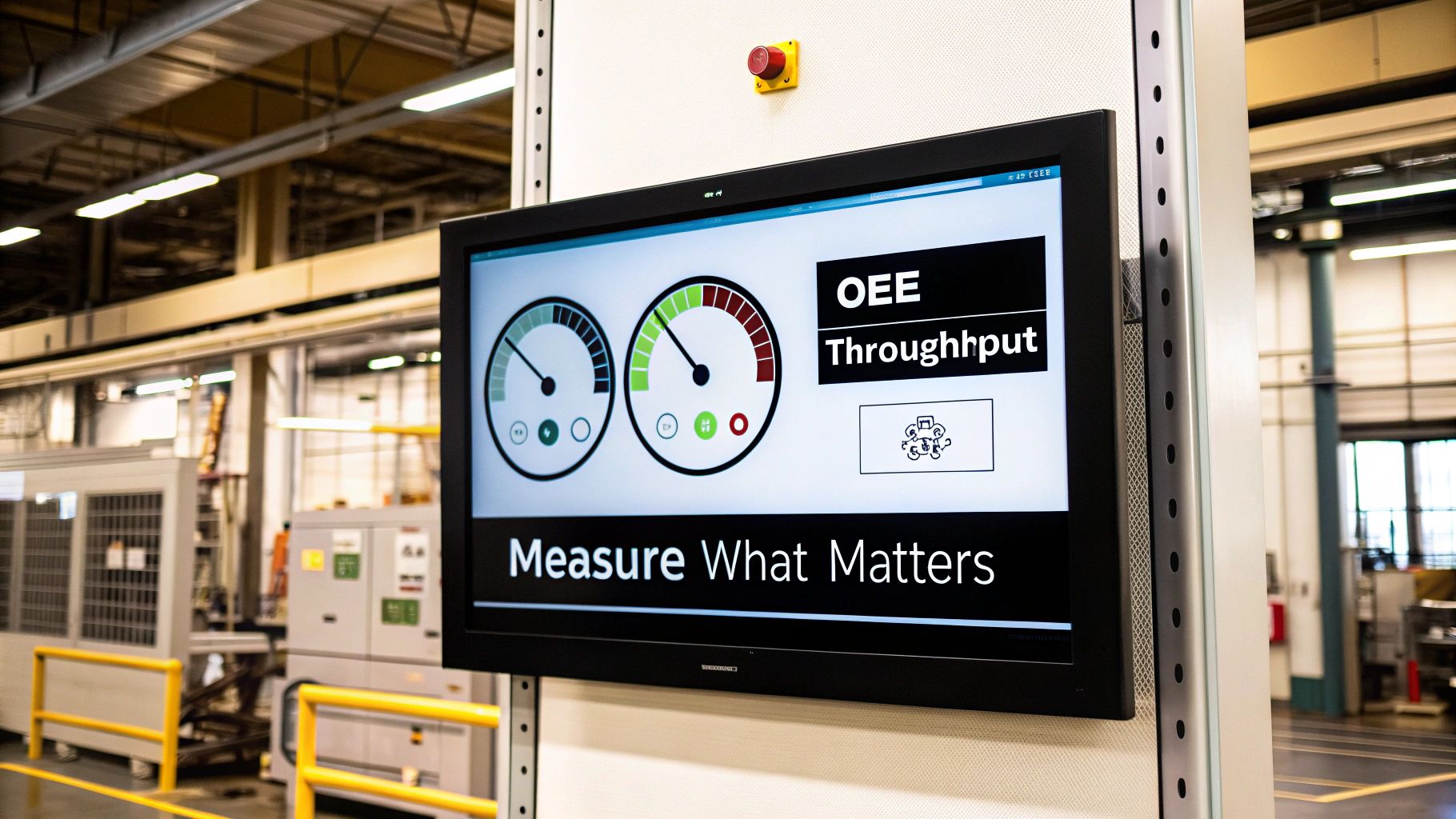
Measuring What Matters with the Right KPIs
If you can't measure it, you can't improve it.
This old saying is the absolute foundation of any real continuous improvement in manufacturing program. Key Performance Indicators (KPIs) aren't just numbers on a spreadsheet; they're the vital signs of your entire operation, telling you exactly how healthy and efficient your processes are.
It’s easy to get lost in surface-level metrics. The right KPIs, however, act like a compass. They point your improvement efforts toward the changes that will actually make a difference to your bottom line, turning vague goals like "get more efficient" into clear, actionable targets your whole team can get behind.
Without the right data, your CI efforts are just guesswork.
Core KPIs for Manufacturing Success
To get a clear picture of what's happening on the floor, you really only need to focus on a handful of high-impact KPIs. For most manufacturing or assembly environments, these three are non-negotiable.
- Overall Equipment Effectiveness (OEE): This is the gold standard for measuring manufacturing productivity. It rolls three critical factors—Availability, Performance, and Quality—into a single, powerful score that shows you how close you are to perfect production.
- First Pass Yield (FPY): A straightforward measure of quality, FPY tells you the percentage of units made correctly the first time, with zero rework or scrap. A high FPY is a sign of a stable, predictable process.
- Cycle Time: This is the total time it takes to produce one unit, from start to finish. Cutting down cycle time is how you boost throughput and meet customer demand faster.
Before you do anything else, you must establish a baseline for these metrics. This is your starting line. It's the only way to track your progress and prove that the changes you're making are actually working.
Decoding Overall Equipment Effectiveness
OEE is worth a closer look because it tells such a complete story about your production losses. A world-class OEE score is around 85%, but honestly, many facilities operate far below that. That gap is pure opportunity.
Here’s how it breaks down the hidden problems:
- Availability: This tracks losses from downtime—things like equipment failures or long changeovers. A 100% score means your machines were running for every second of planned production time.
- Performance: This accounts for speed losses, like running slower than the ideal rate or dealing with minor stops. A 100% score means you're running as fast as theoretically possible.
- Quality: This measures losses from defects, including both scrapped parts and units that needed rework. A 100% score means every single part you made was perfect.
OEE = Availability x Performance x Quality
By multiplying these three factors, OEE gives you a clear window into where your biggest losses are coming from, so you can stop guessing and start fixing the right problems.
Tracking Beyond Production Numbers
Great measurement doesn't stop with machine performance. A truly holistic view looks at the entire operation. This is especially true for continuous manufacturing, which offers big efficiency gains over traditional batch processes by slashing setup times and changeover delays. While the initial investment might be higher, these improvements drive productivity up and long-term costs down.
And you can't talk about performance without talking about safety. A safe workplace is an efficient one. Accidents and injuries cause major disruptions, kill morale, and bring production to a halt.
That’s why smart companies go beyond the usual KPIs. Running a full workplace health and safety audit gives you critical insight into operational risks you might otherwise miss. This complete view ensures that the push for efficiency never compromises the well-being of your team.
Common Mistakes That Stall Progress
Embarking on a continuous improvement journey is exciting, but let's be honest—many initiatives lose steam after the initial push. The road to manufacturing excellence is littered with common, avoidable potholes that can stall even the most well-intentioned programs.
Spotting these traps ahead of time is the first step toward building an improvement culture that actually sticks.
One of the biggest mistakes? Treating continuous improvement like a one-and-done project. It's not a sprint to fix a single problem; it's a marathon of small, compounding gains. When leadership treats it like a short-term initiative, teams quickly slide back into old habits the moment the spotlight moves on. All that progress? Gone.
Lacking Genuine Leadership Commitment
A major roadblock is leadership that talks the talk but doesn’t walk the walk. When managers praise continuous improvement in meetings but won’t free up time, provide resources, or get their hands dirty, employees see it for what it is: another corporate buzzword. This breeds cynicism, and frontline workers quickly learn the initiative isn't a real priority.
For continuous improvement in manufacturing to take root, leaders have to be visibly and consistently involved. That means showing up for Gemba walks, celebrating the small wins, and defending improvement time from the constant pressure of daily production quotas. Without that active support, even the best grassroots efforts will eventually fade.
A classic failure is focusing only on the symptoms, not the root cause. Adding another inspection step to catch defects is a perfect example. A true CI mindset uses tools like the 5 Whys to dig deeper and fix the process that created the defect, making sure the problem doesn't just keep coming back.
Ignoring the Human Element
Another critical error is getting so lost in tools, charts, and data that you forget about the people. A program that feels like a top-down mandate will always be met with resistance. Real, lasting improvement is built on the insights and engagement of the operators doing the work day in and day out.
To avoid this pitfall, you have to:
- Empower Your People: Give teams the autonomy to identify and solve problems in their own work areas. Don't just ask for ideas—give them the power to test and implement them.
- Celebrate the Small Wins: Don't wait for a massive breakthrough to give a high-five. Recognizing small, incremental improvements keeps morale high and shows that every contribution matters. This is how you build momentum for the long haul.
- Prevent "Analysis Paralysis": Data is vital, but endlessly analyzing a problem without taking action leads nowhere. Encourage teams to use the PDCA cycle: test a small change, learn from it, and try again. The goal is progress, not perfection.
By sidestepping these common mistakes, you can turn your continuous improvement program into a self-sustaining engine for operational excellence—one that becomes part of your team's DNA.
Common Questions About Starting Continuous Improvement
Moving from the idea of continuous improvement to a real, working program always brings up a few practical questions. Here are some straight answers to the most common things we hear from manufacturers getting started.
How Do We Start If Our Budget Is Tight?
You don't need a huge budget to get started. In fact, your most powerful asset—your team’s own ingenuity—is already on the payroll.
The key is to start small with a Kaizen mindset. Focus on low-cost changes that deliver a high impact, which are often the things your team points out during Gemba walks. Simple fixes like reorganizing a workstation to cut down on wasted movement or creating a visual checklist to prevent common mistakes cost virtually nothing but pay off immediately.
What’s the Single Biggest Factor for Success?
Hands down, it's genuine and visible leadership commitment. When leaders are actively involved—clearing roadblocks, providing resources, and celebrating the small wins—the program gains momentum and thrives.
If leadership treats CI like just another corporate checklist item, it's doomed to fail. Their real job is to champion the process and show everyone that this isn't a temporary project, but a core part of how the business operates.
Remember, the goal of continuous improvement isn't about achieving perfection overnight. It's about making consistent progress. Encourage your teams to test small ideas, learn from them, and try again. That’s how you build a culture where everyone feels empowered to make things better.
How Much Time Should Our Team Dedicate to This?
There’s no magic number, but consistency is everything. A great way to begin is by setting aside a small, protected block of time each week.
- Team Huddles: A quick 15-minute huddle daily or weekly to talk through challenges and new ideas.
- Improvement Events: A dedicated two-hour block once a month for a specific team to laser-focus on a single process.
The idea is to weave improvement into the daily rhythm of work, not to add it as another burden. By making it a regular habit, the CI mindset becomes part of your company culture.
At Wolverine Assemblies, our entire operation is built on the principles of continuous improvement to deliver leaner, more efficient solutions for our partners. Contact us to learn how our value-added services can strengthen your supply chain.
Subscribe to our weekly newsletter