.png)
Car Wheel Assembly Parts: A Close Look at car wheel assembly parts
Explore car wheel assembly parts from hubs to sensors and learn how manufacturers optimize materials, QA, and logistics for peak performance.


A car's wheel assembly is the collection of parts that connects the axle to the tire—think hubs, bearings, studs, and the rim itself. But calling it a simple collection of hardware doesn't do it justice. These are precision-engineered systems absolutely critical to the safety, performance, and even the fuel efficiency of any modern vehicle.
The Critical Role of Wheel Assemblies in Modern Vehicles
At its most basic level, the wheel assembly is the essential link between your vehicle and the road. It's what takes power from the engine and transmission and turns it into forward motion. It also bears the vehicle's entire weight while handling the massive, ever-changing forces of accelerating, braking, and turning.
I like to think of it as the vehicle's ankle and foot. For the car to remain stable and under control, this "joint" has to be incredibly strong, yet flexible and perfectly coordinated.
But the job of a wheel assembly has expanded dramatically over the years. With the rise of electric vehicles (EVs) and advanced driver-assistance systems (ADAS), what was once a purely mechanical system is now a high-tech nerve center. It has to do a lot more than just spin.
- Integrate Advanced Sensors: It's now home to the sensors for anti-lock braking systems (ABS), tire pressure monitoring systems (TPMS), and electronic stability control.
- Support EV Drivetrains: It must be built to handle the instant torque and unique regenerative braking forces that come from electric motors.
- Optimize for Efficiency: Every gram of unsprung weight and rotational mass matters, especially for maximizing battery range in EVs or squeezing out extra MPG in gas-powered cars.
Navigating Increasing Complexity
This shift has created some real headaches for automotive OEMs and their Tier-1 suppliers. Sourcing all the individual components, managing their sub-assembly, and handling the logistics is a far more intricate dance than it used to be. A tiny flaw in a bearing's tolerance or a single fastener torqued incorrectly can compromise an entire safety system, leading to potentially catastrophic failures. Getting this right requires a deep, almost obsessive understanding of every single part and a supply chain built for absolute precision.
The money involved is staggering, too. The global automotive wheel market was valued at $30,011.3 million in 2017 and is on track to hit $47,355.3 million by 2025. That growth highlights the sheer volume of production and the immense pressure on supply chains to deliver perfect assemblies, every single time. For those interested, you can find more data on the global automotive wheel market growth and what’s driving production in different regions.
For automotive leaders, the key takeaway is this: Optimizing the wheel assembly supply chain is no longer a matter of simple cost savings. It is a strategic necessity for de-risking program launches, ensuring vehicle safety, and maintaining a competitive edge in a demanding market.
When it all comes together perfectly, a well-built wheel assembly is the unsung hero of vehicle performance. You don't even notice it's there. That's the goal: every component sourced, assembled, and tested to exact OEM specifications, resulting in a safe, reliable, and efficient vehicle.
To help you get there, let's take a closer look at the key components that make up a modern wheel assembly. This table gives a quick overview before we dive into the details of each part.
This guide will provide a detailed breakdown of these essential car wheel assembly parts, exploring their functions, materials, and the best practices for achieving OEM-level quality from the factory floor to the final assembly line.
2. Anatomy of the Modern Wheel Assembly
To really get a handle on the engineering that goes into a modern vehicle, you have to break down the wheel assembly piece by piece. It's easy to dismiss it as a simple collection of hardware, but it’s actually a tightly integrated system. Each part has a specific job, and they all have to work in perfect concert to deliver the stability, safety, and performance we expect. If you're managing the assembly and supply of these components, understanding their mechanical relationships is everything.
Let's start from the inside out, with the core components that form the assembly's structural backbone.
The Foundation: Hub and Bearing
Right at the center of it all is the wheel hub. The simplest way to think of it is as the main mounting point—it's what connects the stationary part of the car (the axle) to the part that spins (the wheel). These are typically forged from high-strength steel or sometimes aluminum alloys because they have to endure incredible forces. We're talking about the vehicle's entire weight, plus the sharp, jarring impacts from potholes and rough roads. The hub's flange is precision-machined to give the wheel rim a perfect surface to bolt onto.
Working hand-in-glove with the hub is the wheel bearing. If the hub is the strong, static foundation, the bearing is what makes movement possible. It's an engineering marvel, designed for incredibly low friction, allowing the wheel to spin smoothly for hundreds of thousands of miles while under immense load. A failing bearing isn't just a noise issue; it directly compromises vehicle stability and can lead to a catastrophic failure on the road. You can see just how intertwined these parts are by looking at a modern pre-assembled wheel bearing and hub unit.
The shift from traditional gas-powered cars to EVs and vehicles loaded with ADAS (Advanced Driver-Assistance Systems) has only ratcheted up the demands on these core parts. The complexity is growing exponentially.

As this shows, integrating new technologies means our mechanical systems have to be more complex and precisely assembled than ever before. Everything has to function as one cohesive unit.
The Connection Point: Knuckle and Spindle
The component that physically connects this rotating hub and bearing assembly to the car's chassis is the steering knuckle (or spindle, on some designs). It’s a beefy, often strangely shaped part that serves as the main link to both the suspension and steering systems. It provides the pivot point for the front wheels to turn and the anchor for the suspension to do its job of soaking up bumps.
The interface where the bearing, hub, and knuckle all meet is a zone of extremely tight tolerances. We’re talking about microscopic levels of precision. Any deviation here can cause a domino effect, leading to premature wear, alignment problems, or persistent vibrations felt through the steering wheel. That's why the materials, often cast iron or forged aluminum, are chosen for maximum rigidity and fatigue resistance to handle the constant stress.
Think of the knuckle as the vehicle’s wrist. It has to be incredibly strong to support the “hand” (the wheel assembly), yet it also needs to provide the fine articulation required for both steering and suspension movement.
This integration of multiple parts into a single unit defines the modern wheel hub assembly. And the demand for these pre-assembled units is growing right alongside global vehicle production. The entire automotive wheel market ballooned from roughly $30 billion in 2017 and is on track to hit nearly $50 billion by 2025. This growth is fueled by massive production volumes—China alone produced over 26 million motor vehicles in 2021, and every single one needed a set of robust hub assemblies.
Securing It All: Studs and Rim
Finally, you have the parts that complete the connection to the road. Wheel studs (or bolts, in some European designs) are the high-tensile steel fasteners that physically bolt the wheel to the hub. They might seem simple, but their material strength and correct torque specs are non-negotiable for safety. Under-tighten them, and the wheel could come loose. Over-tighten them, and you can stretch the stud, causing it to snap under stress.
The wheel rim itself provides the structure for the tire to mount onto. Rims are generally made from one of three materials, each with its own trade-offs:
- Steel: It's cheap and tough, but heavy.
- Aluminum Alloy: Much lighter than steel, which reduces "unsprung weight" for better handling and fuel efficiency. It also allows for more creative designs.
- Carbon Fiber: Incredibly light and strong, but its high cost reserves it for high-performance supercars where every ounce matters.
No matter the material, the rim's mounting surface must be perfectly flat and clean. This ensures it sits flush against the hub, which is crucial for preventing vibrations and achieving a balanced rotation. When you put it all together, you see a system where the performance of each part directly affects all the others. This is why precision in sourcing, kitting, and sub-assembly isn't just a goal—it's a fundamental requirement.
Materials Science and Common Failure Modes
It’s one thing to know what the parts of a wheel assembly are, but it’s another to understand why they’re made from specific materials. The choice of materials for car wheel assembly parts is a constant tug-of-war between strength, weight, and cost—a decision that has a ripple effect on everything from how the car feels on the road to how efficiently it can be built.
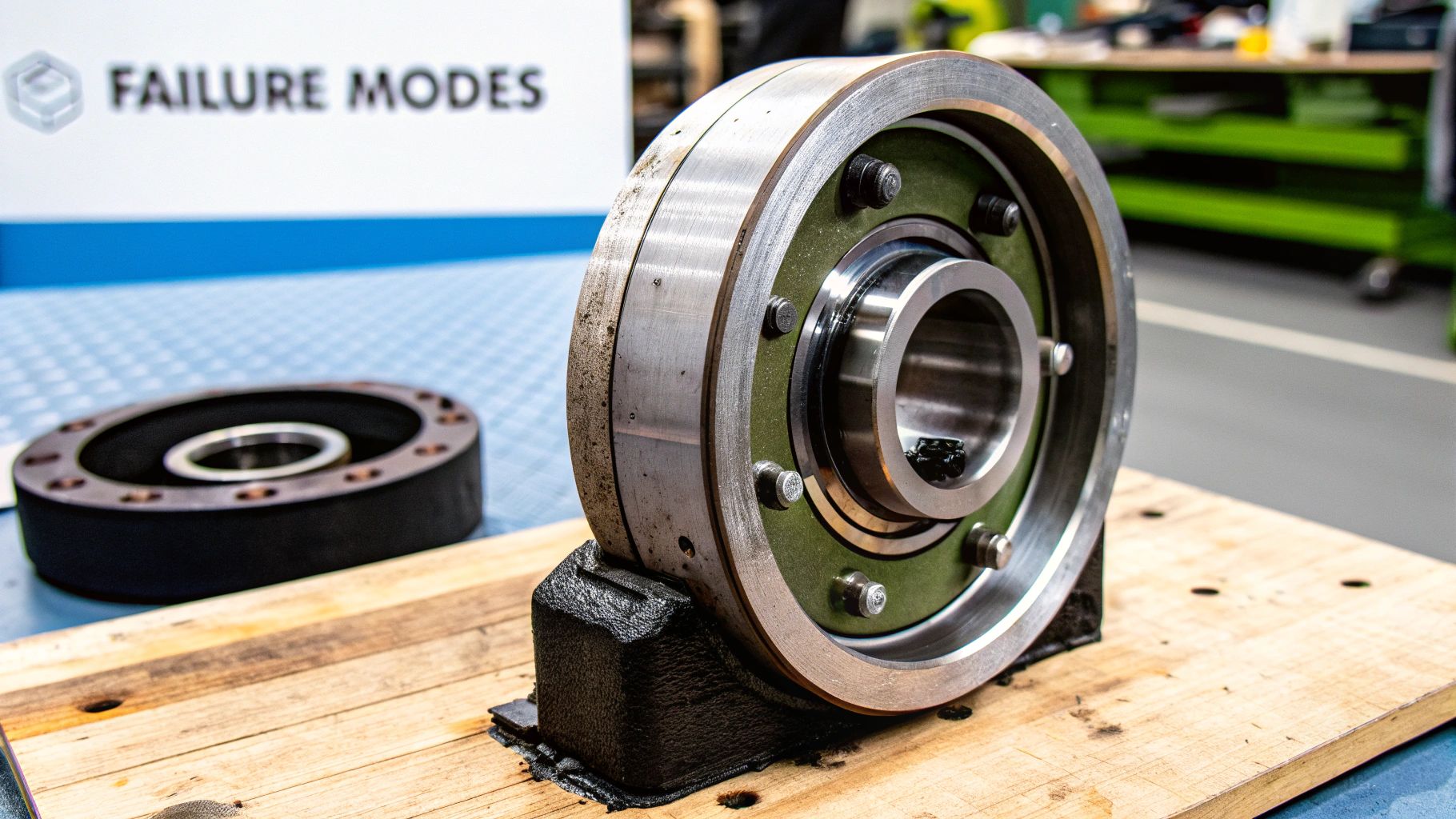
This engineering balancing act doesn't end when the car rolls off the line. Out on the road, these materials face a daily onslaught of stress, corrosion, and simple wear and tear. Having a solid grasp of the common failure modes is absolutely crucial for both manufacturing quality control and long-term vehicle maintenance.
The Trade-Offs in Material Selection
Engineers have to juggle a complex set of priorities when they're spec'ing out materials. There’s no silver bullet; every material brings its own pros and cons to the table, and they all have to be weighed against the vehicle’s specific purpose and price point.
- Forged Steel: Think of this as the old reliable workhorse for parts like wheel hubs, studs, and bearings. It’s got incredible strength and fatigue resistance, making it perfect for taking a beating from heavy loads and sharp impacts. The big downside? It's heavy.
- Aluminum Alloys: Lighter and naturally more resistant to corrosion, aluminum is a popular choice for wheel rims and sometimes even steering knuckles. Cutting down this "unsprung weight" helps the suspension react faster and improves handling, but you're usually looking at a higher material cost.
- Composites: Materials like carbon fiber sit at the peak of performance, offering a mind-boggling strength-to-weight ratio. The trade-off is their extremely high cost, which is why you typically only see them on high-end performance cars where every last gram counts.
Of course, the material itself is only half the battle. External protection is just as important for a long service life. The finish on a wheel rim, for example, isn’t just for looks—it’s a shield against corrosive road salt and brake dust. Applying a tough ceramic wheel coating can take that protection to the next level, fighting off both cosmetic and structural decay.
Identifying Common Failure Modes
Even with the best materials, parts wear out. It's just a fact of life. Being able to spot the early warning signs of a failure is critical for safety and for catching a small problem before it becomes a big, expensive one. You can think of these symptoms as the assembly’s way of trying to tell you something’s wrong.
A worn wheel bearing is probably one of the most common culprits. It’s constantly spinning under the full weight of the vehicle, so it’s a high-stress component by nature. When one starts to go, it rarely does so quietly.
A failing wheel bearing is a progressive problem. The initial subtle noise can quickly escalate into severe vibration or, in the worst-case scenario, complete wheel separation. Rigorous inspection during the assembly process is the first line of defense against premature failure.
The signs of a bad bearing usually show up in ways a driver can actually feel or hear.
1. Audible Grinding or Growling Noises
This is the classic symptom. It often starts as a low-pitched growling or grinding sound that gets louder as you speed up, and it can become more noticeable when you’re turning. This usually means the bearing's internal lubrication has broken down, and you’re hearing metal grinding on metal.
2. Steering Wheel Vibration
As a bearing wears down, it can introduce a tiny bit of "play" or looseness into the whole wheel assembly. That slight wobble gets transmitted right up to the steering wheel as a vibration, which often gets worse at certain speeds.
3. Uneven or Accelerated Tire Wear
A faulty bearing can knock the wheel's alignment out of whack. When this happens, the tire starts to wear unevenly, usually chewing up the inner or outer edge much faster than the other tires on the car.
Another frequent point of failure is hub damage, which is almost always caused by a major impact like clobbering a deep pothole or smacking a curb. This can physically bend the hub flange, meaning the mounting surface for the wheel is no longer perfectly flat. The result is a persistent wheel wobble that no amount of tire balancing can fix. For any OEM or Tier-1 supplier, putting strict inspection criteria in place during the sub-assembly phase is simply non-negotiable. It’s how you guarantee that only flawless car wheel assembly parts make it onto the final vehicle, heading off these kinds of predictable—and preventable—failures.
Sensors, Fasteners, and Seals: The Unseen Essentials
While the big, heavy-duty parts like the hub and knuckle get all the attention, a handful of smaller components are just as critical to the safety and longevity of a modern wheel assembly. These are the unsung heroes: the sensors, fasteners, and seals. Think of them as the nervous system and connective tissue that allow the entire assembly to function, protecting it from both internal and external threats. Without them, the whole system falls apart.

If the main components are the skeleton, then the sensors are the nerve endings. They constantly relay crucial data back to the vehicle’s brain—the ECU, or onboard computer. These small but powerful parts are what make today’s sophisticated active safety features possible.
The Digital Sentinels: ABS and TPMS
Two of the most important sensors you'll find in modern car wheel assembly parts are for the Anti-lock Braking System (ABS) and the Tire Pressure Monitoring System (TPMS).
The ABS sensor is usually a magnetic or Hall effect sensor mounted with razor-thin precision next to a toothed "tone ring" on the hub. Its only job is to constantly measure how fast the wheel is spinning and report back hundreds of times a second. If the ECU sees one wheel suddenly slowing down way faster than the others during a hard brake—a sure sign it's about to lock up and skid—it instantly pulses the brake pressure to that specific wheel.
Meanwhile, the TPMS sensor is a small, battery-powered unit, often built right into the tire's valve stem. It directly measures the air pressure inside the tire and sends that information wirelessly to the car. If the pressure drops to an unsafe level, a warning light pops up on the dash. This simple system has been credited with preventing countless accidents caused by underinflated tires.
For both sensors, the placement and integration during sub-assembly are absolutely critical. An ABS sensor with even a slightly incorrect air gap can feed the computer bad data, which could disable the entire ABS and stability control system when you need it most.
The Unyielding Grip of Fasteners and Seals
The high-tensile steel wheel studs, bolts, and nuts are what physically hold everything together. Their job might seem simple, but the engineering behind them is incredibly precise. Every fastener is designed with a specific torque specification—the exact amount of rotational force needed to create the perfect clamping pressure.
Applying the correct torque isn't just a suggestion; it's a non-negotiable safety mandate. Under-torquing can let the wheel work itself loose over time. Over-torquing can stretch the fastener past its limits, creating a weak point that can snap under stress.
This is exactly why controlled, repeatable assembly processes are so vital. Using calibrated tools and automated systems ensures every single fastener is tightened to the exact OEM spec, taking human error completely out of the equation.
Equally important are the seals. High-quality bearing seals are the assembly's silent guardians. They form a tough barrier that keeps lubricating grease in and locks contaminants out. They are constantly under attack from water, road salt, dirt, and brake dust. A failed seal is a death sentence for a wheel bearing. Once grit and grime get inside, the grease breaks down, the polished surfaces get scored, and the bearing is on a fast track to failure.
Bringing OEM Precision to the Assembly Line and Beyond
Once you have the right components, the real challenge begins: putting them all together. For Tier 1 suppliers and OEMs, assembling these critical wheel components isn't just a mechanical process—it's a discipline built on absolute precision. We're talking about hitting microscopic targets where even the slightest error can ripple outward, affecting everything from vehicle safety to long-term performance.
This entire operation rests on a deep respect for tight tolerancing. Think of tolerances as the "wiggle room" allowed in a part's dimensions. In a modern wheel assembly, this room is incredibly small, often measured in microns. If a wheel hub is off by just a fraction of a millimeter, it can create vibrations, cause premature bearing failure, and ultimately compromise the entire wheel end system.
Best Practices for a Flawless Build
To meet these demanding standards, you can't just have recommendations; you need mandatory best practices. Your assembly operations have to be repeatable, verifiable, and designed from the ground up to eliminate errors. This means turning a bin of individual parts into a perfectly integrated unit, every single time.
Here are a few core strategies that make this happen:
- Kitting: This is the simple but powerful practice of gathering every single component for one assembly—hub, bearing, seals, fasteners, sensors—into a single, ready-to-go package. It takes the guesswork out of the equation on the line and guarantees the right parts are used for the right vehicle.
- Sequencing: Taking kitting to the next level, sequencing delivers these complete kits to the assembly line in the exact order they're needed. For any modern just-in-time manufacturing floor, this is non-negotiable. It slashes line-side inventory and keeps the production flow smooth and predictable.
- Sub-Assembly: Some jobs just shouldn't be done on the main line. Pressing a bearing into a hub, for example, demands specialized equipment and a clean, controlled environment to prevent contamination. By performing these critical steps in a dedicated sub-assembly cell, you ensure they’re done perfectly.
These practices are the bedrock of a robust manufacturing quality management system, which provides the framework needed for consistently high-quality output.
From Assembly to Delivery: Testing and Logistics
After a unit is built, it has to prove it's ready for the road. This is where rigorous testing comes in—and these aren't just random spot-checks. We're talking about comprehensive protocols designed to hunt down any potential flaw before an assembly ever leaves the building.
In the world of OEM supply, "good enough" is a failing grade. The goal is zero defects. This requires a culture of continuous improvement and an investment in testing technologies that can verify every critical parameter of the assembly.
Key testing and inspection steps almost always include:
- Runout Testing: Using a dial indicator, this test measures any wobble or deviation as the hub rotates. Excessive runout is a classic cause of vibration and a dead giveaway of a flawed assembly.
- Sensor Function Checks: Every ABS and TPMS sensor is electronically tested to make sure it's communicating clearly and sending accurate data. This is a non-negotiable safety check.
- Torque Verification: Automated systems check that every last fastener has been tightened to the exact OEM torque spec. This is fundamental to the assembly's structural integrity.
The In-House vs. Partner Advantage
Handling this level of complexity in-house presents significant hurdles for many OEMs, from supply chain disruptions to capital-intensive infrastructure. This is where a specialized 3PL assembly partner can fundamentally change the equation.
Here’s a quick breakdown of the common pain points versus the solutions a dedicated partner provides:
Ultimately, a 3PL assembly partner doesn't just build parts; they absorb the complexity, risk, and overhead, allowing the OEM to focus on final vehicle assembly.
The final piece of this puzzle is getting these perfect assemblies safely to the plant. Precision has to extend from the assembly floor right into packaging, warehousing, and data communication. Custom-designed packaging is a must to protect units from damage in transit. Behind the scenes, seamless integration through Electronic Data Interchange (EDI) and Advance Ship Notices (ASN) ensures real-time communication, so the right parts show up at exactly the right time.
This end-to-end control is what truly sets top-tier suppliers apart. It’s a holistic system where every step is meticulously managed. And the market for this precision is booming. The automotive wheel rims market, valued at $43.99 billion in 2024, is expected to hit $91.53 billion by 2032. This growth is fueled by OEMs adopting lighter, stronger materials to boost vehicle efficiency and performance. You can dig deeper into these automotive wheel rim market trends to see how they're shaping the industry.
How a 3PL Partner Can Unclog Your Supply Chain
Let's be honest. Juggling the sheer number of suppliers for every last component in a car wheel assembly can turn into an operational nightmare. You're coordinating with dozens of different vendors, trying to manage unpredictable inventory levels—it's a massive administrative weight on any OEM or Tier 1 supplier. This is exactly where a dedicated third-party logistics (3PL) partner stops being just another vendor and becomes a genuine extension of your own team.
Think of a specialized 3PL as a central hub that takes your tangled web of suppliers and turns it into a single, efficient pipeline. Instead of dealing with countless contacts, varying quality standards, and chaotic delivery schedules, you have one expert point of contact. This partner shoulders the crucial work of receiving, inspecting, and managing all those individual components, making sure every part is up to spec long before it gets anywhere near your main assembly line.
From Component Chaos to Cohesive Kits
The real magic of a 3PL in the automotive space is its ability to handle precision sub-assembly in a controlled, off-site environment. This is where complex jobs, like pressing bearings into hubs or mounting sensitive electronics, are done right. They use specialized equipment and follow ironclad quality checks, resulting in a perfect, ready-to-install sub-assembly shipped directly to your line.
This model solves several major headaches at once:
- Lower Total Landed Cost: A good 3PL finds efficiencies everywhere—optimizing logistics, consolidating shipments, and improving labor productivity—all of which chip away at your cost per unit.
- Safer Program Launches: Partnering with a team that has launch discipline baked into its DNA is a huge advantage. It dramatically reduces the risk of component shortages or quality hiccups that can completely derail a new vehicle program.
- Focus on What You Do Best: It frees up your internal teams to concentrate on final vehicle assembly and engineering innovation, instead of getting bogged down in the weeds of component-level supply chain management.
The end game here is building a supply chain that's not just stable, but also incredibly responsive. When you hand off the complexity of sub-assembly and logistics, you gain the freedom to react to shifting production demands without sinking millions into specialized equipment and facility space.
The Power of Integrated Operations
A true 3PL partner does more than just bolt parts together; they become a seamless part of your operational nervous system. With full ERP and EDI/ASN integration, they offer a real-time window into your supply chain. This is what makes true just-in-time (JIT) delivery of sequenced kits possible.
Suddenly, you're not wasting money on line-side inventory, because the right assembly shows up at the exact moment it's needed. If you're based in the Midwest, a great first step is exploring the specific capabilities of a 3PL logistics company near me.
To really grasp the strategic edge a 3PL provides, especially with inventory, it’s worth reading up on how third-party logistics business storage can revolutionize your operations. By entrusting your wheel assembly supply chain to an expert, you’re not just outsourcing a task—you’re building a more resilient, efficient, and cost-effective manufacturing ecosystem.
Common Questions We Hear About Wheel Assemblies
When you're dealing with the intricate details of sourcing and managing wheel assembly components, a few key questions always seem to pop up. Let's tackle some of the most frequent ones we hear from supply chain leaders in the field.
What's the First Thing to Go?
If you're looking for the most common point of failure, your first suspect should almost always be the wheel bearing. It's a high-stress, constantly moving part, and its internal grease can only last so long before it breaks down.
Once that happens, you get metal-on-metal friction. That’s the source of the classic grinding or growling noise you hear from a bad bearing, a sound that gets louder and more intense the faster you go. This is exactly why meticulous inspection during assembly and insisting on high-grade steel bearings are non-negotiable.
Why Is Everyone So Obsessed with Torque Specs?
Simply put, torque specifications for wheel studs and bolts are a critical safety standard. It's not just about making them "tight enough"—it's about applying a precise clamping force that holds the entire wheel securely against the hub without damaging the parts.
- Go too loose (under-torque), and the wheel can gradually work its way free, causing dangerous vibrations and, in the worst-case scenario, detaching from the vehicle.
- Go too tight (over-torque), and you can stretch the stud or bolt past its breaking point. This weakens the metal and can cause it to snap unexpectedly under the stress of driving.
The bottom line? Precise torque is the foundation of the assembly's structural integrity. You can't eyeball it. Using automated, calibrated tools in a controlled assembly environment is the only reliable way to ensure every single fastener meets the exact OEM spec, every single time.
How Do Electric Vehicles Change the Game?
The shift to EVs has definitely shaken up wheel assembly design. The instant torque from an electric motor and the forces from regenerative braking put entirely new kinds of stress on the hub and bearings.
Assemblies for EVs have to be engineered to withstand these immediate, high-load scenarios. At the same time, they need to be as lightweight as possible to help extend the vehicle's battery range. This often means specifying stronger, more advanced materials and more robust bearing designs from the outset.
At Wolverine Assemblies, LLC, our job is to manage this complexity so you don't have to. Our precision sub-assembly, kitting, and sequencing services guarantee every wheel assembly meets strict OEM standards and arrives at your line exactly when you need it. Discover how we can help you launch programs confidently and bring stability to your supply chain at https://www.wolverine-llc.com.
Subscribe to our weekly newsletter