.png)
How to Improve Supply Chain Efficiency in Your Operations
Learn how to improve supply chain efficiency with actionable strategies for diagnostics, process redesign, technology, and supplier collaboration.

You can't fix what you can't measure. Before you can tighten up your supply chain, you need a crystal-clear, data-driven picture of where you stand right now. This isn't about gut feelings or what you think is happening; it's about establishing a hard baseline to measure all future improvements against.
Finding Your True North: A Data-Driven Diagnostic
Trying to boost supply chain efficiency without a proper diagnostic is like driving blind. You need a map of the plumbing before you can start fixing the leaks. This initial phase is all about moving past anecdotes and building a solid, data-backed case for change.
The goal here isn't to get lost in spreadsheets. It's to use data to tell a story—to shine a bright light on the real friction points, whether they're supplier delays, fulfillment mistakes, or warehouse bottlenecks. This creates an undeniable baseline that justifies every dollar and hour you'll invest down the line.
Key Performance Indicators That Actually Matter
To get an accurate read, you need to track the right things. While every operation has its unique quirks, a few core KPIs are universal for diagnosing the health of your supply chain. These are the metrics that cut through the noise and show you what's really going on.
To make this practical, here’s a breakdown of the KPIs we see as most critical for identifying where the real problems are hiding.
Essential KPIs for Supply Chain Efficiency Diagnostics
Focusing on these core metrics helps you see the big picture without getting bogged down in vanity numbers.
Of course, any analysis is only as good as the numbers behind it. Garbage in, garbage out. It’s worth exploring practical strategies to improve data quality to ensure your diagnostic is built on a rock-solid foundation.
A common mistake is tracking too many KPIs. Focus on the vital few that directly link to customer satisfaction and total cost. If a metric doesn't drive a specific, actionable decision, it's probably just noise.
Pinpointing the Bottlenecks
Once you have clean data, the real work begins: finding the bottlenecks. Start looking for patterns. Are delays consistently popping up at the receiving dock? Are certain SKUs constantly being mis-picked? Sometimes, just visualizing the data on a simple process map makes these friction points jump right off the page.
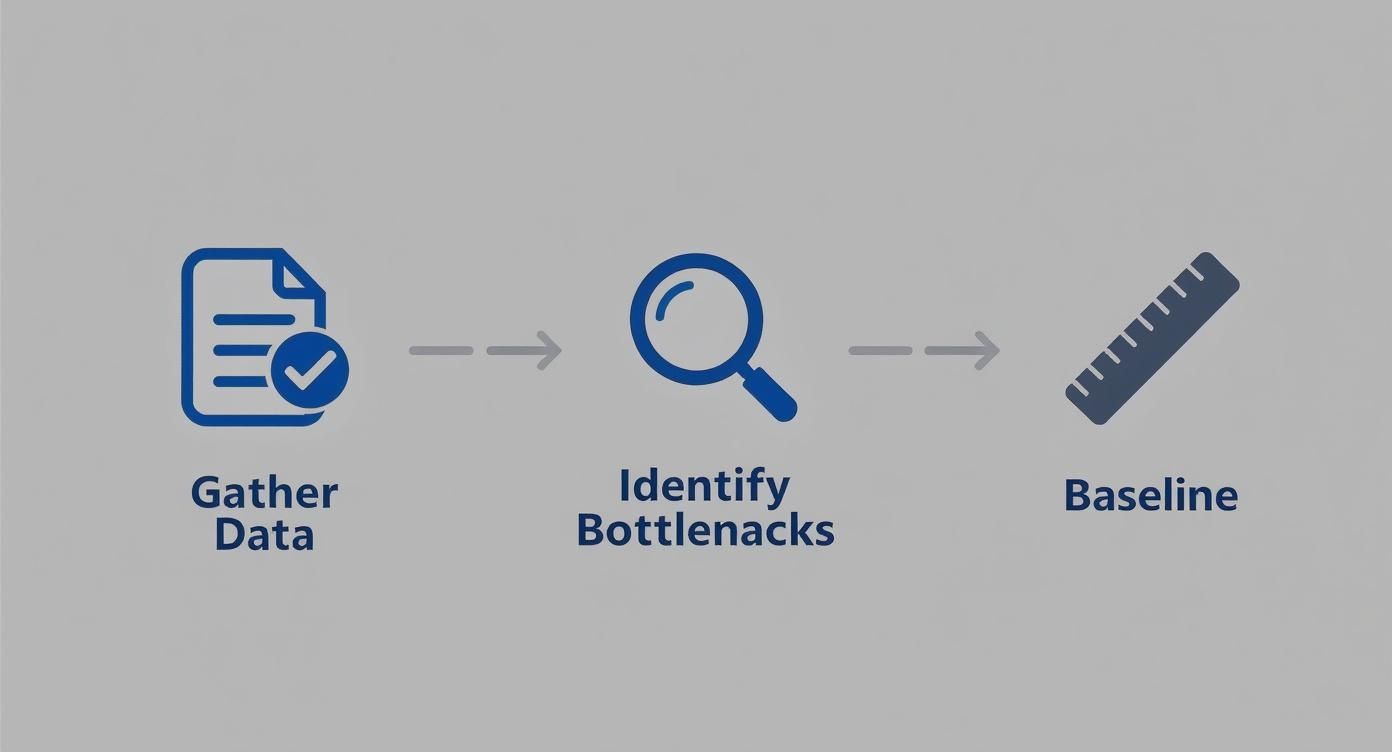
This simple flow—gather data, find the blockages, set a baseline—is how you turn raw numbers into a clear roadmap for improvement. It ensures you’re aiming your efforts where they'll have the biggest impact.
For example, an OEM we worked with discovered its Order Cycle Time was being inflated by a consistent 48-hour lag between parts hitting the dock and getting logged into the ERP. That single data point gave them a clear, targeted project: fix the receiving process. That's the power of a good diagnostic.
This isn’t just about fixing problems, either. It’s about unlocking serious financial gains. The data shows that well-managed, digitized supply chains achieve about 20% lower operating costs and up to 11% higher earnings before interest and taxes (EBIT). By establishing a clear baseline, you’re not just finding issues; you’re building the business case for changes that deliver real, measurable results.
Redesigning Workflows with Lean Principles
Once you’ve diagnosed where the real problems are, it's time to fundamentally redesign how work gets done. Lasting gains in supply chain efficiency don't come from working harder—they come from working smarter and questioning the "why" behind every single process. This is where the battle-tested philosophy of Lean comes into play.
Lean isn't just another manufacturing buzzword. It's a mindset focused on one core idea: ruthlessly hunting down and eliminating waste. In the world of logistics and supply chains, waste isn’t just scrap metal. It’s any step, delay, or resource that doesn’t add direct value for your customer.
Making Waste Visible with Value Stream Mapping
You can't fix what you can't see. That's why Value Stream Mapping (VSM) is one of the most powerful first moves you can make. A VSM is essentially a visual roadmap of your entire operational flow, from the moment a part is ordered from a supplier to the second your finished product ships out the door.
But unlike a simple flowchart, a VSM tracks both the steps and the time and information flow between them. This is what makes it so eye-opening.
- Process Time: The actual "hands-on" time spent working on a product (like assembly or packing).
- Lead Time: The total time a product sits in your system, which includes all the waiting.
You’ll almost always find that the lead time is exponentially longer than the process time. That gap? That's pure waste—time spent waiting for parts, waiting for approvals, or just sitting on a dock. That gap is your goldmine for improvement.
Identifying the Eight Wastes in Your Supply Chain
Lean methodology breaks waste down into eight categories. Thinking through this lens helps your team spot non-value-added activities that have just become "the way things are done."
Looking at your operation through this framework turns vague inefficiencies into concrete, solvable problems. Many of these ideas apply whether you run logistics in-house or with a partner. In fact, understanding how lean manufacturing and 3PL work together can unlock major cost reductions by getting everyone focused on eliminating waste.
The most dangerous phrase in any operation is, "We've always done it this way." Lean principles force you to challenge that assumption at every turn, asking if a step truly adds value or simply adds time and cost.
Driving Change with Kaizen Events
Spotting waste is one thing, but getting rid of it is another. That's where Kaizen events, or rapid improvement workshops, make a huge difference. These aren't your typical endless meetings. They're focused, multi-day sprints where a cross-functional team dives deep to solve a specific problem you found in your VSM.
Think about that receiving dock bottleneck we mentioned. A Kaizen team—made up of a receiving clerk, a quality inspector, a forklift driver, and a supervisor—would physically map out the current process. They'd time every step, from the moment a truck pulls in to when the parts are finally in the system and ready for use.
By empowering the people who do the work every day to redesign the workflow, you get practical solutions that actually stick. Maybe they decide to pre-schedule dock appointments, start using mobile scanners to log parts instantly, or create a direct-to-line delivery path for critical components. These small, targeted changes, implemented fast, are the real engine of continuous improvement.
Transforming Your Warehouse into a Strategic Asset

Once you've got the data and lean principles locked in, it's time for the next big move: turning your warehouse from a simple cost center into a real strategic advantage. This is where all that planning hits the floor and you start seeing tangible gains in throughput and cost savings.
Think of your fulfillment center as the physical engine of your supply chain. It's more than just shelves and forklifts. Optimizing this engine means being intentional about every single movement, from the moment parts arrive to the second finished goods ship out. Get this right, and you'll see a direct impact on production uptime, order accuracy, and your total landed cost.
Prepping for Production: Kitting and Sequencing
For any OEM or Tier 1 supplier, time wasted on the assembly line is money down the drain. This is where your warehouse can become the hero by making sure parts are line-ready before they ever leave your facility.
Two of the most powerful ways to do this are kitting and sequencing.
- Kitting: Instead of assemblers grabbing ten different parts from ten different bins, you group all the necessary components for a specific job into a single package. This simple step slashes pick times and almost completely gets rid of errors from missing or wrong parts.
- Sequencing: This takes kitting to the next level. You deliver these kits or individual parts to the line in the exact order they're needed for production. In a complex build like a vehicle, this ensures the right wiring harness shows up just in time for the specific car on the line, making just-in-time manufacturing a reality.
By adding these services, your warehouse stops being a passive storage unit and starts acting as a critical partner in the manufacturing process.
Accelerating Flow with Cross-Docking and Smart Slotting
Here's a simple truth: not everything that comes through your receiving doors needs to sit on a shelf. For high-turnover goods that are already sold, cross-docking is a massive win. You unload materials from an incoming truck and move them directly to an outbound truck, with almost no storage time in between.
Imagine a pallet of finished goods arrives, already allocated to a customer order. Instead of wasting labor putting it away only to pick it again hours later, you slide it straight across the dock to the waiting outbound trailer. You can literally cut days out of your order cycle time.
How you organize the inventory you do store is just as important. Smart slotting is all about strategically placing items to cut down on picker travel time. Your fastest-moving "A" items should be in the easiest-to-reach spots—close to packing stations and at a comfortable height. Slower movers can go to the back.
This isn't rocket science, but it's incredibly effective when you consider that travel time can eat up over 50% of a picker’s day.
Driving Down Freight Costs Through Consolidation
The final stop inside your four walls—outbound shipping—is a goldmine for cost savings. Instead of sending out a dozen small, less-than-truckload (LTL) orders to customers in the same state, freight consolidation lets you combine them into a single full truckload.
This move pays off in a few big ways. Full truckload rates are far cheaper per pound than LTL. You also reduce the number of trucks on the road and minimize handling, which lowers the risk of transit damage.
To make this happen, your team needs clear visibility into the order pipeline. By strategically holding one shipment for a day to group it with another going to the same area, you can unlock serious savings. This turns your warehouse into a true hub of efficiency that directly impacts your bottom line.
Integrating Technology That Actually Works
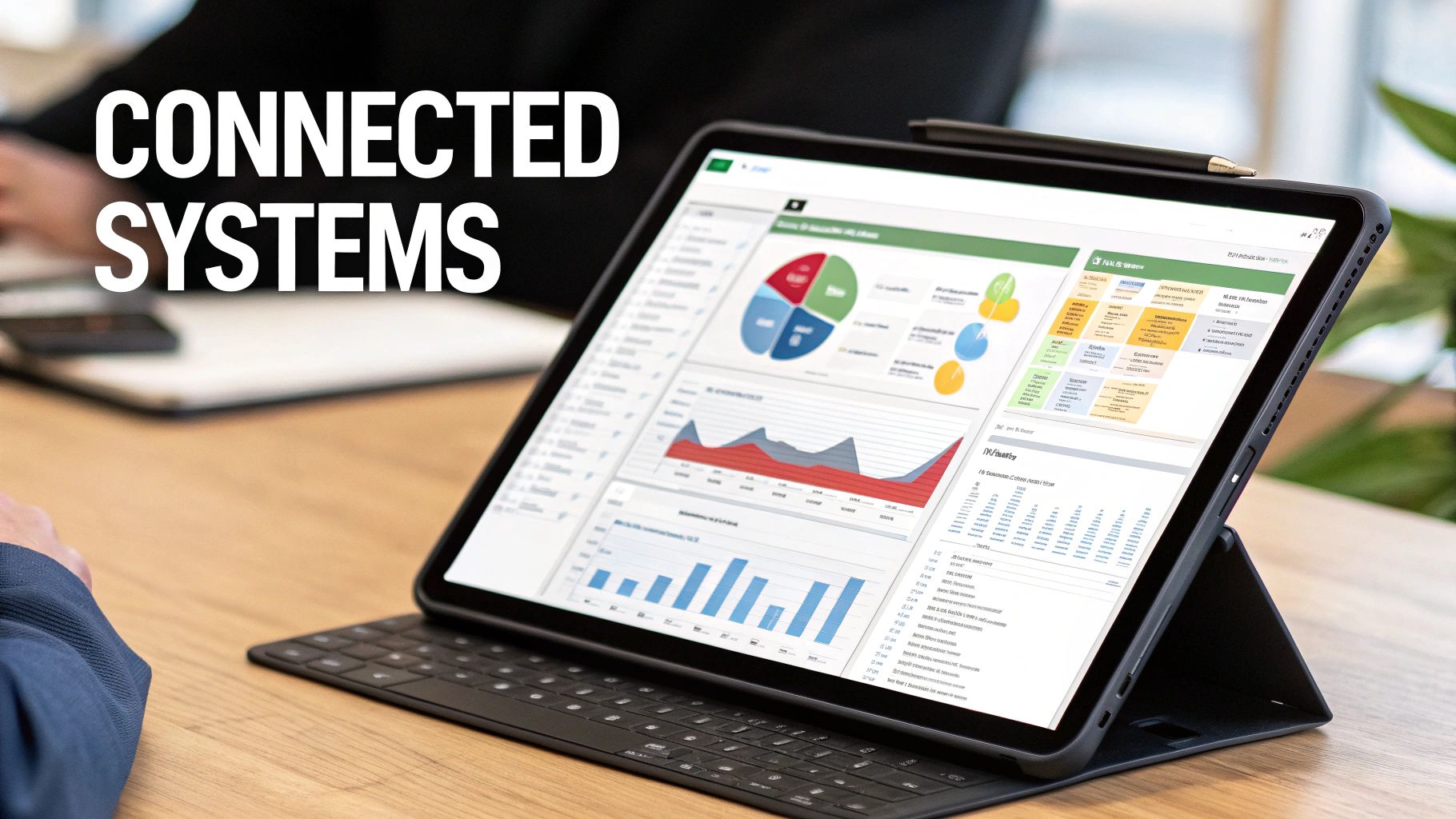
This is what a connected supply chain looks like—a single, clear dashboard pulling live data from every corner of your operation. Technology is the central nervous system tying your lean processes and warehouse optimizations together.
But let’s be clear. This isn't about adding more software for the sake of it. It’s about choosing the right tools that automate, simplify, and give your team clarity without burying them in complexity.
A disjointed tech stack is the enemy of efficiency. When your warehouse, procurement, and production floor are all looking at different versions of the truth, you get delays, errors, and wasted money. The goal is simple: one single source of truth for everyone.
Creating a Unified Digital Foundation
Before you can get fancy, you have to get the basics right. Your core systems are the bedrock of your operation, and getting them to talk to each other is non-negotiable.
- Enterprise Resource Planning (ERP): This is your company's operational brain. It holds the master data for financials, inventory, production schedules, and POs. A solid ERP means everyone is working from the same playbook. If you want a deeper dive, here's a good overview of what an ERP system in manufacturing really entails.
- Warehouse Management System (WMS): This is your on-the-ground commander. A WMS directs every move in the fulfillment center—receiving, putaway, picking, and shipping. Modern systems optimize travel paths and manage inventory locations in real-time, giving you the data for smart slotting and labor planning.
- EDI and ASNs: Electronic Data Interchange (EDI) and Advance Shipping Notices (ASNs) are the digital handshakes between you and your partners. EDI automates the back-and-forth of purchase orders and invoices. An ASN gives your receiving team a heads-up on what’s arriving on a truck before it hits the dock, so they can have the space and people ready.
When these systems are integrated, the real work gets done automatically. An order in the ERP triggers a pick instruction in the WMS, and a supplier’s ASN populates your receiving schedule without anyone touching a keyboard. This eliminates hours of manual data entry and kills the risk of human error.
To take it a step further, many are now using top intelligent document processing software to automatically pull data from invoices and packing slips right into their core systems.
Moving From Reactive to Predictive Operations
Once your foundational systems are connected, you can stop just reacting to problems and start preventing them. This is where analytics and AI stop being buzzwords and become practical tools.
The real power of technology isn't just in doing things faster; it's in doing things smarter. Predictive analytics can flag a potential stockout weeks in advance, giving you time to expedite a shipment or adjust production schedules instead of scrambling at the last minute.
Advanced analytics platforms can dig through historical sales data, seasonal trends, and even weather patterns to create far more accurate demand forecasts. This lets you dial in your inventory levels—holding just enough to meet demand without tying up cash in slow-moving stock.
The data backs this up. One survey found 62% of operations leaders consider AI tools highly effective for boosting productivity and controlling costs. It’s clear that a smart investment in technology isn’t a cost—it’s a direct path to a more resilient and efficient supply chain.
Building Resilient Supplier Partnerships
Your supply chain is only as strong as its weakest link. And more often than not, that weakness isn't a single event—it's a transactional, arms-length relationship with your suppliers.
Shifting that dynamic is one of the most powerful moves you can make. It’s about moving beyond just issuing POs and demanding on-time delivery. When suppliers feel like an extension of your own team, they stop being order-takers and start becoming proactive problem-solvers.
Fostering Collaboration and Shared Success
The first step is getting everyone on the same page. A shared performance scorecard is a fantastic tool for this. Instead of just tracking a supplier's on-time delivery from your perspective, you sit down and co-develop KPIs that actually matter to both sides.
A good scorecard might include:
- Perfect Order Percentage: A blended metric that tracks accuracy, timeliness, and quality in one number.
- Lead Time Variance: This measures consistency. Are they always early? Always late? Or all over the map? Consistency is often more valuable than raw speed.
- Cost Reduction Contributions: This tracks supplier-led initiatives that help lower your total landed cost. It gives them skin in the game.
Another great tool is a Vendor-Managed Inventory (VMI) program. In a VMI setup, you grant a trusted supplier visibility into your inventory levels. They take on the responsibility of replenishing that stock automatically, making sure you never run out of critical components. It cuts a massive amount of administrative overhead on your end and keeps material flowing.
When excellent supply chain collaboration is in place, 63% of manufacturers report on-time delivery of more than 95%. This isn't just about better relationships; it’s about a direct, measurable impact on performance.
Building a Supply Chain That Bends, Not Breaks
Collaboration smooths out day-to-day operations, but it’s also your best defense against major disruptions. Resilience isn't about trying to prevent every single problem—that's impossible. It's about building a network that can absorb a shock and recover fast.
Start by mapping your entire supply chain. And I mean entire. Don't stop at your Tier 1 suppliers. Who supplies them? And who supplies their suppliers? This deep dive is the only way to uncover those hidden single points of failure, like realizing three of your most critical suppliers all source a key raw material from the same small region.
Once you have that map, you can build smarter, more redundant sourcing strategies.
- Dual-Sourcing: Get a second supplier qualified for your most critical components. Even if they only handle a small percentage of the volume to start, they're ready to ramp up if your primary has an issue.
- Multi-Shoring: Diversify your geographic footprint. Sourcing from different regions (say, one supplier in Asia and another in Mexico) protects you from localized disruptions like natural disasters, port strikes, or political instability.
The data backs this up. Organizations with strong supplier relationships and robust risk strategies face 20% fewer supply chain disruptions.
Planning for the Inevitable
The final piece of the puzzle is having a clear contingency plan before you need it. What's the protocol if your primary logistics carrier goes on strike? What do you do if a key supplier’s factory has a fire?
Work with your partners to game out these "what-if" scenarios. A truly collaborative supplier will be more than willing to discuss their own disaster recovery plans and work with you to create a joint response strategy. This is what turns a potential five-alarm crisis into a manageable, planned-for event.
Common Questions on Supply Chain Efficiency
Even with the best roadmap, real-world questions always pop up. Here are the straight-up answers to what we hear most often from operations leaders trying to dial in their supply chain efficiency.
Where Should I Even Start?
This is the big one: "Where do I begin?" It's easy to look at the whole system and feel overwhelmed by a dozen potential projects.
Don't try to boil the ocean. The best first move is always a focused diagnostic, just like we talked about earlier. Use your data to find the single biggest point of friction—the bottleneck that costs you the most time or money—and go after that first. A quick, measurable win creates momentum that makes everything else easier.
Is New Technology Really Necessary?
Another common question is whether you need to sink a ton of cash into new tech to see results. The short answer is no, but the right technology is a massive accelerator.
You can make huge strides just by redesigning workflows and applying Lean principles—all without spending a dime on software. But once you've cleaned up your processes, technology like a WMS or a modern ERP becomes crucial for locking in those gains. It gives you the visibility you need to get to the next level of performance.
The global trend is clear: automation and AI-driven insights are helping supply chains get ahead of disruptions, manage risk, and run smarter.
Key Takeaway: Fix the process first, then use technology to automate and scale it. Putting expensive software on top of a broken workflow just helps you do the wrong thing faster.
How Do I Balance Efficiency and Resilience?
A lot of leaders worry that a hyper-efficient, lean supply chain is also a fragile one. That’s a valid concern. The key isn't bloating your inventory; it's building in strategic redundancy.
It’s a balancing act that involves:
- Strategic Buffers: Holding small amounts of safety stock for only your most critical, hard-to-source components.
- Supplier Diversification: Qualifying a second source for key materials, even if they only get 10-20% of the volume to start.
- Logistics Redundancy: Having backup carriers and alternate routes planned for your main shipping lanes.
This approach lets you absorb shocks without carrying the high cost of an inefficient system. It often comes down to looking at various supply chain cost reduction strategies that don't force you to sacrifice stability.
How Do We Make These Changes Stick?
This might be the most important question of all. How do you make sure this isn't just a one-and-done project? The only way to sustain gains is to build a culture of continuous improvement.
This means giving your front-line teams the power to spot and solve problems themselves. It means making your core KPIs—like Perfect Order Rate and Order Cycle Time—visible to everyone, not just locked away in a manager's office.
When the whole team owns the numbers and is encouraged to find better ways of working, efficiency stops being a project and just becomes how you operate.
Ready to transform your supply chain from a cost center into a strategic asset? Wolverine Assemblies, LLC provides the expert 3PL, warehousing, and light manufacturing solutions you need to improve efficiency and lower your total landed cost. Learn how we can stabilize and scale your operations.
Subscribe to our weekly newsletter