.png)
8 Practical Value Stream Mapping Examples for Manufacturing in 2026
Explore 8 in-depth value stream mapping examples for manufacturing, 3PL, and supply chain. See how to reduce waste and boost efficiency with VSM.

Value stream mapping (VSM) is more than a lean manufacturing buzzword; it's a powerful diagnostic tool for visualizing, analyzing, and transforming your entire production and logistics flow. Too often, discussions around VSM remain theoretical, stuck on whiteboards without translating into tangible operational improvements. This guide changes that by providing eight detailed, industry-specific value stream mapping examples, moving from abstract concepts to concrete application.
We will dissect real-world scenarios in automotive assembly, electronics kitting, warehousing, and supplier management, offering a blueprint for identifying waste and designing future-state processes that drive measurable results. The objective is to move beyond simply identifying process steps and start optimizing the flow of both materials and information. A critical component of this information flow is reducing manual effort through tools like automated data processing, which can significantly cut down non-value-added time in administrative tasks.
Each of the following examples provides a complete tactical breakdown:
- A specific operational scenario and its initial 'before' state map.
- Key metrics like process time, lead time, and inventory levels.
- A clear analysis of wastes identified (Muda) within the process.
- Targeted lean interventions designed for maximum impact.
- A proposed 'after' state vision for a more efficient future.
This is your practical playbook for turning lean theory into operational excellence and tangible cost savings. These strategies are directly applicable to complex supply chains and value-added service environments, providing a replicable framework for your own continuous improvement initiatives.
1. Automotive OEM Assembly Line VSM: Toyota Production System Implementation
The automotive assembly line is the classic, high-stakes environment where value stream mapping (VSM) originated. Pioneered within the Toyota Production System (TPS), this VSM approach meticulously charts the flow of both materials and information from individual components to the final assembled vehicle. The goal is to synchronize every step, eliminate waste, and create a seamless production rhythm dictated by customer demand.
This method is foundational for any high-volume, complex assembly operation. It provides the strategic visibility needed to identify bottlenecks, excess inventory, and process delays that inflate costs and extend lead times. By mapping the entire value stream, an Original Equipment Manufacturer (OEM) can pinpoint exactly where non-value-added activities occur and systematically eliminate them.
Strategic Analysis & Key Benefits
Automotive VSM is not just about drawing a map; it's a diagnostic tool for implementing core lean principles. The primary benefit is achieving a state of one-piece flow, where vehicles move smoothly through assembly without stagnation. This dramatically reduces work-in-process (WIP) inventory and shortens the cash-to-cash cycle.
Another key benefit is the precise alignment of production with takt time (the rate of customer demand). This prevents overproduction, one of the most significant forms of waste. Successful implementation, seen in Toyota’s legendary reduction of changeover times or Ford’s 99.5% delivery accuracy in modular assembly, demonstrates the power of this focused analysis.
Key Insight: The VSM in an automotive context forces a critical distinction between material flow (the physical movement of parts) and information flow (the signals that trigger action). Optimizing both is essential; a perfect material flow can still be crippled by a delayed or inaccurate information flow.
Actionable Takeaways & Implementation Tips
For organizations looking to replicate these results, here are actionable steps derived from successful value stream mapping examples in the automotive sector:
- Start Small and Focused: Begin by mapping a single, high-impact production cell or one specific vehicle model line. This creates a manageable scope for learning and achieves a quick win before scaling the effort.
- Engage the Front Line: Your assembly line operators and team leads possess invaluable, firsthand knowledge of real-world constraints and inefficiencies. Involve them directly in the VSM process to ensure the "current state" map reflects reality, not theory.
- Prioritize by Takt Time: Calculate your takt time based on actual customer orders, not the plant's maximum capacity. This ensures your entire value stream is paced to meet real demand, preventing the costly waste of overproduction.
2. Electronics Manufacturing Kitting & Sequencing VSM: Gentex-Style Integration
In electronics manufacturing, the value stream extends beyond a single assembly line to encompass complex kitting and sequencing operations. This specialized VSM approach maps the flow of numerous small components from storage to a dedicated kitting cell, then onward as a sequenced package to the point of use. The goal is to deliver perfectly accurate, just-in-time kits that align with a build-to-order (BTO) final assembly schedule, eliminating line-side clutter and picking errors.
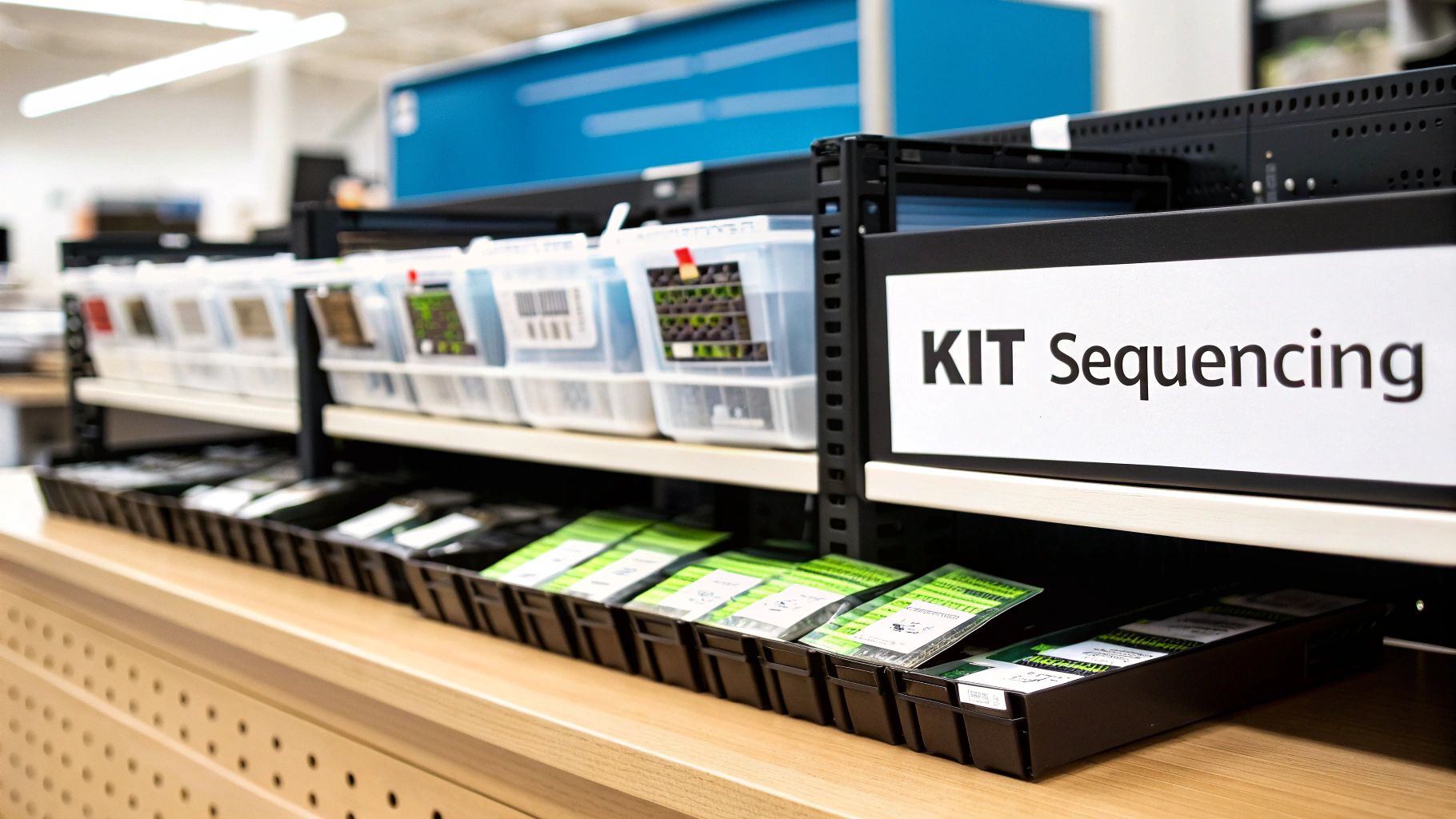
This method is crucial for manufacturers dealing with high product variation and component complexity. It provides a clear blueprint for synchronizing supplier deliveries, internal logistics, and customer assembly needs. By mapping the entire kitting value stream, an electronics supplier can identify waste in motion, inventory holding, and information delays that cause line stoppages and quality defects.
Strategic Analysis & Key Benefits
Kitting and sequencing VSM is a strategic tool for achieving mass customization with lean efficiency. The primary benefit is transforming a chaotic component supply chain into a streamlined, error-proofed delivery system. This directly supports the final assembly line by ensuring the right parts are delivered in the right sequence at precisely the right time, which is a core function of value-added warehousing services.
Another key benefit is the drastic reduction of line-side inventory and complexity. Instead of stocking hundreds of individual part numbers at the assembly station, operators receive a single, verified kit. Implementations by pioneers like Gentex Corporation have shown this can reduce line stoppages by over 45% and boost throughput by simplifying the operator's tasks. This focused analysis leads to higher first-pass yield and improved ergonomics.
Key Insight: The VSM for kitting shifts the focus from "process time" of individual parts to the "cycle time" of a completed kit. The value is added not just by picking parts, but by verifying the kit's accuracy and delivering it in perfect sequence with the production schedule, turning a logistical task into a critical quality gate.
Actionable Takeaways & Implementation Tips
For organizations seeking to implement this type of VSM, here are actionable steps derived from successful value stream mapping examples in electronics manufacturing:
- Map Backwards from Takt Time: Begin your map at the final assembly point of use. Calculate the takt time of the customer’s line and work backward to determine the required pace for kit creation, picking, and component replenishment.
- Implement Visual Management: Use color-coding, clear bin labeling, and designated staging lanes at kit stations. This makes the correct sequence and components instantly recognizable, reducing the cognitive load on operators and minimizing picking errors.
- Standardize Kit Configurations: Analyze product demand and consolidate component variations into standardized kits where possible. This reduces SKU complexity in the kitting cell, streamlines the picking process, and improves overall efficiency.
3. Agricultural Equipment Supplier VSM: Seasonal Demand Planning & Inventory Optimization
Value stream mapping for agricultural equipment suppliers addresses a unique and critical challenge: extreme demand seasonality. This VSM approach extends beyond the factory floor to map material flows, procurement cycles, and inventory strategies across distinct build seasons and off-seasons. The primary goal is to balance peak-season production capacity with year-round working capital efficiency, preventing crippling inventory holding costs during low-demand periods.
This method is essential for any manufacturer whose sales are concentrated in specific windows, such as planting and harvesting seasons. By creating separate value stream maps for peak and off-season operations, a company can develop a dynamic strategy for procurement and production. It allows for proactive planning of long-lead-time components and ensures the right level of inventory is positioned at the right time to meet surges in customer orders without tying up unnecessary cash.
Strategic Analysis & Key Benefits
This type of VSM is a powerful tool for aligning supply chain actions with a volatile, forecast-driven market. The core benefit is inventory optimization, moving away from a "just-in-case" model that leads to massive off-season carrying costs. Instead, it enables a more flexible "build-to-forecast" or "build-to-order" strategy, dramatically improving capital efficiency.
Another significant benefit is enhanced supplier collaboration. The map visualizes the long lead times inherent in the industry (often 9-12 months for specialized components), making it clear why early and continuous communication with suppliers is non-negotiable. Successful examples, like John Deere's tiered supplier delivery system that cut pre-season inventory by 25% or AGCO's strategic shift to build-to-order, showcase how this analysis directly impacts financial performance and market responsiveness.
Key Insight: In seasonal manufacturing, the VSM reveals that time is not a constant. The value of a component in inventory changes drastically between the off-season and the peak-season. This VSM forces a strategic plan that treats inventory not just as a physical asset but as a time-sensitive financial instrument.
Actionable Takeaways & Implementation Tips
For organizations facing seasonal demand swings, here are actionable steps derived from effective value stream mapping examples in the agricultural sector:
- Map Duality: Create two distinct "current state" maps: one for your peak production season and one for the off-season. This immediately highlights the different bottlenecks, inventory levels, and process priorities that exist at different points in the year.
- Utilize Rolling Forecasts: Base your material and information flow on a rolling 12-month (or longer) forecast. This forward-looking data is the critical input that allows you to collaborate with suppliers on long-lead-time components well ahead of the demand curve.
- Build Contractual Flexibility: Work with your key suppliers to establish flexible contracts that allow for a defined variance (e.g., 15-20%) in order volume. This provides a buffer to adjust to forecast inaccuracies without incurring severe penalties or disrupting the supply chain.
4. Energy Sector Compliance & Regulated Component VSM: Quality-First Supply Chain
In highly regulated sectors like energy, value stream mapping takes on a critical new dimension. This specialized VSM approach integrates rigorous compliance, traceability, and safety documentation directly into the flow of materials and information. The goal is not just to be lean but to be demonstrably compliant at every step, from raw material certification to final asset deployment.
This method is indispensable for suppliers and operators in oil, gas, renewables, and utilities. It addresses the unique challenge of embedding non-negotiable quality and regulatory gates into the process without creating excessive delays or administrative waste. By mapping compliance activities as value-added steps (from a customer and regulatory perspective), organizations can streamline them rather than treating them as separate, obstructive hurdles.
Strategic Analysis & Key Benefits
Energy sector VSM is a tool for risk management and operational integrity. The primary benefit is achieving built-in compliance, where quality checks, certifications (like ASME or API), and traceability documentation are integral parts of the workflow, not afterthoughts. This dramatically reduces the risk of costly rework, regulatory fines, and project delays caused by documentation errors.
Another key benefit is the enhanced supply chain visibility required for safety-critical components. By mapping the "chain of custody" for both physical parts and their associated data, companies can ensure 100% traceability. Success stories include oil and gas suppliers reducing compliance-related delays from 20% to under 5% of total cycle time and utility equipment providers cutting audit findings by 80% through this integrated mapping approach. To understand the evolving landscape of regulated components, insights into EU regulations on F-gases in switchgear and the transition to sustainable alternatives provide crucial context for VSM in the energy sector.
Key Insight: In regulated industries, the "information flow" includes compliance documentation, test certificates, and regulatory filings. A delay or error in this data stream is as disruptive as a physical bottleneck and can halt the entire value stream, regardless of production efficiency.
Actionable Takeaways & Implementation Tips
For organizations navigating complex regulatory environments, here are actionable steps from successful value stream mapping examples in the energy sector:
- Map Compliance as a Process Step: Treat every required inspection, certification, and documentation task as an official step in your value stream map. Assign process times and identify waiting periods to highlight compliance-related bottlenecks.
- Engage Cross-Functional Experts: Involve your quality assurance, regulatory affairs, and legal teams in the VSM creation process from the very beginning. Their expertise is essential for accurately mapping the current state and designing a future state that is both lean and compliant.
- Integrate Technology for Traceability: Use digital tools like RFID tags, QR codes, or blockchain-style ledgers to link physical components to their digital documentation trail. This automates the chain of custody and makes audit preparation seamless.
5. 3PL & Warehouse Operations VSM: Cross-Dock & Pick-Pack Optimization
For third-party logistics (3PL) providers and large-scale warehouse operations, value stream mapping transcends the factory floor to optimize the flow of goods from receiving to shipping. This VSM approach meticulously charts inbound receiving, put-away, storage, order picking, and outbound processes. The primary goal is to minimize product handling, reduce dwell time, and increase throughput by systematically eliminating waste in motion, waiting, and inventory.
This methodology is essential for high-velocity environments like cross-docking facilities and e-commerce fulfillment centers. It provides the clarity needed to identify bottlenecks in pick paths, underutilized dock doors, and inefficient storage strategies that inflate labor costs and delay customer shipments. By mapping the entire fulfillment stream, a logistics provider can re-engineer layouts and processes for maximum efficiency.

Strategic Analysis & Key Benefits
Warehouse VSM is a powerful diagnostic tool for implementing lean logistics principles. The most significant benefit is the reduction of non-value-added travel time for both people and equipment. By optimizing warehouse layouts based on VSM data, pickers travel shorter distances, leading to a direct increase in picks per hour and order fulfillment capacity.
Another key benefit is the synchronization of inbound and outbound flows, which is critical for efficient cross-docking. This prevents yard congestion and staging area bottlenecks, slashing the time goods spend sitting idle. Success stories, such as XPO Logistics reducing cross-dock dwell time by 40% and Amazon Fulfillment Centers optimizing pick-to-ship cycles, highlight the transformative impact of these value stream mapping examples on operational performance.
Key Insight: In warehousing, the "product" is not being transformed, but its location is. Therefore, VSM focuses intensely on the waste of motion and waiting. Every step a worker takes and every minute a pallet sits idle is a direct target for elimination, turning the warehouse into a fluid conduit rather than a static storage space.
Actionable Takeaways & Implementation Tips
For logistics and supply chain managers aiming to replicate these outcomes, here are actionable steps derived from successful warehouse VSM initiatives:
- Map by Process, Not Just Area: Instead of a general facility map, create separate VSMs for distinct flows like cross-dock, pick-and-pack, and bulk storage. This isolates unique waste streams and allows for targeted improvements.
- Use Data to Guide Layout: Employ heat maps showing pick frequency to redesign slotting strategies, placing high-velocity items in the most accessible locations. Time studies of pick paths will reveal the most inefficient routes that need re-engineering. Explore more strategies for efficient pick and pack operations here.
- Synchronize to Outbound Schedules: Pace all internal warehouse activities, including receiving and put-away, based on the timing of scheduled outbound shipments. This customer-driven approach prevents the accumulation of staged goods and ensures dock resources are used effectively.
6. Supplier Integration & Multi-Tier VSM: Supply Chain Network Optimization
Advanced value stream mapping extends beyond the four walls of a single plant to encompass the entire supply network. This multi-tier VSM approach maps the flow of materials and information across multiple suppliers, logistics partners, and geographic locations. Its purpose is to synchronize the entire chain, from raw material suppliers to the end customer, revealing systemic waste that originates outside the primary facility.
This network-level analysis is critical for complex global supply chains where a disruption in a Tier 2 or Tier 3 supplier can halt production downstream. By mapping inter-company handoffs, communication protocols, and inventory buffers, organizations can identify opportunities for collaborative planning, reduced lead times, and enhanced resilience across the entire ecosystem.
Strategic Analysis & Key Benefits
The primary benefit of a multi-tier VSM is achieving end-to-end supply chain visibility. This holistic view uncovers hidden costs and risks, such as excessive "just-in-case" inventory held at different supplier nodes or delays caused by misaligned communication protocols. It shifts the focus from optimizing a single factory to optimizing the performance of the entire network.
Another key benefit is the ability to improve overall delivery predictability and responsiveness. By synchronizing production schedules and logistics, companies can reduce network-wide lead times and inventory carrying costs. Dell’s legendary direct-to-consumer model, which drastically cut inventory by over 30% across its network, is a prime example of successfully applying these principles to align supplier capabilities directly with customer demand.
Key Insight: In a multi-tier supply chain, the most significant "waste" is often poor information flow. A lack of shared visibility into forecasts, inventory levels, and production schedules between partners creates a bullwhip effect, leading to excess inventory, stockouts, and expedited freight costs throughout the network.
Actionable Takeaways & Implementation Tips
For organizations aiming to optimize their extended supply chain, here are actionable steps from successful value stream mapping examples in network integration:
- Start with Critical Suppliers: Don’t try to map the entire network at once. Begin by mapping the value stream for 2-3 critical components or strategic suppliers to prove the concept and demonstrate value before expanding.
- Map Information Flow Rigorously: Treat the flow of information (purchase orders, forecasts, advanced shipping notices) with the same level of detail as the flow of physical materials. Identify delays, inaccuracies, and communication gaps between partners.
- Establish Shared Metrics and Incentives: Develop supplier scorecards that track key performance indicators like on-time delivery, quality, and forecast accuracy. Use these metrics to create transparency and align incentives, ensuring all partners are working toward the same network-level goals.
7. Launch & New Product Introduction (NPI) VSM: Program Risk Reduction
Unlike production-focused maps, a New Product Introduction (NPI) value stream map charts the complex flow of information, decisions, and cross-functional handoffs required to bring a product from concept to full-scale manufacturing. This specialized VSM shifts focus from physical materials to critical path activities, quality gates, and communication loops that define a successful launch. The goal is to de-risk the entire process and compress the timeline from design freeze to customer delivery.
This VSM is essential for industries like automotive and electronics, where launch delays or early quality failures can have catastrophic financial consequences. By mapping the NPI process, organizations gain visibility into inter-departmental dependencies, resource constraints, and potential failure points long before they occur. It transforms launch management from a reactive exercise into a proactive, data-driven discipline.
Strategic Analysis & Key Benefits
The primary benefit of an NPI VSM is risk mitigation. It systematically identifies dependencies between engineering, procurement, quality, and production, allowing teams to anticipate and address bottlenecks. This leads to a dramatic improvement in launch readiness, ensuring tooling, supplier capabilities, and operator training are all validated before production begins.
A key strategic outcome is a significant reduction in the prototype-to-production cycle time. Automotive OEMs have used these value stream mapping examples to reduce vehicle launch cycles from 18 months to 12. Similarly, Tier 1 suppliers have improved first-production run yields from 75% to over 95% by resolving issues identified during the mapping process. This approach aligns perfectly with methodologies like Advanced Product Quality Planning (APQP).
Key Insight: The NPI value stream is dominated by information flow, not material flow. Delays are most often caused by slow decision-making, missing data, late engineering changes, or misaligned departmental timelines. The VSM makes these intangible information-based wastes visible and actionable.
Actionable Takeaways & Implementation Tips
For organizations seeking to implement a disciplined launch process, here are actionable steps derived from successful NPI value stream mapping:
- Separate Timelines: Create distinct but linked maps for the product development timeline (engineering, design) and the production logistics timeline (supplier readiness, material flow). This clarifies critical handoff points.
- Identify the Critical Path: Use the VSM to pinpoint activities with zero float or slack. These tasks directly dictate the final launch date and must be managed with the highest priority. Program management tools like Gantt charts are excellent complements.
- Establish Quality Gates: Integrate key go/no-go decision points into the map, such as supplier capability assessments or prototype validation reviews. This prevents flawed designs or unprepared suppliers from moving downstream.
8. Quality & Inspection Integration VSM: Defect Prevention vs. Detection Trade-Off
This specialized value stream mapping approach integrates quality control directly into the process flow, shifting the focus from simply finding defects to strategically preventing them. It meticulously charts not just the flow of materials and information, but also the placement, effectiveness, and cost of every quality check, inspection, and rework loop. The goal is to make a data-driven decision on the fundamental trade-off: is it more cost-effective to invest in upstream process controls (prevention) or to rely on downstream inspection (detection)?
This method is critical for industries where quality is non-negotiable, such as automotive or electronics manufacturing. It moves beyond traditional VSM by treating quality activities as distinct process steps with their own lead times, costs, and value contributions. By visualizing the "cost of quality" across the entire stream, organizations can pinpoint where a small investment in prevention can eliminate massive costs associated with scrap, rework, and customer-level failures downstream.

Strategic Analysis & Key Benefits
A Quality & Inspection VSM serves as a diagnostic tool for optimizing your entire quality management system. The primary benefit is a dramatic reduction in the total cost of quality, which includes prevention, appraisal (inspection), and internal/external failure costs. By strategically placing in-process controls, electronics manufacturers have improved first-pass yield from 85% to over 99%, while automotive suppliers have used it to slash defect rates from 500 parts per million (PPM) to under 50.
Another key benefit is the ability to rationalize labor and resources. Many facilities over-inspect out of caution, creating a costly bottleneck. This VSM can reveal that by strengthening a single upstream process, a company can reduce final inspection labor by 40% while simultaneously improving overall defect capture rates. This transforms quality from a cost center into a strategic competitive advantage. For more information, explore these concepts within manufacturing quality management systems.
Key Insight: This VSM forces a critical evaluation of every quality checkpoint. The central question shifts from "Is this part good or bad?" to "Why did this process create a defect, and where is the earliest, most cost-effective point to prevent or detect it?" It moves the organization from a reactive to a proactive quality culture.
Actionable Takeaways & Implementation Tips
For organizations seeking to embed quality into their value stream, here are actionable steps derived from successful value stream mapping examples that focus on quality integration:
- Map the "Hidden Factory": Explicitly draw all rework loops, scrap paths, and quarantine areas on your current state map. Quantify the time, labor, and material costs associated with this "hidden factory" to reveal the true price of poor quality.
- Position Inspections Strategically: Place quality checks immediately after high-risk processes or before costly downstream operations. The goal is to catch a defect before more value (and cost) is added to the faulty part.
- Empower the Front Line: Train operators to be the first line of defense for quality. Implement tools like Andon lights and standardized work with built-in quality checks to foster immediate problem identification and ownership directly at the source.
Value Stream Mapping — 8 Use Cases Compared
Integrating VSM for a Resilient Supply Chain
Throughout this exploration of diverse value stream mapping examples, a consistent theme emerges: VSM is not merely a diagnostic tool, but a strategic blueprint for operational excellence. It transcends simple process documentation, becoming a dynamic engine for continuous improvement that drives tangible business outcomes. The power of this methodology lies in its remarkable adaptability, proving its worth across vastly different industrial landscapes.
From the high-stakes, just-in-time environment of automotive OEM assembly to the precision-driven kitting and sequencing in electronics manufacturing, each map tells a story of transformation. We’ve seen how VSM helps agricultural equipment suppliers navigate the complexities of seasonal demand and enables energy sector companies to build quality and compliance into the very fabric of their supply chains. The core lesson is clear: identifying and eliminating waste is a universal imperative for building a competitive advantage.
From Static Maps to Strategic Action
The most critical takeaway from these examples is the transition from mapping to doing. A value stream map hanging on a wall is a static artifact; a map used to drive targeted Kaizen events and align cross-functional teams is a catalyst for change. The true value is unlocked when the insights from the "current state" map are translated into a concrete, measurable action plan aimed at achieving the "future state."
This requires a fundamental shift in perspective. Instead of viewing VSM as a one-time project, leading organizations integrate it into their operational rhythm.
Strategic Insight: Treat your value stream map as a living document. It should be revisited and revised as processes evolve, market demands shift, and new technologies are introduced. This iterative approach ensures that your continuous improvement efforts remain aligned with your overarching business objectives.
Key Takeaways for Your Organization
Mastering the VSM process provides a powerful toolkit for any operations or supply chain leader. Synthesizing the insights from the automotive, electronics, agricultural, and energy sector examples, we can distill several actionable principles:
- Holistic Visibility is Non-Negotiable: VSM forces you to look beyond individual process silos. The supplier integration and multi-tier VSM examples, in particular, highlight the importance of mapping the entire end-to-end flow, including external partners, to uncover hidden delays and inventory buffers.
- Data-Driven Decisions Trump Assumptions: Every map we analyzed was built on a foundation of quantifiable metrics: cycle times, lead times, uptime, and inventory levels. This data removes ambiguity and allows teams to focus improvement efforts on the areas with the greatest impact on value delivery and cost reduction.
- VSM is a Communication Tool: The visual nature of a value stream map makes it an incredibly effective tool for aligning stakeholders. It creates a shared understanding of problems and a unified vision for the future state, whether you are optimizing a warehouse pick-pack operation or de-risking a new product introduction.
Ultimately, the journey through these value stream mapping examples demonstrates that VSM is the definitive language of lean operations. It provides the framework for asking the right questions, identifying the most significant opportunities, and building a culture dedicated to relentless waste elimination. By applying these principles, you are not just improving a single process; you are building a resilient, agile, and highly efficient supply chain capable of withstanding market volatility and exceeding customer expectations. This strategic capability is what separates industry leaders from the competition.
Ready to move from theory to application? The principles and value stream mapping examples discussed here are foundational to the high-performance kitting, sequencing, and light assembly solutions we provide. At Wolverine Assemblies, LLC, we leverage VSM to design and optimize value-added warehousing and logistics services that eliminate waste directly from our partners' supply chains. Visit our website to see how we can help you build a more resilient and efficient operation.
Subscribe to our weekly newsletter