.png)
A Guide to Standard Truck Dock Height for Peak Efficiency
Master the standard truck dock height for flawless logistics. Our guide covers design, equipment, and safety to optimize your loading operations.
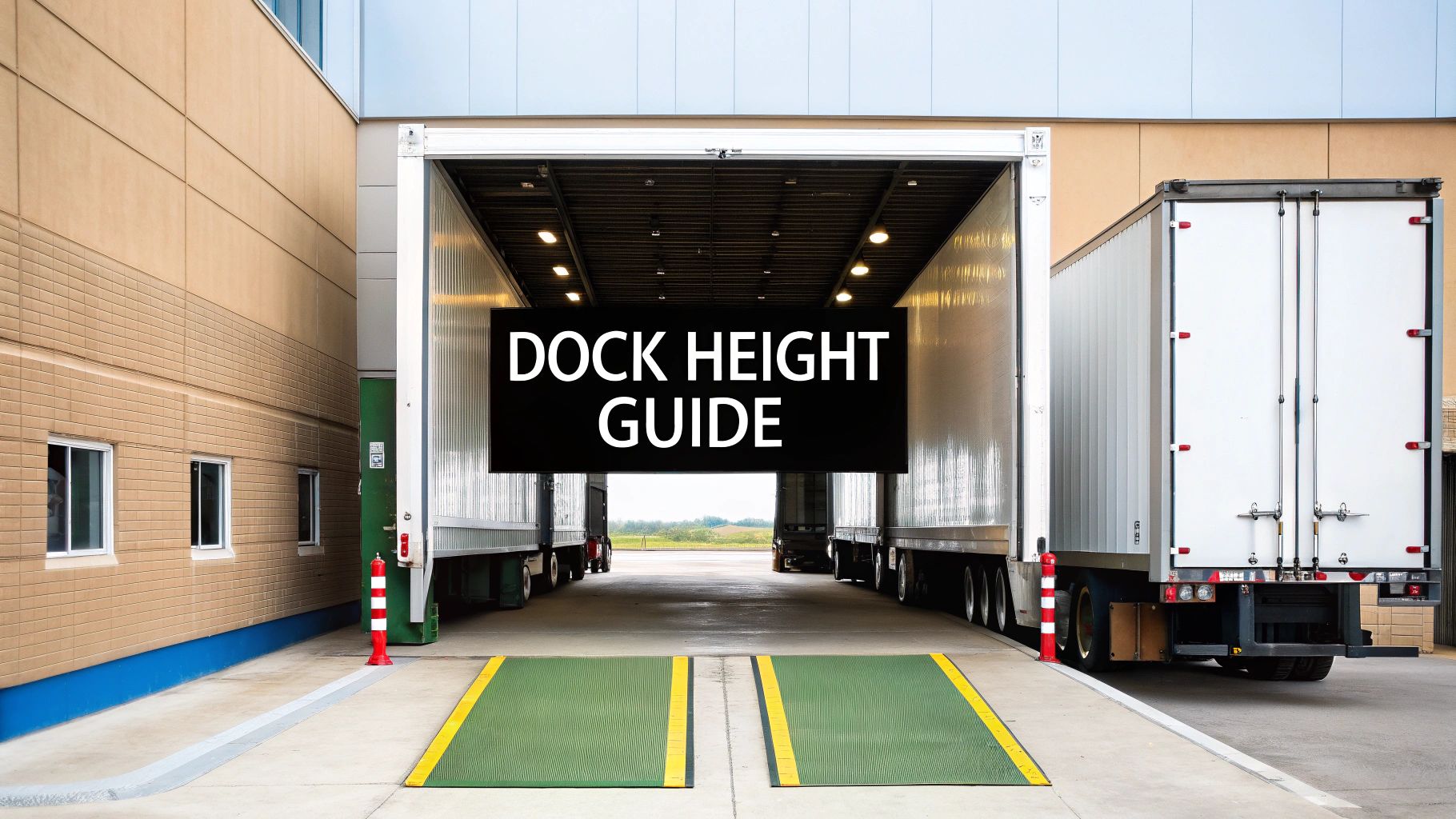

When you're designing a loading dock, one measurement stands above all others: the truck dock height. The industry standard generally falls between 48 to 52 inches, a range calculated to line up with the floor of a standard semi-trailer. This isn't just a number pulled out of a hat; it's the critical starting point for creating a safe and efficient bridge between your facility and the trucks that service it.
Why Truck Dock Height Is the Linchpin of Warehouse Operations
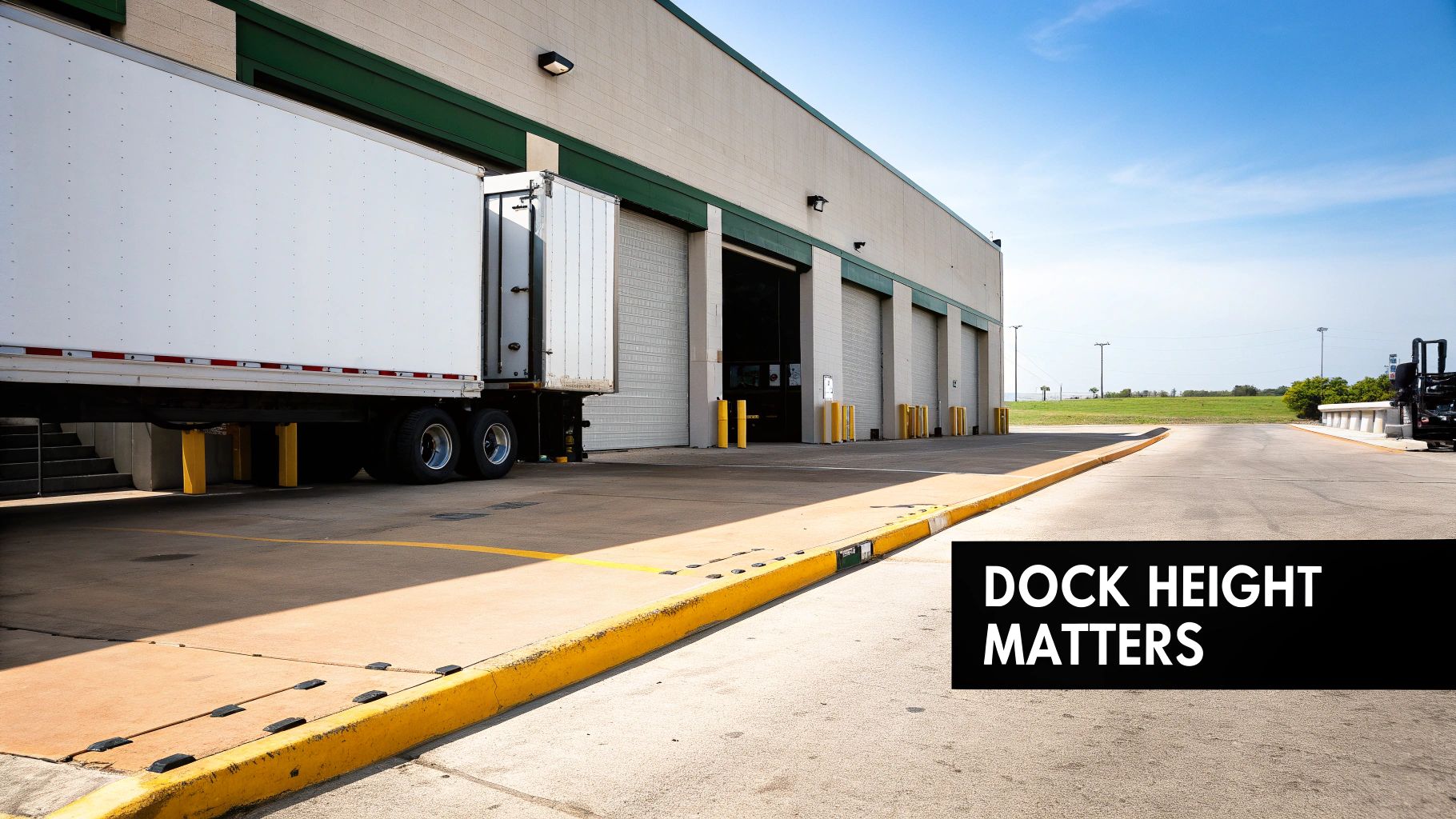
Imagine your entire supply chain is a high-performance engine. Your loading dock is the intake valve, and the dock height is the precise calibration that controls the flow. When your dock height perfectly matches the trailer bed, forklifts and pallet jacks can glide across, creating a level, safe, and incredibly efficient pathway for goods.
But get that height wrong, even by a few inches, and you introduce a steep, dangerous incline. This seemingly small slope is a huge problem. It dramatically increases the risk of accidents—from forklift tipovers to damaged products and, worst of all, serious injuries to your team. It also forces everyone to slow down, creating frustrating bottlenecks that send ripples of delay through your entire operation.
The Foundation of Speed and Safety
Getting the dock height right isn't just a matter of convenience; it’s a strategic decision that directly boosts your facility's most important performance metrics. A dock that’s properly aligned guarantees a smooth transition, which is absolutely essential for fast loading and unloading cycles. It's the first and most important step toward maximizing throughput and getting drivers back on the road faster.
Even more importantly, a level interface is fundamental to workplace safety. It completely removes the hazards of navigating up a ramp or dropping off a ledge, which are notorious causes of accidents. For any facility pushing a high volume of freight, this single dimension can make or break both profitability and operational stability.
An improperly aligned dock acts like a constant source of friction in your logistics machine. It slows down every pallet, adds wear to equipment, and introduces unnecessary risk with every single movement.
More Than Just a Number
Truly understanding dock height means looking past the tape measure. You have to appreciate how this one dimension affects every other piece of equipment and every process at your loading bay. It becomes the central reference point that influences key decisions about:
- Equipment Selection: The effectiveness of your dock levelers, seals, and vehicle restraints hinges on the initial height difference they are built to bridge.
- Operational Workflow: A well-designed dock is the cornerstone of lean processes, cutting down on wasted motion and making your labor force more productive.
- Building Integrity: Consistent, level docking prevents trailers from repeatedly crashing into the building wall, protecting your structural assets from expensive damage over the long haul.
This guide will break down how this foundational dimension shapes your warehouse's efficiency, safety, and bottom line. By mastering the principles of dock height, you can turn a simple loading bay into a high-performance logistics hub. You can find more insights on optimizing your facility in our article about modern distribution and warehousing strategies.
Understanding the Standard Truck Dock Height
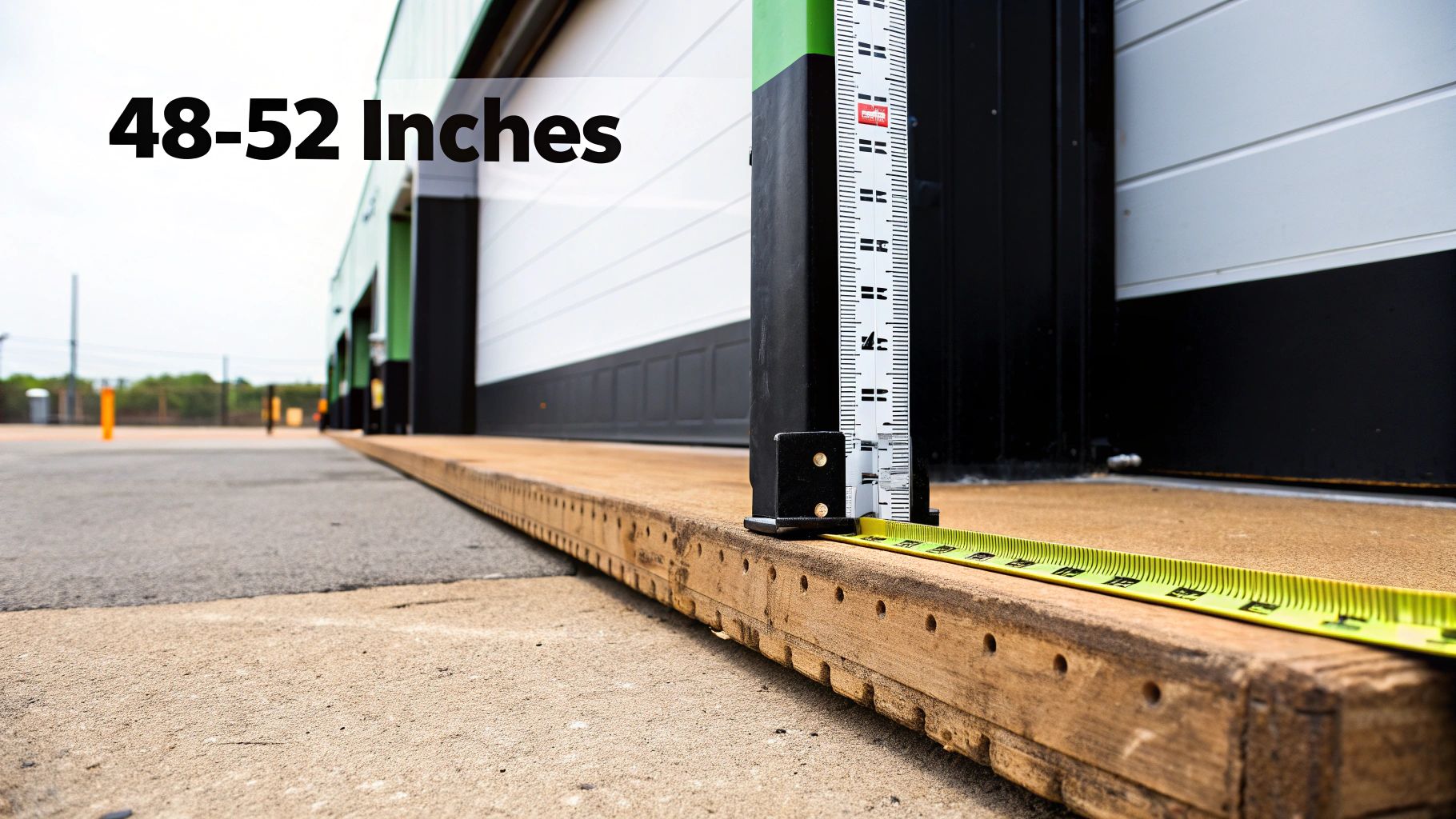
The standard truck dock height isn't just a random number; it's a critical dimension that has evolved over decades of logistical problem-solving. For nearly every modern warehouse, this sweet spot is between 48 and 52 inches, measured from the ground up to the dock floor. This measurement is the cornerstone of efficient freight movement across North America.
Think of it as a universal handshake between a building and a truck. When a trailer backs into a dock built to this standard, its floor lines up almost perfectly with the warehouse floor. This seamless alignment creates a bridge, allowing forklifts and staff to move goods in and out safely and quickly, without dealing with dangerous gaps or slopes. It’s the single most important design element for a high-functioning loading bay.
This standard didn't just happen. It was a direct response to the rise of the trucking industry after World War II. As 53-foot semi-trailers became the workhorse of American logistics, industry leaders pushed for standardization to streamline operations. By the 1960s, the 48- to 52-inch range was widely adopted, a move that reportedly slashed loading times by as much as 30% compared to older, non-standard facilities. You can find more on the history and benefits from these insights provided by industry experts.
Why Trailer Bed Height Is the Other Half of the Equation
A dock's height is pointless if it doesn't match the trucks it's meant to serve. The 48-52 inch range is king because it aligns perfectly with the bed height of the most common vehicle on the road: the standard dry van semi-trailer.
But the world of freight isn't one-size-fits-all. Different trucks are built for different jobs, and that means their trailer bed heights can vary quite a bit. A refrigerated "reefer" trailer, for example, has a thicker, insulated floor and often sits a bit higher. On the other end, a smaller straight truck used for city deliveries will have a much lower bed. That four-inch window—from 48" to 52"—is designed to provide a bit of wiggle room for these common variations.
A loading dock is a fixed asset, but the fleet it serves is variable. The key to operational success lies in creating a dock environment that can adapt to the full spectrum of vehicles your business encounters daily.
Common Truck Types and Their Bed Heights
Understanding these vehicle differences is what separates a good dock design from a great one. A distribution center that only handles long-haul semi-trailers has different requirements than a facility that also sees a mix of local delivery trucks. The goal is always to anticipate your traffic and build a dock that can handle everything you throw at it.
To put this into perspective, here is a quick reference guide that shows why the 48-52 inch standard is so versatile, yet still requires planning for outliers.
Common Truck Types and Corresponding Bed Heights
This table makes it clear why a "set it and forget it" approach doesn't work. While the 48-52 inch standard is a fantastic baseline that covers the majority of freight, true warehouse efficiency comes from equipping your dock to handle the exceptions. Without the right equipment, these height differences can create serious bottlenecks and safety hazards, completely defeating the purpose of a well-designed loading dock.
The Essential Equipment for a Versatile Loading Dock
Getting the dock height right is the foundation, but it's the specialized equipment that really makes a loading dock perform. Think of it this way: a loading dock isn't just a hole in the wall. It’s a highly engineered system where every piece of hardware works together to bridge gaps, protect your building, and keep people safe. This equipment is what turns that opening into a dynamic, flexible hub for the constant flow of truck traffic.
To run a smooth and secure operation, you have to understand what each component does. The most critical piece of this puzzle is the dock leveler—it’s the bridge that spans the inevitable gap between your dock floor and the trailer bed. Without it, even a small height difference creates a dangerous ramp for forklifts and workers.
The Dock Leveler: Your Essential Bridge
No matter how perfectly you plan, a trailer rarely sits completely flush with the dock. Suspension sags under weight, tire pressure varies, and different loads shift the balance. A dock leveler solves this problem. It's a hinged steel plate that extends from the dock's edge to the trailer floor, creating a smooth, stable path for forklifts and pallet jacks.
You’ll generally run into three main types, each built for different levels of use:
- Mechanical Levelers: These are the old-school, reliable workhorses. Powered by springs and operated manually with a chain, they’re a cost-effective choice for docks with lower traffic where simplicity is a priority.
- Hydraulic Levelers: This is what you'll find in most high-volume, demanding warehouses. Powered by hydraulic cylinders and operated with a push of a button, they can handle heavier loads and are built to last.
- Air-Powered Levelers: These use an industrial airbag to lift the platform. They're a great alternative to hydraulics, offering push-button ease with fewer moving parts and often less maintenance.
The right choice really comes down to your facility’s daily truck volume, how heavy your typical loads are, and the range of height differences you need to bridge.
Sealing the Gaps: Dock Seals and Shelters
Once a truck is parked, you’re left with a gap around the trailer opening. This is a huge problem. It lets your expensive climate-controlled air pour out, invites pests in, and allows rain or snow to disrupt your operations. Dock seals and shelters are the answer, acting as the weatherproofing for your loading bay.
A dock seal is made of thick foam compression pads. The trailer simply backs into them, creating a snug, tight seal around the top and sides. They're fantastic for maintaining temperature in food-grade facilities or any climate-sensitive environment.
A dock shelter, on the other hand, is a more rigid frame with fabric curtains that surrounds the trailer opening without actually compressing against it. This design gives you full, unobstructed access to the trailer, making shelters the go-to choice for docks that service trucks of all different shapes and sizes, or those with liftgates.
Protecting Your Investment: Dock Bumpers
The sheer force of a 40-ton truck backing into your building, even at a crawl, is staggering. Dock bumpers are the essential shock absorbers designed to take that impact, protecting both the truck and your building’s foundation from serious, expensive damage.
Without proper bumpers, every single time a truck docks, it's causing cumulative stress on your facility. They're a small investment that prevents huge structural repair bills down the road.
Bumpers are usually made from extremely tough materials, like laminated rubber from recycled tires or solid molded rubber. For really busy docks where trailers tend to scrape along the wall, steel-faced bumpers offer an extra layer of protection that drastically extends their life and saves on replacement costs. Of course, inside the dock, mobile equipment like efficient roll cage trolleys is just as vital for keeping the loading and unloading process moving smoothly.
Anchoring for Safety: Vehicle Restraints
This might just be the most important piece of safety equipment on your dock. A vehicle restraint, often called a truck lock or dock lock, physically anchors the trailer to the building. Its job is to prevent "trailer creep"—that slow, dangerous separation that can happen during loading as the forklift moves in and out. If a gap opens up, it can lead to a catastrophic forklift accident.
For any operation that takes safety seriously, vehicle restraints are non-negotiable. They typically feature a clear light system for both the dock worker inside and the truck driver outside, giving a positive signal that the trailer is locked and secure. That confirmation gives forklift operators the confidence they need to work safely, knowing their path is stable.
How to Design Your Loading Dock for Peak Performance
A loading dock isn't just a hole in the wall; it's the heart of your facility's supply chain. Getting the truck dock height right is the first step, but transforming that space into a high-performance logistics hub requires a much broader design perspective. If you overlook the details, you’ll end up with hidden bottlenecks that choke your throughput, no matter how perfect the dock height seems.
Think of it this way: a well-designed dock anticipates the entire journey of the truck, from the moment it pulls onto your property until it's back on the road. This means planning for how drivers will maneuver, accounting for subtle grades in the pavement, and building an opening that meets modern freight demands. When all these pieces work together, your loading dock becomes a serious competitive advantage.
It all starts with one simple measurement. To get your dock height, just run a tape measure from the surface of the drive approach straight up to the top of the finished dock floor. But be warned—that number is only part of the story. The environment around the dock can change everything.
The Importance of Apron Space and Drive Approach
Before a trailer can even think about backing in, the driver needs enough room to line it up. That critical area is the apron space—the open pavement directly in front of the dock. Skimp on this, and you’re asking for trouble. Drivers will be forced into awkward, multi-point turns that kill time and dramatically increase the risk of an accident. A good rule of thumb is to have an apron space that is roughly twice the length of your longest truck, plus an extra ten feet for good measure.
Just as critical is the drive approach, which is the slope of the driveway leading up to the dock. It’s often so subtle you might not notice it, but it has a huge impact.
- Declined Approach: If the driveway slopes down toward the building, the back of the trailer will sit higher than it should. Your dock is now effectively too low.
- Inclined Approach: If the driveway slopes up toward the building, the trailer bed will drop. Your dock is now effectively too high.
Even a slight grade can create a problematic height gap, forcing your dock leveler to compensate and creating a dangerously steep ramp for forklifts.
Sizing Doors for Modern Logistics
The dimensions of the dock door itself are another piece of the puzzle. Walk into an older warehouse, and you’ll likely see 8-foot wide by 8-foot tall doors. Those were fine for the smaller trailers of yesterday, but they're a liability today. Modern 53-foot trailers are wider and almost always loaded right up to the ceiling.
A wider door opening isn't a luxury; it's a necessity for efficiency. It provides a larger target for drivers, reducing docking time and minimizing the risk of a trailer striking the building wall.
That's why modern facilities have standardized on 9-foot wide by 10-foot tall doors. The extra foot of width makes it far easier for drivers to center the trailer, which prevents costly damage to the dock seals and the building itself. The added height accommodates today’s taller trailers, ensuring cargo doesn’t get snagged on the door frame during loading and unloading. Seeing how these individual design choices fit into a bigger picture is a key part of effective warehouse layout and design.
Getting these details right has massive economic implications. By standardizing a dock with a 48-52 inch height and 9-foot wide doors, a facility directly supports the efficiency of the multi-trillion-dollar U.S. trucking industry. For example, some data shows that 9-foot doors can boost pallet loading efficiency by as much as 25% over older 8-foot doors. The costs of getting it wrong are just as stark; one study found that facilities with non-standard docks rack up 18% higher labor costs.
Navigating Critical Dock Safety and Compliance Standards
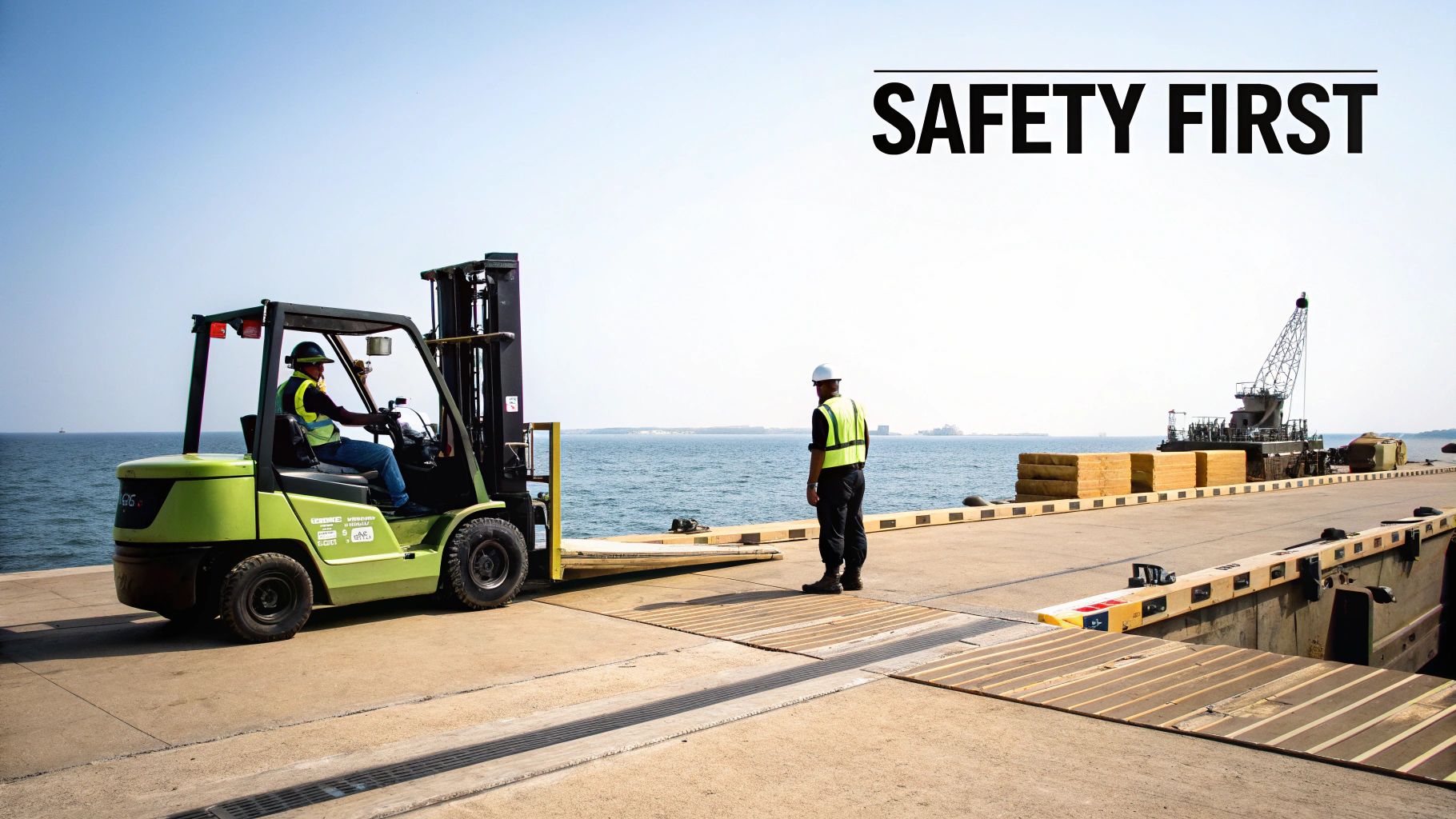
When it comes to the loading dock, there's practically zero room for error. Think of a properly set truck dock height as your first and most important line of defense against serious accidents. That gap between the dock and the trailer? It's easily one of the most dangerous spots in any warehouse or factory. Even a small height mismatch creates a hazardous slope, turning the simple task of moving a pallet into a high-risk gamble.
This is where the rubber meets the road for both safety and regulatory compliance. A poorly designed dock isn't just inefficient—it's a blatant disregard for the safe working environment mandated by the Occupational Safety and Health Administration (OSHA). The stakes are incredibly high, with risks ranging from damaged goods all the way to life-altering injuries for your team.
Identifying Major Loading Dock Hazards
Most of the dangers lurking at the loading dock stem directly from the instability caused by gaps, uneven slopes, and unexpected trailer movement. These aren't just theoretical problems; they are real-world incidents that carry massive financial and human costs. Getting a handle on these specific risks is the first step toward creating a safety culture that actually works.
Three of the most critical hazards to watch out for are:
- Forklift Rollovers: When an operator has to drive a forklift up or down a steep ramp created by a mismatched dock height, the machine's center of gravity shifts dangerously. This instability, especially with a heavy load, can easily lead to a tip-over.
- Trailer Creep: As a forklift moves in and out of a trailer, the repeated jolts of momentum can cause the trailer to slowly inch away from the dock. This widening gap is a disaster waiting to happen, creating a void a forklift can fall into.
- Worker Injuries: Trying to maneuver pallet jacks or even just walk across uneven surfaces puts a huge amount of strain on the body. Trips, falls, and musculoskeletal injuries become common when your team has to constantly fight against a gap or a slope.
The Role of OSHA and Industry Standards
You won't find a specific truck dock height mandated by OSHA. However, their General Duty Clause is crystal clear: employers must provide a workplace free from known hazards. A poorly configured dock that allows for trailer creep or creates dangerous inclines is a direct violation of that principle.
Proper truck dock heights are fundamental to warehouse safety. Across the U.S., with its over 1.2 million loading docks, height mismatches are a significant contributor to the thousands of dock-related injuries reported each year. For more context, you can explore additional insights on dock height safety standards to see just how critical this is.
A safe dock is a compliant dock. The goal is simple: create a stable, level bridge between your building and the truck, eliminating any possibility of unexpected movement or gaps.
This reality makes robust safety equipment non-negotiable. Vehicle restraints, for example, are the single most effective way to prevent trailer creep by physically locking the trailer to the building. Just as important is the diligent maintenance of your dock levelers to ensure they provide a smooth, reliable transition every single time.
Ultimately, a proactive safety culture—built on the right equipment and regular, thorough inspections—is the foundation of a compliant and secure operation. Addressing these risks isn't just about avoiding OSHA fines; it's about protecting your people and your business from disasters that are entirely preventable.
Strategies for Retrofitting and Optimizing Existing Docks
What do you do when your facility is stuck with a loading dock from a bygone era? It’s a common problem. Many older buildings were built with a one-size-fits-all dock height that just doesn’t work for the wide variety of trucks on the road today. The good news is you can fix these limitations without tearing everything down and starting over.
The single most effective tool for this job is a modern dock leveler. Swapping out an old, fixed plate for a new hydraulic or air-powered leveler can radically increase the range of trucks you can service. These systems act like an adjustable bridge, easily closing the gap between the dock and trailers of all kinds, from low-slung city delivery trucks to towering refrigerated units.
Introducing Flexible and Mobile Solutions
Sometimes, a permanent installation just isn't in the cards. That’s where more flexible, mobile solutions really shine. A portable loading dock or a mobile yard ramp can be a total game-changer, especially for buildings that only have ground-level doors or need to add extra loading spots on the fly.
Think of these ramps as long, gradual slopes that give your forklifts a runway to drive right from the ground into the back of a trailer. They bring incredible versatility to the table:
- Adaptability: You can move them wherever you need them as your operational flow changes.
- Cost-Effectiveness: They give you a fully functional loading dock for a fraction of what new construction would cost.
- Immediate Impact: You can put them to work almost immediately to clear up bottlenecks without suffering through major downtime.
An outdated dock isn't a permanent roadblock; it's an opportunity for strategic optimization. By leveraging modern equipment, you can transform a logistical challenge into a high-efficiency asset.
Strategic Adjustments for Lasting Improvement
Beyond just adding new equipment, you can make some smart physical changes to the dock area itself. For instance, if your dock is consistently too high for most trailers, a common fix is to re-grade the truck approach. By creating a slight incline in the pavement leading up to the dock, you effectively lower the trailer’s final resting position, shrinking that problematic height gap.
It's also worth looking up. Older facilities can often find a ton of untapped potential by making better use of their vertical space. Smart storage solutions, like those outlined in guides to mezzanine floor plans, help you optimize your whole warehouse, taking pressure off the dock area.
Of course, none of these strategies mean much if the equipment isn't reliable. That’s why a solid maintenance plan is non-negotiable. Using an Equipment Preventative Maintenance Checklist as part of your optimization project is critical. Regular checks on your levelers, restraints, and bumpers ensure everything works safely and efficiently, protecting both your investment and your people.
Common Questions About Truck Dock Height
Even when you have a good handle on dock design theory, the real world always throws a few curveballs. Let's tackle some of the most common questions that pop up for facility managers and logistics pros when they're trying to put these concepts into practice.
What Should I Do If My Dock Is Too High or Too Low?
A constant height mismatch isn't just a minor annoyance—it's a daily drain on your efficiency and a real safety risk. The best fix for most situations is to install a dock leveler with an extended service range. Think of it as a heavy-duty bridge that can handle a much wider gap between the dock and the trailer, giving your forklifts a safe, stable path.
For more severe height differences, you might need a more permanent solution, like retrofitting the dock to create a recessed leveler pit. If you can't commit to construction, a portable yard ramp is a great, flexible option that can close major height gaps without tearing up concrete.
Do International Dock Height Standards Differ?
Yes, absolutely. While North America has settled on a standard of roughly 48-52 inches, the rest of the world plays by different rules. In Europe, for instance, you'll find docks are typically built to 1.2 meters (that's about 47.2 inches), a height that lines up with their specific truck fleets.
And if you're dealing with international shipping containers on chassis, you'll often need docks that are even higher, sometimes in the 52-54 inch range. These global variations are exactly why adaptable equipment is no longer a luxury but a necessity for any facility that's part of an international supply chain.
Global logistics is a language of millimeters and inches. A dock that can't 'speak' multiple heights will inevitably create costly translation errors in the form of delays and damage.
How Does a Sloped Driveway Affect My Dock Height?
The slope of your driveway—what we call the "drive approach"—has a massive, and often overlooked, impact on your effective dock height. It’s simple physics.
- A downward slope toward the dock will push the back of the trailer up, making your dock feel lower than it actually is.
- An upward slope will cause the back of the trailer to drop, making your dock functionally higher.
This has to be accounted for in the initial design. A steep, uncompensated slope can turn a perfectly measured dock into a dangerous and inefficient bottleneck, forcing your forklifts to navigate risky inclines.
What Is the Difference Between a Dock Seal and a Dock Shelter?
Both create a barrier between your warehouse and the outside world, but they go about it in different ways.
A dock seal uses big foam pads that the trailer literally compresses into when it backs in. This creates an incredibly tight seal, which is perfect for climate-controlled environments where you can't afford to lose hot or cold air.
A dock shelter, on the other hand, is more like a rigid awning with curtains that surrounds the trailer opening. This design provides full, unimpeded access to the inside of the trailer. Shelters tend to be more durable and are better at accommodating a wider variety of truck sizes, while seals are the champions of insulation for temperature-sensitive goods.
At Wolverine Assemblies, LLC, we know that a well-designed loading dock is the first link in a strong supply chain. Our complete 3PL, warehousing, and light manufacturing services are built on a foundation of operational excellence, ensuring your components get from the dock to the assembly line safely and without a hitch. We help leaders in the automotive, industrial, and energy sectors de-risk their programs and boost throughput with precision logistics. Find out how our expertise can bring stability to your supply chain by visiting https://www.wolverine-llc.com.
Subscribe to our weekly newsletter