.png)
Security in Warehouse: Essential Guide to Protecting Assets and Operations
Discover a practical security in warehouse framework to defend assets and operations from physical, cyber, and internal threats.
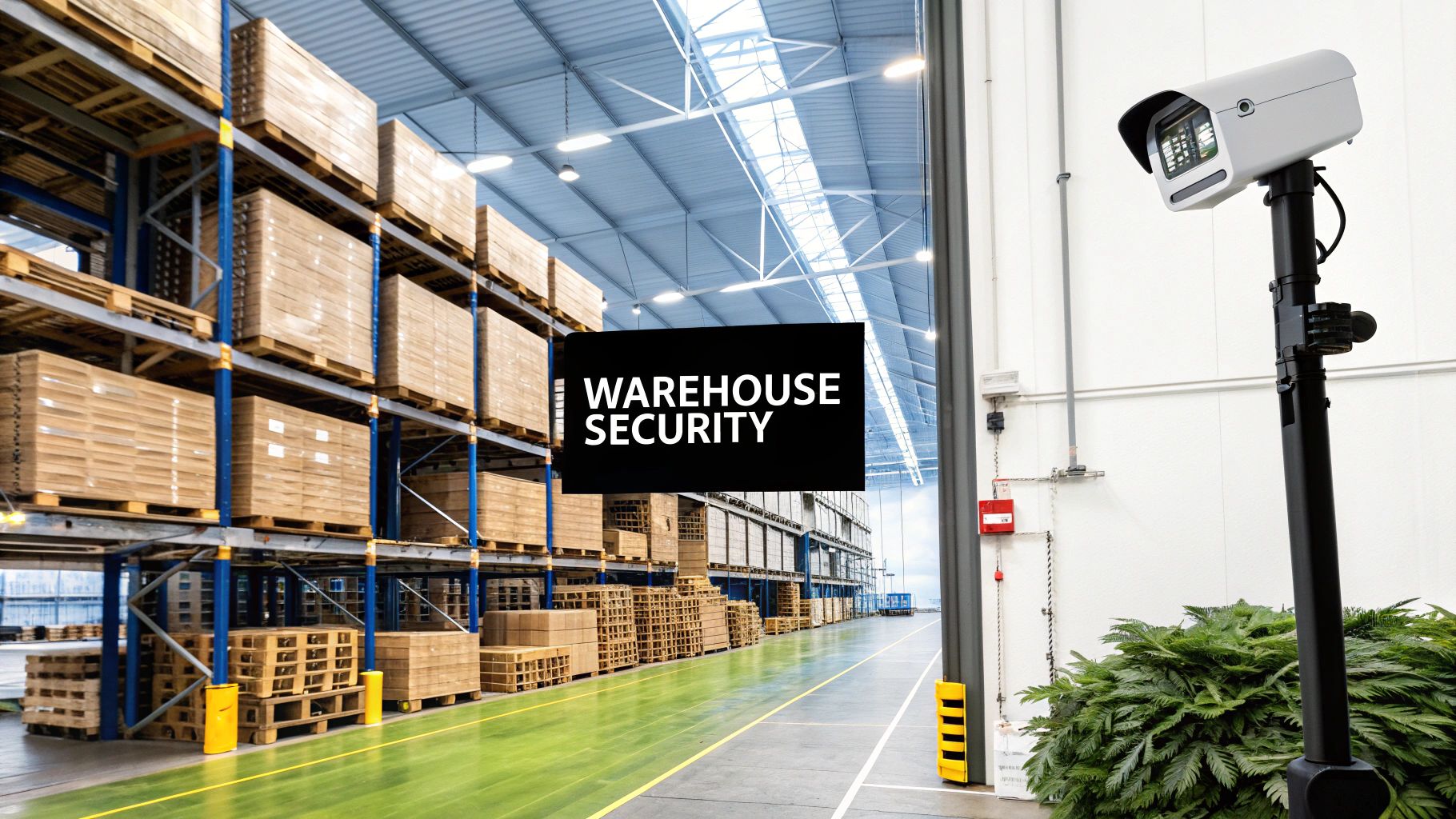

When you think about warehouse security, what comes to mind? For most, it's still a picture of tall fences, a few cameras, and maybe a night guard doing rounds. That image is dangerously out of date.
Today's warehouses aren't just storage buildings; they're bustling hubs of commerce where physical goods are managed by a constant stream of digital information. This mix of physical and digital operations has created a whole new set of threats that demand a much smarter, more integrated approach to security.
Why Warehouse Security Is More Than Just Locks and Alarms
Imagine a bank with a vault made of reinforced steel, but they leave their public Wi-Fi completely unsecured. The cash might be safe, but a hacker could still walk away with customer data, account numbers, and transaction records. Without ever touching the vault door, they've stolen something just as valuable.
That's the risk in a modern warehouse. Protecting your physical inventory is only half the battle. If you don't secure the information that manages it, you're leaving the digital back door wide open. Real security in a warehouse is about protecting both your products and the data that makes your operation run.
The Evolving Threat Landscape
The threats we face have moved far beyond simple break-ins. While theft is still a problem, the biggest risks now often start online and have a massive physical impact. Cybercriminals have realized that the logistics and transportation sectors are prime targets—disrupting a supply chain is incredibly profitable.
This isn't just a theory. A 2025 threat analysis found that the Transportation and Warehousing sector was the target in over 64% of data theft incidents. This led to the exposure of more than 2.28 million credentials and thousands of payment cards tied directly to logistics operations. Ransomware is another huge issue, with one study showing Truck Transportation was the single most targeted sub-sector. You can see the full breakdown in the global logistics and transportation threat landscape report for 2025.
A cyberattack on your Warehouse Management System (WMS) or ERP can be just as devastating as a fire. It can halt shipments, corrupt your inventory data, and bring your entire operation to a grinding halt.
An Integrated Security Philosophy
A solid security strategy recognizes that everything in your facility is connected. You can’t just focus on one area and ignore the others. A truly resilient defense is built on three pillars that support each other:
- Physical Security: This is your first line of defense—perimeter controls, access management, and surveillance that stop unauthorized entry and theft.
- Cybersecurity: This is about protecting your digital backbone—the WMS, ERP, network infrastructure, and all connected devices from data breaches and ransomware.
- Procedural Security: This covers the human element—everything from employee training and background checks to inventory control protocols that close loopholes people can exploit.
Ultimately, securing a modern warehouse means creating a unified plan where your physical, digital, and procedural controls work together. It’s the only way to build a defense strong enough for the full spectrum of today’s threats.
Building Your Physical Fortress From the Outside In
Good warehouse security isn’t just one big wall; it’s a series of smart, overlapping layers. Think of it like a castle—you’ve got the outer walls, a gatehouse, and finally, the heavily guarded keep where the real valuables are. Each layer is designed to slow down, detect, and deter anyone who isn't supposed to be there.
This "concentric ring" approach turns a bunch of standalone gadgets into a coordinated defense system. An alert at the fence line can automatically trigger cameras and lock down doors inside. It’s about making your security proactive, not just reactive.
This diagram shows how a solid strategy covers two critical fronts—the physical and the digital—which have to work hand-in-hand.
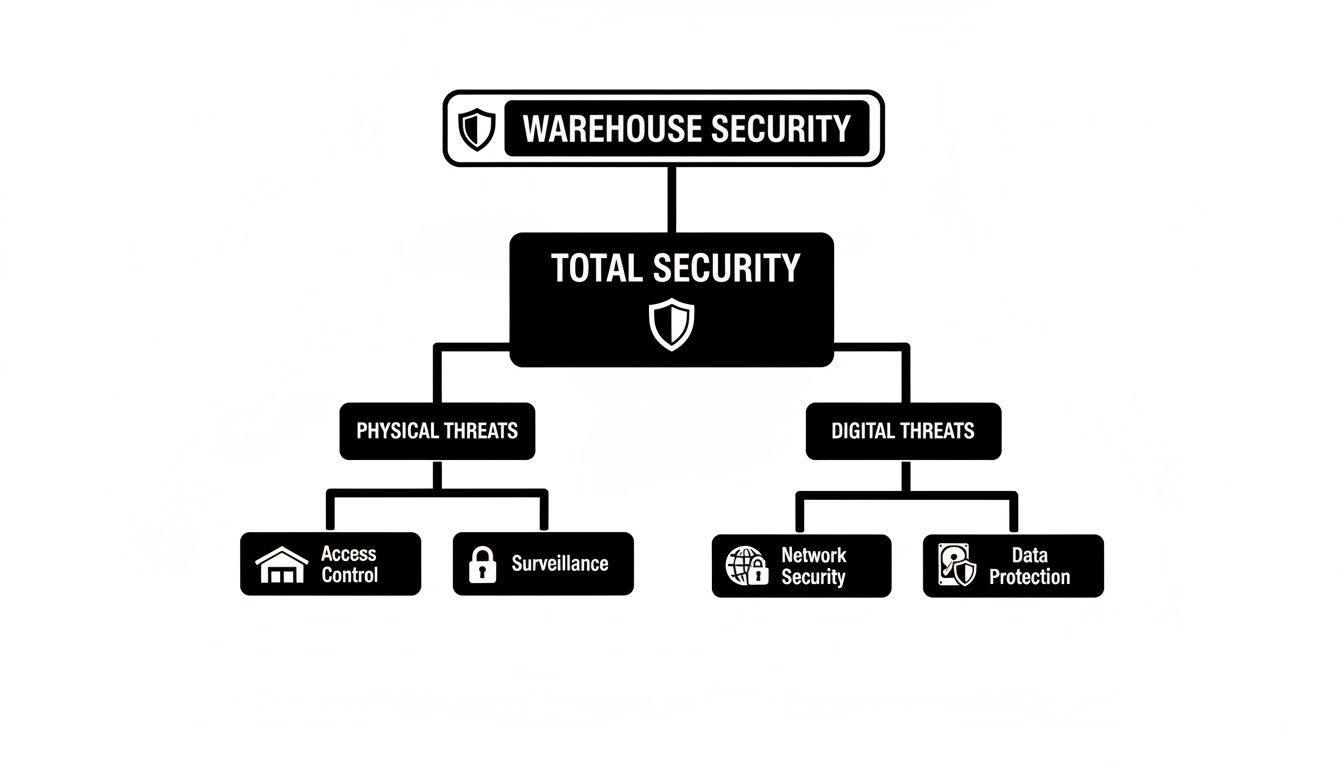
A weakness on one side can easily expose the other. That’s why you can’t have strong physical security without locking down your digital systems, and vice versa.
The First Line of Defense: The Perimeter
Your security starts at your property line, long before anyone gets near a door. A weak perimeter basically puts up a "help yourself" sign for thieves, signaling that your facility is an easy target.
Modern perimeter security is more than a chain-link fence. It’s an active system.
- Intelligent Fencing: Today’s fences can be equipped with sensors that detect climbing or cutting, instantly triggering alarms and pointing cameras right at the breach.
- Strategic Lighting: A well-lit yard is a huge deterrent. Motion-activated LED lights can blast dark corners with light, startling intruders and giving your cameras a crystal-clear shot.
- Automated Gate Control: Tying your gates into the WMS lets you automate entry for scheduled deliveries. This cuts down on bottlenecks and stops unauthorized vehicles from just rolling in.
How you lay out these elements matters. For a deeper dive into how a facility’s footprint impacts security, check out our guide on strategic warehouse layout and design.
To organize these concepts, here’s a quick breakdown of how each physical security layer functions.
Core Physical Security Layers and Technologies
These layers build on each other to create a comprehensive defense, ensuring that even if one layer is bypassed, others are in place to stop a threat.
Controlling Access at Every Entry Point
Once someone is on your property, the next job is to control who gets inside the building and where they can go. This is fundamental for stopping both external theft and internal pilfering.
By assigning specific permissions, you ensure that only authorized people can access sensitive areas, inventory, or data. This granular control is a cornerstone of modern loss prevention.
Good access control is a mix of tech and tough protocols. The goal is a smooth process for your team but a hard stop for everyone else.
- Keycard and Biometric Systems: These don't just open doors; they create a digital log of every single entry and exit. Biometrics are even better—you can’t lose or "loan" a fingerprint.
- Visitor Management Protocols: Every visitor, contractor, and driver needs to be checked in. That means verifying their ID, issuing a temporary badge with limited access, and escorting them in sensitive zones.
- Dock Door Discipline: Loading docks are chaotic and high-risk. Your policy should be simple: dock doors stay closed and locked unless a truck is actively being loaded or unloaded.
Interior Surveillance and High-Value Zones
The final layers work inside the warehouse. This is where you watch over daily operations and put extra protection around your most valuable assets. It’s how you spot suspicious behavior and investigate incidents.
Modern cameras do more than just record. AI-powered systems can now spot someone lingering in a restricted area after hours and send an immediate alert. You need 100% coverage of aisles, staging areas, and docks—no blind spots.
For high-value goods like electronics or pharmaceuticals, a dedicated secure zone is a must. This could be a locked cage or a separate room with its own access control, maybe even requiring two people to enter. This "keep within the castle" approach isolates your most critical inventory so it stays safe, even if other defenses fail.
Defending Your Digital Warehouse and Connected Systems
Physical security is only half the battle. Your warehouse's digital backbone—the Warehouse Management System (WMS), ERP software, and connected machinery—is the nervous system of your entire operation. An attack here can be just as paralyzing as a physical break-in, grinding your logistics to a dead stop.
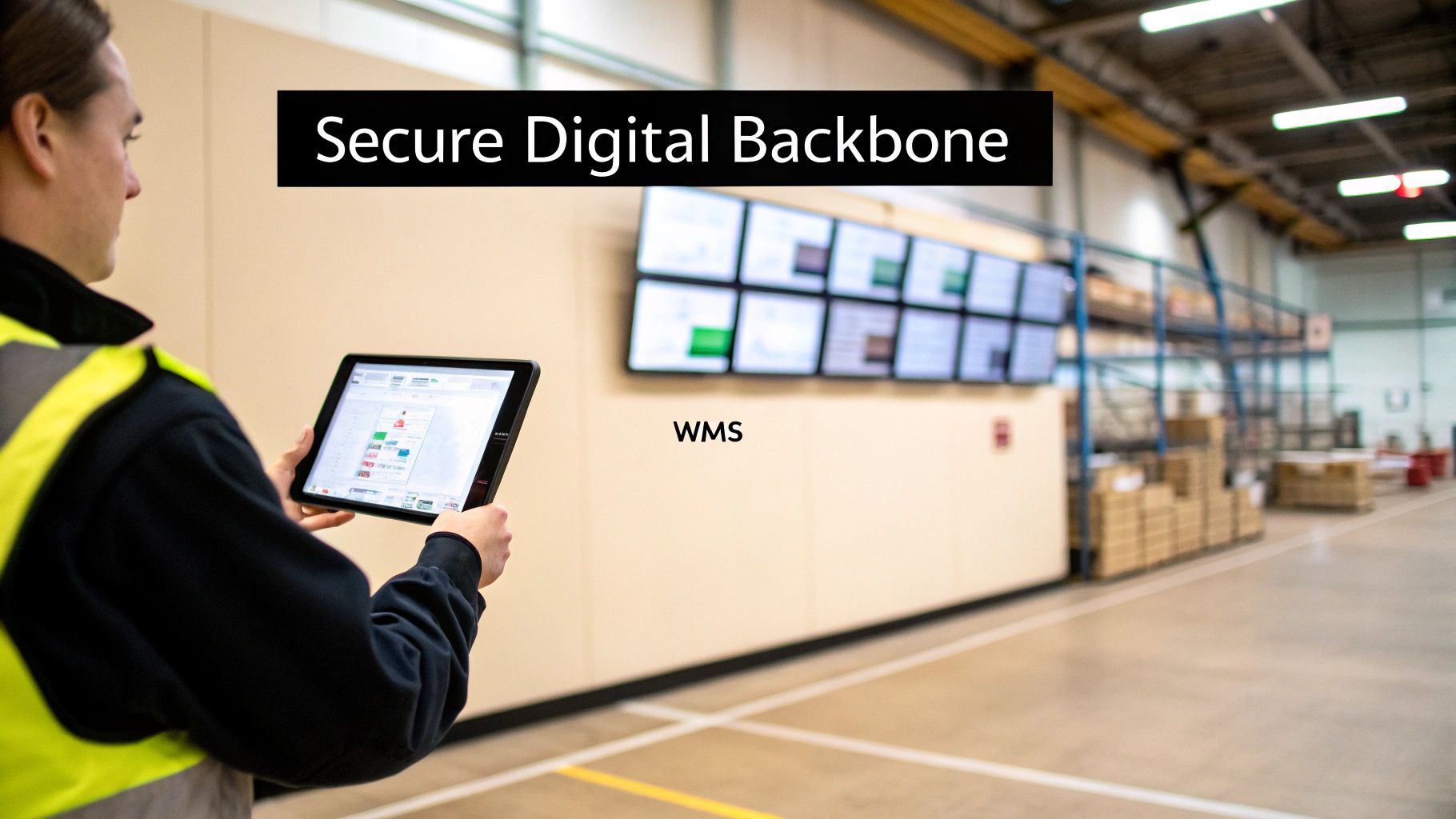
Think of your network as an unseen conveyor belt, moving critical data instead of boxes. One single weak link, like a convincing phishing email opened by an employee, can give an attacker the keys to the kingdom. Suddenly, they're viewing sensitive shipping manifests, altering inventory counts, or deploying ransomware that locks you out of your own building.
Understanding Your Digital Vulnerabilities
The modern warehouse is a hive of interconnected devices. You've got handheld scanners, IoT sensors on conveyor belts, and servers running your core software. Every one of those connections is a potential doorway for attackers if it isn't locked down. This connectivity gives you incredible efficiency, but it also creates a much larger surface area to defend.
The threats are very real and getting more sophisticated by the day. It's crucial to stay informed about things like the rising threat of infostealer malware. This isn't some abstract threat; this type of malware is designed to steal credentials and give criminals a direct line into your most important systems.
A compromised WMS isn't just a data breach; it's an operational catastrophe. Attackers can manipulate inventory to hide theft, misdirect shipments, or just shut down your ability to fulfill orders. The cost isn't just in lost revenue—it's in lost customer trust.
A Practical Cybersecurity Playbook
Securing your digital warehouse doesn’t mean you need an army of IT gurus. It just demands a disciplined, layered approach. The goal is simple: make it as difficult as possible for anyone to get in who shouldn't be there.
Here are the essential strategies every warehouse should have in place:
- Network Segmentation: Don't put everything on one giant, flat network. Isolate your critical operational tech (like the PLCs running your automated lines) from your corporate IT network. That way, a malware infection on a front-office computer can't jump over and shut down your conveyors.
- Strong Access Controls: This is the principle of least privilege. Every user should only have access to the systems and data they absolutely need to do their job—and nothing more. Use role-based permissions in your WMS and ERP to keep a shipping clerk out of financial data or prevent a temp worker from changing system settings.
- Multi-Factor Authentication (MFA): Passwords just aren't enough anymore. Requiring a second step for verification, like a code sent to a phone, is one of the single most effective ways to block an attack. Even if a password gets stolen, MFA stops the intruder in their tracks.
The Human Firewall: Your First Line of Defense
Technology is a fantastic tool, but at the end of the day, your employees are the true gatekeepers of your digital security. The vast majority of cyberattacks start with a simple human error, like clicking a bad link or using a weak password.
This makes ongoing security training a non-negotiable. Your team needs to know how to spot a phishing email, why they can't use "Password123" for their login, and exactly who to call the moment they see something suspicious. When your people are vigilant, a WMS becomes the powerful tool it's meant to be. You can learn more about warehouse management system benefits and how they function in a secure environment.
Ultimately, strong security in a warehouse is a blend of physical barriers, smart digital defenses, and—most importantly—a well-trained team. When you protect your data with the same seriousness you protect your physical inventory, you build a resilient operation that's ready for anything.
Mastering Inventory Control And Preventing Internal Theft
While we spend a lot of time worrying about threats from outside the warehouse walls, one of the biggest risks to your inventory often comes from within. Human error can lead to misplaced parts and bad counts, but intentional internal theft is a quiet, persistent, and incredibly costly problem.
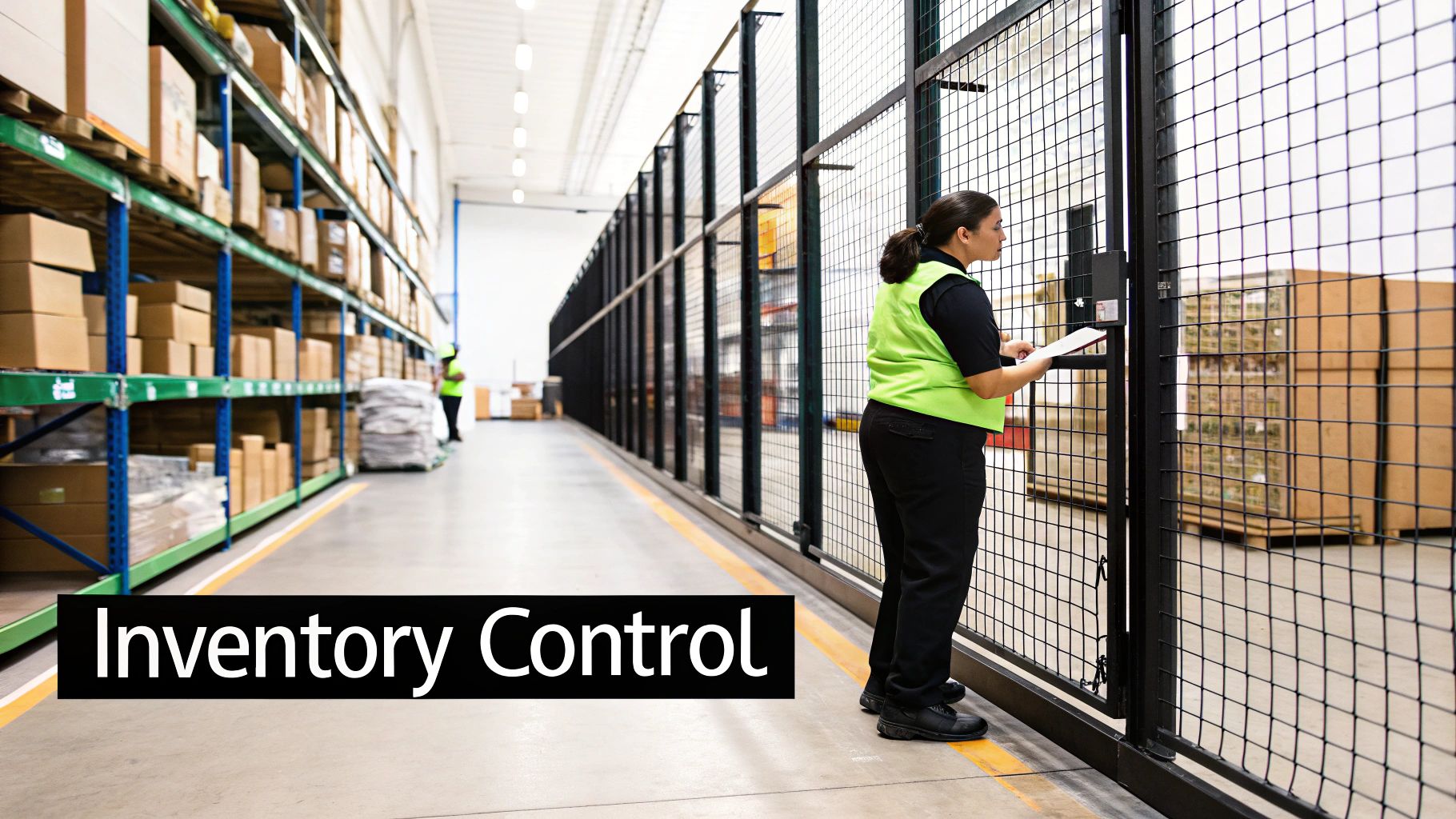
Mastering inventory control is all about building a system of checks and balances. The goal is to make it extremely difficult for products to simply disappear, whether it's by accident or by design. This isn't just about doing a big annual count; it's about creating transparency and accountability from the moment a truck arrives until a finished product ships out.
Process Controls That Drive Accuracy
Relying on your team to "be careful" is not a strategy. You have to design workflows that automatically cut down the opportunities for mistakes and theft. These process-driven controls are the bedrock of solid inventory security.
- Blind Receiving: When your team unloads a shipment, they shouldn't see the purchase order quantity. Instead, they count what they actually receive. Later, that number is compared to the PO. This simple step eliminates confirmation bias and forces a true, honest count right from the start.
- Systematic Cycle Counting: Forget the chaos of a massive, once-a-year inventory shutdown. Cycle counting means counting small, manageable sections of your warehouse on a rolling schedule. This practice constantly verifies your stock, catches errors fast, and helps you find the root cause of a problem without halting your entire operation.
These methods turn inventory from a reactive headache into a proactive, daily discipline. It's also a crucial piece of building effective stock and replenishment strategies that keep your lines running.
Leveraging Data To Uncover Red Flags
Your Warehouse Management System (WMS) is more than just a digital ledger—it's one of your best security tools. The data it tracks can reveal patterns of behavior that are otherwise invisible.
Your data tells a story. Look for things like unusual inventory adjustments, a spike in "damaged" product write-offs all coming from one shift, or access logs showing an employee in a high-value cage outside their normal hours. These are the red flags that demand a closer look.
By setting up automated alerts for certain triggers—like an inventory adjustment over a specific dollar amount—you can catch potential issues in real-time instead of weeks later.
The Human Element Of Internal Theft Prevention
Processes and technology are critical, but they fall apart without focusing on your people. A huge percentage of warehouse losses trace back to employee-related risks. Building robust theft protection strategies that deter bad behavior is non-negotiable.
The numbers back this up. The warehousing and transportation sector reported an injury and illness rate of 4.8 cases per 100 full-time workers in 2022. That's nearly double the private-industry average of 2.7 per 100. High-risk environments often create vulnerabilities that extend beyond safety to security.
To get ahead of these human-centric risks, you need a plan.
- Thorough Pre-Employment Screening: Run comprehensive background checks on all potential hires, especially for roles with access to high-value goods or sensitive systems. It’s a simple but vital first line of defense.
- Clear Security Policies: Your employee handbook needs to spell out your policies on theft, proper inventory handling, and exactly what happens when those rules are broken. Make sure every single employee signs off on it.
- Building a Security-Aware Culture: Security can't just be a management concern. Through ongoing training and clear communication, you can create an environment where everyone feels responsible for protecting company assets. When your team understands why the rules exist, they're far more likely to help enforce them.
Managing Security Risks from Vendors and Contractors
Your warehouse is only as secure as its weakest link. Too often, that vulnerability isn't an employee—it's a third party. Every time a maintenance crew, temp worker, or 3PL driver walks through your door, they introduce a new set of potential risks. Without a solid plan, these partners can accidentally become your biggest security liability.
This isn't just a hypothetical problem. Security gaps with suppliers and third-party vendors are a massive driver of breaches in the logistics world. A 2025 global report found that North America was home to about 53% of all recorded third-party incidents, with a regional breach rate hitting nearly 32%. That data makes it clear: relying on outside partners creates real, measurable risk. You can dig into the numbers yourself by reviewing the findings on third-party breach risks.
The only way to manage this is to extend your security standards to everyone, treating non-employees with the same rigor you apply to your own team.
Implementing Tiered Access Controls
Not every contractor needs the keys to the kingdom. A technician servicing your HVAC system has no business being near your high-value inventory cage. A temp hired for a one-day project shouldn't have a badge that works for a week. The answer is tiered access control—a system that grants access based strictly on need.
This means creating specific access profiles for different types of vendors and contractors.
- Role-Based Permissions: Program keycards and fobs to only open doors relevant to their specific job. No more, no less.
- Time-Limited Access: Set credentials to automatically expire at the end of a shift or the conclusion of a contract.
- Geofenced Zones: Block off access to sensitive areas like the IT server room or specific assembly lines to stop unauthorized wandering.
This granular approach ensures vendors have exactly the access they need to do their job—and absolutely nothing more.
Think of it like giving a guest a key that only opens their hotel room, not the manager's office. It's a simple, effective way to contain risk without getting in their way.
Mandating Security Briefings and Protocols
Never assume contractors know your rules. Before any third party starts work, they need to go through a mandatory security briefing. This isn't a long, drawn-out training session; it's a clear, quick overview of your non-negotiables.
This briefing should hammer home the critical policies:
- Visitor Identification: All contractors must wear clearly visible ID badges at all times.
- Escort Requirements: In high-security areas, vendors must be escorted by a full-time employee. No exceptions.
- Prohibited Items: Be explicit about rules regarding personal phones, cameras, or outside tools in restricted zones.
- Incident Reporting: Show them exactly how to report a security concern, accident, or anything suspicious they might see.
By making this briefing a prerequisite for site access, you establish a baseline of security awareness for every single person who steps into your facility.
Writing Security into Your Contracts
At the end of the day, the most effective way to guarantee partner compliance is to make security a contractual obligation. Your service level agreements (SLAs) and vendor contracts must spell out your security expectations and what happens if they aren't met.
Your contracts should include clauses that require vendors to run background checks on their staff who will be on your site. They should also detail cybersecurity requirements if their systems connect to yours, like following your data protection rules. This legal framework turns your security guidelines from suggestions into enforceable requirements, making your partners a seamless part of your overall security in warehouse strategy.
Time to Build Your Warehouse Security Action Plan
Knowing the threats is one thing. Doing something about it is everything. A real security plan is what turns that knowledge into a hard defense for your facility. It's the blueprint that takes you from theory to action, giving you a clear roadmap to lock down your warehouse and protect your bottom line.
Think of it less as a one-and-done project and more like a continuous quality control loop for your security program. The goal is to build a system that adapts right alongside your operations and the threats that come with them.
Step 1: Start with a Real-World Risk Assessment
You can't build the right defenses until you know exactly what you're defending against. A hands-on risk assessment is ground zero. It’s where you identify your most critical vulnerabilities across your physical space, your digital systems, and your day-to-day processes.
This isn’t a theoretical exercise. You need to pinpoint specific weak spots.
- Walk the Floor: Get out there and check every single entry point, from the dock doors to the employee entrance. Look for camera blind spots, poorly lit corners of the perimeter, and any door that isn't tightly controlled.
- Audit Your Digital Access: Dig into your WMS and ERP user permissions. Who has admin rights? Are old employee accounts still active? Is multi-factor authentication turned on for every critical system? It better be.
- Map Your Processes: Follow your inventory from the moment it hits receiving to the second it ships out. Where are the handoffs? Are there chances for someone to fudge numbers with blind receiving or unverified inventory adjustments?
Step 2: Put Your Security Policies in Writing
Once you know the risks, you need to write down the rules. Formal, documented policies eliminate guesswork and create a single, consistent standard for how everyone operates. This policy manual shouldn't just collect dust on a shelf; it needs to be a living document that every single employee can access easily.
A security policy isn't just a rulebook—it's how you build a culture of accountability. When the expectations are crystal clear and enforced consistently, security stops being one person's job and starts being everyone's responsibility.
Step 3: Create a Training and Audit Rhythm
Policies are pointless if your team doesn't know them or, worse, doesn't follow them. You need a regular cycle of training and auditing to make sure the plan actually works in the real world. Schedule quick security briefings for all staff and run unannounced spot-checks on key procedures, like visitor sign-ins or the end-of-shift lock-up routine.
Finally, you have to measure what matters. Key Performance Indicators (KPIs) are how you prove the value of your security spend.
- Inventory Shrinkage Rate: This is the ultimate scorecard for inventory loss.
- Security Incident Response Time: How fast does your team spot and stop a breach?
- Access Control Violations: How many unauthorized attempts are your systems catching?
Tracking these numbers proves your action plan is delivering real results and gives you the hard data you need to justify future security investments.
Answers to Common Warehouse Security Questions
Even with a solid plan, upgrading your warehouse security can bring up some tough, practical questions. Let's tackle the most common concerns managers run into, so you can justify your strategy and get it right the first time.
Where Should I Start If Our Budget Is Limited?
A tight budget doesn't sideline security. It just means you have to be smarter about it. The key is to find the moves that deliver the biggest impact for the lowest cost.
Start with a real-world risk assessment to see where you're truly vulnerable. You'll often find that your biggest wins aren't about expensive tech—they're about process.
- Strengthen Access Protocols: Get serious about sign-in/sign-out logs for every single visitor and contractor. No exceptions.
- Improve Inventory Processes: Start using blind receiving and a disciplined cycle counting program. This builds accountability and tightens up accuracy overnight.
- Boost Security Awareness: Run mandatory training for every employee on how to spot and report anything that looks out of place.
By fixing your highest-impact risks first, you build a strong foundation before you ever spend a dime on new hardware. It ensures every dollar goes exactly where it needs to.
How Do I Balance Security With Operational Speed?
There’s a common myth that good security has to slow you down. The opposite is true. A well-designed security system should actually make your workflows faster and more efficient, not create bottlenecks.
Think about an automated gate system that recognizes pre-approved trucks. It gets them in the yard faster while keeping unauthorized vehicles out. Or consider role-based access in your WMS, which only shows employees the info they need, cutting down on screen clutter and the risk of errors.
The goal is to weave security so deeply into your daily operations that it becomes an invisible, supportive layer—not another hurdle for your team to jump over. It should help everyone work smarter and safer.
What Is The Biggest Security Mistake Warehouses Make?
The single most common—and most expensive—mistake is tunnel vision. Too many facilities pour money into impressive physical security like high fences, blinding lights, and a sea of cameras, but completely ignore their internal and digital weak points. This creates a dangerous false sense of security.
You can have the best perimeter fence in the state, but if your cybersecurity hygiene is weak or you have no real controls against internal theft, you're still exposed. The only way to achieve real protection is with a holistic strategy that gives equal weight to physical, cyber, and procedural security. If you ignore one, you've left a door wide open for trouble to walk right in, making all your other efforts worthless.
At Wolverine Assemblies, LLC, we build security and resilience into every corner of our warehousing and logistics solutions. Our rigorous processes and integrated systems are designed to protect your assets from start to finish. Learn how our secure 3PL services can stabilize your supply chain at https://www.wolverine-llc.com.
Subscribe to our weekly newsletter