.png)
Hazardous Materials Storage Requirements: A Practical Compliance Guide
hazardous materials storage requirements explained with practical steps, compliance tips, and safety best practices to protect your...
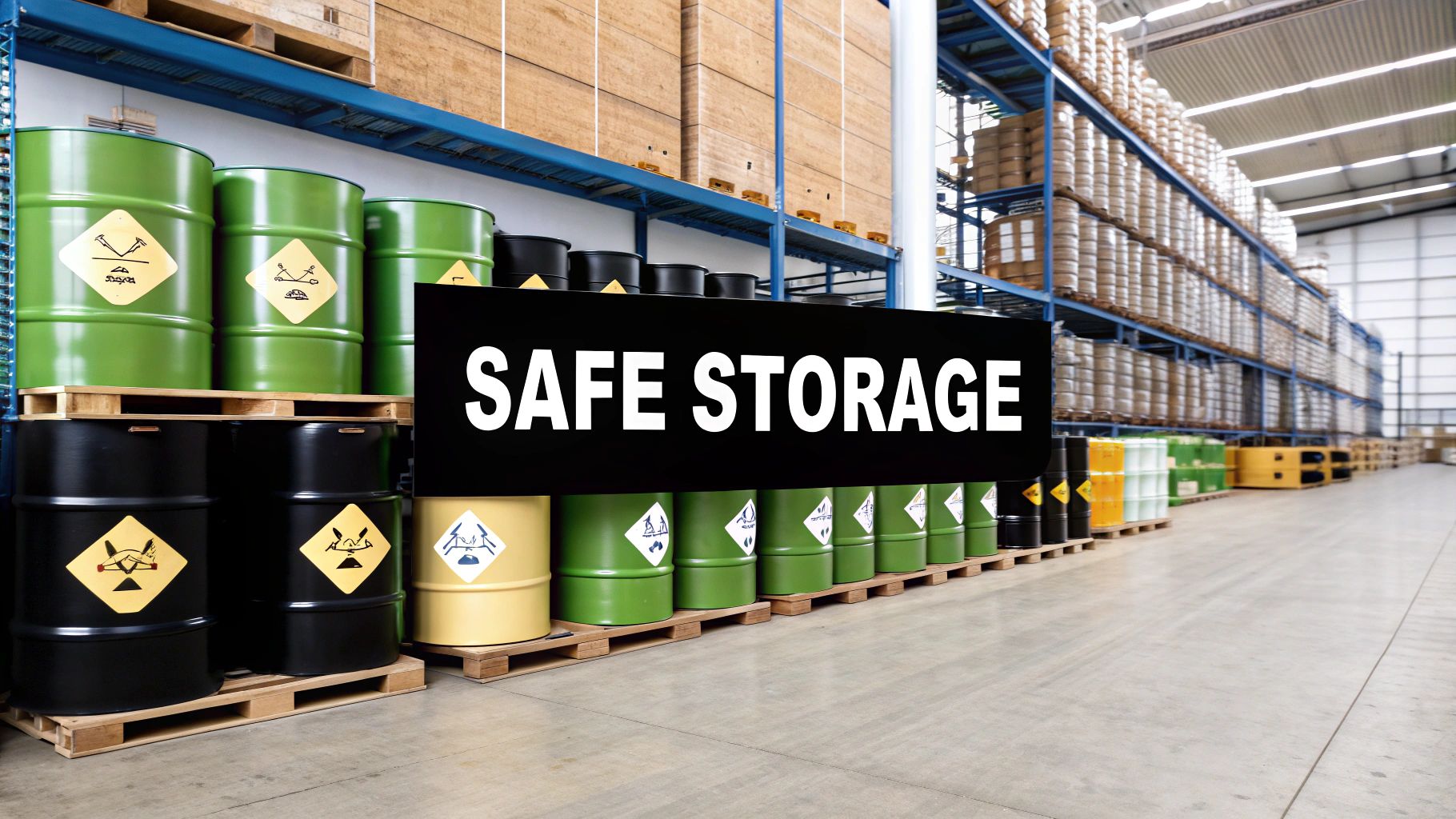

When we talk about hazardous materials storage, we’re not just dealing with a set of rules. We're talking about a multi-layered system of federal, state, and local regulations designed to prevent disaster. These aren't just bureaucratic checkboxes; they are critical safeguards put in place by agencies like OSHA, the EPA, and the DOT to protect your people, the environment, and your entire operation from catastrophic failure. Getting this right is fundamental to your business's survival.
Why Hazmat Storage Compliance Is A Strategic Imperative
It’s easy for supply chain leaders to see hazmat regulations as a cost center—just another compliance headache. That’s a mistake. A much smarter way to look at it is as a core part of your risk management strategy.
These rules exist for a reason: to stop the kinds of incidents that lead to devastating workplace accidents, environmental cleanups that run into the millions, and supply chain standstills that can cripple a business. The first step to building a truly resilient operation is understanding who the key players are and what they expect from you.
Key US Regulatory Agencies For Hazmat Storage
Think of the regulatory landscape as a team of specialists, each with a distinct job. You have OSHA focused on your employees' well-being, the EPA protecting the world outside your walls, and the DOT governing everything that moves. While they have different priorities, their rules often overlap, creating a web of requirements you need to navigate.
The table below breaks down the primary responsibilities of these key agencies.
Knowing each agency's role is crucial because a single container on your warehouse floor can fall under the jurisdiction of all three simultaneously.
The sheer scale of this industry puts its importance into perspective.
The global hazardous goods logistics market hit an estimated USD 237.3 billion in 2023. Experts project it will continue to climb at a 5.6% CAGR through 2032, with hazardous materials making up as much as 20% of all global cargo in some key industrial sectors.
This isn’t a niche market; it’s a massive and growing part of the global supply chain.
Let's put this into a real-world context. Imagine a drum of solvent stored in your facility. OSHA's rules govern the training your employees need to handle it safely. The EPA's regulations dictate how you must manage it as waste if it’s no longer usable. And when you get it ready for shipment, its packaging and labels have to meet strict DOT standards.
To truly get your arms around this, you have to look at the big picture and adopt comprehensive hazmat waste management strategies that weave these different requirements together. When you stop seeing these regulations as separate mandates and start treating them as an interconnected safety system, you move beyond just checking a box. You begin to build a genuinely resilient and secure operation.
The Three Pillars Of Hazmat Identification
Before a single drum is moved or a pallet gets racked, safely storing hazardous materials all comes down to one question: “What exactly are we dealing with?” Getting this wrong is the first domino to fall in a chain reaction that can lead to spills, fires, or toxic exposure. To stop that from happening, every facility has to master three core pillars of identification that create a clear, universal language for understanding chemical risks.
These pillars work together as a unified system. It's how you ensure that from the manufacturing plant to the 3PL warehouse, everyone who touches a substance understands its dangers at a glance.
Decoding The Globally Harmonized System
The first pillar is the Globally Harmonized System (GHS) of Classification and Labelling of Chemicals. Think of GHS as the universal translator for chemical safety. It provides a standard way to define health, physical, and environmental hazards, then communicates those risks through consistent labels and Safety Data Sheets (SDS).
You've definitely seen the most visible part of this system: the GHS pictograms. These simple, diamond-shaped symbols with red borders are like international traffic signs for chemicals. A skull and crossbones immediately signals acute toxicity, while a flame pictogram warns of a fire risk. This allows workers to get the gist of the primary dangers without reading a single word.
The diagram below shows how different regulatory bodies—each with its own lane—work in concert to enforce these safety standards.
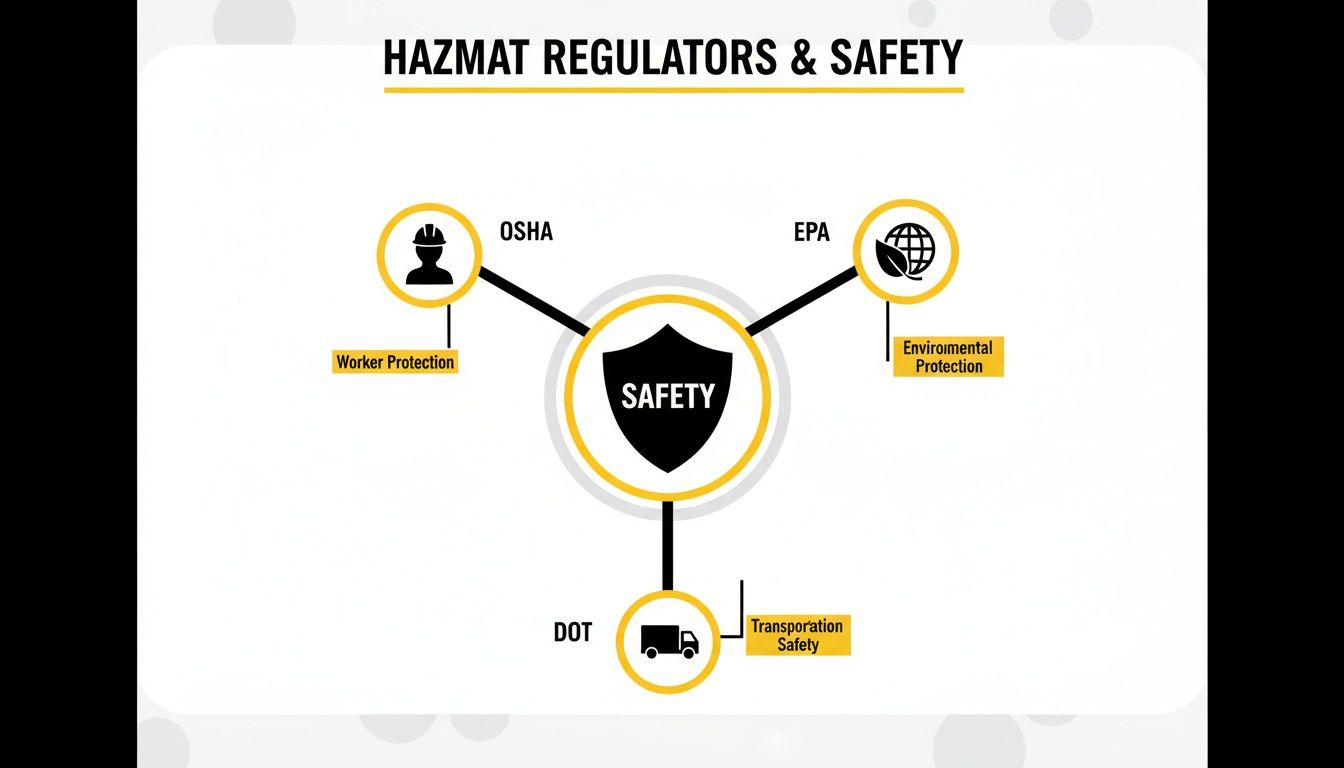
This really drives home the point that hazmat safety is a team effort. OSHA is focused on protecting your people, the EPA is safeguarding the environment, and the DOT makes sure everything is transported securely.
Understanding The Nine Hazard Classes
While GHS pictograms give you that immediate visual warning, the second pillar provides deeper context. A fundamental piece of the puzzle is understanding the nine classes of dangerous goods. This system sorts materials based on their specific chemical and physical properties.
This classification is absolutely critical for segregating materials in your warehouse. For example:
- Class 3 Flammable Liquids: This is where you’ll find things like automotive paints and industrial solvents.
- Class 5 Oxidizing Substances: These can cause or accelerate the combustion of other materials. Think of certain bleaches or peroxides.
- Class 8 Corrosive Substances: This class includes materials like battery acid or strong industrial cleaners that can destroy living tissue or metal on contact.
Storing a Class 3 flammable liquid right next to a Class 5 oxidizer is a recipe for absolute disaster. You're basically putting the fuel right next to the oxygen source, which dramatically increases the risk of a ferocious, hard-to-control fire. Proper classification is the only way to build a safe storage map for your facility.
Mastering The Safety Data Sheet
The third and most detailed pillar is the Safety Data Sheet (SDS). If the GHS label is the headline, the SDS is the full investigative report. This 16-section document is your operational blueprint for safely handling, storing, and responding to emergencies involving a specific chemical. It is, without a doubt, the single most important document in your hazardous materials compliance program.
When you're focused on storage, two sections are especially critical:
- Section 7: Handling and Storage: This section gives you direct instructions. It will specify conditions like temperature controls, ventilation needs, and—most importantly—which other materials are incompatible and must be kept separate.
- Section 10: Stability and Reactivity: Here’s where you’ll find the nitty-gritty details on chemical incompatibilities—the "bad neighbors" that must be kept far apart. It lists specific conditions to avoid (like heat or sunlight) and other substances that could trigger a dangerous reaction.
The global adoption of these systems just keeps growing. As of late 2023, the UNECE was tracking GHS implementation in over 127 countries. And these rules are constantly evolving—just look at the U.S. PHMSA's April 2024 updates to harmonize with new UN regulations, which have a big impact on things like lithium batteries. It's a reminder that staying current is non-negotiable.
Designing a Compliant and Safe Warehouse Layout
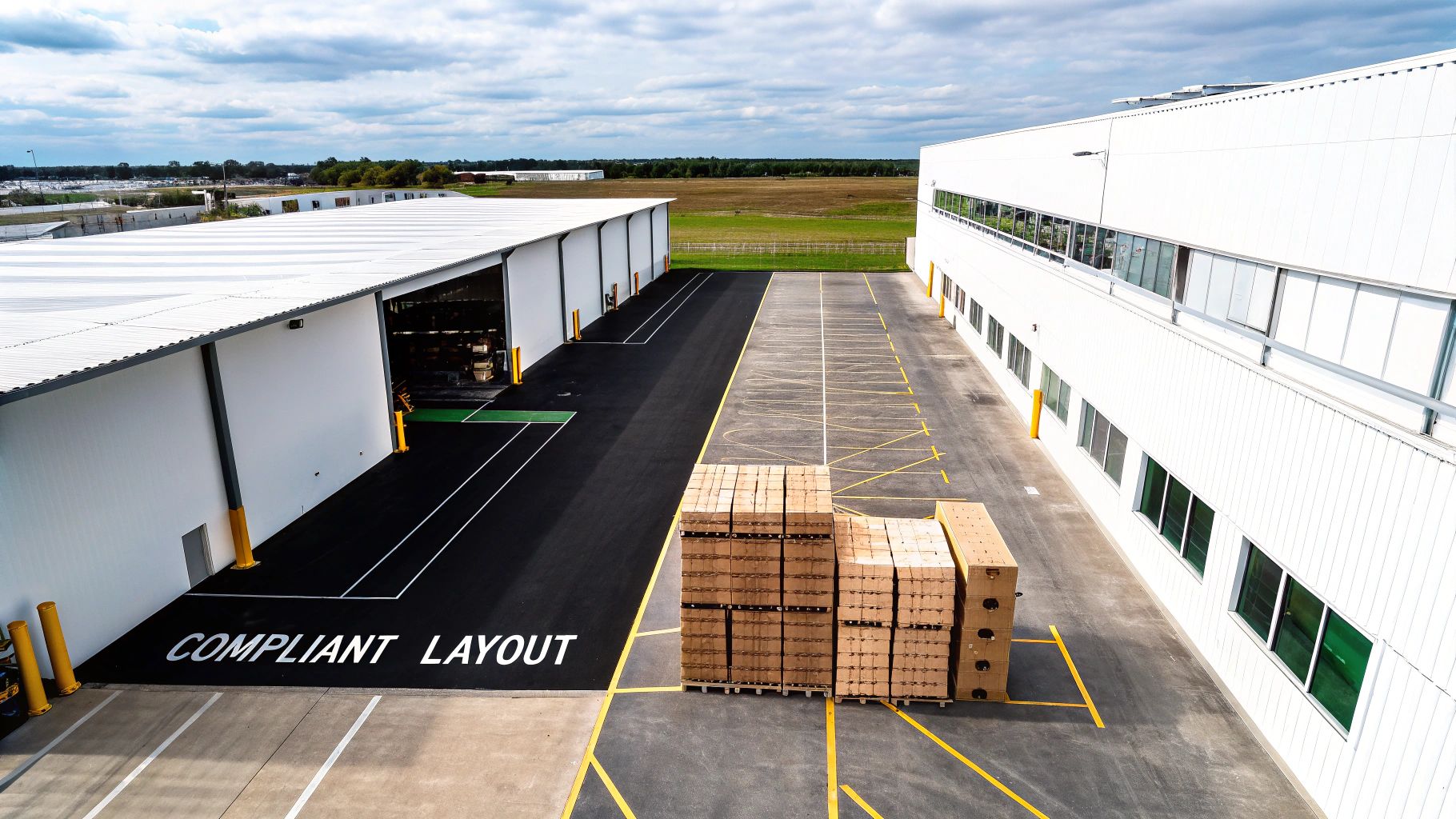
A compliant facility is built on a foundation of smart design. The physical layout of your warehouse is more than just a blueprint for efficiency—it’s an engineered control that actively prevents chemical incidents. Good design turns a simple storage space into your first line of defense against spills, fires, and dangerous reactions.
At the very core of a safe layout is the principle of segregation. It’s a simple concept: some chemicals just can’t be near each other. Think of it like keeping bad neighbors apart. You wouldn’t want someone who collects gasoline cans living next to someone who plays with matches. It’s the same logic in a warehouse.
For instance, storing Class 5 Oxidizers next to Class 3 Flammable Liquids is a recipe for disaster. Oxidizers are eager to release oxygen, which can supercharge a fire. A small leak from a flammable container could instantly escalate from a manageable incident into a raging inferno. A good segregation chart, built from your Safety Data Sheets, is the non-negotiable map for keeping these bad neighbors on opposite sides of the block.
Engineering Your Defenses Against Spills and Fires
Once you've figured out where everything goes, the next layer of protection comes from engineering controls. These aren't just nice-to-have features; they are built-in systems designed to contain and suppress hazards before they get out of hand.
The most critical control is secondary containment. Picture a drum or tote as a castle. Secondary containment is the moat around it. It’s a backup system, like a bermed floor area or a spill pallet, designed to catch 100% of the volume of the largest container it holds. It's there to ensure that if the castle wall (the primary container) is breached, the mess doesn't spread.
Under the EPA’s Resource Conservation and Recovery Act (RCRA), secondary containment isn't just a good idea—it's mandatory for certain hazardous waste storage areas. It's a cornerstone of environmental protection, preventing leaks from contaminating soil and groundwater.
Proper ventilation is another essential piece of the puzzle. It’s basically the building’s respiratory system, constantly pulling contaminated or flammable air out and bringing fresh air in. This is absolutely vital for materials that give off toxic or flammable vapors. Specialized systems, often including explosion-proof fans, are needed to stop a dangerous atmosphere from building up. For a more detailed look, check out our guide on warehouse layout and design strategies.
Hardening the Facility Structure
Finally, the structure of the storage area itself needs to be purpose-built for the materials inside. This means going beyond standard construction and integrating specific, heavy-duty safety features.
Here are some of the key structural requirements you'll need to consider:
- Fire-Rated Walls: These aren’t just regular drywall. They are specially built to contain a fire within one area for a specific amount of time, like two or four hours. That delay provides precious time for people to evacuate and for first responders to arrive.
- Appropriate Fire Suppression: A one-size-fits-all approach doesn't work here. A standard water sprinkler could be catastrophic if it hits water-reactive chemicals. Depending on the hazard, you may need a specialized foam, dry chemical, or gas-based system instead.
- Explosion-Proof Fixtures: In any area where flammable vapors could accumulate, every single piece of electrical equipment—from the overhead lights to the forklifts—must be intrinsically safe or "explosion-proof." This eliminates potential sparks that could ignite the air.
- Impermeable and Sloped Flooring: Floors need to be made of a non-absorbent material, like specially coated concrete. They should also be sloped towards a containment drain or sump, so if a spill does happen, you can control exactly where it goes instead of letting it spread across the facility.
By building these principles into your warehouse design from the start, it becomes much more than just a building. It becomes an active safety system, engineered from the ground up to meet hazardous materials storage requirements and protect your people, property, and business.
Choosing The Right Containment And Storage Systems
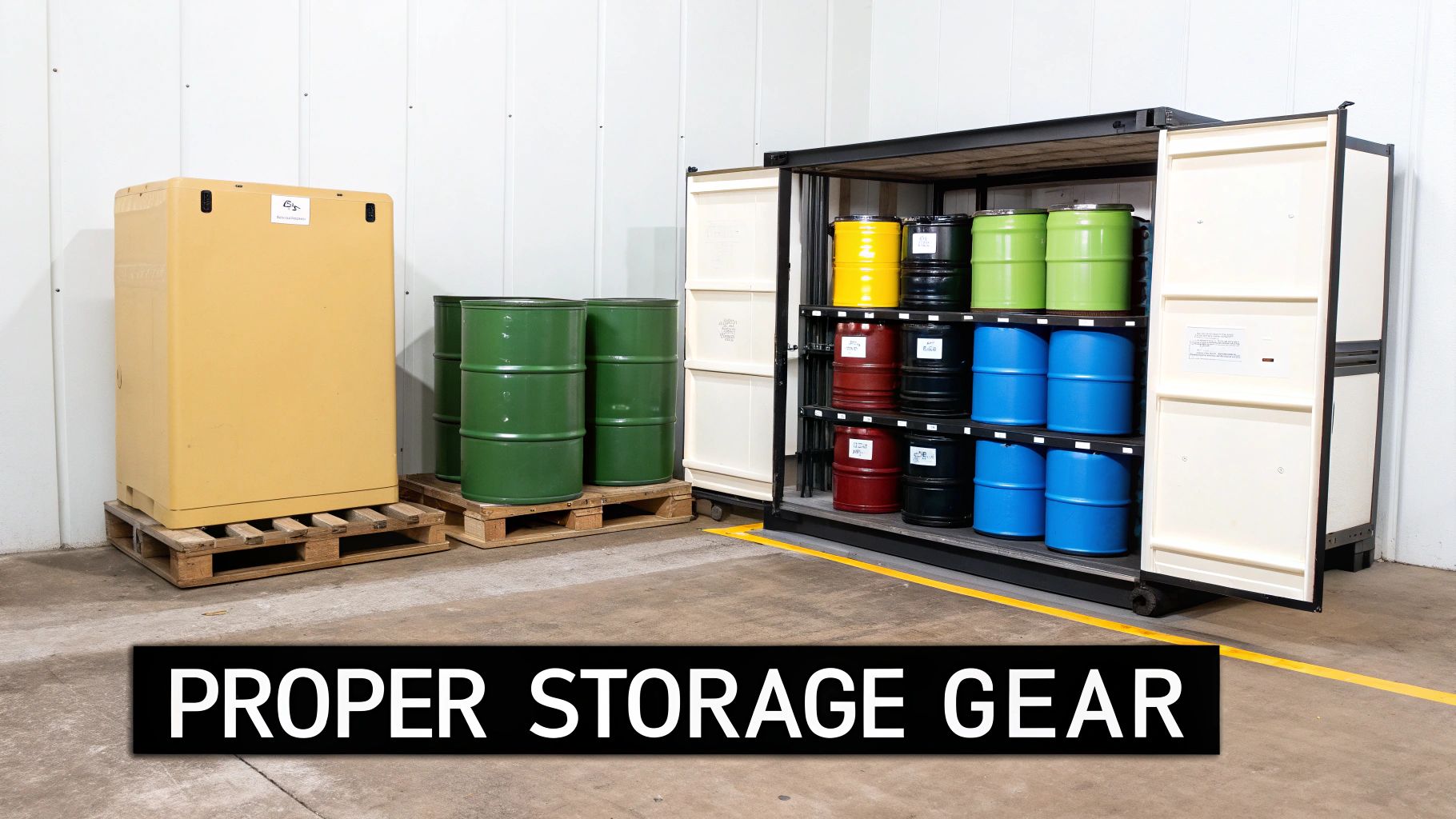
While the overall warehouse layout sets the stage for safety, the actual hardware—the containers, cabinets, and shelving—is your frontline defense. Picking the right equipment isn't just about what fits. It’s a direct reflection of your commitment to meeting hazardous materials storage requirements and containing hazards at the source, preventing a small leak from spiraling into a major incident.
Think of your storage setup as a layered defense system. The primary container is the first barrier. The storage cabinet is the second. Finally, the room's engineering controls provide the third layer of protection. Each piece has to be specifically chosen for the unique risks of the materials it holds, directly addressing the strict mandates from OSHA and the NFPA.
Matching Containers To Chemical Hazards
Getting this right starts with the primary container. A drum is not just a drum, and a tote is not just a tote. The Department of Transportation (DOT) and the United Nations (UN) have laid out a rigorous, performance-based packaging system that keys directly into the severity of the hazard.
This system sorts materials into three Packing Groups (PG):
- PG I: High-danger materials.
- PG II: Medium-danger materials.
- PG III: Low-danger materials.
A container rated for PG III is completely wrong—and illegal—for a PG I chemical. Using the wrong one is a serious violation that puts everyone at risk. UN-rated containers are not your average plastic or steel bins; they've been put through the wringer with stringent tests for pressure, drops, and stacking to prove they can handle the real-world stress of transport and storage.
This focus on certified, robust packaging is a big deal. The hazmat container market was valued at USD 3.5 billion in 2024 and is expected to hit USD 6.9 billion by 2034. A lot of that growth comes from the wider adoption of UN-certified Intermediate Bulk Containers (IBCs), which have been shown to cut material handling accidents by up to 50% in some industrial settings. You can find more details in this hazmat packaging market report.
The Critical Role Of Safety Cabinets And Shelving
Once properly contained, hazmats need to be stored in specialized cabinets or on appropriate shelving. This is especially true for flammable liquids, which represent one of the most common and dangerous risks in any warehouse.
FM-approved (Factory Mutual) flammable safety cabinets are non-negotiable. These aren't just glorified lockers; they are precision-engineered systems designed for one purpose: buying time.
A compliant flammable safety cabinet is engineered to protect its contents from a fire for at least 10 minutes. That critical window gives your team the time they need to evacuate safely before the chemicals inside can turn a bad situation into a catastrophe.
These cabinets are built with double-walled steel, self-latching doors, and leak-proof sills. The same logic applies to shelving. If you’re storing corrosive acids or bases, the shelving must be made of or coated with a chemical-resistant material. Standard steel will quickly degrade and fail when exposed to corrosives, leading to a structural collapse and a nasty spill.
Making these infrastructure choices early on is a foundational step. Our guide on how to build a warehouse delves deeper into making these critical decisions during the planning phase.
To simplify the selection process, it helps to match the equipment directly to the hazard class and regulatory standard.
Hazmat Storage Equipment Selection Guide
This table breaks down common storage solutions and their ideal applications, helping you align your hardware with specific material types and compliance needs.
Ultimately, choosing the right containment systems is a deliberate process guided by the Safety Data Sheet (SDS) for every chemical you handle. By methodically linking each material’s specific hazards to the equipment’s protective features, you ensure your hardware isn't just holding inventory—it's actively building a safer, more compliant, and resilient operation.
Building a Culture of Ongoing Safety and Compliance
Engineered controls and physical barriers are a great start, but they’re only half the battle. A truly effective safety program is built on people and procedures. Compliance isn’t a one-time project you can check off a list; it's a culture of vigilance you have to nurture every single day. This is how you turn a list of requirements into a living, breathing safety system.
The people working in your warehouse are your single greatest safety asset. But without the right training, they can quickly become your biggest liability. Giving your team the knowledge and skills to handle these materials correctly isn't just a good idea—it's a core requirement for preventing accidents before they even have a chance to happen.
Mandatory Training and Competency
OSHA is incredibly clear on this: anyone who handles or could be exposed to hazardous materials needs specific, documented training. The main rule book for this is the Hazardous Waste Operations and Emergency Response (HAZWOPER) standard.
This isn't a simple, one-and-done seminar. HAZWOPER lays out a structured path to make sure your team stays competent over the long haul:
- Initial Training: Before anyone even touches a hazardous material, they must complete a full training course. Depending on their role and potential exposure, this can be a 24-hour or a 40-hour program.
- Annual Refresher: To keep skills from getting rusty, every single employee needs an 8-hour refresher course each year. This gets them up to speed on new procedures, regulatory changes, and any updates to your emergency protocols.
This cycle of continuous learning is what separates the best operations from the rest. It’s a philosophy that mirrors the principles of continuous improvement in manufacturing, where the focus is always on getting better through small, consistent refinements.
The Critical Role of Meticulous Recordkeeping
If training is the education, your records are the official transcript. This documentation is the hard proof that you're meeting your legal duties. When an auditor shows up or an incident needs investigating, these files become your facility’s "black box"—a clear, defensible history of your compliance efforts.
Think of your records as your most important compliance tool. Meticulous documentation of training, inspections, and incidents isn't just paperwork—it's your primary defense against regulatory fines and legal liability.
Your recordkeeping can't be an afterthought. It needs to be organized, easy to access, and complete. At a bare minimum, you should have:
- Training Certifications: Proof of initial and refresher HAZWOPER training for every single team member involved.
- Inspection Logs: Dated records of all your facility inspections, clearly noting any issues found and the steps taken to fix them.
- SDS Binder/Database: A complete and current library of Safety Data Sheets for every chemical you store.
- Emergency Plan: Your up-to-date, documented emergency response and evacuation plan.
Planning for the Unthinkable: Emergency Response
No matter how many precautions you take, you have to be ready for the worst-case scenario. A solid emergency response plan is your playbook for when things go sideways, giving your team the confidence to act fast and minimize the damage.
This plan has to be grounded in reality. That means having well-stocked and clearly marked spill kits and eyewash stations within easy reach of any area where hazardous materials are stored or handled. These aren’t just accessories; they are front-line tools that can stop a small leak from escalating into a serious injury or environmental disaster.
Of course, a plan is useless if no one has practiced it. Regular evacuation and spill response drills are non-negotiable. Drills are where you find the weaknesses in your plan and build muscle memory, so when a real emergency hits, the response is automatic, swift, and correct. This is what a true safety-first culture looks like in action.
Your Essential Hazmat Storage Compliance Checklist
Let's be honest, turning dense regulatory manuals into a practical, day-to-day routine is where the real work begins. This checklist is designed to do just that—it boils down everything we've covered into a straightforward self-audit tool.
Whether you're walking your own warehouse floor or kicking the tires on a potential 3PL partner, use this to get a real-world assessment of your hazmat storage practices. It’s about spotting the small gaps before they morph into big problems, like costly fines or, worse, a serious safety incident.
Identification and Documentation
Everything starts here. If you don't know exactly what you have on-site, every other safety measure is just guesswork.
- SDS on Demand: Can you pull up a current and complete Safety Data Sheet (SDS) for every single hazardous chemical in your facility, right now?
- Clear Container Labeling: Take a look at your containers. Are they all clearly marked with the right GHS-compliant pictograms, product names, and hazard warnings? This includes both the original containers and any secondary ones you use for dispensing.
- Accurate Inventory: Do you have a living, breathing inventory list that tells you exactly what hazardous materials you have, how much you have, and precisely where they are stored?
Warehouse Layout and Engineering Controls
Now, let's look at the physical space. A properly designed warehouse doesn't just rely on people doing the right thing; it uses smart engineering to build safety right into the structure.
A proactive audit is your best defense. Systematically walking through your facility with a checklist transforms abstract regulations into concrete observations, allowing you to identify and mitigate risks before an inspector does.
- Proper Segregation: Are you keeping incompatible chemicals apart? Check their SDS and make sure they are physically separated based on their hazard class to prevent dangerous reactions.
- Sufficient Ventilation: Do your storage areas feel stuffy? You need adequate ventilation to keep flammable or toxic vapors from concentrating, and it has to meet specific regulatory standards.
- Secondary Containment: If a container leaks, where does the spill go? You must have secondary containment systems, like spill pallets or berms, that can hold at least 110% of the volume of the largest container in that area.
- Fire Safety Measures: Are the right fire suppression systems in place for the chemicals you store? Are they inspected regularly? For highly flammable materials, you should see things like fire-rated walls and explosion-proof electrical fixtures.
Storage Equipment and Procedures
This final piece focuses on the hardware and the human element—the specific tools and daily habits that keep everything running safely.
- Correct Cabinets: Are your flammables, corrosives, and other specific hazards stored in dedicated safety cabinets that are properly rated for the job (e.g., FM-approved)?
- Accessible Emergency Gear: Are eyewash stations, safety showers, and fully-stocked spill kits located close to your hazmat areas? They need to be within a certain travel distance, unobstructed, and inspected on a set schedule.
- Up-to-Date Training: Has every employee who handles these materials completed HAZWOPER training? Can you show documentation for their annual refresher courses? When was your last emergency drill?
- Solid Recordkeeping: If an auditor walked in today, could you quickly provide all your inspection logs, training records, and waste manifests? These documents need to be meticulously organized and easy to access.
Frequently Asked Questions
When you're dealing with hazardous materials, the questions that come up are rarely simple. Operations and supply chain leaders often find themselves wrestling with specific details that can make or break their compliance strategy. Let's tackle some of the most common ones to give you clear, actionable answers.
How Often Is Employee Hazmat Training Required?
This is a big one, and the answer is clear: hazmat training is never "one and done." OSHA's HAZWOPER standard is very specific about this. Every employee needs comprehensive training before they ever handle hazardous substances on the job.
After that initial session, everyone is required to take an 8-hour refresher course every single year. This isn't just about checking a box; it’s about keeping your team sharp on safety protocols, aware of new regulations, and ready to act in an emergency. And remember, auditors will want to see meticulous records of every training session completed.
Differentiating Flammable and Combustible Liquids
It all comes down to one critical number: the flash point. That’s the lowest temperature where a liquid gives off enough vapor to ignite in the air. This single data point is what separates a flammable liquid from a combustible one, and it dictates how you must store it.
- Flammable Liquids: These are the more volatile of the two. OSHA classifies them as having a flash point below 100°F (37.8°C). Think about it—they can easily ignite at normal room temperatures, making them a higher-risk material.
- Combustible Liquids: These have a flash point at or above 100°F. They still pose a fire risk, but they need more heat to become a danger.
This isn't just trivia. This classification directly impacts everything from the type of safety cabinet you need to how far away you have to store them from any potential ignition source.
Storing Different Hazardous Materials Together
So you have two different chemicals, both in approved containers. Can they sit next to each other on the shelf? The answer is a firm "it depends." Approved containers are just the starting point; the real guiding principle is chemical compatibility.
Storing incompatible materials together, even if they're in separate, sealed UN-rated drums, is courting disaster. A leak from one container mixing with a spill from another could trigger a violent chemical reaction, release toxic fumes, or start a fire.
For example, you never store acids with bases. Oxidizers must be kept far from anything flammable. Your go-to guide for this is always Section 7 (Handling and Storage) of the chemical's Safety Data Sheet (SDS). It provides explicit instructions on segregation, telling you exactly what can't be stored together and what kind of physical barriers or distances are required. A detailed segregation chart is an absolute must-have for meeting NFPA and OSHA standards and keeping your people safe.
At Wolverine Assemblies, LLC, we don't just follow the rules—we build our entire operation around safety and compliance, from our warehouse design to our team’s expert training. If you’re looking for a 3PL partner who truly understands the nuances of hazmat storage, we should talk. Find out more about our complete supply chain solutions at https://www.wolverine-llc.com.
Subscribe to our weekly newsletter