.png)
How Much Does a Warehouse Cost A Complete Pricing Guide
Asking how much does a warehouse cost? Our guide breaks down buying vs. leasing, operating expenses, and 3PL pricing to reveal the true total cost.
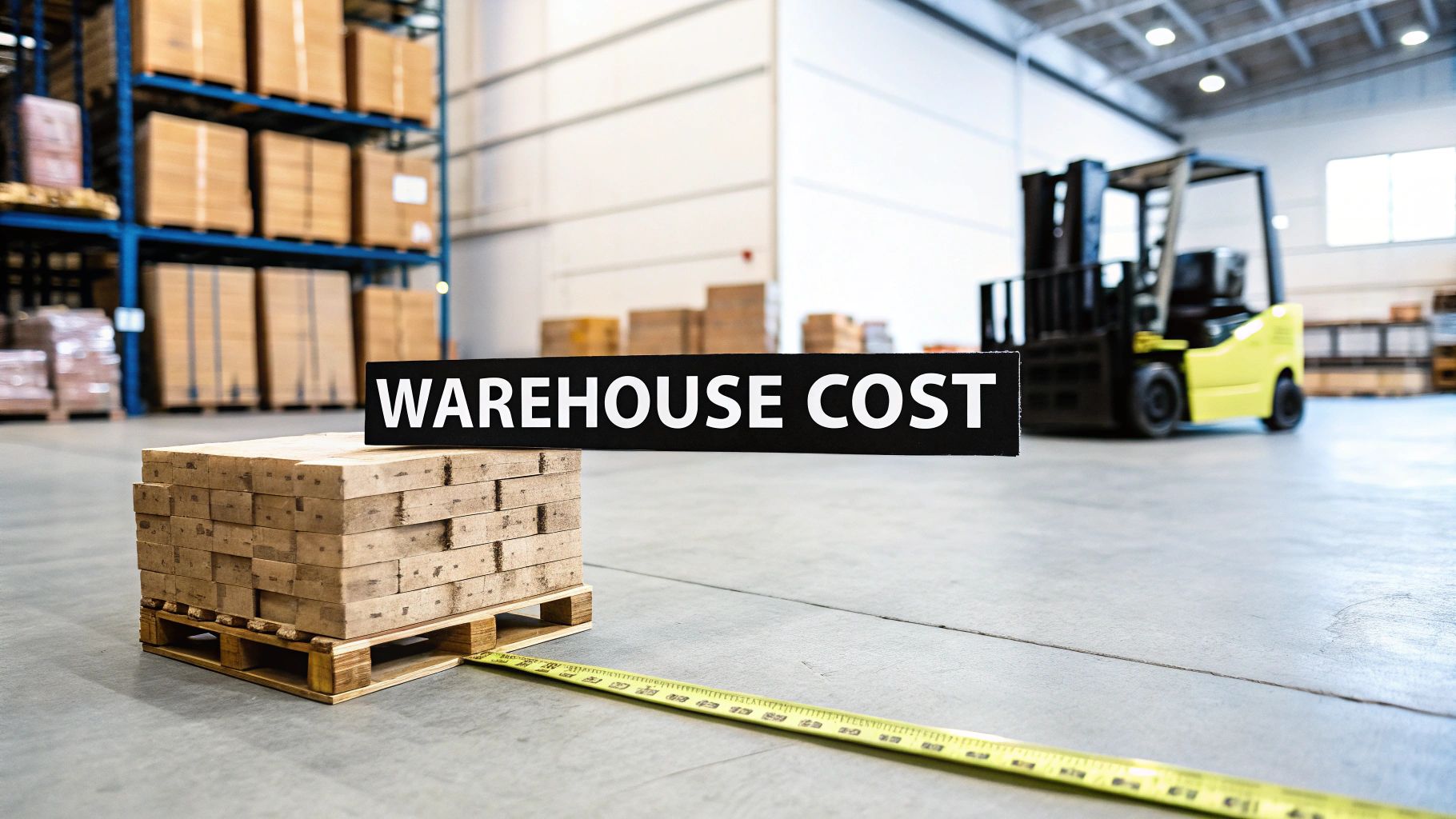

When people ask, "How much does a warehouse cost?" the answer is never a simple number. You might see lease rates anywhere from $8 to over $20 per square foot, while building from the ground up can easily run into the millions. The real cost, however, depends entirely on which path you take: buying, leasing, or partnering with a third-party logistics (3PL) provider.
Understanding the True Cost of Warehouse Space
Thinking about warehousing costs is a lot like figuring out the total cost of a car. The sticker price is just the starting line. After that, you've got insurance, gas, regular maintenance, and the inevitable surprise repair. It's the same with a warehouse—the per-square-foot rate barely scratches the surface.
This all-encompassing figure is what we in the industry call the Total Cost of Ownership (TCO). It’s the only number that gives you an honest picture of your long-term financial commitment. A simple lease rate or purchase price just doesn't capture all the expenses that will eventually hit your P&L.
Breaking Down the Three Core Models
To get a real handle on potential costs, you first have to understand the three fundamental ways to get warehouse space. Each one has a completely different financial footprint and its own set of strategic pros and cons that directly shape your TCO.
Before we dive deep, here's a quick look at how these models stack up.
At-a-Glance Warehouse Cost Models
As you can see, the financial implications are worlds apart. Let's briefly break down what each means for your business.
- Buying or Building: This is a major capital investment (CapEx). It gives you total control but demands a huge upfront spend on everything from the land and building to the racking and software.
- Leasing: This moves the cost into the operational expense (OpEx) column. You avoid the massive upfront purchase, but you're still on the hook for hiring staff, paying the utility bills, and managing the day-to-day grind.
- Outsourcing to a 3PL Partner: This approach turns your warehousing costs into a variable, service-based expense. It completely sidesteps capital investment and fixed operational headaches, giving you the freedom to scale up or down while tapping into professional logistics management.
Choosing between these is a major strategic decision. For a closer look at how these pieces fit into the bigger supply chain puzzle, our guide on distribution and warehousing offers some great background.
The best warehousing strategy isn't about finding the cheapest option; it's about aligning with your specific business goals. Get it right, and your supply chain can transform from a cost center into a real competitive advantage.
In the sections that follow, we'll pull back the curtain on each of these models, exposing the hidden expenses and operational realities behind the numbers. Our goal is to give you the insight to build a realistic budget, compare your options intelligently, and pick the path that truly fuels your long-term growth. By looking beyond the sticker price, you can make a decision you won't regret.
The Cost to Build or Buy a Warehouse

Deciding to build or buy a warehouse is the ultimate capital commitment. It gives you total control over the facility, its layout, and your operations, but it comes with a serious price tag that goes well beyond the initial construction bid or purchase price. This is a strategic move for companies with stable, predictable, long-term needs who are ready for a major upfront investment.
This decision shifts your warehousing budget from a predictable operational expense to a massive capital expenditure (CapEx). The initial journey alone involves navigating several expensive phases, each with its own variables that can dramatically change the final number on your balance sheet.
Deconstructing the Initial Capital Investment
The total cost to get your own warehouse up and running is a sum of several distinct parts. If you overlook even one of them, you’re setting yourself up for budget overruns and project delays. A realistic financial plan has to account for every single line item, from the dirt to the dock doors.
Your primary investments will fall into these buckets:
- Real Estate Acquisition: The land itself is your first big hurdle. Prices are driven by location, local zoning laws, and how close you are to critical infrastructure like major highways, ports, and a good labor pool.
- Construction and Development: This covers everything from architectural design and site prep to pouring the foundation and erecting the building shell. The cost here depends on square footage, clear height, the number of dock doors, and the quality of the materials you choose.
- Essential Infrastructure: You're not done once the walls are up. You also have to fund utility hookups (water, sewer, electricity), pave the parking lots and truck aprons, handle the landscaping, and secure all the necessary permits and inspections from local authorities.
Equipping Your Facility for Operation
Once the structure is in place, the next wave of spending begins. A warehouse is just an empty box until it’s outfitted with the systems needed to move, store, and manage inventory. This phase requires another substantial capital outlay.
Key equipment and technology costs include:
- Material Handling Equipment (MHE): This is everything from pallet racking and shelving to forklifts, pallet jacks, and conveyor systems. The complexity—and cost—of your MHE is a direct result of your product type, inventory volume, and operational workflow.
- Warehouse Management System (WMS): A solid WMS is the brain of the entire operation. This investment includes software licenses, hardware like servers and scanners, and the professional services needed to implement and integrate it all.
- Safety and Security Systems: You’ll also need to budget for essentials like fire suppression, security cameras, access control, and proper lighting to keep your people and products safe.
The decision to build isn't just a financial one; it’s a long-term strategic commitment to a specific location and operational model. The process is complex, but for those ready to take it on, our guide on how to build a warehouse provides a detailed roadmap.
Understanding Market Fluctuations in Construction Costs
It’s also critical to remember that construction costs are not static. Market conditions, material availability, and labor rates create regional price swings that can significantly alter your budget.
For instance, recent data shows that while average costs for large warehouse development rose nationally, the impact was felt unevenly. Markets like Seattle saw a sharp cost increase of $24.59 per square foot, while others, like Cleveland, actually saw costs go down.
For those leaning toward purchasing an existing facility, understanding specialized commercial property financing options is crucial for navigating these variables. This just highlights how important it is to get localized, up-to-date quotes before you lock in your financial models.
The Ongoing Costs of Running a Warehouse
So, you’ve bought or built the warehouse. The big check has been written, but the spending is far from over. Now the real work begins, and with it comes a relentless stream of operating expenses (OpEx)—the daily, weekly, and monthly costs that keep the doors open and products moving.
Over the life of a facility, these ongoing expenses will almost always dwarf the initial purchase price. This is the single most important financial reality to grasp when you’re evaluating your warehousing strategy.
Think of it like owning a car. The sticker price is just the entry fee. The real cost comes from the endless cycle of gas, insurance, maintenance, and repairs. For a manufacturer, every inefficient process or wasted movement on the warehouse floor directly pumps up that "fuel" bill, burning through cash and time.
Breaking Down Warehouse OpEx
Operating expenses aren’t just one big number; they’re a collection of different costs, each with its own drivers. Getting a handle on these is the difference between a warehouse that’s a competitive advantage and one that’s a boat anchor on your P&L. Let's dig into the big ones.
Labor: The 800-Pound Gorilla
Make no mistake: labor is the single largest operating expense in almost every self-managed warehouse. It’s not just about hourly wages, either. The true cost of your workforce is a layered expense that can snowball if not managed meticulously.
- Wages and Salaries: This is the obvious part—the paychecks for your pickers, packers, forklift drivers, supervisors, and administrative staff.
- Benefits and Payroll Taxes: This is the hidden multiplier. Health insurance, retirement plans, workers' comp, and payroll taxes can easily add 20-30% on top of an employee's gross pay.
- Training and Development: Every new hire requires a significant investment to get them productive and safe. This isn't a one-time cost; ongoing training is essential for compliance and efficiency.
- Overtime and Temp Staff: When demand surges, you’re stuck paying time-and-a-half or bringing in temporary workers from an agency, which always comes at a premium.
This constant cycle of hiring, training, and managing people isn't just a line item on a budget. It's a massive operational distraction that pulls focus from what you do best—engineering and manufacturing great products.
An inefficient warehouse doesn't just waste money on utilities or rent; it burns through your most valuable and expensive resource—your people's time. The biggest win in controlling long-term warehousing costs always comes from optimizing workflows to get the most out of every labor hour.
Facility and Technology Overheads
Beyond your team, the building itself and the systems that run it are a constant source of expense. While some of these costs are predictable, they are far from static and require constant attention.
Here's a look at what you can expect to pay for, month in and month out. The table below gives a general idea of how these expenses break down as a percentage of your total operating budget.
Typical Warehouse Operating Expense Breakdown
Note: These are estimates for a mid-sized operation and can vary significantly based on location, automation levels, and inventory type.
These categories cover the non-negotiable costs of doing business. You need electricity for the lights and conveyors, property insurance to protect your assets, and a budget for when a forklift punches a hole in a wall or a dock leveler fails. Your Warehouse Management System (WMS) needs annual license renewals and support contracts. It all adds up.
It’s this complex, never-ending web of expenses that often leads businesses to look for a simpler path—one where a partner manages all of this complexity for a predictable, all-in fee.
Comparing Your Options: Leasing vs. Buying vs. a 3PL
Deciding how you’ll handle warehousing is one of those foundational choices that sends ripples through your entire supply chain. It shapes your financial structure, dictates your operational flexibility, and determines where you spend your most valuable asset: your team’s focus. The three main paths—buying, leasing, and partnering with a 3PL—each come with a very different set of trade-offs.
Ultimately, the decision comes down to a simple strategic question. Do you want to be in the real estate and logistics business, or do you want to concentrate solely on your core manufacturing and engineering strengths? The answer will point you to the model that truly supports your long-term goals.
The Capital-Intensive Path: Buying a Warehouse
Buying or building a warehouse is the ultimate move for control and long-term stability. You own the asset, you call all the operational shots, and you can build equity over time. The catch? This path demands a massive upfront capital expenditure (CapEx) and locks you into a single physical location, which can quickly become a liability if your market dynamics change.
This option really only makes sense for large, established companies with highly predictable demand and the financial muscle to tie up a huge amount of capital in a non-core asset. It’s a serious commitment that requires deep expertise not just in logistics but in commercial real estate and facility management.
The final price tag is also heavily influenced by the wider economy. While the sky-high construction cost inflation of the pandemic has cooled, it's still a major factor. A recent global survey projects construction costs will still climb by 3.9% globally, a number that goes straight to the bottom line of any new build. Labor costs are a massive part of that equation, making your choice of location a critical variable in the total project budget. You can dig into the specifics in these global construction cost findings.
The Middle Ground: Leasing Warehouse Space
Leasing offers a more accessible path into a dedicated facility. The biggest advantage is financial: it shifts the cost from a giant upfront CapEx to a predictable monthly operating expense (OpEx). This frees up precious capital that you can reinvest in your actual business—think R&D, new production lines, or sales expansion. It also provides more flexibility than buying, with typical lease terms running anywhere from three to ten years.
But don't mistake "leasing" for "easy." While you avoid the property purchase, you’re on the hook for everything that happens inside those four walls. You have to hire and manage the labor, buy or lease all the material handling equipment, implement a WMS, and tackle all the daily operational fires.
Leasing gets you the space, but it doesn't solve the operational complexity. You're still running a warehouse—you just don't own the building. This means your team's focus is split between your core business and logistics management.
The Strategic Alternative: Partnering with a 3PL
The third option, outsourcing to a Third-Party Logistics (3PL) provider, completely flips the script on your cost structure. It takes the heavy, fixed overhead of buying or leasing and converts it into a variable expense that scales directly with your business activity. You pay for the space and services you use, when you use them. That’s it.
This model gives you incredible agility. Need to expand into a new market or handle a massive seasonal surge? You can do it without the risk and expense of taking on new real estate. More importantly, it allows you to offload the entire operational headache.
A 3PL partner takes responsibility for the three core pillars of warehouse OpEx: labor, utilities, and maintenance.
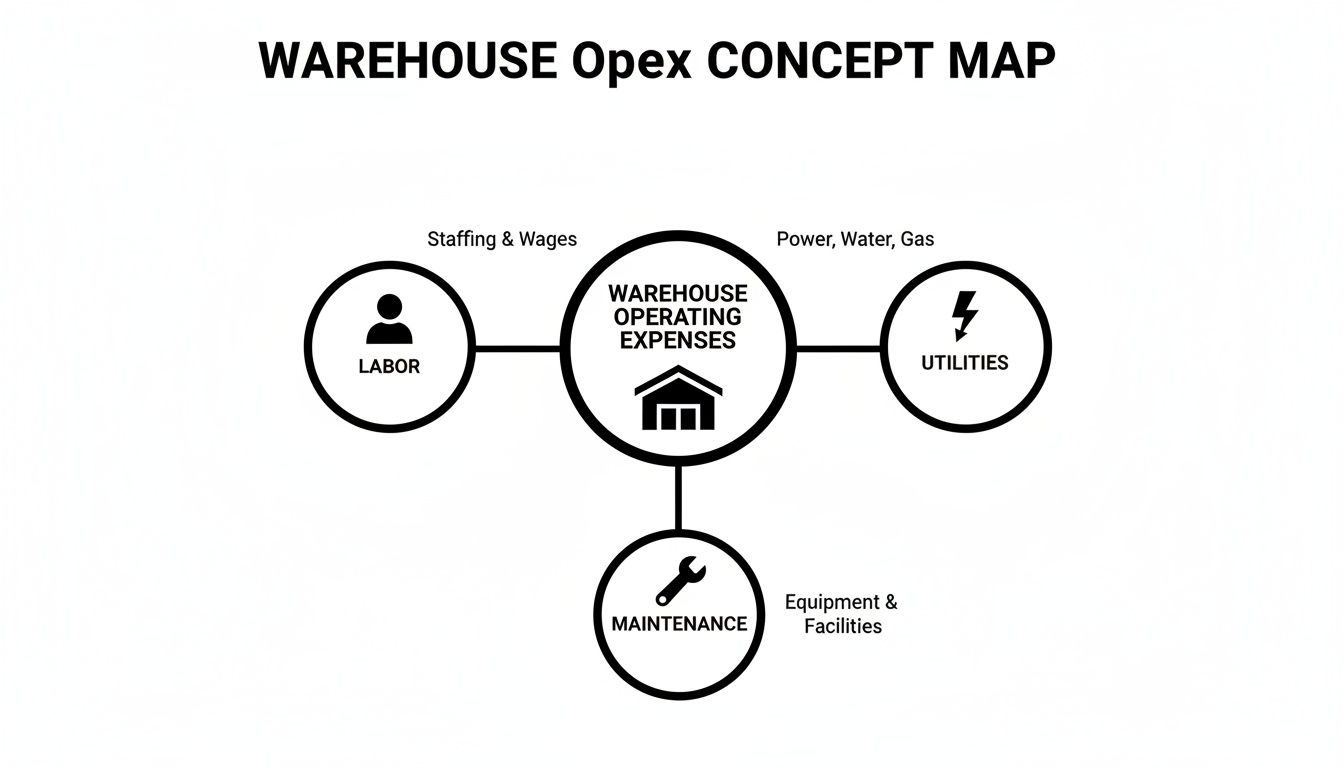
As you can see, a 3PL essentially absorbs these major operational cost centers, turning them from fixed liabilities on your books into a single, streamlined service fee.
By outsourcing, you’re tapping into a partner's established expertise, trained workforce, and modern technology without a single dollar of direct investment. This is a game-changer for manufacturers and Tier-1 suppliers whose real strength lies in what they make, not in how they store and ship it. It frees up your best people to focus on product innovation, quality control, and customer relationships—the things that actually grow your business. A 3PL doesn't just rent you space; they provide a fully managed, scalable logistics engine.
Decoding 3PL Pricing Models and Hidden Fees
Choosing to partner with a Third-Party Logistics (3PL) provider is a savvy move. It essentially transforms unpredictable capital expenses into a manageable, variable cost. But to really understand what you'll be paying, you need to look past the initial quote and get into the nitty-gritty of how they bill.
The beauty of a 3PL is that your costs are directly tied to your activity—you pay for the resources you use, when you use them. This is a world away from the fixed, sunk costs of leasing or owning a building.
Common 3PL Pricing Structures
Getting familiar with the main pricing models is the first step. It helps you compare apples to apples when you're vetting potential partners. A transparent provider will have no problem walking you through their structure and explaining how it applies to your specific inventory and order flow.
Here are the most common frameworks you’ll come across:
- Per-Transaction Fees: Think of this as an à la carte menu. You pay a set fee for each specific task the 3PL performs—receiving a pallet, picking an item, packing an order, or shipping a box. It’s wonderfully straightforward, but can be a beast to audit if you have a ton of transactions.
- Cost-Plus Pricing: In this model, the 3PL calculates the total cost to manage your account (labor, space, utilities) and then adds an agreed-upon markup for their profit. This approach gives you a clear window into the provider's own expenses.
- Fixed-Rate or All-Inclusive Pricing: Some 3PLs offer a bundled monthly fee that covers a pre-defined scope of services and activity levels. This is all about budget predictability, making it a great fit for businesses with stable, consistent operations.
No matter the model, a good 3PL will give you a detailed rate sheet that itemizes every potential charge. For a deeper look at what to look for in a partner, our guide on selecting a third-party logistics provider has some really valuable tips.
Uncovering Potential Hidden Fees
The real trick to forecasting 3PL costs isn’t understanding the core model—it’s sniffing out the secondary fees that can pop up on the invoice. A good partner will be upfront about these, but you have to know what to ask. These aren't always "hidden" to be sneaky; they often cover non-standard work or the initial legwork to get you set up.
A great 3PL partnership is built on transparency. The initial quote should be a starting point for a detailed conversation about all potential service charges, ensuring your final invoice perfectly matches your expectations.
Make sure you get clarity on these common charges before you sign on the dotted line:
- Initial Setup and Onboarding Fees: This is typically a one-time cost to cover the technical heavy lifting. Think integrating your ERP with their warehouse management system (WMS), mapping out bin locations for your inventory, and training their team on your product's unique handling needs.
- Inbound Receiving Costs: Don't just assume receiving is included. Most providers charge for the labor involved in unloading trucks, inspecting your goods, and putting everything away. This might be billed per pallet, per carton, or as an hourly rate.
- Minimum Monthly Fees: Many 3PLs have a "cost to serve" floor. If your storage and activity fees in a slow month don't hit that minimum threshold, you’ll be billed the difference. It’s how they protect their business during your off-season.
- Value-Added Service Charges: Anything that goes beyond the basic "receive, store, and ship" will have its own price tag. This covers things like kitting, sub-assembly, special labeling, or performing detailed quality inspections on your behalf.
By asking direct questions about these potential costs from the start, you can build a truly complete financial picture. This proactive approach is what ensures your 3PL partnership delivers on its promise: simplifying your supply chain with a predictable, scalable solution to your warehousing needs.
Answering Your Top Warehouse Cost Questions
After breaking down the capital, operating, and strategic models of warehousing, you probably have some specific questions bubbling up. Let's get right into the practical answers for the things people ask us most. This will help connect the dots and make your decision-making process that much clearer.
What Is a Typical Cost Per Square Foot to Lease a Warehouse?
This is a bit like asking for the price of a car—the answer is always, "It depends." Lease rates for industrial space are incredibly sensitive to geography, facility quality, and market demand. There really is no single "typical" cost.
That said, in major US industrial hubs, you can expect annual triple net (NNN) lease rates to fall anywhere from $8 to over $20 per square foot. A modern, high-ceiling facility near a major port in Southern California is going to be on a completely different planet, price-wise, than a building in a less congested Midwestern market.
But here’s the critical part: the NNN base rent is just the starting line. That "triple net" is code for "you pay for everything else." The tenant is on the hook for the property's three main overheads:
- Property Taxes: These vary wildly by location and are always subject to change.
- Building Insurance: This covers the physical structure against damage.
- Common Area Maintenance (CAM): This bucket includes everything from landscaping and parking lot repairs to snow removal.
These NNN charges can easily tack on several more dollars per square foot to your total annual cost. What looked like a reasonable lease can quickly become a much heavier financial burden. It’s a major reason why so many companies look for a better way.
Working with a 3PL partner effectively rolls all these unpredictable real estate costs into a single, consistent service fee. It simplifies your budgeting, shields you from the volatile commercial real estate market, and lets you focus on your actual business instead of playing property manager.
How Can I Calculate the Total Cost of Ownership for a Warehouse?
If you're seriously considering buying or building, calculating the Total Cost of Ownership (TCO) is non-negotiable. It's the only way to get an honest financial picture. TCO forces you to look beyond the exciting sticker price and confront the long-term reality of owning the asset.
At its core, a TCO calculation sums up your initial investment with all the projected operating costs over a set timeframe, like 10 years.
Here’s a simplified look at the essential components you need to factor in:
- Initial Capital Investment: This is the purchase price or construction cost, plus closing costs, permits, and the full expense of outfitting the building with racking, forklifts, and other material handling equipment.
- Ongoing Operating Expenses (OpEx): You have to realistically project every recurring cost—mortgage payments, property taxes, insurance, utilities, routine maintenance, major repairs, supplies, and technology subscriptions like your WMS.
- Labor and Management Costs: Often the single largest expense category. This includes all wages, benefits, payroll taxes, training, and management overhead for your entire warehouse team.
- Opportunity Cost: This is the one everyone forgets, but it's huge. What else could you do with the millions of dollars tied up in that building? That capital could be funding R&D, new production lines, or market expansion—the things that actually grow your business.
When you stack this comprehensive TCO against the predictable, variable costs of a 3PL partnership, the true financial trade-offs become crystal clear. It reframes the decision from a simple operational need into a strategic financial choice.
Are There Hidden Costs When Using a 3PL?
With some providers? Absolutely. This is precisely why transparency is the single most important trait to look for in a 3PL partner. You have to be willing to scrutinize the service agreement and ask direct questions to make sure the quote you’re looking at is the real deal. A trustworthy partner will be completely upfront about their fee structure.
Here are the common "hidden" or secondary costs you should always ask about:
- Initial Setup Fees: A one-time charge for integrating your systems with their WMS, slotting your product, and training their team on your account.
- Minimum Monthly Fees: Many 3PLs require a minimum spend to cover their own fixed costs, which can be a factor during your slower months.
- Inbound Receiving Charges: Fees for unloading trucks, verifying counts, and putting inventory away. These are often billed per pallet, per carton, or by the hour.
- Special Project Fees: Charges for any value-added services that fall outside the standard scope of work, like kitting, light assembly, or custom labeling projects.
A transparent 3PL gives you a clear, detailed rate sheet that spells out every potential charge. There should be no surprises on your monthly invoice. Always demand a complete service agreement and walk them through your specific operational needs to get a truly comprehensive quote.
How Does a 3PL Partner Reduce My Total Warehousing Cost?
A strategic 3PL partnership cuts your total costs in a few powerful ways that go well beyond just saving a few bucks on rent. It’s a fundamental shift in both your financial and operational model.
First, it completely eliminates the massive capital expenditure for real estate and equipment. That capital is instantly freed up for you to invest in your core business. Second, it converts fixed overheads—like rent, permanent staff salaries, and utility bills—into variable costs that scale up or down with your actual business volume. If you have a slow month, your warehousing bill goes down.
You also get instant access to a trained, expert workforce and advanced technology without having to spend a dime on hiring, benefits, or software licenses. Finally, by building value-added services like kitting, component consolidation, and sequencing directly into the warehouse workflow, a great 3PL can streamline your entire supply chain, cutting out unnecessary transportation legs and reducing your total landed cost in ways you couldn’t do on your own.
At Wolverine Assemblies, we don't just provide space; we deliver a fully integrated logistics solution engineered for the high-stakes demands of OEM and Tier 1 suppliers. Our transparent pricing and value-added services are designed to lower your total cost of ownership and de-risk your supply chain. Discover how our precision assembly and warehousing solutions can bring stability to your operations by visiting us at https://www.wolverine-llc.com.
Subscribe to our weekly newsletter