.png)
what is oem manufacturing: Learn its role in product brands
what is oem manufacturing: A concise explainer on OEM vs ODM, contract manufacturing, and how OEM partners deliver products for leading brands.


Here’s a simple truth: Original Equipment Manufacturer (OEM) manufacturing is the silent engine running behind many of the products you use every single day. It's a strategic partnership where one company handles the design, and another company—the OEM—builds it to their exact specifications.
What Is Original Equipment Manufacturing
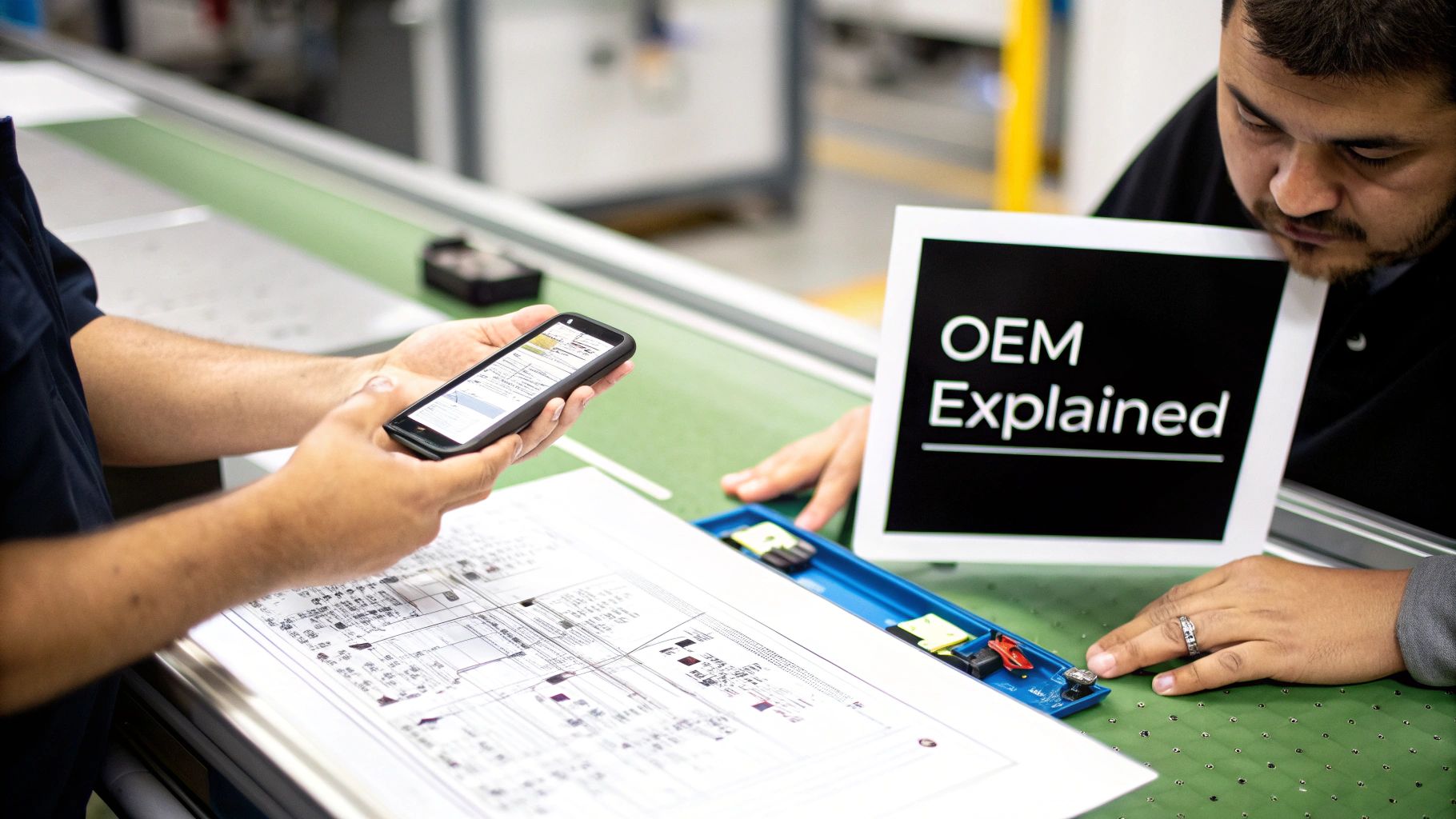
Think of an OEM as a highly skilled, behind-the-scenes production partner. The client company—often a well-known brand—brings the intellectual property. That means the detailed blueprints, CAD files, material requirements, and the complete vision for the product.
The OEM provides the factory, the skilled labor, and the manufacturing expertise to bring that vision to life.
This model is a cornerstone of modern industry, powering everything from automotive parts to consumer electronics. The final product is sold under the client’s brand name, and the end customer often has no idea another company was responsible for its physical creation.
The Core of the OEM Relationship
The OEM partnership works because of a clear division of labor. The brand focuses on what it does best—innovation, design, and marketing—while the manufacturer handles the complexities of production. This creates a powerful synergy that benefits both sides.
Here’s what that looks like in practice:
- Design Ownership: The client company keeps 100% ownership of the product's design and all related intellectual property. The OEM is hired purely to execute the manufacturing process.
- Production Specialization: OEMs are experts in production efficiency, quality control, and supply chain management. They give clients immediate access to advanced manufacturing capabilities without the need to build a new factory from the ground up.
- Brand Anonymity: The OEM’s name never appears on the final product. Their job is to be an invisible extension of the client's brand, ensuring every single item meets their strict quality standards.
The essence of OEM is specialization. It allows innovative companies to focus on research and marketing, while manufacturing experts handle the intricate process of building products at scale.
This contract manufacturing model frees up brand owners to pour their resources into research and development (R&D), marketing, and sales, while OEMs manage the heavy lifting of production. A classic example is Apple, which designs its iPhones but outsources the actual manufacturing to OEMs like Foxconn. This allows them to achieve massive production scale without owning the factories themselves.
To learn more about this strategic model, check out these insights from industry experts at toolsense.io.
Comparing OEM vs ODM vs Contract Manufacturing
Navigating the world of manufacturing means knowing the language. You’ll often hear terms like Original Equipment Manufacturing (OEM), Original Design Manufacturing (ODM), and Contract Manufacturing (CM) thrown around, sometimes interchangeably. But these aren't just buzzwords—they represent fundamentally different partnership models.
The easiest way to tell them apart is to ask one simple question: Who owns the design? Your answer will point you straight to the right manufacturing model for your product, budget, and business goals.
Original Equipment Manufacturing (OEM) Explained
In an OEM relationship, you’re in the driver's seat. You bring a fully developed product design to your manufacturing partner—you own the intellectual property (IP), the blueprints, every last specification. The manufacturer’s job is to be your production arm, building the product exactly to your standards.
Think of a major automotive brand that designs a one-of-a-kind infotainment system. They don’t build it themselves; they hire a specialized electronics manufacturer to produce it for them. The auto brand keeps total control over the design, ensuring their product remains exclusive.
Original Design Manufacturing (ODM) The Private Label Path
ODM flips the script entirely. With this model, the manufacturer has already designed and developed a market-ready product. You simply choose an item from their catalog, put your brand on it, and start selling. This is often called "private labeling" or "white labeling."
This path is all about speed and efficiency.
- Go-to-Market Speed: Because the design and tooling are already done, you can launch a product in weeks, not months or years.
- Lower Upfront Costs: You skip the heavy R&D investment. The factory already footed that bill.
- Reduced Technical Burden: The manufacturer handles all the engineering, so you can focus entirely on marketing, branding, and sales.
The biggest trade-off? You give up exclusivity. Since the factory owns the core design, they are free to sell the same base product to anyone—including your direct competitors.
Contract Manufacturing (CM) The Pure Production Partner
Contract Manufacturing is often a broader term that can include OEM work, but it usually refers to a more straightforward production-for-hire agreement. You hire a CM to produce a specific component or a finished product based on your exact bill of materials and instructions.
The relationship here is typically more transactional. The focus is purely on executing a defined set of production tasks, usually without any deep design collaboration.
Before diving deeper, let's break down how these models stack up side-by-side.
Comparison of Manufacturing Models OEM vs ODM vs CM
Ultimately, the right choice depends entirely on your business strategy.
The choice between OEM, ODM, and CM hinges on your priorities. OEM is for unique innovation, ODM is for speed and market entry, and CM is for straightforward, specified production runs.
To truly grasp the subtle but critical differences, exploring OEM and ODM manufacturing processes in more detail can provide the clarity you need. This decision isn't just a technicality—it directly impacts your budget, timeline, brand strategy, and your competitive edge in the market.
The OEM Partnership Journey: From Blueprint to Product
Turning a detailed design into a physical product isn't as simple as flipping a switch. It’s a carefully managed journey, and the OEM partnership is built on a structured process that makes sure the final product is a perfect match for the client’s vision. This all starts long before the first part is assembled, beginning with a deep dive into the product's DNA.
The process kicks off with the design transfer. This is more than just emailing a file; it’s a complete knowledge handover. The client provides the manufacturer with a full data package: detailed Computer-Aided Design (CAD) files, material specifications, a bill of materials (BOM), and strict quality standards. Think of it like giving a master chef your family's most secret recipe—every ingredient, measurement, and step has to be documented perfectly.
From Prototypes to Production
Once the manufacturer has the blueprint, the real work begins. The first priority is to validate the design and confirm it can be built consistently and to the required quality. This stage is slow and methodical by design, ensuring no detail is missed before ramping up to full-scale production.
The first step is building a prototype. This initial unit gives both teams a physical product to hold, test, and troubleshoot. It’s a vital feedback loop that often leads to small but critical design tweaks.
Next comes tooling and setup. The OEM prepares the assembly line by creating the custom molds, jigs, and fixtures needed to build the product efficiently. This is often a major upfront investment, but it's essential for achieving the precision and speed needed for mass manufacturing.
Finally, the first article inspection (FAI) is performed. A small initial batch is produced using the new tooling, and every single part is meticulously inspected against the original specs. Only when the FAI gets the green light does full-scale production begin. This crucial step prevents a small mistake from turning into thousands of faulty units.
Scaling Up and Locking Down Quality
With the groundwork laid, the focus shifts to ramping up production while maintaining an iron grip on quality control. This is where an OEM's manufacturing expertise really shines. They handle the complex dance of sourcing raw materials, managing labor, and optimizing the workflow on the assembly line.
The real test of an OEM partner is the leap from a single approved prototype to thousands of market-ready units. A great partner builds quality checks into every stage of production—not just at the end—to guarantee consistency from the first product to the last.
This visual breaks down how the client's role in the design phase separates the different manufacturing models.

As you can see, the OEM process is driven entirely by the client's blueprint, ensuring the final product is built exactly to their specifications.
Quality control isn't an afterthought; it's woven directly into the assembly line. This typically includes:
- Incoming Component Inspection: Checking all raw materials and parts from suppliers to make sure they meet the required standards before they hit the production floor.
- In-Process Checks: Operators and automated systems perform inspections at key assembly stages to catch any defects early on.
- Final Product Testing: Every finished unit goes through a final round of tests to confirm it works correctly and meets all quality benchmarks.
Many manufacturing partners today also offer value-added services like specialized kitting and modular assembly, which can make the entire supply chain even leaner. This step-by-step, quality-obsessed journey is how a brand owner’s vision becomes a reality on the shelves.
The Strategic Advantages of Choosing an OEM Partner
https://www.youtube.com/embed/7z6JjkDElx4
Deciding to work with an Original Equipment Manufacturer (OEM) isn't just a production choice. It's a strategic move that can give your company a serious competitive edge.
The biggest win? You get immediate access to top-tier manufacturing infrastructure and expertise without the massive capital investment of building and running your own factory.
This lets a brand skip years of development, tapping directly into a partner’s proven technology, skilled workforce, and fine-tuned production lines. Think of it like a startup using a cloud platform instead of building its own data centers—they get world-class capability from day one and can focus on what really matters: their core product.
Speed to Market and Rapid Scalability
In today's fast-paced markets, timing is non-negotiable. An OEM partnership drastically cuts the time it takes to get a product from a blueprint into a customer's hands.
With tooling, supply chains, and quality systems already dialed in, an experienced OEM can go from final designs to full-scale production way faster than a company could on its own.
This agility also applies to scaling up. When demand for a product suddenly takes off, an OEM partner can ramp up production volume quickly. That kind of flexibility is crucial for seizing market opportunities without being held back by your own facility's limits.
Focus on Core Business Strengths
One of the most powerful benefits of OEM manufacturing is the freedom it gives your internal teams. When you trust production to a specialist, you can point your company's most valuable resources—your people, your time, and your money—toward what you do best.
An OEM partnership isn't about offloading work; it's about reallocating focus. It empowers brands to concentrate on innovation, R&D, brand building, and customer relationships—the very activities that drive long-term growth and market leadership.
Instead of getting bogged down in factory floor logistics, your best people can focus on designing the next big thing or perfecting your marketing. This strategic shift creates a leaner, more effective organization. Many companies find that understanding how lean manufacturing and 3PL work together is the key to getting the most out of this model.
Access to Specialized Knowledge and Risk Reduction
A great OEM partner brings more than just assembly lines to the table; they bring deep industry knowledge. They get the nuances of sourcing materials, navigating regulations, and optimizing processes that lead to real cost savings and better product quality.
This expertise helps sidestep common manufacturing headaches, from supply chain hiccups to quality control failures.
- Cost Efficiency: OEMs work with multiple clients, giving them economies of scale that often lead to lower per-unit production costs for you.
- Quality Assurance: Established OEMs have robust, battle-tested quality control systems, ensuring your product meets precise standards every single time.
- Reduced Overhead: You avoid the ongoing headaches and costs of facility maintenance, managing a workforce, and upgrading equipment.
Choosing an OEM partner turns a massive fixed cost into a predictable variable cost. The result is a more resilient and financially agile business ready for whatever comes next.
How Top Industries Rely on OEM Manufacturing
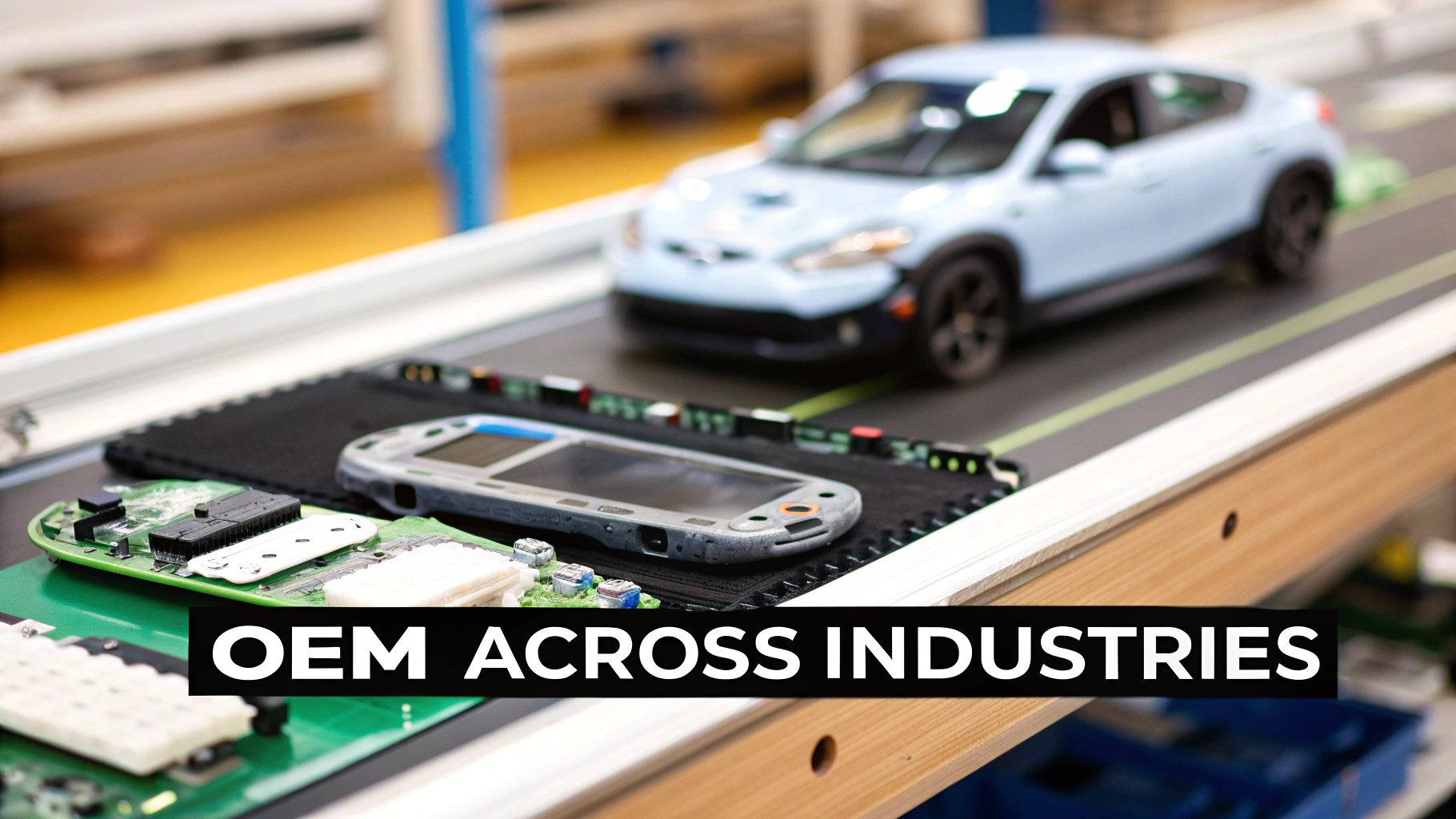
OEM manufacturing isn’t some niche strategy; it’s the backbone of the world's biggest industries. From the car you drive to the phone in your pocket, OEM partnerships are the invisible force turning brand innovations into real-world products at a massive scale.
Think of it like a world-class orchestra. A brand like Ford or Apple is the conductor, holding the unique musical score—the product design. The OEM partners are the master musicians, each a specialist in their own instrument, whether that’s electronics, powertrains, or displays. Together, they create a flawless performance, and the conductor never has to build a single violin.
This model is all about letting companies do what they do best, managing immense complexity by focusing on their core strengths.
Automotive: The Engine of OEM Collaboration
The auto industry is probably the clearest and most powerful example of OEM manufacturing in action. A modern car is staggeringly complex, with tens of thousands of individual parts coming from a global network of specialized suppliers. It’s almost unheard of for major car brands to make every single component themselves.
Instead, they design the vehicle and then partner with Tier 1 suppliers—who are OEMs in their own right—to produce critical systems. This covers everything from advanced driver-assistance systems (ADAS) to engine components and interior electronics. This layered supply chain isn't just common; it's the industry standard.
This model underpins unbelievable production volumes. Global light vehicle production is forecasted to hit roughly 92.17 million units by 2025. That kind of output is only possible with a rock-solid network of specialized OEMs making the essential parts that car brands need for final assembly.
In the automotive world, no single company does it all. The OEM model is a necessity, enabling the intricate coordination of hundreds of suppliers to build a single, cohesive, and reliable vehicle.
Electronics and Industrial Machinery
The consumer electronics industry runs on the same principle, but it’s driven by lightning-fast innovation cycles and the need for massive scale. A tech giant might design a groundbreaking new smartphone, but an OEM partner like Foxconn handles the incredibly intricate assembly, getting millions of units to market with incredible speed.
This model extends deep into the industrial sector, too. Manufacturers of heavy machinery, agricultural equipment, and energy systems count on OEMs for specialized components like hydraulic systems, control panels, and custom-molded parts. Many of these industries use OEM partnerships to integrate advanced manufacturing automation into their production lines, boosting both efficiency and quality.
The OEM framework provides the flexibility and deep expertise needed to navigate today's complex industrial landscape.
Here’s a quick look at how this plays out across different sectors.
OEM Manufacturing Across Key Industries
From cars to circuit boards, the OEM model is what allows brands to innovate while trusting specialized partners to handle the manufacturing.
For manufacturers in the Midwest, the trend of bringing production closer to home is also shaping these partnerships. Understanding the dynamics of reshoring and nearshoring for Michigan manufacturers shows just how these global supply chain strategies are evolving to build more resilient and responsive operations.
Even after you get the hang of the OEM model, a few practical questions always pop up. Let's dig into the details that matter most when you're getting ready to partner with a manufacturer.
Who Owns The Tooling In An OEM Agreement?
This is a big one, and the answer is simple: you do. In nearly every OEM partnership, the client pays for and owns the tooling.
Tooling isn't just a generic machine; it's the custom molds, dies, and fixtures built specifically for your product. Since you're the one providing the proprietary design and footing the bill, you maintain full ownership. This is non-negotiable, as it’s what stops a manufacturer from using your custom tools to make the same part for a competitor.
Make sure your contract clearly states you own the tooling and have the right to take it with you if you ever decide to switch partners.
How Is Intellectual Property Protected?
Protecting your intellectual property (IP) is ultimately your job, not your manufacturer's. A good OEM partner will be professional and discreet, but you should never operate on trust alone.
Before you send over a single design file, get your legal ducks in a row:
- Non-Disclosure Agreements (NDAs): This is your first line of defense. Get an NDA signed before any serious talks begin.
- Manufacturing Agreements: Your contract needs to spell out the exact scope of work and strictly forbid the OEM from using your designs for anything else.
- Patents and Trademarks: If you have a unique invention, file for a patent. Make sure you trademark your brand name and logos in every country where your product will be made and sold.
Is OEM Only For Large Companies?
Not at all. While the big brands make headlines, the OEM model is a powerful tool for businesses of all sizes, including startups. An OEM partnership can give a smaller company access to world-class production muscle without the massive overhead of building and staffing its own factory.
The trick is finding a partner whose capabilities match your needs. Some OEMs are geared for massive production runs, while others are set up to handle smaller, more specialized orders.
What Is The Difference Between OEM And Tier 1?
You'll hear the term "Tier 1 supplier" a lot, especially in the automotive world. A Tier 1 supplier is simply an OEM that provides parts or systems directly to the final brand, like Ford or John Deere. For example, the company that builds the navigation systems and sells them straight to an automaker is a Tier 1 supplier.
The terms are closely related, but not always interchangeable. A Tier 1 supplier is a specific type of OEM that has a direct contractual relationship with the final product's brand owner.
This is a huge deal in electronics. The Electronics Manufacturing Services (EMS) industry, which is mostly made up of OEMs, is the backbone of the global supply chain. In fact, EMS now handles about 47% of all electronics assembly worldwide—a market expected to hit $1.8 trillion by 2025.
You can see more data on the global EMS market at NewVentureResearch.com. This reliance on specialized OEM and Tier 1 partners is what allows brands to build incredibly complex products without having to master every single manufacturing process themselves.
At Wolverine Assemblies, LLC, we're at the center of these complex supply chains. We provide the precision light manufacturing, kitting, and logistics services that top OEM and Tier 1 partners rely on to keep their lines moving. Find out how we can strengthen your production and de-risk your programs by visiting us at https://www.wolverine-llc.com.
Article created using Outrank
Subscribe to our weekly newsletter