.png)
What Is Just In Time Delivery And How It Works
Discover what is just in time delivery, how it cuts costs, and boosts efficiency. Learn the core principles and risks of the JIT model for....


Just-In-Time (JIT) delivery is an inventory strategy that flips traditional warehousing on its head. Instead of stockpiling parts, materials arrive from suppliers at the exact moment they are needed in the production process. It’s all about getting what you need, right when you need it, and not a moment sooner.
This approach cuts out the need for massive warehouses, slashes waste, and creates a razor-sharp, efficient manufacturing flow.
Understanding Just In Time Delivery
Think of a master chef running a busy, high-end restaurant. They don’t keep a huge pantry stocked with weeks' worth of every possible ingredient—that would be a disaster. Food would spoil, and cash would be tied up in inventory that's just sitting there.
Instead, fresh produce and meats are delivered daily, sometimes even multiple times a day, arriving just in time for that evening's service. This keeps everything fresh, minimizes waste, and makes the kitchen incredibly agile.
JIT applies this exact same philosophy to the factory floor. A manufacturer using JIT gets components delivered directly to the assembly line precisely when they are required for the next step in production. It’s a “pull” system, meaning actual customer demand is the trigger for the entire supply chain, all the way back to the raw material suppliers.

Core Goals of JIT
The absolute primary goal here is the relentless elimination of waste. In manufacturing, waste isn't just about defective parts; it's anything that doesn't add direct value for the end customer. JIT is designed to attack several key types of waste head-on:
- Inventory Waste: Slashing the costs tied to storing, managing, and insuring excess parts.
- Waiting Waste: Eliminating downtime on the assembly line while waiting for the next component to show up.
- Overproduction Waste: Preventing the costly mistake of making more products than the market is actually demanding.
For this to work, you need a perfectly synchronized relationship between manufacturers and their suppliers. Communication has to be flawless, and delivery schedules must be exact. A single delayed truck can bring an entire production line to a grinding halt, which shows just how much the system depends on total reliability and precision.
Here's a quick breakdown of how these principles come together:
Just In Time Delivery At A Glance
This table breaks down the JIT model into its fundamental parts, showing how each principle drives a specific goal and outcome.
Ultimately, JIT turns the supply chain from a series of disjointed handoffs into a fluid, highly coordinated system.
The Growing Importance of JIT
As global supply chains get more complex, the push for greater efficiency has made JIT a cornerstone of modern logistics. In fact, the global JIT logistics market was valued at around USD 123.6 billion in 2023 and is expected to hit USD 250.5 billion by 2032.
This growth isn't just a number—it reflects a fundamental shift in how successful companies operate. You can find more details about this trend on DataIntelo.com.
At its heart, Just In Time delivery is more than an inventory strategy; it’s an operational philosophy. It demands a deep commitment to continuous improvement, rock-solid supplier partnerships, and an unwavering focus on efficiency. When done right, it transforms the supply chain from a cost center into a powerful competitive advantage.
The Origins And Core Principles Of JIT
Just-In-Time delivery wasn't dreamt up in a modern boardroom. Its roots are in post-World War II Japan, a place where resources were tight and efficiency wasn't just a goal—it was a survival tactic. Toyota, facing a shortage of both capital and space, simply couldn't afford the Western model of huge factories and warehouses overflowing with parts. They had to get creative.
That pressure gave birth to the Toyota Production System, with JIT at its very core. It was a complete reversal of traditional thinking, moving away from the "just in case" approach of stockpiling inventory to a much leaner, more responsive method.

The Relentless Pursuit Of Eliminating Waste
The whole JIT philosophy stands on three core principles. The first, and most important, is the elimination of muda—the Japanese word for waste.
In the JIT world, "waste" means anything that uses up resources but doesn't add a single ounce of value to the finished product. Toyota famously identified seven types of waste, from defects and overproduction to unnecessary inventory. The mission is to hunt down and eliminate muda at every turn.
This principle goes far beyond the factory floor. By focusing on waste reduction, JIT becomes a key part of a bigger operational strategy. You can see how these ideas connect by learning more about how lean manufacturing and 3PL work together to cut costs.
Shifting To A Demand-Driven Pull System
The second big idea is the switch from a "push" to a "pull" system. A traditional push system is all about forecasting. A company makes a bunch of products based on what it thinks people will buy, then pushes it out to the market. This often leads to overproduction and warehouses packed with stuff nobody wants.
A pull system flips that script. Production only happens when there's actual customer demand. Nothing gets made until the next step in the process needs it, creating a chain reaction all the way down the line.
Think of it like refilling a vending machine. It doesn't get restocked on a whim. It's refilled only after an item is bought, "pulling" a replacement from the supplier. This simple logic prevents costly mistakes, like making thousands of car doors in a color that's already out of style.
The core idea of a pull system is simple yet powerful: Let real demand dictate production. This direct link to the market ensures that resources are only used to create products that customers have already signaled they want, dramatically reducing the risk of obsolete inventory.
Committing To Continuous Improvement
The final pillar holding up JIT is kaizen, or continuous improvement. This isn't just a process; it's a culture. It’s the belief that everything can and should be made better, empowering everyone from the assembly line worker to the CEO to spot inefficiencies and suggest fixes.
Kaizen isn't about huge, disruptive overhauls. It’s about making small, smart improvements, day in and day out.
- A team might rearrange a workstation to shave seconds off the time it takes to grab a tool.
- A supplier could adjust their packaging to make parts easier and faster to unpack on the line.
- A logistics partner may find a new delivery route that’s 5% more efficient.
Over time, these little tweaks add up to massive gains in quality, speed, and cost savings. It’s this commitment to constant refinement that allows a JIT system to adapt and thrive, making the entire supply chain stronger and more resilient.
To really get what Just-In-Time delivery is all about, it helps to first understand what it isn't. The classic approach to inventory has always been a "push" system, better known as Just-In-Case (JIC). It’s a strategy built on being prepared for anything, where companies stock up on inventory to protect against a sudden spike in demand or a hiccup in the supply chain.
Think of a grocery store manager getting ready for a big snowstorm. They don't wait for the weather forecast to turn grim; they proactively load the shelves with extra milk, bread, and bottled water. That's JIC in a nutshell—holding safety stock so you’re ready for whatever comes your way.
JIT, on the other hand, is the complete opposite. It’s a lean "pull" model. Picture a high-end sushi restaurant that lives and dies by the freshness of its ingredients. The chef orders just enough fish for that day's service, and it's delivered right before prep begins. There’s no giant freezer packed with aging inventory. Everything is lean, fresh, and tied directly to what customers are ordering right now.
JIT, Lean, and Kanban: A Trio of Efficiency
You'll often hear the terms JIT, Lean Manufacturing, and Kanban thrown around together, and for good reason—they’re a team working toward the same goal. But they each have a distinct role to play.
- Lean Manufacturing: This is the big-picture philosophy, the team's mission statement. Its core purpose is to deliver maximum value to the customer by ruthlessly eliminating waste in all its forms.
- Just-In-Time (JIT): This is a key strategy used to make the Lean mission a reality. It specifically targets the waste of holding inventory and waiting for parts by ensuring materials show up at the exact moment they're needed.
- Kanban: This is the tool, the communication signal that makes JIT work. A Kanban signal—which could be a simple card, an empty bin, or a digital alert—is the trigger that "pulls" new parts into the production flow.
So, you can think of it like this: Lean provides the "why," JIT provides the "what," and Kanban provides the "how." They're all interconnected pieces of a finely tuned system built for speed and responsiveness.
"A single delay can halt the entire manufacturing process."
This statement gets right to the heart of the JIT trade-off. While it delivers incredible efficiency, its success hinges entirely on the flawless, reliable execution of every single link in the supply chain.
JIT vs. JIC: A Strategic Comparison
Choosing between JIT and JIC isn't just an operational tweak; it’s a major strategic decision that affects everything from your cash flow to your risk profile. The right model really depends on your industry, how stable your product demand is, and how much risk you're willing to take on.
Historically, JIT systems were the gold standard in predictable, stable global environments. But the supply chain disruptions of the past few years have forced a lot of companies to rethink things. Many are now moving toward hybrid models that blend the efficiency of JIT with the resilience of JIC, often by diversifying suppliers or holding a bit more buffer stock to guard against volatility. You can dig deeper into these evolving strategies in recent market research on JIT logistics.
So, how do the two models stack up head-to-head? Here’s a direct comparison of the key factors that set JIT and JIC apart.
Ultimately, the best approach balances JIT's cost-saving efficiencies with the critical need for a supply chain that can withstand unexpected shocks.
Key Benefits And Real Risks Of JIT
For OEMs and Tier-1 suppliers, adopting a Just-In-Time delivery system is a high-stakes game. It’s a powerful strategy that can transform operational efficiency, but it also opens the door to serious vulnerabilities. Before you commit to such a demanding model, you have to understand both the incredible benefits and the very real risks.
The rewards of a JIT system firing on all cylinders are huge, mostly boiling down to cost savings and better financial health. By carrying minimal inventory, companies free up enormous amounts of cash that would otherwise be sitting idle on warehouse shelves. That cash goes straight back into the business, improving cash flow and funding other priorities.
This lean approach also takes a massive bite out of overhead. Less inventory means you need less warehouse space, you pay lower insurance premiums, and you cut the labor costs tied to managing, moving, and tracking all that stock.
The Upside: Financial Efficiency And Agility
While the financial perks are often the main driver, the operational benefits are just as important. They create a production environment that is far more responsive and focused on quality.
A major advantage is agility. With less inventory to worry about, a manufacturer can pivot almost instantly to meet shifts in customer demand. If a new product feature suddenly takes off, a JIT system lets the production line adapt without being stuck with a mountain of now-obsolete components.
This agility leads to a few other great outcomes:
- Improved Quality Control: When you work in smaller batches, you spot defects much earlier. This stops the mass production of faulty parts and makes it far easier to trace problems back to the source.
- Shorter Lead Times: The whole production cycle gets a speed boost. Less time is spent waiting for materials or moving them from storage, which means a faster turnaround from the initial order to the final delivery.
- Stronger Supplier Relationships: JIT demands a deep, collaborative partnership with suppliers. It moves the relationship beyond simple transactions and toward a strategic alliance where everyone is focused on mutual success.
A successful JIT implementation does more than just cut costs; it creates a culture of precision and continuous improvement. It forces an organization to become exceptionally good at forecasting, planning, and executing, which strengthens the entire operational backbone.
The Downside: The High Cost Of Failure
The benefits are clear, but the risks are unforgiving. A JIT system runs with almost zero safety net, meaning even a small hiccup can have catastrophic results. The entire model is built on the assumption that the supply chain is stable, predictable, and perfectly in sync.
Its biggest vulnerability is exposure to supply chain disruptions. Things like natural disasters, transportation strikes, a supplier going bankrupt, or geopolitical issues can stop deliveries cold. Without any buffer stock, a single delayed truck can bring a multi-million-dollar assembly line to a grinding halt in a matter of hours.
This reliance on perfect timing puts immense pressure on suppliers. They must be 100% reliable—no exceptions on quality or delivery schedules. Any failure on their end directly cripples the manufacturer's ability to produce, making supplier selection an area with absolutely no room for error.
This high-risk, high-reward dynamic is especially clear in the automotive industry. Here, JIT logistics ensures components arrive precisely when needed, which can slash inventory holding costs by up to 25% and boost production efficiency by 15-20%. You can dig into more data on how JIT impacts automotive logistics.
Ultimately, the choice to adopt JIT requires a clear-eyed assessment. You have to weigh the powerful financial and operational upsides against the potential for severe, costly disruptions. Success isn't just about flawless execution—it's about building strong contingency plans to handle the inevitable challenges that will pop up.
The Technology That Makes JIT Possible
A Just-In-Time delivery system looks like magic. Parts show up on the factory floor exactly when they’re needed, almost as if they were summoned out of thin air.
But it’s not magic—it's technology. This seamless performance relies on a deeply integrated digital backbone that acts as the central nervous system for the entire supply chain. Without the right tools working in perfect harmony, the JIT model would quickly fall apart.
At its core, JIT runs on instant, accurate communication. It needs a constant, reliable stream of data flowing between the manufacturer, its suppliers, and logistics partners. This is where a few key technologies become non-negotiable.
The Digital Handshake: EDI and ASN
The two main tools that keep everyone synchronized are Electronic Data Interchange (EDI) and Advance Shipping Notices (ASN). Think of them as an automated digital handshake followed by a detailed shipping manifest.
- EDI (Electronic Data Interchange): This is a standardized format for exchanging business documents like purchase orders and production schedules digitally. Instead of someone manually sending an email, an OEM’s system can automatically fire off a production forecast to a supplier’s system, instantly triggering an order. This cuts out human error and shaves days off the procurement cycle.
- ASN (Advance Shipping Notice): As soon as a supplier’s truck leaves the dock, they send an ASN. This digital message tells the manufacturer exactly what’s in the shipment, how it’s packed, and when it will arrive. It gives the receiving team a heads-up so parts can move straight from the truck to the assembly line without sitting around.
Together, EDI and ASN create a transparent, automated communication loop. It replaces guesswork with certainty and provides the real-time visibility that a JIT operation absolutely depends on.
For JIT to work, information has to flow instantaneously. This is where concepts like real-time data streaming become critical, ensuring this constant flow of data is managed without a hitch.
The Command Center: Enterprise Resource Planning
If EDI and ASN are the messengers, the Enterprise Resource Planning (ERP) system is the command center. An ERP platform pulls every part of the operation—inventory, demand forecasting, production scheduling, and finance—into one unified system. It's the single source of truth for the entire company.
In a JIT environment, the ERP is the brain analyzing customer orders, checking production capacity, and calculating the exact materials needed. It then translates those needs into EDI messages that tell suppliers what to send and when. To get a better sense of its role, you can dig into what an ERP system is in manufacturing and see how it orchestrates these complex moving parts.
From Digital Plan To Physical Reality
Technology creates the plan, but it’s value-added logistics services that turn that digital blueprint into a physical reality on the factory floor. These specialized services, often handled by a 3PL partner like Wolverine Assemblies, are the final, critical steps that make JIT work.
Two of the most important services are sequencing and kitting.
- Sequencing: This ensures components arrive at the assembly line in the precise order they’re needed. For an automaker, this might mean delivering car seats that are perfectly sequenced by color and fabric to match the specific vehicles coming down the line.
- Kitting: This is where all the necessary parts for a specific manufacturing step are gathered into a single, ready-to-use package, or "kit." It saves assembly line workers from having to hunt for individual components, which boosts productivity.
These technologies and services all work together in a powerful ecosystem. It’s this combination of digital precision and hands-on execution that delivers the speed and efficiency Just-In-Time is known for.
Putting A JIT Delivery System Into Practice
Moving to a Just-In-Time delivery model isn’t a small tweak. It’s a total operational overhaul that requires serious planning and even better execution. The first step is to stop thinking about suppliers as transactional partners and start treating them as extensions of your own production line. Their performance is your performance.
This deep integration only works with a foundation of shared data and total transparency. Without it, you’re just guessing.
Building The Implementation Roadmap
Implementing JIT means re-engineering your internal workflows from the ground up. You’re shifting to a ‘pull’ system, where real-time demand—not a forecast—triggers production. This often involves redesigning floor layouts, retraining your entire team, and embracing a culture where every single employee is empowered to spot and eliminate waste.
A successful rollout usually breaks down into a few key stages:
- Supplier Vetting and Collaboration: Pinpoint and partner with suppliers who can consistently meet strict quality and delivery windows. This isn't a one-way street; it means sharing production schedules and demand data so they’re always ready to go.
- Technology Integration: Put the right tech in place. This includes an ERP system to act as the central nervous system and EDI/ASN protocols for automated, seamless communication between you and your partners.
- Process Re-engineering: Overhaul internal processes to get rid of bottlenecks. The goal is to create a smooth, continuous flow from the moment a part hits the receiving dock to when it's on the assembly line.
- Comprehensive Training: Train everyone on JIT principles. Your team needs to own their roles in this new, highly interdependent system for it to work.
This flow of technology is what synchronizes the entire operation, from digital data exchange to the physical logistics on the floor.
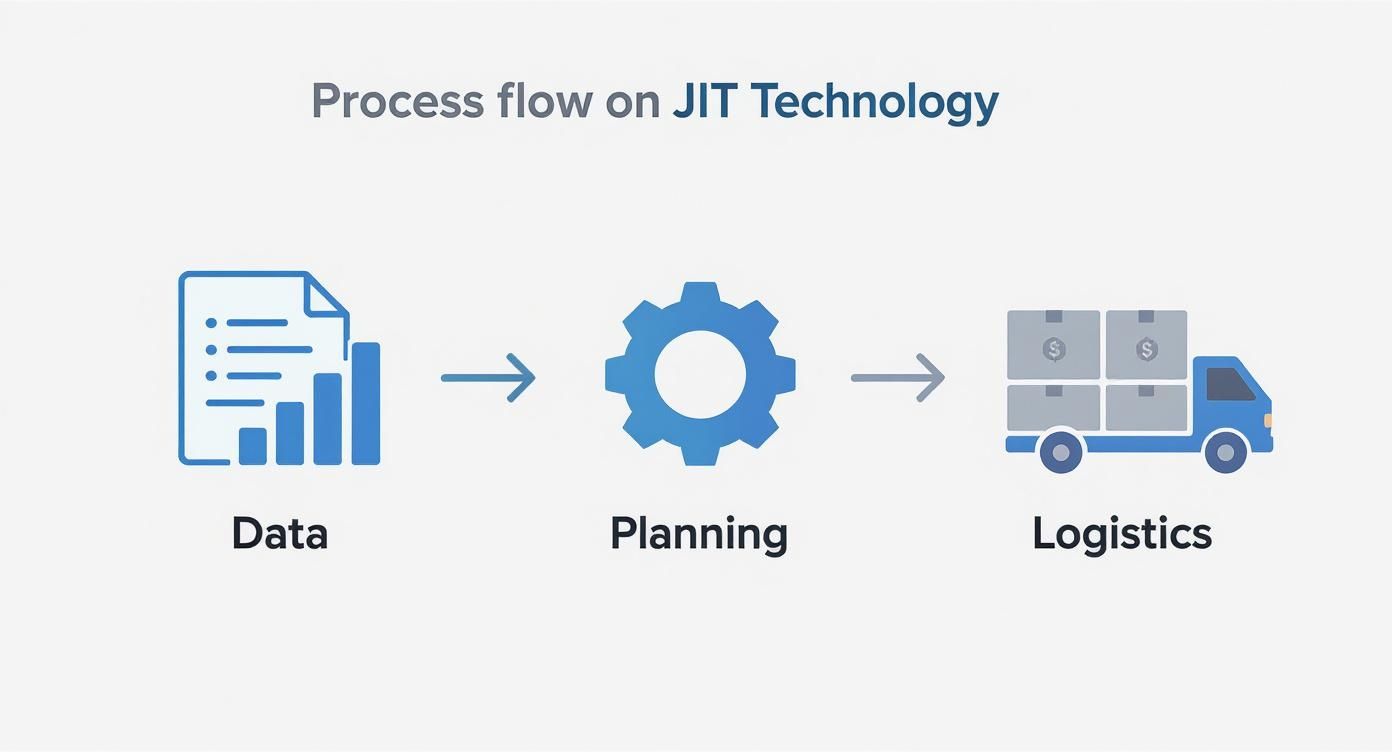
The diagram above shows exactly how data from EDI feeds into ERP planning, which then directs precision logistics like sequencing. This digital-to-physical workflow is the engine that keeps a modern JIT operation running smoothly.
Mitigating The Inherent Risks
While the upside of JIT is huge, its lean nature comes with significant risk. A single hiccup—a late truck, a bad batch of parts—can shut down your entire production line. That’s why a smart risk mitigation plan isn't optional; it's essential for survival.
Building resilience into your JIT model means getting ahead of potential failures. For example, some businesses use hybrid strategies where suppliers manage inventory right at or near the production facility. This blends JIT's efficiency with a small, strategic buffer. You can learn more about these approaches in our guide explaining why Vendor Managed Inventory (VMI) is the future of warehousing.
A resilient JIT system isn't about avoiding disruptions—it's about having a robust plan to withstand them. The goal is to build a supply chain that is both lean and strong, capable of bending without breaking when faced with the unexpected.
To safeguard your operations, you need a multi-layered defense:
- Supplier Diversification: Never single-source critical components. Having vetted backup suppliers in different geographic areas can protect you from localized disruptions.
- Contingency Planning: Develop clear, step-by-step action plans for high-risk scenarios, like transportation delays or a quality issue with a key part.
- Predictive Analytics: Use data to forecast potential weak spots in your supply chain, letting you address problems before they turn into full-blown crises.
By pairing meticulous planning with a tough risk mitigation strategy, any organization can build a powerful and resilient Just-In-Time delivery system.
Common Questions About Just-In-Time Delivery
Even after you grasp the core idea of JIT, the practical "what-ifs" start popping up. It's smart to ask these questions—they're what separate a successful JIT strategy from a risky one.
Let's clear up a few of the most common concerns we hear from manufacturers.
Is JIT Only for Giant Companies?
Not at all. While JIT was made famous by massive automotive players, its principles scale surprisingly well. Small and medium-sized businesses can absolutely make it work, especially for product lines with steady, predictable demand.
The real secret isn't company size; it's supplier reliability. This is where a 3PL partner can level the playing field, offering specialized warehousing, sequencing, and kitting that give smaller operations the infrastructure they need to run lean.
How Does JIT Handle Sudden Spikes in Demand?
This is the big one. A "pure" JIT system, with zero buffer stock, is naturally fragile when faced with unexpected demand. That's why most companies today don't run a pure system. They run a hybrid.
A hybrid JIT approach balances lean efficiency with practical resilience. It maintains the core benefits of waste reduction while building in a strategic cushion to absorb market volatility without shutting down production.
This might mean keeping a small safety stock of high-velocity parts or having pre-arranged agreements with suppliers to ramp up production quickly. The key is seamless communication, often through shared data platforms, so suppliers see a demand spike coming and can react before it becomes a crisis.
What Is the Difference Between Kitting and Sequencing?
Both are essential for making an assembly line hum in a JIT environment, but they solve two different problems. Think of it this way:
Kitting Is About Grouping: It’s about bundling all the components for one specific job into a single package. For instance, a kit for a vehicle's infotainment system would have the screen, the knobs, the wiring harness—everything needed in one neat box. Kitting makes a single workstation incredibly efficient.
Sequencing Is About Order: This ensures unique parts arrive at the line in the precise order they’re needed. If you’re building cars with different colored seats, sequencing delivers the red, then the black, then the tan seat in the exact order required by the production schedule. Sequencing makes the entire line flow without a hitch.
At Wolverine Assemblies, LLC, we provide the precision kitting, sequencing, warehousing, and EDI/ASN capabilities that make a resilient JIT system possible. Discover how our end-to-end supply chain solutions can stabilize your operations and de-risk your programs.
Subscribe to our weekly newsletter