.png)
Supply Chain Risk Management Strategies: 2025 Guide
Discover supply chain risk management strategies to boost resilience, cut disruptions, and protect operations.


In an era of unprecedented volatility, from geopolitical shifts to climate events and pandemics, a reactive approach to supply chain management is no longer viable. Today's disruptions don't just cause delays; they halt production, erode margins, and severely damage brand reputation. For manufacturers in the automotive, industrial, and agricultural sectors, a fragile supply chain isn't just a liability-it's an existential threat. Proactive risk mitigation has become the new competitive advantage.
This article moves beyond theory to provide a comprehensive roundup of 10 proven supply chain risk management strategies you can implement today. We will break down each strategy, detailing what it is, why it's critical, and how to implement it with actionable steps and clear key performance indicators. Each section includes real-world examples, illustrating how these concepts apply in demanding environments and how a strategic Midwest 3PL and assembler can be a critical partner in executing them effectively.
Forget vague advice. This guide is designed for supply chain and operations leaders who need concrete, actionable plans to build resilience. You will learn how to:
- Diversify your supplier base without sacrificing quality.
- Implement real-time monitoring for total supply chain visibility.
- Develop robust business continuity plans that actually work.
- Leverage technology to transform your supply chain into a digital, resilient asset.
By the end of this article, you will have a clear roadmap to transform your supply chain from a vulnerability into a strategic advantage, fully prepared to withstand the shocks of 2025 and beyond.
1. Supplier Diversification: Building a Resilient Sourcing Network
Supplier diversification is a foundational supply chain risk management strategy that involves intentionally spreading your procurement activities across multiple suppliers and, often, different geographic regions. The core principle is to avoid over-reliance on a single source for critical components, raw materials, or finished goods. This proactive approach creates a safety net, ensuring that a disruption affecting one supplier- whether due to financial instability, natural disaster, or geopolitical turmoil- does not halt your entire production line.
Why It Matters
Relying on a single supplier, even one with a stellar track record, introduces a significant single point of failure. The COVID-19 pandemic and subsequent port blockages exposed the fragility of this model. Diversification transforms your supply chain from a rigid, vulnerable chain into a flexible, resilient network. It enhances your bargaining power, promotes competitive pricing, and provides access to innovation from a broader supplier base.
Implementation Steps
- Identify Critical Components: Analyze your bill of materials (BOM) to pinpoint single-source components that pose the highest risk to production continuity.
- Qualify Secondary Suppliers: Proactively vet and onboard alternative suppliers. This includes auditing their quality management systems, assessing their financial stability, and verifying their production capacity. Don't wait for a crisis to start this process.
- Allocate Volume Strategically: Implement a dual- or multi-sourcing model. For instance, an 80/20 split, where your primary supplier receives 80% of the volume and a secondary supplier receives 20%, keeps the alternative source engaged and prepared to scale up.
Key Insight: True diversification isn't just about having backup supplier names on a list. It requires giving secondary suppliers active, albeit smaller, business to maintain the relationship and ensure they are ready to ramp up production when needed.
A Midwest 3PL's Role
A Midwest-based 3PL and assembler can be a strategic partner in your diversification efforts. By managing inbound logistics from multiple global and domestic suppliers, they can consolidate materials at a central U.S. location. This simplifies inventory management and provides a buffer. For an electronics manufacturer, this could mean receiving microchips from a supplier in Asia and casings from a domestic supplier, then performing final light assembly and kitting at the 3PL's facility, reducing complexity and mitigating last-mile risks.
2. Supply Chain Visibility and Real-time Monitoring
Supply chain visibility is the ability to track products, materials, and data in real-time as they move from the source to the final destination. This strategy moves beyond periodic updates to a live, transparent view of your entire network. By leveraging technologies like IoT sensors, GPS tracking, and advanced analytics platforms, organizations can anticipate disruptions, from a delayed shipment to a weather event, and react with agility before they escalate into major problems.

Why It Matters
In a complex global supply chain, ignorance is not bliss; it’s a liability. A lack of visibility means you are constantly reacting to disruptions after the fact, leading to costly expedites, production downtime, and damaged customer relationships. Real-time monitoring transforms your approach from reactive to proactive. It enables better inventory management, improves on-time delivery performance, and provides the data needed for continuous process improvement, forming a core part of modern supply chain risk management strategies.
Implementation Steps
- Map Your Supply Chain: Begin by mapping your entire supply chain, identifying key nodes, transit lanes, and partners. This provides the foundational framework for your visibility initiative.
- Integrate Key Technologies: Deploy and integrate visibility tools. This could involve equipping shipments with IoT sensors for real-time location and condition monitoring or connecting your manufacturing ERP system with carrier data feeds.
- Establish Alert Protocols: Define specific thresholds for alerts, such as a shipment being stationary for more than 12 hours or a temperature-sensitive product exceeding its range. Assign clear action plans for each type of alert.
Key Insight: Visibility without actionability is just data. The true value comes from creating standard operating procedures that empower your team to use real-time insights to make swift, informed decisions that protect the supply chain.
A Midwest 3PL's Role
A technology-forward 3PL partner acts as a central hub for visibility. Using an advanced Warehouse Management System (WMS), they provide real-time inventory data from the moment goods arrive at their Midwest facility. For an agricultural equipment manufacturer, this means having a live view of parts inventory, enabling just-in-time assembly and sequencing to the production line. Beyond just monitoring, effective supply chain visibility is enhanced by robust logistics support, offering proven San Diego logistics support strategies to secure your critical shipments and proactively respond to potential disruptions.
3. Strategic Inventory Buffers and Safety Stock
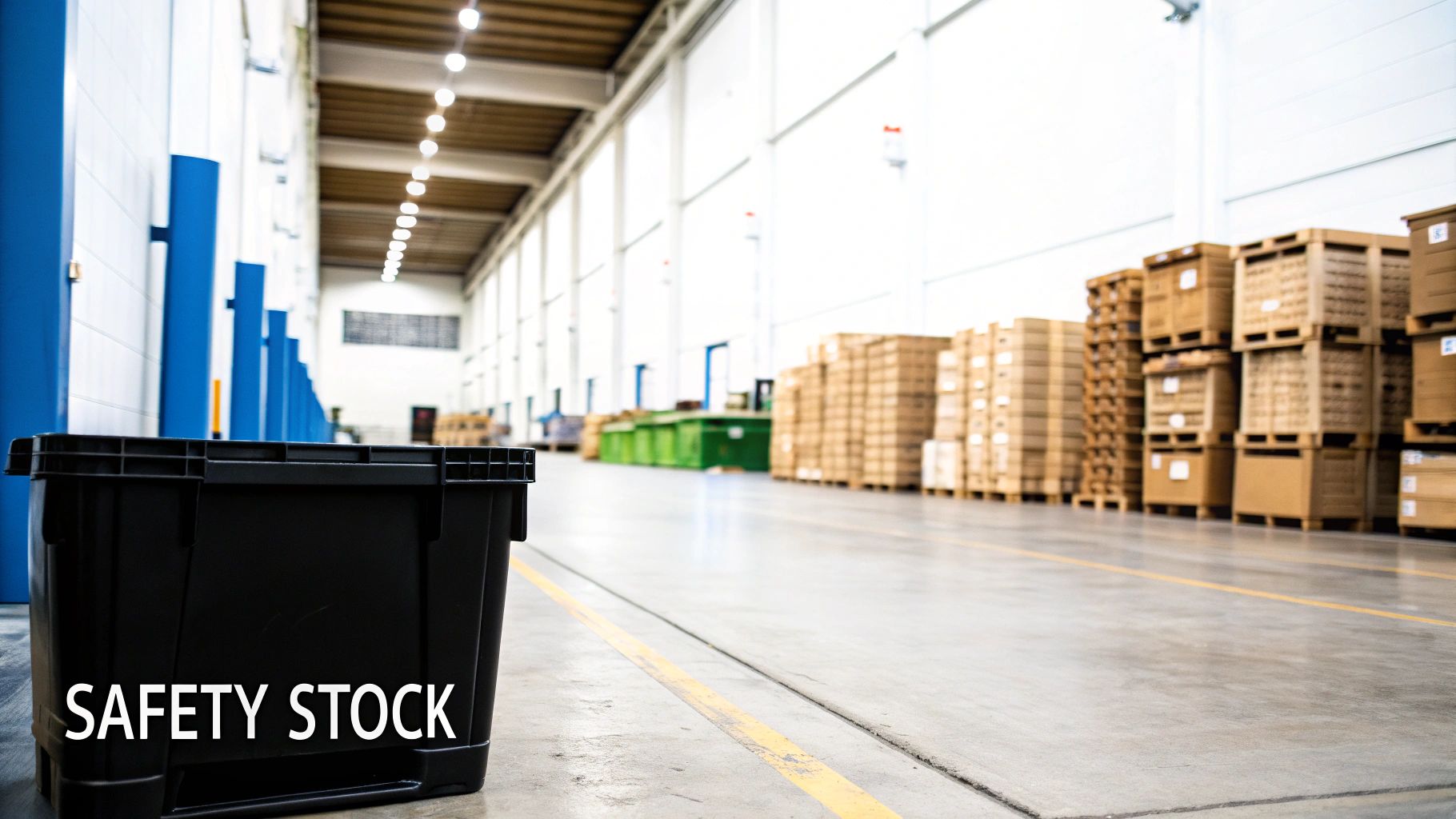
Strategic inventory buffers involve intentionally holding more inventory than needed to meet current demand forecasts. This "safety stock" acts as a crucial cushion, absorbing unexpected supply disruptions or sudden demand spikes. Far from being a relic of "just-in-case" logistics, this is a calculated and data-driven supply chain risk management strategy that balances the cost of holding inventory against the immense financial and reputational cost of a stockout.
Why It Matters
Lean, just-in-time inventory models are highly efficient but extremely brittle. A single delayed shipment can shut down an entire assembly line, as seen with the post-2020 semiconductor shortages that crippled the automotive industry. Maintaining strategic buffers for critical components provides the agility to navigate port congestion, supplier production issues, or geopolitical events without immediate operational collapse. It decouples your production schedule from daily supply chain volatility, ensuring business continuity.
Implementation Steps
- Prioritize with ABC Analysis: Classify your inventory into A (high-value, critical), B (moderate), and C (low-value) items. Focus your safety stock investment on "A" items where a stockout would cause the most significant disruption.
- Calculate Optimal Levels: Use statistical formulas that factor in demand variability and lead time variability. This data-driven approach ensures you aren't over- or under-stocking.
- Review and Adjust Regularly: Market conditions change. Review and adjust buffer levels quarterly or semi-annually to reflect shifts in demand, supplier performance, and emerging global risks.
Key Insight: Strategic buffering is not about hoarding inventory. It’s about surgically placing the right amount of the right stock in the right locations to protect your most critical value streams from predictable volatility.
A Midwest 3PL's Role
A Midwest 3PL with extensive warehousing capabilities is an ideal partner for executing an inventory buffering strategy. They can store your safety stock at a central, cost-effective U.S. location, reducing on-site inventory pressure at your manufacturing plant. For an agricultural equipment producer, this means the 3PL can hold a buffer of critical hydraulic components. When a supplier delay occurs, the 3PL can immediately sequence and dispatch these buffered parts directly to the assembly line, preventing a costly shutdown without requiring the manufacturer to expand their own warehouse footprint.
4. Risk Assessment and Scenario Planning: Proactively Mapping Your Response
Risk assessment and scenario planning is a strategic process of systematically identifying potential supply chain threats, analyzing their potential impact, and developing detailed contingency plans for various disruption scenarios. Rather than reacting to crises as they happen, this approach allows organizations to proactively map out their responses, ensuring a coordinated and effective reaction when a disruption occurs. It moves the business from a reactive posture to a state of preparedness.
Why It Matters
Without a formal risk assessment process, blind spots are inevitable. A minor issue in a lower-tier supplier's operations could cascade into a full-blown production shutdown if not previously identified and planned for. This strategy forces a cross-functional examination of vulnerabilities, from geopolitical instability and natural disasters to supplier financial health and cybersecurity threats. Companies that conducted pandemic scenario planning before 2020, for example, were significantly better equipped to adapt their operations, sourcing, and logistics when COVID-19 emerged.
Implementation Steps
- Form a Cross-Functional Team: Assemble a team with representatives from procurement, logistics, operations, finance, and IT to ensure a holistic view of potential risks.
- Identify and Prioritize Risks: Use a structured framework like a Failure Modes and Effects Analysis (FMEA) or a risk matrix to brainstorm potential disruptions. Prioritize them based on their likelihood and potential impact on operations.
- Develop Response Scenarios: For high-priority risks, develop detailed "what if" scenarios. For example, "What is our response if our primary port of entry is closed for two weeks?" Document step-by-step action plans, communication protocols, and decision-making triggers for each scenario.
Key Insight: Scenario planning is not a one-time exercise. It must be a dynamic process, with plans and assumptions reviewed and stress-tested annually or whenever significant market or geopolitical shifts occur.
A Midwest 3PL's Role
A Midwest 3PL can be an active participant in your scenario planning, particularly for logistical disruptions. They can help model the impact of port closures, carrier failures, or regional weather events. For an agricultural equipment manufacturer, the 3PL can help game out scenarios like a sudden spike in demand due to favorable farming conditions or a rail strike disrupting component delivery. By holding safety stock and having pre-vetted alternative transportation routes, the 3PL acts as a built-in contingency, ready to execute a planned response and absorb logistical shocks.
5. Nearshoring and Localization: Reducing Distance and Risk
Nearshoring is a strategic relocation of manufacturing and sourcing activities to countries geographically closer to the end market. Instead of relying on distant overseas production, a U.S. company might move operations from Asia to Mexico or Central America. This approach directly tackles risks associated with long transit times, geopolitical instability, and complex global logistics by shortening the supply chain.
Why It Matters
Lengthy supply chains are inherently more vulnerable to disruptions, from port congestion and shipping container shortages to international trade disputes. Nearshoring compresses lead times, enabling a more agile and responsive supply chain that can adapt quickly to shifts in demand. This proximity also simplifies communication, aligns time zones, and can reduce transportation costs and carbon footprints, making it a crucial component of modern supply chain risk management strategies.
Implementation Steps
- Conduct a Total Cost of Ownership (TCO) Analysis: Look beyond labor costs. Factor in logistics, tariffs, inventory carrying costs, and the financial benefits of shorter lead times and improved agility.
- Evaluate Regional Stability and Infrastructure: Assess the target country's political climate, labor laws, logistics infrastructure (ports, roads, rail), and regulatory environment to ensure it's a stable long-term partner.
- Phase the Transition: Avoid a high-risk, all-at-once move. Start by nearshoring a single product line or component to pilot the process, build local relationships, and work out logistical challenges before scaling the initiative.
Key Insight: Effective nearshoring isn't just about changing a factory's address. It requires building a robust regional ecosystem, including qualifying local tier-two and tier-three suppliers to reduce dependence on components from far-flung regions.
A Midwest 3PL's Role
A Midwest 3PL and assembler is the ideal strategic partner for a nearshoring strategy. It acts as a central receiving and distribution hub for goods coming from Mexico or Canada. For an automotive supplier nearshoring production to Mexico, the 3PL can receive finished components, perform quality inspections, execute final light assembly or kitting, and sequence parts for just-in-time delivery to a Michigan-based OEM. This creates a critical buffer and value-add point, smoothing the integration of nearshored goods into the domestic supply chain. To explore this further, you can learn more about what reshoring and nearshoring means for Michigan manufacturers.
6. Supplier Relationship Management and Collaboration: Building Alliances for Resilience
Strategic supplier relationship management (SRM) moves beyond transactional procurement to build long-term, collaborative partnerships with key suppliers. This approach emphasizes mutual trust, transparent communication, and joint problem-solving to create a more integrated and resilient supply ecosystem. By treating suppliers as partners rather than just vendors, companies can foster an environment where information flows freely, innovation is shared, and disruptions are managed collectively.
Why It Matters
In a volatile market, a strong supplier relationship can be the difference between a minor hiccup and a complete shutdown. Collaborative partners are more likely to provide early warnings of potential issues, offer flexible solutions during a crisis, and prioritize your needs when capacity is tight. This deep-seated alliance, famously demonstrated in the Toyota Production System, transforms the supply chain from a series of independent links into a unified, shock-absorbent network that can adapt and innovate together.
Implementation Steps
- Segment Your Supplier Base: Not all suppliers require the same level of engagement. Categorize them as strategic, preferred, or transactional to focus your collaborative efforts where they will have the most impact.
- Establish a Governance Framework: Create a formal structure for the relationship. This includes setting clear performance metrics (KPIs), scheduling regular business reviews, and establishing joint planning sessions to align on forecasts and strategic goals.
- Invest in Joint Improvement: Actively work with strategic partners to enhance their capabilities. This could involve sharing best practices, investing in joint technology, or creating integrated teams to tackle critical challenges like cost reduction or quality improvement.
Key Insight: True collaboration is a two-way street. It requires sharing not just your demand forecasts, but also your business challenges and strategic plans, inviting suppliers to contribute to solutions that benefit both parties.
A Midwest 3PL's Role
A Midwest 3PL and assembler can act as a central hub for enhancing supplier collaboration. By co-locating inventory from multiple strategic suppliers, the 3PL facilitates a vendor-managed inventory (VMI) or consignment program, giving partners direct visibility into consumption patterns. For an agricultural equipment manufacturer, this means a key hydraulics supplier and a plastics molder can both manage their inventory at the 3PL's facility, ensuring components are ready for just-in-sequence (JIS) delivery to the assembly line, strengthening the partnership and reducing collective risk.
7. Business Continuity Planning and Disaster Recovery
Business continuity planning (BCP) is a proactive strategy focused on creating systems of prevention and recovery to deal with potential threats to a company. It ensures that critical business functions can continue operating during and after a disaster or disruption. While often used interchangeably with disaster recovery (DR), BCP is broader, encompassing the entire organization, whereas DR is a subset focused specifically on restoring IT infrastructure and data access.

Why It Matters
In a complex supply chain, a disruption can originate anywhere, from an IT system failure to a fire at a key production facility or a sudden regional lockdown. A robust BCP/DR plan minimizes downtime and financial losses by providing a clear, pre-approved roadmap for response. This preparation builds confidence among stakeholders, protects brand reputation, and ensures you can meet customer commitments even when facing unforeseen challenges. Companies with established plans were able to pivot to remote work and alternative production models far more quickly during the COVID-19 pandemic.
Implementation Steps
- Conduct a Business Impact Analysis (BIA): Identify critical supply chain functions, their dependencies, and the potential impact if they are disrupted. This analysis informs your priorities.
- Define Recovery Objectives: Establish clear Recovery Time Objectives (RTO) for how quickly functions must be restored and Recovery Point Objectives (RPO) for the maximum acceptable data loss.
- Develop and Document Plans: Create detailed procedures for various scenarios, including communication protocols, alternative operational processes, and data backup and restoration steps. Developing a comprehensive Business Continuity Policy is a crucial step in formalizing these protocols.
- Test and Refine: Regularly test your plans through tabletop exercises, simulations, and drills. Use the lessons learned to continuously improve your procedures and keep them relevant.
Key Insight: A business continuity plan is not a static document. It's a living strategy that must be tested, updated, and adapted regularly to account for new risks, technologies, and changes in your supply chain network.
A Midwest 3PL's Role
A Midwest 3PL with robust infrastructure can be an integral part of your BCP and disaster recovery strategy. For an agricultural equipment producer, if a primary distribution center is hit by a tornado, a 3PL partner can serve as a pre-vetted, alternative node for receiving, storing, and distributing parts. By holding redundant inventory and having established systems, the 3PL can activate contingency plans to reroute shipments and fulfill orders, drastically reducing the RTO and ensuring minimal disruption to the dealer network. This approach is a cornerstone of building a truly resilient supply chain.
8. Supply Chain Financial Risk Management and Hedging
Supply chain financial risk management is a strategic practice focused on neutralizing the impact of economic volatility on your costs and profitability. It involves using financial instruments and contractual tactics to protect against unpredictable swings in currency exchange rates, raw material prices, and interest rates. This proactive financial oversight ensures that market fluctuations beyond your control do not erode your margins or disrupt your operational budget.
Why It Matters
In a globalized supply chain, you are exposed to numerous financial variables. A sudden spike in the price of steel, a sharp decline in the dollar's value against the euro, or a supplier facing a credit crunch can instantly inflate your cost of goods sold (COGS). Effective financial risk management transforms these unpredictable threats into manageable, predictable costs, allowing for more accurate forecasting, stable pricing, and protected profit margins. It is a critical component of a truly comprehensive set of supply chain risk management strategies.
Implementation Steps
- Identify Key Financial Exposures: Analyze your procurement and sales data to pinpoint your greatest vulnerabilities. Are you buying significant materials priced in a foreign currency? Is your product heavily dependent on a volatile commodity like copper or oil?
- Establish Hedging Policies: Develop clear internal guidelines that define your risk tolerance, which exposures to hedge, and the approved financial instruments (e.g., forward contracts, futures, options). This ensures a consistent and disciplined approach.
- Execute and Monitor Hedges: Work with financial partners to execute the appropriate hedging instruments. Regularly monitor these positions against market movements and rebalance them as your procurement forecasts or market conditions change.
Key Insight: Financial hedging is not about speculating on market movements to make a profit. Its primary goal is defensive: to lock in predictable costs and remove uncertainty, thereby protecting your core business operations from financial shocks.
A Midwest 3PL's Role
A financially stable Midwest 3PL can support your financial risk management by offering flexible payment terms and helping to manage inventory carrying costs. For an agricultural equipment manufacturer importing components from Europe, the 3PL can receive and hold inventory in the U.S. By storing components stateside, the manufacturer can make larger, more cost-effective purchases when currency exchange rates are favorable, using the 3PL's warehousing to buffer against demand fluctuations. This inventory strategy provides a "physical hedge" against both price volatility and supply disruption.
9. Regulatory Compliance and Quality Management: Upholding Standards
Regulatory compliance and quality management are intertwined disciplines focused on ensuring every facet of your supply chain adheres to legal statutes, industry-specific standards, and your own internal quality benchmarks. This strategy is not merely about avoiding penalties; it's a proactive framework for protecting brand reputation, ensuring consumer safety, and building a foundation of operational excellence. It mitigates risks associated with product recalls, fines, market access denial, and reputational damage.
Why It Matters
In today's global marketplace, navigating a complex web of regulations (like FDA, IATF 16949, or REACH) is non-negotiable. A failure in compliance can halt operations, trigger costly legal battles, and erode customer trust in an instant. Robust quality management, integrated with compliance, prevents defects, reduces waste, and ensures the final product consistently meets or exceeds customer expectations. This makes it one of the most critical supply chain risk management strategies for industries where safety and precision are paramount.
Implementation Steps
- Establish a Compliance Framework: Identify all applicable local, national, and international regulations for the markets you operate in. Create a central repository for this information and assign ownership for monitoring changes.
- Define and Document Quality Standards: Create detailed quality specifications for raw materials, components, and finished goods. These standards must be clearly communicated to and contractually agreed upon with all suppliers.
- Implement Rigorous Audits and Traceability: Conduct regular audits of both internal processes and supplier facilities. Implement lot-level traceability systems that allow you to track components from their source through to the final product, which is critical for swift action during a recall.
Key Insight: Compliance and quality are not one-time checks but continuous processes. They must be embedded into the company culture and supported by ongoing training and technology that provides real-time visibility and control.
A Midwest 3PL's Role
A specialized Midwest 3PL and assembler can be a vital partner in maintaining compliance and quality. They can provide climate-controlled, FDA-registered warehousing for sensitive goods like medical devices or food-grade products. Furthermore, their value-added services, such as performing incoming quality control (IQC) checks, managing serial number tracking, and maintaining detailed documentation for traceability, offload a significant operational burden. This ensures that components are verified against your standards before they ever enter your assembly line, safeguarding the integrity of your final product.
10. Technology Integration and Digital Supply Chain Transformation
Digital transformation is one of the most powerful supply chain risk management strategies available today. It involves embedding advanced technologies like AI, machine learning, IoT, and blockchain into your operations to gain unprecedented visibility, predictive capabilities, and agility. By digitizing processes, you move from a reactive to a proactive risk management posture, enabling you to anticipate disruptions and respond in real-time.
Why It Matters
Manual processes and siloed data systems are inadequate for managing the complexities of modern global supply chains. A digital transformation breaks down these barriers, creating a connected, intelligent ecosystem. For instance, Amazon uses AI-powered demand forecasting to optimize inventory placement, minimizing stockouts and overstock risks. This level of technological integration creates a more responsive and resilient supply chain that can adapt quickly to market shifts and unforeseen events.
Implementation Steps
- Identify High-Impact Use Cases: Start by targeting your most significant pain points. This could be improving demand forecasting accuracy, gaining real-time shipment visibility, or automating warehouse operations.
- Develop a Phased Roadmap: Create a comprehensive digital strategy aligned with business goals. Implement technology incrementally, starting with a pilot project to prove ROI and manage change before a full-scale rollout.
- Invest in People and Data: Technology is only effective with skilled users and clean data. Prioritize change management, staff training, and establishing robust data governance and security protocols from day one.
Key Insight: A successful digital transformation is not just about adopting new software. It’s a strategic shift that requires aligning technology, processes, and people to build a truly intelligent and predictive supply chain.
A Midwest 3PL's Role
A technologically advanced Midwest 3PL can accelerate your digital journey. They provide access to a sophisticated Warehouse Management System (WMS) and Transportation Management System (TMS) without the massive upfront capital investment. For an industrial manufacturer, this means leveraging the 3PL’s systems for real-time inventory tracking, automated order fulfillment, and optimized shipping routes. This partnership provides immediate access to advanced digital capabilities, enhancing visibility and control over your inventory and logistics managed at their central U.S. facility.
Supply Chain Risk Management: 10-Point Strategy Comparison
From Strategy to Action: Building Your Resilient Supply Chain
Navigating the complexities of the modern global marketplace requires more than just efficient logistics; it demands a proactive and deeply integrated approach to resilience. Throughout this guide, we've explored ten essential supply chain risk management strategies, moving from foundational concepts like supplier diversification and strategic inventory buffers to advanced tactics such as digital transformation and financial hedging. Each strategy represents a critical layer of defense against the volatility that has become the new normal.
The common thread connecting these diverse approaches is the shift from a reactive, crisis-management mindset to one of proactive, continuous improvement. A resilient supply chain isn't one that never encounters disruptions; it's one that anticipates them, absorbs their impact, and adapts swiftly to maintain operational integrity and competitive advantage. It’s an ecosystem built on visibility, collaboration, and agility.
Synthesizing Your Risk Management Framework
As we've seen, these strategies are not isolated tactics to be deployed independently. Their true power is unlocked when they are integrated into a cohesive framework tailored to your organization's specific vulnerabilities and strategic goals.
- Visibility as the Foundation: Strategies like real-time monitoring and digital transformation (Strategies 2 and 10) are the bedrock. Without a clear, data-driven view of your entire network, implementing effective inventory policies, managing supplier relationships, or executing a business continuity plan becomes an exercise in guesswork.
- Structural and Relational Defenses: Nearshoring, supplier diversification, and robust supplier relationship management (Strategies 1, 5, and 6) fundamentally alter the physical and relational structure of your supply chain. These are long-term plays that reduce dependence on single points of failure and foster the collaborative partnerships needed to navigate crises together.
- Operational and Financial Fortification: Strategic inventory buffers, business continuity planning, and financial risk management (Strategies 3, 7, and 8) provide the immediate operational and financial shock absorbers. They give you the breathing room and the procedural roadmap to respond effectively when a disruption occurs, preventing a localized issue from cascading into a catastrophic failure.
The key takeaway is that true supply chain resilience is a multi-faceted endeavor. It requires a holistic view that balances efficiency with redundancy, cost with security, and technology with human expertise.
Your Actionable Path Forward
Moving from conceptual understanding to tangible implementation can feel daunting. The goal is not to execute all ten strategies at once but to begin a deliberate, phased journey toward greater resilience. Start by focusing your efforts where they will have the most significant and immediate impact on your unique operational landscape.
- Conduct a Comprehensive Vulnerability Assessment: Begin by revisiting your risk assessment and scenario planning processes (Strategy 4). Identify your most critical suppliers, single-source components, and choke points in your logistics network. Where would a disruption cause the most damage to your revenue, customer relationships, or production schedules?
- Prioritize and Select Initial Strategies: Based on your assessment, select two or three high-impact strategies to pilot. If your biggest vulnerability is a single overseas supplier, perhaps focusing on supplier diversification and nearshoring is the logical first step. If a lack of insight into inbound shipments is causing constant production delays, then investing in visibility and real-time monitoring tools should be your priority.
- Engage Strategic Partners: You do not have to build this resilience alone. Leverage the expertise and infrastructure of specialized partners. A flexible, Midwest-based 3PL and assembly provider can be instrumental in executing these strategies, offering localized warehousing for nearshoring, quality control to de-risk new suppliers, and assembly or kitting services to create strategic inventory buffers.
Ultimately, mastering supply chain risk management strategies is not a cost center; it is a powerful competitive differentiator. It’s the capability that allows you to make promises to customers and keep them, even when the world is unpredictable. By taking deliberate, strategic action today, you are not just mitigating risk; you are building a more robust, agile, and profitable enterprise for tomorrow.
Ready to turn your risk management strategies into a physical reality? Partner with Wolverine Assemblies, LLC to leverage our Midwest location for nearshoring, strategic warehousing, light assembly, and quality inspection services that build resilience directly into your supply chain. Visit Wolverine Assemblies, LLC to discover how our value-added services can help you de-risk your operations and strengthen your competitive edge.
Subscribe to our weekly newsletter