.png)
12 Essential Logistics and Warehousing Strategies to Drive OEM Success in 2025
Explore 12 key strategies in logistics and warehousing to boost efficiency. Learn how 3PL partners can de-risk programs and improve...

In the high-stakes world of Original Equipment Manufacturers (OEMs) and Tier 1 suppliers, precision is everything. A single disruption in the supply chain can ripple through production lines, causing costly delays and damaging reputations. The solution lies not just in storage, but in strategic logistics and warehousing-a dynamic discipline that integrates people, processes, and technology to create resilient, efficient, and cost-effective operations. For supply chain leaders, mastering these elements is no longer optional; it's a critical competitive differentiator.
This comprehensive roundup unpacks 12 essential strategies that separate market leaders from the competition. We will provide a clear framework for building a robust and responsive supply chain, moving beyond theory to offer actionable insights. Readers will gain a practical understanding of core service models, from Just-In-Time delivery to advanced Value-Added Services, and receive a structured approach for evaluating third-party logistics (3PL) providers.
We will explore critical concepts such as:
- Inventory Management Models: Analyzing Just-In-Time (JIT) and Vendor-Managed Inventory (VMI) to reduce carrying costs.
- Operational Excellence: Implementing Lean Warehousing principles and automation to maximize throughput.
- Strategic Planning: Optimizing network design, regionalization, and risk management for long-term resilience.
- Quality and Compliance: Navigating the importance of certifications and Quality Management Systems in complex industries.
For OEMs looking to stabilize operations and de-risk complex programs, understanding these strategies is the first step toward building a truly competitive advantage. This guide provides the tactical knowledge needed to transform your logistics and warehousing from a cost center into a strategic asset.
1. Just-In-Time (JIT) Inventory Management
Just-In-Time (JIT) is a lean logistics strategy that aligns raw material orders from suppliers directly with production schedules. The core principle is to receive materials and components precisely when they are needed in the manufacturing process, effectively eliminating the need for extensive on-site inventory. This precision-driven approach drastically reduces carrying costs, minimizes the required warehouse footprint, and improves cash flow by not tying up capital in dormant stock.
For automotive OEMs and Tier 1 suppliers, where production lines operate on razor-thin margins and tight schedules, JIT is not just a strategy but a necessity. It demands a highly synchronized supply chain where every partner understands their role in the production timeline.
Actionable Implementation Steps
The successful execution of JIT hinges on visibility, reliability, and data accuracy. Pioneered by Toyota and now a staple for manufacturers like Ford and Stellantis, this model requires robust technological and strategic frameworks.
- Integrate EDI/ASN Systems: Establish strong Electronic Data Interchange (EDI) and Advance Shipping Notice (ASN) capabilities for real-time data exchange. For example, Wolverine Assemblies leverages its PLEX ERP integration to provide clients with immediate visibility into inventory levels and delivery schedules, ensuring seamless coordination.
- Strategic 3PL Partnership: Collaborate with a third-party logistics provider that specializes in JIT and understands the nuances of your production cycle. They should offer services like sequencing and kitting that feed directly into your assembly line.
- Build Calculated Redundancy: While JIT aims to eliminate waste, it doesn't mean eliminating all safety nets. Identify critical components and establish relationships with backup suppliers to mitigate disruption risks. Maintain a small, strategic buffer stock for volatile SKUs to balance lean principles with operational resilience.
2. Cross-Docking and Transshipment
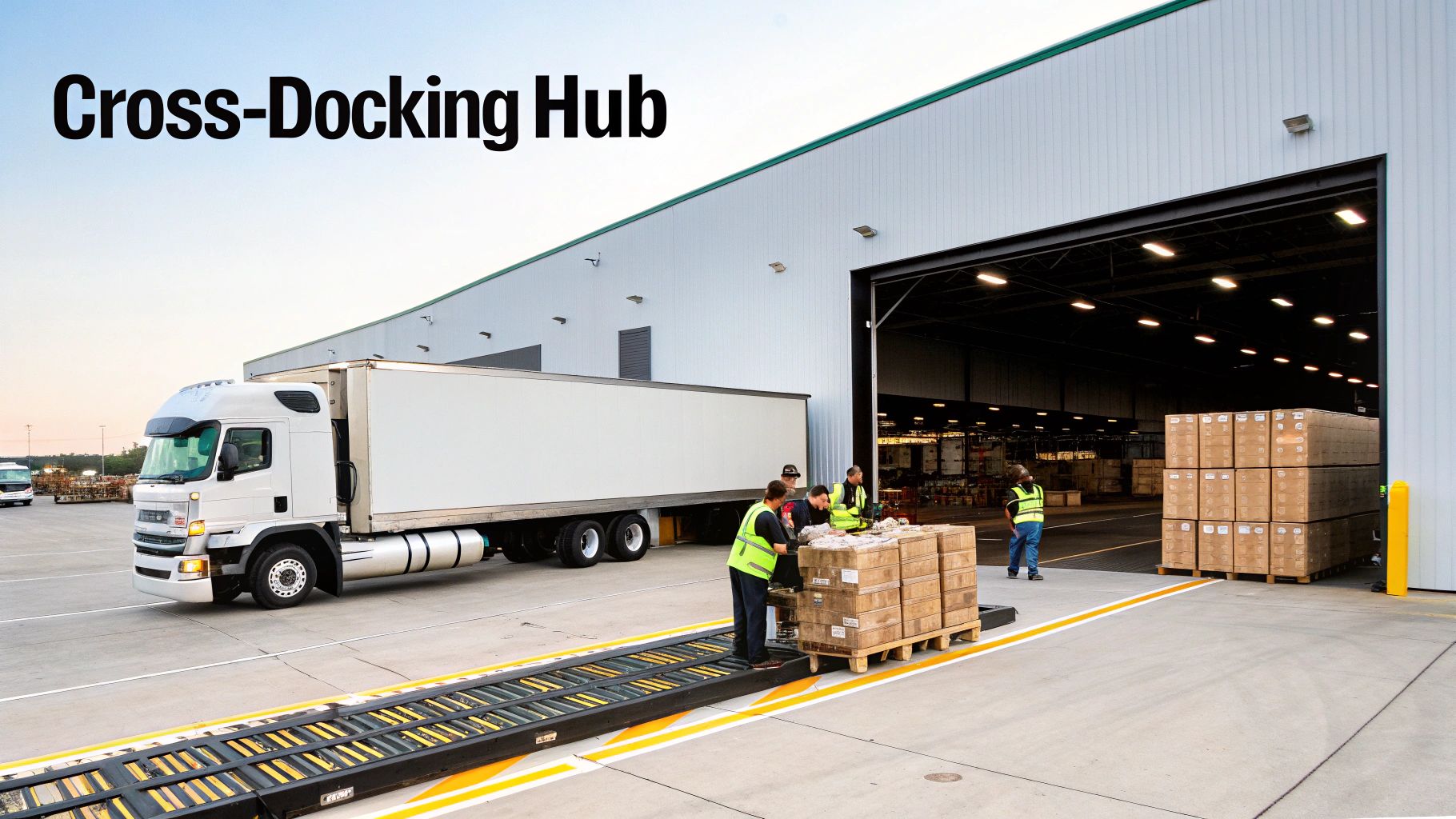
Cross-docking is a high-velocity logistics and warehousing strategy where inbound products are unloaded from trucks and immediately transferred to outbound vehicles, bypassing traditional storage. This approach consolidates shipments, minimizes handling, and drastically reduces the time inventory spends in a facility. It is a powerful method for accelerating the supply chain, especially for time-sensitive materials or pre-sorted goods destined for a specific endpoint.
For supply chains that prioritize speed and efficiency, like automotive component consolidation hubs or retail distribution networks, cross-docking is an essential tool. It transforms the warehouse from a storage center into a dynamic sorting and transfer hub, keeping inventory in constant motion and reducing lead times.
Actionable Implementation Steps
Effective cross-docking requires precise coordination, technology, and facility design. Leading logistics providers like UPS, FedEx, and specialized 3PLs in the automotive sector have perfected this model to achieve maximum throughput.
- Invest in a Capable WMS: Implement a Warehouse Management System (WMS) with real-time visibility and advanced sorting logic. The system must be able to receive ASNs, direct unloaders on where to stage goods, and coordinate outbound loads seamlessly.
- Synchronize Inbound and Outbound Schedules: Meticulous planning is crucial. Work closely with suppliers and carriers to ensure inbound deliveries arrive just as outbound trucks are ready. This alignment minimizes dwell time on the dock and prevents congestion.
- Leverage Barcode and RFID Technology: Use barcode or RFID scanning at every touchpoint to ensure rapid identification, sorting, and verification of goods. This technology eliminates manual errors and provides the data needed for an efficient cross-docking operation, similar to how Wolverine Assemblies uses its technology to manage component consolidation at its Wixom facility.
- Optimize Facility Layout: Design the dock area for a smooth, unimpeded flow of goods. Ensure adequate door count, staging space between inbound and outbound doors, and clear pathways for material handling equipment.
3. Value-Added Services (VAS) and Kitting
Value-Added Services (VAS) are specialized activities performed by a 3PL provider that go beyond basic storage and transportation. These services, such as kitting, light assembly, and inspection, transform a warehouse into a strategic extension of the manufacturing floor. By outsourcing these tasks, OEMs and suppliers can streamline their production lines, reduce internal labor costs, and improve overall supply chain efficiency in logistics and warehousing.
This approach allows manufacturers to focus on their core competencies while their 3PL partner handles final product configuration. For instance, an automotive supplier might rely on a 3PL to assemble multiple components into a single, line-ready kit, ensuring the right parts are delivered in the right sequence, at the right time.

Actionable Implementation Steps
Successfully integrating VAS requires meticulous planning, quality control, and system integration. Providers like DHL and regional specialists like Wolverine Assemblies have built their reputations on delivering these precise, value-driven services that are critical for modern manufacturing.
- Define Strict Quality Protocols: Implement rigorous quality control procedures that mirror OEM standards. This includes creating detailed Standard Operating Procedures (SOPs) for every VAS activity, from component inspection to final packaging, and ensuring ISO 9001 compliance.
- Leverage Integrated ERP Systems: Use an advanced ERP like PLEX to manage complex VAS workflows. This provides end-to-end traceability for every component, ensures accurate inventory management for kits, and allows for real-time visibility into the progress of assembly or inspection tasks. Learn more about how these processes enhance warehousing efficiency.
- Invest in a Flexible Workforce: Cross-train warehouse staff on multiple VAS functions to create a flexible team capable of adapting to fluctuating client demands. This agility is crucial for managing diverse projects, from simple kitting to more complex sub-assembly operations, without compromising quality or speed.
4. Warehouse Automation and Robotics
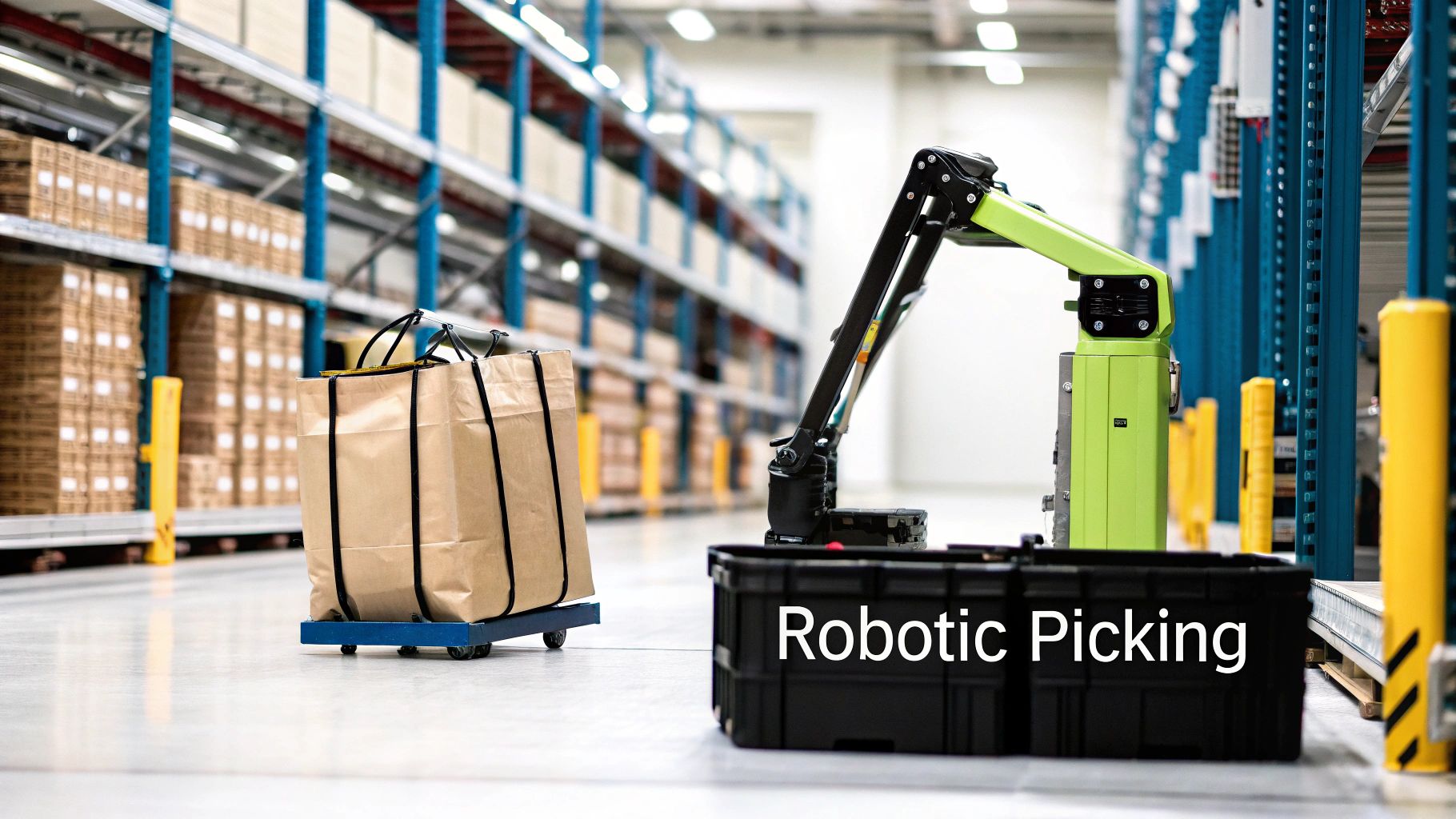
Warehouse automation integrates technology such as automated storage and retrieval systems (ASRS), robotic picking arms, and automated guided vehicles (AGVs) to enhance throughput, improve accuracy, and reduce manual labor dependency. This strategy in logistics and warehousing ranges from implementing simple conveyor systems to deploying fully autonomous operations managed by artificial intelligence, transforming facilities into highly efficient, data-driven environments.
For operations with high-volume, repetitive tasks, like those found in automotive component distribution or e-commerce fulfillment, automation is critical for maintaining a competitive edge. It minimizes human error in picking and sorting, accelerates order processing, and creates a safer working environment by assigning physically demanding tasks to machines.
Actionable Implementation Steps
Successful automation requires a phased, strategic approach that aligns technology with operational goals. Companies like Amazon and DHL have set the standard, but the principles are scalable for Tier 1 suppliers and OEMs looking to optimize their own logistics and warehousing functions.
- Conduct a Thorough ROI Analysis: Before investing, analyze your specific operational volume, SKU variability, and labor costs to identify which processes will yield the highest return on automation. Start with tactical solutions like smart conveyors or sorters where the business case is strongest.
- Prioritize System Integration: Select automation technologies that seamlessly integrate with your existing Warehouse Management System (WMS) and ERP. This ensures data flows smoothly between systems, providing a single source of truth for inventory management and order fulfillment. To further enhance efficiency, consider leveraging augmented reality in warehouse operations to guide human-led tasks with digital overlays.
- Plan for Change Management: Prepare your workforce for the shift by investing in comprehensive retraining programs. Focus on developing skills for system oversight, maintenance, and data analysis. Partner with experienced integrators who can guide implementation and help manage the transition, ensuring both technology and personnel are ready for launch.
5. Real-Time Inventory Visibility and Track-and-Trace
Real-time inventory visibility is a cornerstone of modern logistics and warehousing, utilizing integrated technology to provide an accurate, up-to-the-minute view of inventory. By leveraging systems like WMS, ERP, IoT sensors, and RFID, businesses can track the exact location, quantity, and status of goods. This transparency extends to track-and-trace capabilities, allowing stakeholders to monitor shipments from the warehouse floor to their final destination, enabling proactive problem-solving.
For industrial manufacturers and their tiered suppliers, this level of insight is non-negotiable. It eliminates guesswork, reduces the risk of stockouts or overstocking, and enhances trust with partners. Whether it's Walmart using its sophisticated supply chain platform or automotive OEMs integrating with supplier portals, the goal is a single source of truth for all inventory movements, improving planning and operational efficiency.
Actionable Implementation Steps
Achieving end-to-end visibility requires a robust, interconnected technology stack. The benefits, including improved accuracy and responsiveness, are driven by how well these systems communicate. Implementing effective track-and-trace also relies heavily on powerful data streaming platforms for robust real-time data.
- Integrate Key Systems: Ensure seamless, bidirectional data flow between your WMS, ERP, and any customer-facing portals. Wolverine Assemblies achieves this through its PLEX ERP, which offers full EDI/ASN capabilities, giving clients a real-time window into their inventory status.
- Leverage Predictive Analytics: Use the data collected from your systems to identify potential disruptions before they impact operations. Predictive tools can flag potential delays or inventory shortages, allowing for preemptive action.
- Provide Client-Facing Dashboards: Enhance transparency and build stronger partnerships by giving clients direct access to tracking information and inventory levels through a secure portal. You can learn more about the benefits of a sophisticated WMS in creating this visibility.
- Establish Data Governance: Implement strict protocols for data security and accuracy. Regularly audit inventory data and system performance to maintain the integrity of your visibility tools and protect sensitive information.
6. Lean Warehousing and Continuous Improvement (Kaizen)
Lean warehousing extends lean manufacturing principles to logistics and warehousing operations. Its primary goal is the relentless elimination of waste (muda) by streamlining workflows, standardizing processes, and creating a culture of continuous improvement (kaizen). This approach minimizes unnecessary movement, optimizes space, and empowers every team member to identify and solve operational inefficiencies.
For automotive suppliers and manufacturers where every second and every square foot impacts the bottom line, lean principles are a competitive necessity. The philosophy, pioneered by Toyota, transforms a warehouse from a simple storage facility into a dynamic, value-driven component of the supply chain.
Actionable Implementation Steps
True lean transformation is less about a single project and more about cultivating a mindset. It requires commitment from leadership and active participation from the entire workforce. Success depends on making small, consistent improvements that compound over time.
- Implement Visual Management Systems: Use tools like 5S (Sort, Set in Order, Shine, Standardize, Sustain), color-coding, and clear signage to create an organized and intuitive workspace. This reduces search times, prevents errors, and makes process deviations immediately obvious.
- Conduct Regular Kaizen Events: Dedicate focused time (daily huddles, weekly workshops) for teams to analyze a specific process, brainstorm improvements, and implement changes. Wolverine Assemblies embeds this into its culture, encouraging employee-led initiatives that enhance workflow efficiency and safety.
- Establish Key Performance Metrics: Track metrics related to the seven wastes, such as travel distance, order picking accuracy, and cycle time. Use this data to identify bottlenecks and measure the direct impact of improvement efforts, ensuring that changes are driving tangible results.
7. Supply Chain Network Optimization and Facility Location Strategy
Supply chain network optimization is a strategic analysis that designs the entire logistics network to minimize total costs while meeting service-level agreements. This process involves determining the ideal number, location, and capacity of facilities like warehouses, distribution centers, and manufacturing plants. It considers critical factors such as proximity to suppliers and customers, transportation infrastructure, labor availability, and regional regulations to create the most efficient flow of goods.
For OEMs and suppliers, a well-optimized network is a significant competitive advantage. It reduces transportation costs, shortens lead times, and enhances resilience against disruptions. The goal is to balance trade-offs between inventory, transportation, and facility costs to create a network that is both cost-effective and highly responsive to market demands.
Actionable Implementation Steps
Executing a network optimization strategy requires deep analytical capabilities and a forward-looking perspective. Pioneered by consulting firms like McKinsey & Company and supported by powerful modeling tools, this approach moves beyond simple cost-cutting to build a strategic logistical framework.
- Conduct Total Landed Cost Analysis: Move beyond freight costs and analyze the total cost of ownership. This includes transportation, inventory carrying costs, duties, tariffs, and the impact of lead time variability. This holistic view prevents shifting costs from one part of the supply chain to another.
- Model Multiple Scenarios: Use optimization software to model various network configurations before committing capital. Evaluate scenarios based on different demand forecasts, supplier locations (nearshoring vs. offshoring), and potential disruptions to identify the most robust and flexible design.
- Leverage Strategic 3PL Locations: Partner with a 3PL that offers a strategic geographic advantage. For example, Wolverine Assemblies’ location in Wixom, Michigan, provides a central hub for serving the Midwest automotive and industrial corridor, allowing clients to optimize their distribution footprint without investing in new facilities.
8. Quality Management Systems and Compliance Certifications
A Quality Management System (QMS) provides the documented framework of processes, procedures, and responsibilities for achieving quality policies and objectives. In logistics and warehousing, a robust QMS ensures that every service, from receiving to final delivery, meets stringent customer and regulatory standards. For automotive and industrial sectors, certifications like IATF 16949 and ISO 9001 are not just beneficial; they are often mandatory prerequisites for partnership.
These systems establish a culture of continuous improvement and risk mitigation, guaranteeing that value-added services like light assembly, kitting, and sequencing are performed with precision and consistency. They provide objective proof of a supplier's commitment to excellence, which is critical for OEMs like Toyota, known for its zero-defect culture and rigorous supplier quality expectations.
Actionable Implementation Steps
Implementing a certified QMS transforms quality from an abstract goal into a measurable, repeatable process. This is essential for any 3PL provider handling complex components where errors can lead to costly line-down situations.
- Pursue Foundational and Sector-Specific Certifications: Start with ISO 9001 to establish a baseline for quality management. If serving automotive clients, IATF 16949 is non-negotiable, as it integrates core automotive requirements like Advanced Product Quality Planning (APQP) and Failure Mode and Effects Analysis (FMEA).
- Develop Granular Work Instructions: Document every critical process with clear, visual, and concise work instructions. At Wolverine Assemblies, these instructions are central to training and operational execution, ensuring every team member performs tasks to the exact OEM standard, every time.
- Conduct Rigorous Internal Audits: Implement a schedule of regular internal audits, at least monthly, to proactively identify non-conformities and areas for improvement. This internal discipline is key to maintaining compliance and being perpetually ready for external customer or certification audits.
9. Demand-Driven Material Requirements Planning (DDMRP) and Replenishment
Demand-Driven Material Requirements Planning (DDMRP) is a modern supply chain methodology designed to manage the bullwhip effect and demand volatility. It blends elements of traditional MRP with pull-based concepts by using strategic inventory buffers at key decoupling points. This allows the supply chain to react to actual sales orders rather than relying solely on imperfect forecasts, significantly reducing both stock-outs and excess inventory.
This approach is highly effective for manufacturers facing unpredictable demand or long lead times, such as automotive suppliers managing thousands of SKUs. By decoupling production from forecast error, DDMRP creates a more stable and resilient logistics and warehousing environment, ensuring components are available without tying up excessive capital in safety stock.
Actionable Implementation Steps
Successful DDMRP implementation, as championed by the Demand Driven Institute, hinges on shifting from a forecast-driven to a demand-driven mindset. This requires strategic planning and alignment across sales, operations, and supply chain teams.
- Identify Strategic Decoupling Points: Analyze your supply chain to determine the most logical points to hold inventory buffers. These points should absorb variability and shorten the cumulative lead time to the customer. This is the foundational step before any software is implemented.
- Set Dynamic Buffer Levels: Use historical demand variability and lead time data to calculate initial buffer levels (red, yellow, and green zones). These are not static; they must be dynamically adjusted based on changing market conditions and performance metrics to remain effective.
- Leverage DDMRP-Compliant Software: Implement technology from providers like Kinaxis or Blue Yonder to automate buffer management and generate replenishment signals. A 3PL partner with an integrated ERP system can manage these demand signals, executing replenishment orders to maintain optimal inventory flow.
10. Regional and Nearshoring Strategy
Regional and nearshoring strategies involve locating logistics and warehousing operations closer to the end customer or primary points of consumption. This approach moves supply chains away from distant offshore locations to nearby countries or regions, significantly reducing transportation lead times, freight costs, and geopolitical risks. It enhances supply chain resilience and responsiveness, which is critical for industries sensitive to disruption.
For automotive and industrial manufacturers, nearshoring mitigates the volatility associated with long-distance shipping and complex customs processes. By positioning inventory and value-added services in proximity to assembly plants, companies can react faster to demand fluctuations and ensure a more stable flow of goods. This strategic placement is fundamental to modern, resilient logistics and warehousing.
Actionable Implementation Steps
Successfully implementing a nearshoring strategy requires a holistic analysis of costs, risks, and regional capabilities. It's a strategic shift championed by firms like Ford and GM to localize their North American supply chains and reduce dependency on overseas suppliers.
- Analyze Total Landed Cost: Look beyond simple labor arbitrage. Calculate the total cost, including transportation, tariffs, inventory carrying costs, and potential duties. A higher regional labor cost may be offset by savings in logistics and improved speed to market.
- Leverage a Strategic 3PL: Partner with a 3PL provider that has a strong regional presence and deep local expertise. For instance, Wolverine Assemblies’ Midwest location is strategically positioned to serve the heart of North America’s automotive and industrial sectors, offering a turnkey solution for nearshoring initiatives.
- Evaluate Regional Supplier Ecosystems: Assess the quality, capacity, and reliability of suppliers within the target region. Building a robust local network is crucial for the long-term success of the strategy and avoids creating new single-source vulnerabilities.
11. Supplier Collaboration and Vendor-Managed Inventory (VMI)
Supplier Collaboration and Vendor-Managed Inventory (VMI) are strategies that shift the responsibility for managing inventory from the manufacturer to the supplier. In this model, the supplier gains access to the manufacturer's inventory data and demand forecasts, allowing them to proactively replenish stock to pre-agreed levels. This deep partnership minimizes the risk of stockouts, reduces the manufacturer's administrative overhead, and lowers overall inventory carrying costs.
This approach transforms the traditional buyer-supplier relationship into a symbiotic partnership focused on mutual efficiency. For instance, in the automotive sector, a Tier 1 supplier might manage the inventory of specific components directly at an OEM's assembly plant, ensuring a continuous flow of parts to the production line without the OEM needing to place individual purchase orders. This model fosters a highly responsive and lean logistics and warehousing environment.
Actionable Implementation Steps
Executing a VMI program successfully requires trust, transparency, and robust data integration. Pioneered by companies like Procter & Gamble and Walmart, this collaborative model is built on shared goals and metrics.
- Establish a Data-Sharing Framework: Implement reliable EDI or API connections to grant suppliers secure, real-time visibility into your inventory levels and consumption data. This digital backbone is critical for accurate forecasting and timely replenishment.
- Define Clear Performance Metrics: Co-develop Key Performance Indicators (KPIs) with your supplier. These should include inventory turn rates, in-stock percentages, and order fulfillment accuracy. Regular business reviews should be held to track performance against these targets.
- Pilot the Program with Low-Risk Items: Begin your VMI initiative with C-class or non-critical components. This allows both parties to refine processes, test system integrations, and build trust in a lower-risk environment before expanding the program to more critical SKUs.
12. Supply Chain Resilience and Risk Management
Supply Chain Resilience and Risk Management is a strategic framework designed to identify, assess, and mitigate vulnerabilities across the supply chain. This approach ensures business continuity by preparing for disruptions like natural disasters, supplier failures, or geopolitical instability. It moves beyond a purely cost-driven model to one that prioritizes stability and the ability to adapt to unforeseen events.
For OEMs and their suppliers, the shocks from the recent semiconductor shortage and global pandemics highlighted the critical need for resilient logistics and warehousing. A resilient supply chain is not just about having a backup plan; it’s about building a network robust enough to absorb shocks and recover quickly.
Actionable Implementation Steps
Building a resilient supply chain requires a proactive, data-driven approach to identifying and neutralizing threats before they impact operations. This involves diversifying risk and creating strategic redundancies, a model now widely adopted by industries from automotive to food and beverage.
- Map Critical Dependencies: Conduct a thorough supply chain mapping exercise to identify single points of failure, including critical component suppliers, transportation lanes, and key personnel. Use this map to prioritize your risk mitigation efforts.
- Diversify Sourcing and Logistics: Avoid over-reliance on a single supplier or geographic region for critical parts. Establish relationships with alternate suppliers and pre-qualify different logistics routes and carriers to enable rapid pivots during a disruption. You can learn more about how to navigate these challenges in the automotive supply chain on wolverine-llc.com.
- Establish Strategic Safety Stock: While lean principles are valuable, resilience demands a calculated buffer. Position strategic safety stock of high-risk components at key nodes in your network, such as a secure 3PL facility in a stable, centrally located region like the Midwest.
- Conduct Regular Risk Reviews: Threats evolve constantly. Implement a process for quarterly or semi-annual risk assessments to review supplier stability, monitor geopolitical tensions, and update business continuity plans accordingly.
12-Point Logistics & Warehousing Comparison
Partnering for a Resilient and Agile Future
The landscape of modern manufacturing, particularly for OEMs and Tier 1 suppliers in demanding sectors like automotive, industrial, and energy, is defined by relentless pressure. The pursuit of efficiency, resilience, and responsiveness is not just a strategic goal; it is a fundamental requirement for survival and growth. As we have explored through the 12 essential strategies, from Just-In-Time inventory to advanced risk management, the world of logistics and warehousing has evolved far beyond simple storage and transport. It has become the central nervous system of the entire production ecosystem, a complex network of processes, technologies, and partnerships that dictates an organization's ability to compete and innovate.
The concepts discussed are not isolated tactics but interconnected components of a holistic supply chain philosophy. Mastering real-time inventory visibility, for instance, directly empowers a more effective Demand-Driven Material Requirements Planning (DDMRP) system. Likewise, a successful nearshoring strategy is fundamentally supported by robust supplier collaboration and the operational excellence of lean warehousing principles. These strategies, when integrated, create a powerful flywheel effect, where improvements in one area amplify gains in another, culminating in a supply chain that is not only cost-effective but also remarkably agile and resilient to disruption.
From Strategy to Execution: The Role of a Specialized Partner
While understanding these strategies is the first step, the true challenge lies in their execution. Implementing advanced automation, maintaining rigorous quality certifications like IATF 16949, and optimizing a regional distribution network requires significant capital investment, specialized expertise, and unwavering focus. For many manufacturers, attempting to build these capabilities entirely in-house can divert critical resources from core competencies such as product design, engineering, and brand development. This is the pivotal moment where the decision to partner with a third-party logistics (3PL) provider becomes a strategic imperative.
A specialized 3PL partner does more than just provide physical space and labor. They offer a pre-built ecosystem of solutions, integrating a sophisticated technology stack, proven operational methodologies, and a depth of industry-specific knowledge. Consider the value of a partner who has already mastered:
- Complex Value-Added Services: Delivering pre-inspected, kitted, and sequenced sub-assemblies directly to the production line, eliminating waste and simplifying floor-side operations.
- Rigorous Launch Discipline: Navigating the high-stakes environment of new product introductions with meticulous planning and flawless execution, ensuring deadlines are met without compromising quality.
- Seamless Systems Integration: Leveraging advanced ERP systems, like PLEX, to ensure data flows seamlessly between the manufacturer and the logistics partner for total transparency and control.
By outsourcing these complex functions, OEMs and Tier 1 suppliers transform their logistics and warehousing from a potential bottleneck and significant cost center into a dynamic competitive advantage. This strategic delegation allows internal teams to focus on innovation and market growth, confident that their supply chain is not only stable but also optimized for the challenges and opportunities of tomorrow. The right partnership builds a foundation for scalable, efficient, and resilient operations, enabling you to deliver on your promises to customers, today and in the future.
Ready to transform your supply chain from a cost center into a competitive weapon? Discover how Wolverine Assemblies, LLC leverages deep expertise in value-added services, quality management, and advanced logistics and warehousing to support leading OEMs and Tier 1 suppliers. Visit Wolverine Assemblies, LLC to learn how our tailored solutions can drive resilience and efficiency for your operations.
Subscribe to our weekly newsletter