.png)
Automotive supply chain management: A practical guide
Automotive supply chain management: Build resilience and efficiency with practical strategies, technologies, and best practices.


Building a modern vehicle is an incredible feat of coordination. Automotive supply chain management is the art and science of making sure every single one of the thousands of parts—from countless suppliers across the globe—shows up at the right assembly plant, at exactly the right moment, and in the perfect sequence. It's the operational nervous system that allows the entire industry to function with precision and speed.
What Is Automotive Supply Chain Management Today?

Think of it as a vehicle's central nervous system. It's a massive, interconnected web where OEMs, suppliers, and logistics partners have to communicate and operate in perfect sync. Every signal, whether it's an electronic data interchange (EDI) message or a physical pallet of parts, triggers a specific, time-sensitive action that ultimately results in a finished car rolling off the line.
This isn't a simple A-to-B delivery route. It’s a complex dance involving multiple tiers of suppliers. A Tier 2 supplier might produce the plastic housing for a sensor. That housing then goes to a Tier 1 supplier, who integrates it into a full airbag module. Finally, that finished module is shipped to the OEM for final assembly. Every step has to be flawless.
The Modern Automotive Landscape
Today, getting this right is more critical than ever. The industry is facing intense pressure from all sides—the massive shift to electric vehicles (EVs), ongoing geopolitical disruptions, and the constant demand for better digital integration. A tough, efficient supply chain isn't just a competitive edge anymore. It’s a basic requirement for survival.
The money involved is staggering. The North American automotive logistics market is projected to climb from $65 billion to $87 billion by 2035. But that growth comes with serious challenges. In a recent survey, 77% of industry players named cost pressures as their top concern, followed closely by red tape and a shortage of skilled workers.
The core challenge is maintaining a delicate balance. OEMs must manage the extreme complexity of producing vehicles with up to 30,000 individual parts while simultaneously controlling costs, ensuring quality, and adapting to constant market shifts.
Foundational Pillars for Success
You can't manage this level of complexity without a clear strategy. Success comes down to orchestrating three key elements, often explained using the People, Process, and Technology framework. This model makes it clear that great tech is useless without skilled people and smart, repeatable workflows to back it up.
Here’s a quick overview of what goes into a modern, high-performing automotive supply chain strategy.
Key Pillars of Modern Automotive Supply Chain Management
These three pillars work together to build a system that is both resilient and efficient.
Ultimately, automotive supply chain management is about creating a synchronized, unbroken flow of both physical parts and digital information. It’s about transforming thousands of separate components into a single, cohesive, high-quality vehicle that is ready for the customer.
The Big Squeeze: Navigating Today's Automotive Supply Chain Challenges
The automotive supply chain, once a model of finely tuned efficiency, is now under constant, immense pressure. The very principles that defined it for decades—like lean manufacturing—have become points of extreme vulnerability in the face of modern disruptions. To make it through, you have to understand the specific, interconnected challenges squeezing the industry from all sides.
At the heart of the issue is the brittleness of Just-in-Time (JIT) and Just-in-Sequence (JIS) inventory. For years, these were the gold standards. Parts arrived at the assembly line exactly when needed, slashing waste and storage costs. But this lean approach leaves zero room for error.
A single delayed shipment, a supplier shutting down, or a port getting clogged can bring a whole production line to a grinding halt in a matter of hours. The global semiconductor shortage was the perfect, painful example of this weakness. When chip deliveries dried up, automakers had no choice but to idle plants, losing billions simply because they had no inventory buffer to ride out the storm.
The Great Electric Vehicle Scramble
Piling on top of this is the industry-wide scramble to go electric. This isn’t just a simple component swap; it’s a fundamental rewiring of the entire supply chain from the ground up. OEMs are now in a global race to lock down raw materials like lithium, cobalt, and nickel for batteries—materials that come from entirely new and often geopolitically tricky regions.
This massive shift forces companies to forge relationships with a whole new class of suppliers, from battery cell makers to the software wizards behind advanced driver-assistance systems (ADAS). The learning curve is steep, and the competition for these limited resources is absolutely fierce.
Managing two supply chains at once—one for traditional internal combustion engine (ICE) vehicles and another for EVs—is a monumental task. It means balancing legacy supplier relationships while frantically building a totally new, resilient ecosystem for the future of mobility.
Caught in the "Stagformation" Trap
Making these operational hurdles even tougher is a painful economic condition best described as stagformation. Think of it as a nasty mix of stagnant production growth combined with the intense financial pressure of transformation—electrification, digitalization, and new sustainability rules.
While global vehicle production is expected to climb past 96 million units by 2030, the overall growth is slow. At the same time, suppliers are getting crushed. Global supplier EBIT margins have plummeted to 5.3%, a whopping 25% drop from their 2016/17 peak. They’re getting squeezed by inflation and the massive capital needed for new tech. You can dig deeper into these financial pressures and production forecasts in the full study.
This economic reality puts everyone in a tough spot. Here’s how it breaks down:
Original Equipment Manufacturers (OEMs): Have to pour cash into R&D for EVs and autonomous tech, all while sales for their most profitable ICE models are flat.
Tier 1 Suppliers: Are forced to make huge investments to retool for EV parts, often without clear long-term volume promises from OEMs, and with their margins shrinking by the day.
Tier 2 and 3 Suppliers: Feel the pressure trickling down, struggling with rising material and labor costs without the power to pass those costs along.
In the end, these challenges—brittle JIT systems, the chaotic EV transition, and the financial vise of stagformation—aren't separate problems. They’re deeply connected, creating a perfect storm that demands a whole new level of resilience, agility, and strategic thinking in the automotive supply chain.
The Technology Powering Resilient Supply Chains
In the automotive world, data is the new horsepower. The line between a smooth production run and a costly shutdown often boils down to one thing: the speed and quality of information.
Without the right digital tools, trying to manage the sheer complexity of modern vehicle manufacturing is next to impossible. Technology is the central nervous system that connects every partner, turning a sprawling network into a single, responsive unit. It transforms thousands of fragmented data points into clear, actionable intelligence, giving you the power to track parts in real-time and spot disruptions before they bring the line to a halt.
The ERP as a Single Source of Truth
At the heart of this digital ecosystem is the Enterprise Resource Planning (ERP) system. Think of it as the operational brain of a manufacturing facility.
An ERP weaves together every critical function—inventory, production schedules, finance, quality control—into one unified platform. This is absolutely vital for breaking down the data silos that cause so many headaches.
A system like PLEX ERP, for example, creates a single source of truth for everyone from the plant floor manager to the CEO. When a shipment of steel coils arrives, the inventory module updates instantly. That data immediately informs the production schedule, which then updates the financial forecasts. To get a deeper dive on how these systems work, check out our guide on what an ERP system is in manufacturing.
This infographic shows the "stagformation" dilemma many companies face—balancing production growth and the EV transition against shrinking profits.
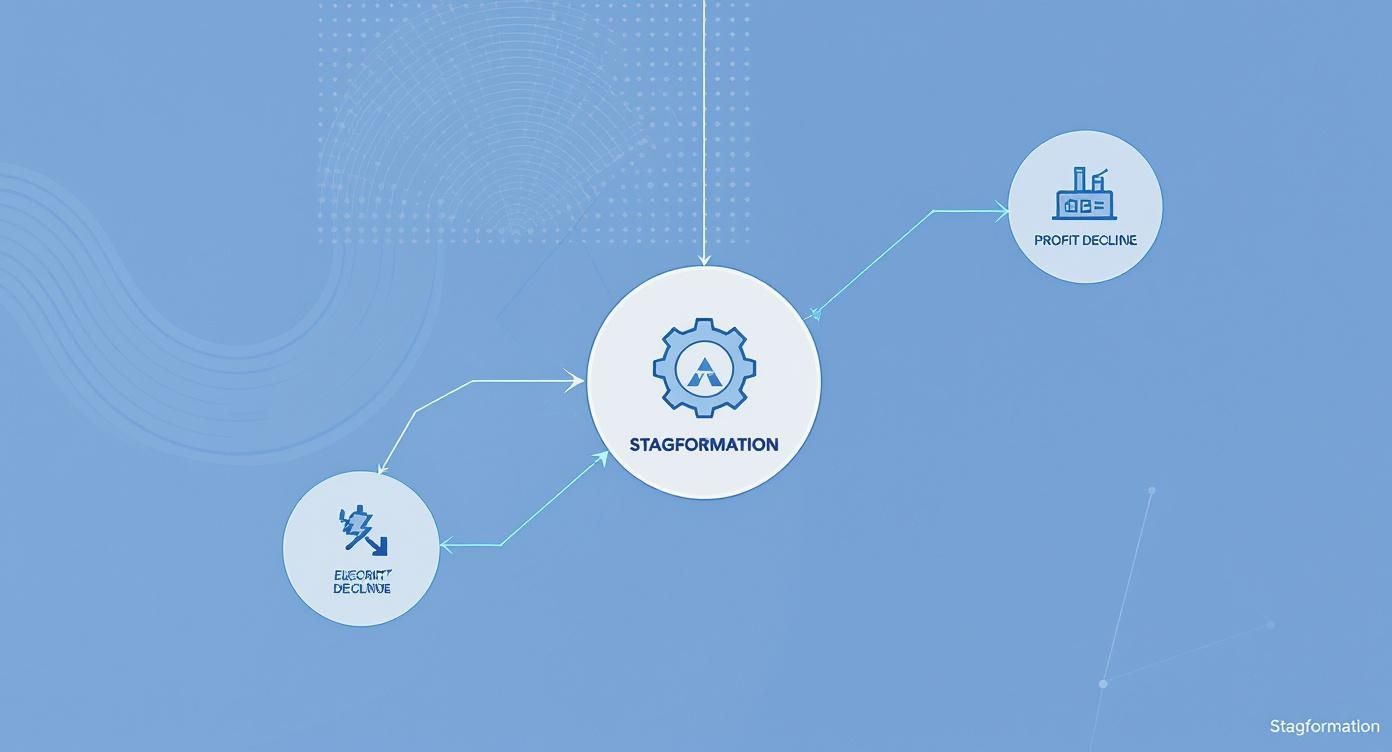
It’s clear how these competing pressures make technology essential for finding efficiencies and protecting margins.
Automating Communication with EDI and ASNs
While an ERP runs your internal world, Electronic Data Interchange (EDI) manages the conversation between you and your partners. EDI is a standardized language that lets a supplier’s system "talk" directly to an OEM's system without anyone lifting a finger. It’s the digital handshake that automates the whole procurement cycle.
A crucial part of that handshake is the Advance Ship Notice (ASN). This is an EDI message a supplier sends to the OEM before a shipment ever leaves their dock.
It sounds simple, but this electronic heads-up is incredibly powerful. It contains all the vital details:
What’s in the shipment: Exact part numbers and quantities.
How it’s packaged: Info on pallets, containers, and labeling.
When it will arrive: The estimated time of delivery.
When an ASN is received, the OEM’s ERP system is updated automatically. This lets the receiving team schedule labor, clear a dock door, and get the production line ready for the incoming parts. The result? A dramatically faster receiving process with far fewer errors.
Without this automated flow, you’re stuck with emails, phone calls, and spreadsheets—a slow, clumsy process that just can’t keep up with the demands of just-in-time manufacturing.
Emerging Technologies and Future Integration
The foundation of ERP and EDI is now being supercharged by other powerful tools. Real-time visibility platforms use GPS and IoT sensors to give you a live map of your shipments, while AI is getting smart enough to predict delays based on weather or traffic jams.
Augmented reality (AR) is another game-changer. AR tools can overlay digital instructions onto a worker’s view, guiding them through a complex assembly or helping a technician perform a remote quality check. For a complete rundown on how this tech is shaking up the industry, explore the practical guide to AR in automotive.
Ultimately, all these technologies work together to create a data-rich environment. They deliver the real-time insights you need to manage complexity, react instantly to problems, and build the kind of tough, agile supply chain that’s required to win in today’s automotive market.
How Strategic Partnerships Drive Efficiency

In the high-stakes world of automotive manufacturing, nobody goes it alone. The speed and scale are just too immense for any single OEM or supplier to manage every logistical detail themselves.
This is where third-party logistics (3PL) providers come in. They’re not just vendors anymore; they’ve become true strategic partners, transforming how the modern factory operates. A good 3PL acts as a direct extension of your plant, handling critical functions that create a leaner, more agile manufacturing environment.
By taking on these complex tasks, they free up manufacturers to do what they do best: build world-class vehicles.
Value-Added Services That Accelerate Production
The real power of a 3PL partnership is in the specialized, value-added services they provide. These aren’t just basic warehousing tasks. They are precision-driven operations designed to feed the assembly line with perfect timing and accuracy.
Think of it as pre-processing parts so they’re ready for the main event. This prep work is the secret ingredient to making lean manufacturing a reality.
Here are a few of the most impactful services:
Kitting: Instead of a line-side operator grabbing ten different components from various bins, a single pre-assembled kit arrives with everything needed for a specific step. This simple change dramatically cuts down on errors and speeds up the entire build process.
Sequencing: This is the art of delivering parts to the assembly line in the exact order they will be installed. If a blue door is followed by two red doors on the line, the 3PL makes sure they arrive in that precise sequence, perfectly synched with the production schedule.
Quality Inspections: A 3PL partner can perform tough quality checks on incoming parts before they ever hit the factory. This proactive step catches defects early, preventing a faulty component from shutting down the line and causing expensive rework.
Freeing Up Space and Focusing on Core Competencies
One of the first things you’ll notice when outsourcing these tasks is the space it frees up inside your plant. Factory floor space is incredibly valuable real estate. Every square foot used for sorting parts is a square foot that isn't being used for revenue-generating assembly.
Moving these activities to a 3PL’s facility lets you reclaim that space for new production lines, more robotics, or just a safer, less cluttered work environment.
A strategic 3PL partnership effectively expands a manufacturer's operational footprint without the capital expense of building a new facility. It allows for flexible capacity that can scale up or down with production demands, turning a fixed cost into a variable one.
This shift lets OEMs and suppliers focus their time, money, and people on what they do best. A Tier 1 supplier, for example, can concentrate on engineering a best-in-class braking system instead of managing the logistics of its sub-components.
This clear division of labor creates a stronger, more expert-driven supply chain where every partner excels at their role. If you want to dive deeper, you can learn more about the role of a Tier 1 supplier in the automotive ecosystem in our detailed article.
Building a Supply Chain That Bends Not Breaks
The old days of a predictable, clockwork automotive supply chain are long gone. Today, the real question isn't if a disruption will hit, but when. The smartest companies have stopped just reacting to crises. They're proactively building shock absorbers right into their operational DNA, creating systems designed to bend under pressure instead of shattering.
This is a strategic pivot away from daily firefighting and toward long-term resilience. It’s all about looking ahead at real-world threats—from raw material shortages and geopolitical friction to sudden demand spikes—and having a clear, data-driven playbook ready to go. The goal is simple: build a supply chain that can take a hit, then recover faster and stronger than the competition.
From Single Source to Multi-Shore
For decades, the standard playbook was single-sourcing from low-cost regions to squeeze out every last bit of margin. But recent history has exposed that strategy for what it is: a high-stakes gamble. The modern approach is multi-shoring, a smarter strategy focused on diversifying your supplier base across different geographical regions.
This isn’t about ditching global partners. It's about creating a balanced, resilient network. Think of an OEM sourcing a critical electronic component from suppliers in both Southeast Asia and Mexico. If a trade dispute or natural disaster suddenly shuts down one region, production can be rerouted through the other, minimizing downtime and protecting revenue.
Globally, supply chain disruptions have cost companies an average of 8% of their annual revenues, with the auto sector feeling some of the worst of it. In response, 50% of companies are now planning to diversify their supplier regions to secure their supply. On top of that, early adopters of AI in supply chain management are reporting logistic cost reductions of 15%, inventory levels dropping by 35%, and service efficiency jumping by 65%. You can find additional supply chain statistics on Procurement Tactics to see how the industry is shifting.
The Art of Launch Discipline
A new vehicle launch is one of the most intense, high-pressure moments for any automotive supply chain. This is where Launch Discipline becomes absolutely non-negotiable. It’s a rigorous, almost military-grade framework for planning, executing, and validating every single step required to bring a new model to market without a hitch.
Launch Discipline is the institutional commitment to flawless execution. It means every supplier is production-ready, every part is validated, and every logistics route is tested long before the first vehicle is scheduled to roll off the line.
A failure here can be catastrophic, leading to million-dollar delays, quality recalls, and a black eye for the brand. It involves:
Rigorous Supplier Readiness Reviews: Making sure every Tier 1 and Tier 2 partner can actually meet volume and quality targets when the pressure is on.
Production Part Approval Process (PPAP): A standardized process to formally verify that a supplier can consistently produce parts that meet every single specification.
Logistics Network Validation: Running trial shipments to confirm transit times, test customs clearance, and make sure there are no hidden bottlenecks.
By embedding this level of rigor, companies de-risk the most vulnerable and complex phase of manufacturing. For more strategies, check out our guide on how to build a resilient supply chain in 2025. Building a supply chain that bends, not breaks, is a continuous effort where data-driven strategies and meticulous planning turn potential vulnerabilities into a powerful competitive advantage.
If you can't measure it, you can't manage it. In the high-stakes world of automotive logistics, flying blind is a recipe for disaster. Line-down situations and massive cost overruns are the direct result of guessing instead of knowing.
To get a real grip on your operations, you need to track the right Key Performance Indicators (KPIs). These aren't just numbers on a spreadsheet; they're the vital signs of your supply chain, telling you exactly where things are stable and where they're about to break down. They expose bottlenecks, highlight inefficiencies, and give you the intelligence to make smarter, faster decisions.
Gauging Timeliness and Reliability
The entire automotive industry runs on a razor-thin schedule. A minute late can feel like an hour late. This makes on-time performance the absolute bedrock of success.
On-Time Delivery (OTD): This is the ultimate pass/fail test. It’s a simple percentage: how many of your shipments arrived within the scheduled delivery window? A consistent OTD rate of 98% or higher is the benchmark for a stable, predictable network.
On-Time In-Full (OTIF): This takes things a step further. Did the correct quantity of the correct parts arrive on time? A shipment that shows up on schedule but is missing half the components is still a failure that can shut down the line.
Tracking these two KPIs gives you a clear picture of carrier performance and helps you spot recurring delays in specific shipping lanes before they become critical problems.
Monitoring Costs and Financial Health
While timeliness is king, cost control is what keeps you profitable. Unchecked spending can quickly evaporate the margins on any program, which is why financial KPIs are so essential.
The most revealing metric here is Premium Freight Cost. This tracks every dollar spent on expedited shipments—air freight, dedicated hot-shot trucks, or any other method outside of your standard, planned logistics.
Think of premium freight as a direct tax on poor planning. Every dollar spent here is a red flag signaling a failure somewhere upstream. It could be a supplier delay, a quality issue, or a bad forecast. Consistently high premium freight spending means you have deep-rooted problems that need immediate attention.
Ensuring Accuracy and Quality
What happens inside the four walls of your warehouse is just as crucial as what happens on the road. A late truck causes chaos, but so does inaccurate inventory or poor quality control.
Inventory Record Accuracy (IRA): This KPI is simple: does the inventory your system thinks you have match what's physically on the shelf? An IRA below 99% is a huge risk. It leads to surprise stockouts of critical parts or, just as bad, carrying costs for components you didn't even know you had.
Supplier Quality Rating: This measures the percentage of parts received from a supplier that pass quality inspection without any defects. It’s a direct reflection of that supplier's reliability and shows you how their performance impacts your own operational flow.
Putting it all together, these KPIs give you a 360-degree view of your automotive supply chain. They transform raw data into a powerful tool for driving real, continuous improvement.
You can't rely on just one or two metrics to understand the full picture. A healthy automotive supply chain is a balance of speed, cost-efficiency, and quality.
The table below breaks down the most critical KPIs that every OEM and Tier 1 supplier should be tracking.
Essential Automotive Supply Chain KPIs
By consistently monitoring these metrics, you move from reacting to problems to proactively managing your supply chain, which is where the real competitive advantage lies.
Your Questions Answered
The world of automotive logistics can get complicated fast. Here are a few clear, straightforward answers to the questions we hear most often.
What's the Single Biggest Challenge in Automotive Supply Chains?
Right now, it’s the massive cost pressure from running two entirely different supply chains at once: one for traditional gas-powered cars and another for electric vehicles (EVs).
Manufacturers have to keep their internal combustion engine (ICE) parts profitable while sinking billions into building a brand-new network for EV components like batteries and advanced software. It’s a financial and operational tightrope walk for everyone, from the big OEMs down to the smallest Tier 3 supplier.
What Does a 3PL Actually Do in the Auto Industry?
A 3PL (Third-Party Logistics) provider is much more than just a warehouse or a fleet of trucks. Think of them as a strategic extension of the assembly plant itself.
The real job of an automotive 3PL is to handle the complex, value-added work that keeps the main assembly line humming. This frees up the manufacturer to focus on what they do best: building great vehicles.
Instead of just storing parts, a good 3PL partner manages critical tasks like:
Sequencing: Delivering parts to the line in the exact order they’ll be installed.
Kitting: Pre-packing all the components needed for one specific assembly step.
Quality Checks: Inspecting and verifying parts before they ever hit the factory floor.
Warehousing and Transport: Of course, they handle the core storage and movement of components too.
Why Is Just-In-Time So Important in Automotive?
Just-in-Time (JIT) is a lean strategy that’s all about efficiency. The goal is to have parts show up at the assembly line precisely when they are needed—not a moment sooner. This eliminates the need for massive, expensive warehouses full of inventory.
In an industry with razor-thin margins, JIT is a lifeline. By keeping inventory to a minimum, automakers slash the costs tied up in storage, handling, and parts that might become obsolete. The trade-off? JIT demands a perfectly synchronized and incredibly reliable supply chain. Even a tiny hiccup can bring a multi-million-dollar production line to a dead stop.
At Wolverine Assemblies, LLC, we build the precision and reliability your automotive supply chain needs by integrating people, process, and technology. Learn how our value-added services can stabilize your operations and de-risk your next program launch.
Subscribe to our weekly newsletter